



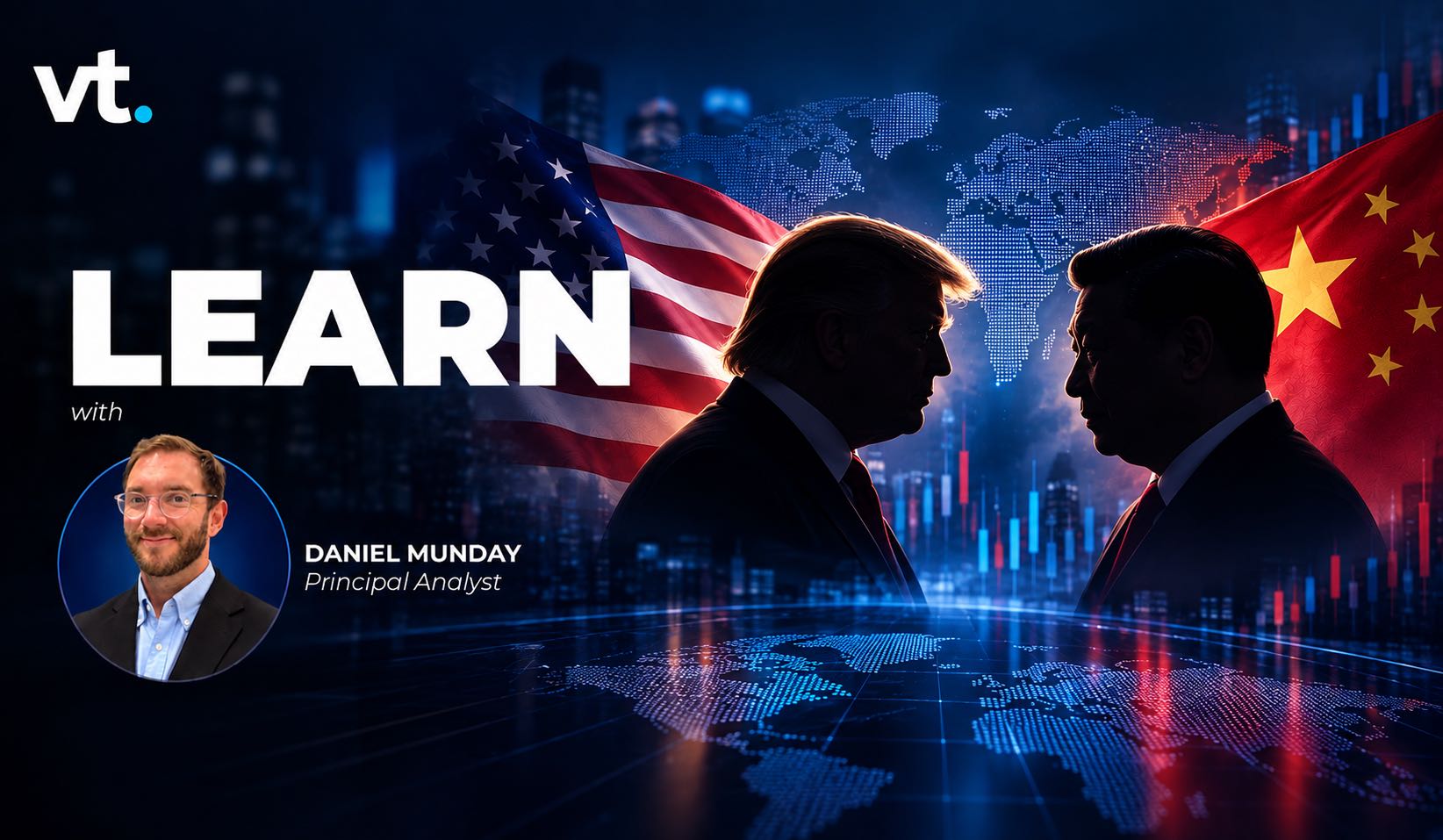
Trump and Xi meet on Thursday, but the big question isn’t simply whether they extend the US-China trade truce. It’s how long they extend it for.
USTR Jamieson Greer said Washington could support an extension of around three to six months, although nothing has been agreed yet.
That leaves room for surprise. With gold around $4,350, the dollar supported by a hawkish Fed and US equities sensitive to AI and trade headlines, even a small change in tone could move markets into month-end.
What the Market Is Expecting
Xi arrives in Washington on Wednesday, with Trump expected to personally greet him at Joint Base Andrews before Thursday’s bilateral meeting and state dinner.
Expectations for a major breakthrough are relatively low. Markets are mainly looking for an extension of the current truce and continued dialogue rather than a comprehensive trade agreement.
Goldman Sachs sees an extension as its base case, while MUFG expects incremental progress without a major breakthrough on technology restrictions.
This means the extension itself may not be enough to surprise markets. The length and conditions could matter more.
Three Issues That Matter
Rare earths remain a major negotiating point, particularly after Chinese export restrictions disrupted global supply chains. To better understand broader supply dynamics, read our comprehensive commodity trading guide.
AI and semiconductors could matter even more for US equities. Any change in restrictions involving advanced chips or AI technology could quickly affect semiconductor stocks and the Nasdaq.
Iran is another wildcard. China remains an important buyer of Iranian oil, so any shift in Beijing’s position could also influence energy markets. Take a look at the key factors that affect crude oil prices to see how geopolitical shifts translate to volatility.
Taiwan remains a source of tension, although it would probably require a significant change in rhetoric to trigger an immediate market reaction.
What Could Surprise Markets?
A basic extension of the trade truce may already be largely expected.
The bigger positive surprise would be a longer extension combined with progress on rare earths, agricultural purchases or technology restrictions.
A negative surprise would be renewed disagreement over tariffs, semiconductors or rare earth exports.
That creates an interesting setup. Expectations for a major breakthrough are low, but expectations for continued stability are relatively high.
Gold: Watch $4,350
Gold is trading around $4,350 and remains one of the more interesting markets heading into Thursday. If you are new to tracking precious metals, start with our beginner’s guide to gold trading.
Normally, improving US-China relations could reduce safe-haven demand. A breakdown in negotiations could have the opposite effect.
But gold has not followed the traditional risk-off playbook consistently. For a detailed breakdown of current price setups, check out our latest XAU/USD price forecast and analysis.
The dollar, Treasury yields and Fed expectations remain major drivers, so traders should be careful about assuming that a negative summit automatically means higher gold. To see how metal holds up during monetary shifts, read our guide on gold and inflation, as well as our Gold vs S&P 500 comparison.
The reaction around $4,350 and $4,400 could therefore matter more than the headline itself.
US Dollar: Don’t Forget the Fed
The dollar remains supported by the Fed’s hawkish stance.
A disappointing summit could add to USD strength if markets turn risk-off, while a more constructive outcome could encourage some unwinding. For key strategies on managing volatility here, read why the DXY rises in uncertain markets and learn how to manage risk when trading DXY CFDs.
However, Fed policy and Treasury yields remain the bigger underlying drivers.
The important question is whether Thursday creates a genuinely new USD move or simply accelerates the existing Fed-driven trend.
Nasdaq: AI Could Be the Key
The Nasdaq could be particularly sensitive to any discussion around AI and semiconductors. To dive deeper into algorithmic and automated trading trends, read our analysis on AI in trading and how it’s transforming stock markets.
Any easing of technology restrictions could support chip and AI stocks. A harder line from either side could quickly pressure the sector.
This matters because US indices have already entered the summit with strong momentum.
If optimism is already priced in, even a seemingly positive agreement could produce a limited reaction.
USD/CNH: Watch the Market’s Verdict
USD/CNH could provide one of the cleanest reads on how markets interpret the summit. If you are looking to trade currency pairs, read our complete guide to forex trading.
A stronger yuan and lower USD/CNH would suggest traders see the outcome as constructive.
A higher USD/CNH could signal disappointment or renewed concerns over trade tensions.
Watching USD/CNH alongside the Nasdaq could provide an even clearer signal.
What Traders Should Watch
The main points are simple:
- Trade truce: Three months, six months or longer?
- Rare earths: Any new export commitments?
- Semiconductors: Any change to US restrictions?
- AI: More cooperation or more restrictions?
- Tariffs: Any signs of escalation or de-escalation?
- Iran: Does China’s position change?
Most importantly, watch how markets react after the headlines.
A positive announcement followed by falling equities or a weaker yuan would suggest traders are unconvinced. A modest agreement followed by stronger equities and a stronger yuan could suggest the details were better than expected.
The Bottom Line
Thursday doesn’t need to produce a major trade deal to move markets.
An extension of the current truce is already expected, so the length and conditions of that extension could be more important than the announcement itself.
For gold, watch $4,350 and $4,400.
For US equities, watch AI and semiconductor headlines.
For the immediate market reaction, watch USD/CNH and Nasdaq together.
The Fed and yields remain the underlying drivers. Trump and Xi are wildcards.
Don’t just trade the headline. Trade the reaction.
Frequently Asked Questions (FAQ)
1) What is the main expectation for the Trump-Xi summit? The main expectation is a potential extension of the current US-China trade truce, likely for three to six months, alongside ongoing dialogue rather than a comprehensive, sweeping trade deal.
2) How is the gold market reacting ahead of the summit? Gold is trading around $4,350 as markets weigh geopolitical tension against central bank policies. While improving diplomatic relations typically reduces safe-haven demand, gold has not strictly followed traditional risk-off patterns in 2026, making key levels at $4,350 and $4,400 crucial to monitor.
3) Why are AI and semiconductors critical for the Nasdaq during this meeting? US equities and tech indices like the Nasdaq are highly sensitive to discussion around technology restrictions. Any easing of trade rules on advanced microchips or artificial intelligence could boost semiconductor stocks, while tighter restrictions could quickly pressure the sector.
4) What role does the US Dollar play during the meeting? The US Dollar remains primarily anchored by the Federal Reserve’s hawkish policy and Treasury yields. A disappointing summit could add short-term strength to the dollar if risk-off sentiment takes over, but overall Fed policy remains the primary underlying driver.
5) Why is USD/CNH an important currency pair to watch after the headlines? USD/CNH offers one of the clearest market signals on how traders interpret the outcome. A lower USD/CNH indicates a stronger Chinese yuan and a constructive summit outcome, whereas a higher USD/CNH suggests market disappointment or renewed trade friction.
6) What key issues could create a market surprise? Markets could be surprised by a trade truce extension longer than six months, progress on rare earth exports, adjustments to agricultural purchases, or changes in US semiconductor restrictions. Conversely, renewed friction over tariffs or chip exports would act as a negative market catalyst.










