




The latest US Non-Farm Payrolls (NFP) report delivered a major surprise, with the American economy adding 165,000 jobs in October, more than double the 65,000 expected by economists.
The stronger-than-expected employment figures immediately shifted market expectations towards another Federal Reserve interest rate hike in December. The US dollar strengthened, Treasury yields climbed, and gold retreated towards $4,050, interrupting its recovery earlier in the week.
For traders, the question now is whether this marks the beginning of another leg higher for the dollar or merely a temporary setback for gold ahead of next week’s US inflation report.
US Jobs Report Beats Expectations Across the Board
The October employment report showed that the US labour market remains more resilient than expected, giving the Federal Reserve additional room to maintain its restrictive monetary policy.
| NFP Indicator | Actual | Forecast |
| Non-Farm Payrolls | 165,000 | 65,000 |
| Unemployment Rate | 4.10% | 4.20% |
| Average Hourly Earnings (MoM) | 0.40% | 0.30% |
Beyond the headline figures, annual wage growth reached 3.1%, while employment figures for August and September were revised upwards by a combined 84,000 jobs. September’s payroll figure alone increased from 29,000 to 60,000.
However, signs of weakness remain beneath the surface. The number of Americans working part-time because they could not secure full-time employment rose by 339,000 to 4.8 million.
Despite this underlying weakness, the stronger employment figures reinforced expectations that the Federal Reserve could raise interest rates again in December, supporting the US dollar while putting pressure on gold.
December Fed Rate Hike Expectations Jump to 78.8%
Before the NFP release, markets assigned approximately a 68% probability to a December interest rate hike. Following the report, that probability climbed to around 78.8%, according to CME FedWatch figures cited in the NFP review.
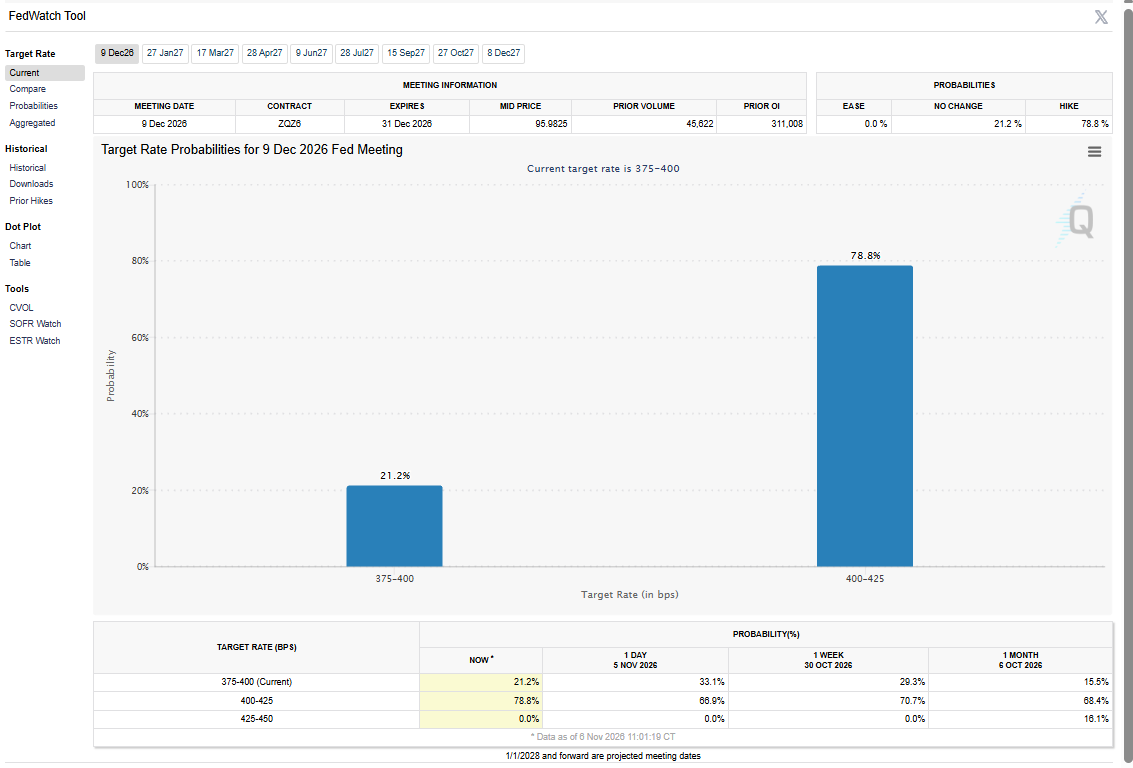
With the Federal Reserve’s benchmark interest rate currently at 3.75%–4.00%, the stronger employment data reduces the immediate pressure on policymakers to prioritise supporting the labour market.
Instead, attention is returning to inflation, particularly as wage growth remains firm.
The next major catalyst will be the upcoming US Consumer Price Index (CPI) report. A higher-than-expected inflation reading could strengthen expectations of further monetary tightening, while weaker inflation may challenge the market’s increasingly hawkish outlook.
Gold Falls Towards $4,050 as the US Dollar Strengthens
Financial markets reacted quickly to the NFP surprise, with the US dollar emerging as one of the biggest beneficiaries.
The US Dollar Index (DXY) climbed approximately 0.6% to 102.2, while the two-year Treasury yield rose towards 4.5% and the 10-year yield approached 4.9%.
Major currencies came under pressure, with EURUSD declining approximately 0.65%, GBPUSD falling around 0.6%, and both the Australian and New Zealand dollars losing roughly 1%.
Gold also suffered a setback, declining approximately 1% to trade near $4,050.
Higher Treasury yields tend to weigh on gold because the precious metal does not generate interest income. Understanding the relationship between US Treasury yields and gold prices helps explain why stronger employment data can trigger selling pressure in the precious metal.
At the same time, a stronger US dollar can make dollar-denominated gold more expensive for international buyers. This reflects the broader correlation between gold and other financial markets, although these relationships can weaken or reverse during periods of market stress.
However, gold’s broader recovery has not necessarily ended. Despite the NFP-driven decline, prices remain above the demand zone that supported the recent rebound.
Gold Price Analysis: Can XAUUSD Recover Towards $4,220?
Gold entered the NFP release with improving bullish momentum after rebounding from its daily demand zone between $3,820 and $3,870.
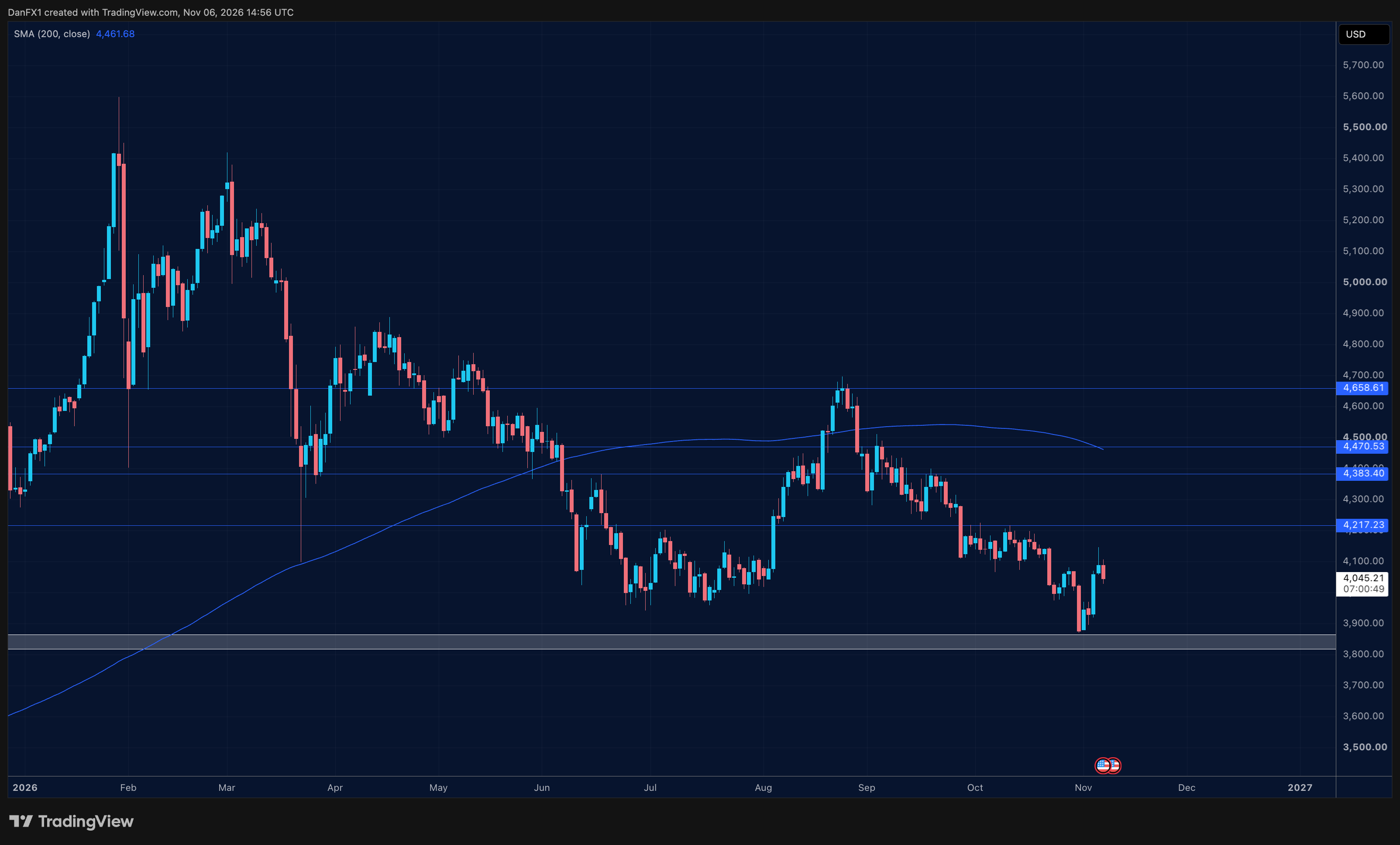
The recovery carried prices towards $4,130 earlier in the week before stronger US employment figures triggered renewed selling pressure.
With gold now trading near $4,050, the market faces an important test of whether buyers can regain control.
Key gold price levels to watch
| Price level | Technical significance |
| $4,470 | 200-day simple moving average (SMA) |
| $4,380 | Next upside level beyond $4,220 |
| $4,220 | Key resistance and potential bullish trend confirmation |
| $4,130 | Recent recovery high |
| $4,050 | Post-NFP price area |
| $3,820–$3,870 | Daily demand and potential support zone |
A sustained break above $4,220 would strengthen the case for a bullish trend reversal, potentially opening the way towards $4,380 and subsequently the 200-day SMA near $4,470.
Until that breakout occurs, the recovery remains vulnerable to further selling, especially if US Treasury yields and the dollar continues strengthening.
On the downside, the $3,820–$3,870 demand zone remains an important area to monitor should the current pullback deepen.
For traders unfamiliar with XAUUSD, understanding how gold trading works provides useful context when assessing price movements around major economic announcements.
Gold traders should also pay attention to developments in US-Iran negotiations and oil prices, as changes in energy costs could influence inflation expectations and the Federal Reserve’s policy outlook.
EURUSD Price Analysis: Strong NFP Puts 1.1110 Support in Focus
The stronger US dollar also pushed EURUSD lower, reinforcing the currency pair’s existing bearish pressure.
Both EURUSD and XAUUSD are quoted against the US dollar, which helps explain why gold and EURUSD often move in the same direction, although the relationship is not always consistent.
Since early October, EURUSD has largely traded within a range between 1.1110 support and 1.1280 resistance.
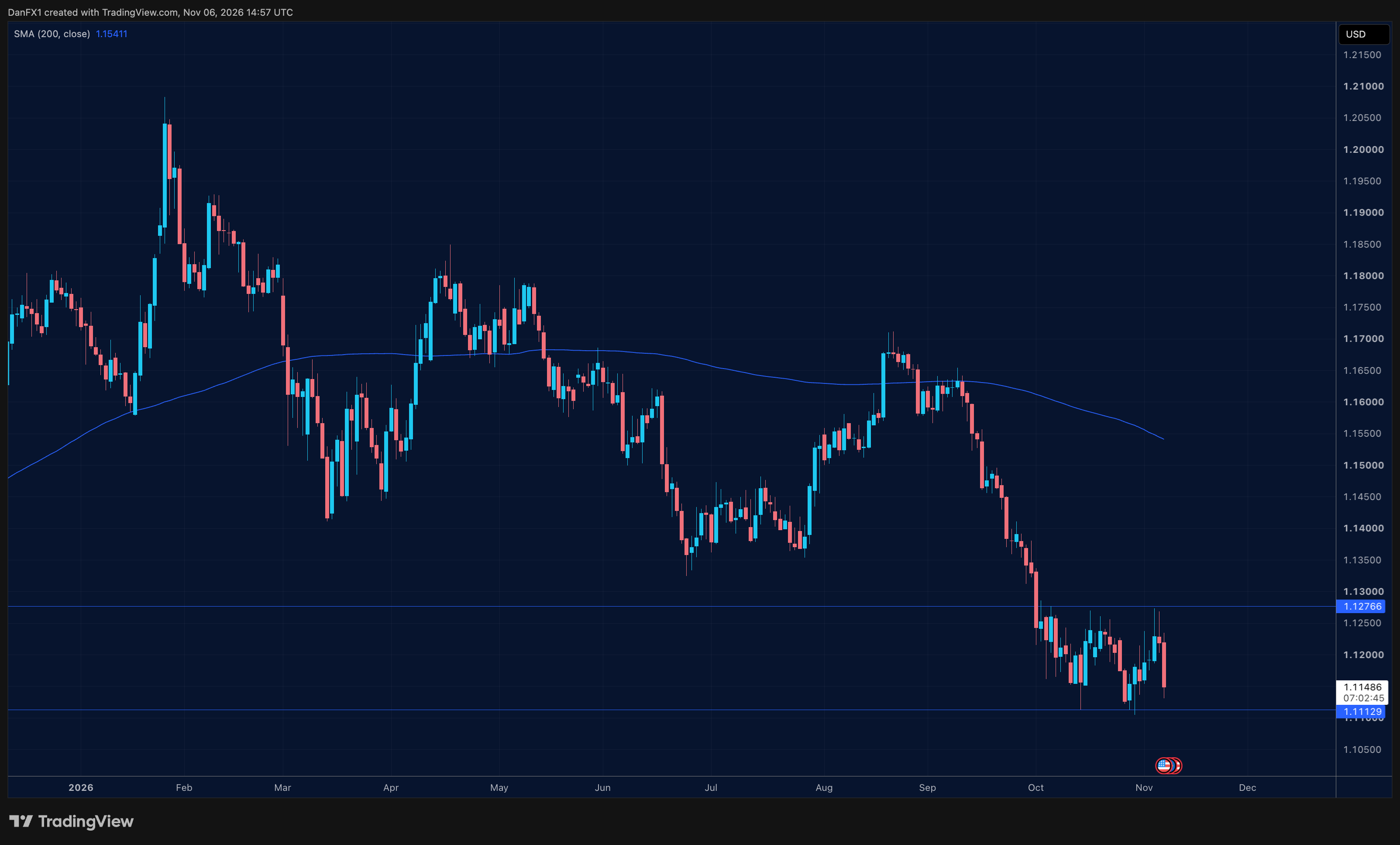
Earlier in the week, the pair approached its 200-day SMA near 1.1240 but failed to break higher. The NFP surprise subsequently pushed EURUSD back towards 1.1150.
Two levels now stand out.
1.1110: Critical downside support
This level has held during several tests throughout the month. A decisive break below it would strengthen the argument that the broader downtrend is resuming, particularly if US yields remain elevated.
1.1280: Resistance to overcome
For buyers to regain control, EURUSD would need to break above 1.1280 and reclaim its 200-day SMA.
Until either boundary breaks, the pair could remain range-bound, with incoming US inflation data potentially determining the next directional move.
What Comes Next for Gold and the US Dollar?
Although the October NFP report has strengthened the dollar’s near-term outlook, the next market direction will depend heavily on whether incoming inflation data supports the case for higher interest rates.
Three developments deserve particular attention:
- US CPI next week: Stronger inflation could reinforce December rate hike expectations, potentially supporting the dollar and pressuring gold. Softer inflation could produce the opposite reaction.
- Federal Reserve meeting on 8–9 December: The updated dot plot will offer further insight into policymakers’ expectations for future interest rates.
- Treasury yields, oil prices and geopolitical developments: These remain important drivers of inflation expectations, gold demand and broader currency movements.
The NFP surprise has given dollar buyers fresh momentum, but the outlook for gold and EURUSD remains sensitive to upcoming economic releases.
For gold, $4,220 is the key upside level that could confirm a stronger recovery, while EURUSD faces an important test of support at 1.1110.
With CPI approaching, traders will be watching whether the employment-driven dollar rally can extend or whether the next inflation reading changes the market’s expectations once again.

Trade Gold with VT Markets
Gold remains one of the most actively monitored markets as traders assess changes in inflation expectations, interest-rate outlooks and global risk sentiment.
With VT Markets, traders can monitor XAUUSD price action alongside USDX, forex, indices and other global CFD markets.
This flexibility allows traders to monitor how gold responds to major market drivers, including inflation data, central bank policy expectations and movements in the US dollar.
Explore all Gold products at VT Markets Trade Gold CFDs | Trade Gold 24/7 | Open account today
Frequently Asked Questions
- Why did gold fall after the US NFP report?
Gold declined towards $4,050 after stronger-than-expected US employment data increased expectations of another Federal Reserve interest rate hike. Rising Treasury yields and a stronger US dollar also weighed on gold prices.
- How many jobs did the US economy add in October 2026?
The US economy added 165,000 jobs in October 2026, significantly exceeding economists’ forecasts of approximately 65,000. The unemployment rate also fell to 4.1%.
- What are the key gold price levels after NFP?
Gold traders are monitoring resistance at $4,220, followed by $4,380 and $4,470. On the downside, the $3,820–$3,870 demand zone remains a key potential support area.
- Why did EURUSD fall after NFP?
EURUSD weakened because strong US employment figures supported expectations of higher interest rates, strengthening the US dollar against the euro. The pair is now approaching important support around 1.1110.
- What economic event could move gold after NFP?
The upcoming US CPI inflation report is a major catalyst. Higher-than-expected inflation could reinforce interest rate hike expectations, while softer inflation could reduce pressure on gold.



