





Key Points
- USDINR trades near 96.321, down 0.63%, as the Indian rupee strengthens following fresh intervention measures from the Reserve Bank of India (RBI).
- The RBI has introduced a special dollar-supply window to meet the daily dollar requirements of three state-owned oil companies.
- A 20% foreign exchange risk reserve now applies to qualifying rupee derivative contracts exceeding $2 million, increasing the cost of certain currency hedges.
- The threshold for derivative transactions has fallen from $100 million to $5 million, tightening restrictions on forex activity.
- Elevated crude oil prices, US Treasury yields and foreign portfolio outflows remain risks to a sustained rupee recovery.
Market Move
The Indian rupee strengthened against the US dollar on Monday, 12 October 2026, after the Reserve Bank of India introduced a series of measures designed to reduce dollar demand and stabilise the foreign exchange market.
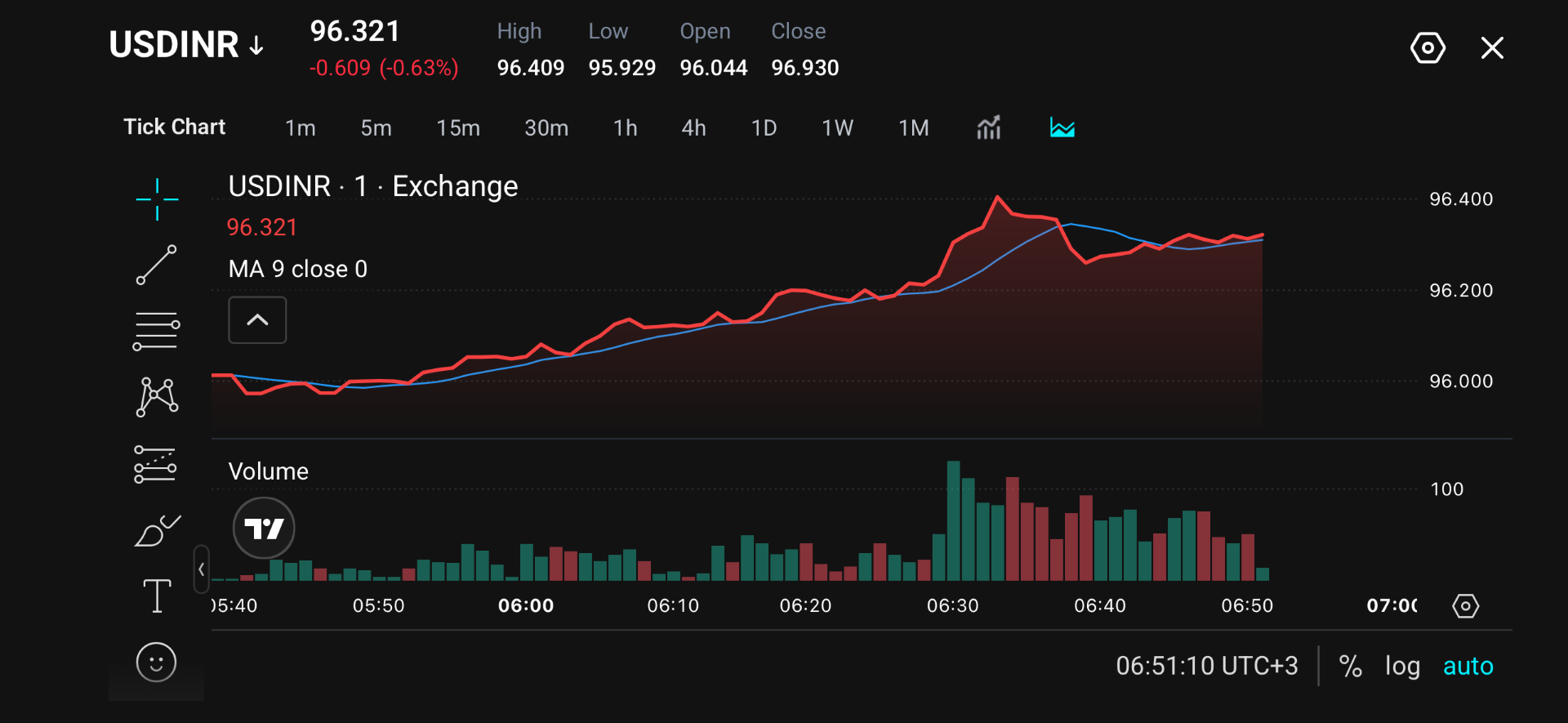
USDINR traded near 96.321, down 0.609 or 0.63%, reflecting renewed demand for the rupee following the RBI’s policy announcements. The recovery follows months of pressure on India’s currency. The rupee has lost nearly 7% against the dollar in 2026, with rising crude oil prices, elevated US bond yields and foreign investment outflows contributing to its weakness.
Why Traders Are Watching USDINR
The RBI announced its latest measures on 10 October, ahead of the special dollar facility becoming operational on Monday. Under the arrangement, the central bank will supply dollars through designated banks to three major state-run oil marketing companies: Indian Oil Corporation, Hindustan Petroleum Corporation and Bharat Petroleum Corporation. These companies require substantial amounts of US dollars to finance India’s crude oil imports. By directing their purchases through a dedicated facility, the RBI aims to reduce immediate dollar demand in the wider spot market.
The central bank also tightened rules governing foreign exchange derivatives. Dealers must maintain a cash reserve equivalent to 20% of the rupee value of qualifying derivative contracts exceeding $2 million when the contracts involve purchasing foreign currency against the rupee to hedge current account exposures. Meanwhile, the threshold for certain derivative transactions without establishing underlying exposure has been lowered from $100 million to $5 million.
The measures have already influenced offshore currency markets. The one-month USDINR non-deliverable forward fell by approximately 40 paise in thin trading following the announcements, indicating an initial strengthening of the rupee.
Key Trading Levels
| Level | Price | Technical importance |
| Resistance 3 | 96.80–96.93 | Broader overhead recovery zone |
| Resistance 2 | 96.6 | Potential upside extension |
| Resistance 1 | 96.4 | Immediate resistance near the chart’s intraday high |
| Current price | 96.321 | Latest supplied chart reading |
| Support 1 | 96.2 | Intraday consolidation area |
| Support 2 | 96 | Psychological support near the early-session base |
| Support 3 | 95.93 | Session low reference |
The pair experienced an intraday recovery from the 96.00 region towards 96.40, followed by consolidation near 96.32. The 96.40 level is the immediate resistance to watch, with the session high recorded at 96.409. A sustained move above this area could open the way towards 96.60.
On the downside, 96.20 represents the first technical support area. A move below it could expose 96.00, followed by the session low near 95.93.
Bullish and Bearish Setups
| Scenario | Confirmation | Potential targets |
| Bullish | Sustained break above 96.40 | 96.60, followed by 96.80 |
| Bearish | Sustained break below 96.20 | 96.00, followed by 95.93 |
| Range-bound | Price remains between 96.20 and 96.40 | Continued consolidation |
For a bullish scenario, a sustained move above 96.40 could indicate that dollar demand is returning despite the RBI’s intervention. A confirmed breakout could bring 96.60 into focus, with 96.80 representing a further recovery target.
For a bearish scenario, a sustained decline below 96.20 would suggest that the rupee’s recovery is extending as USDINR moves lower. The next technical level would be 96.00, followed by 95.93. A sharper decline could develop if the RBI’s dollar-supply facility reduces spot-market pressure more effectively than expected, particularly if crude oil prices and global dollar demand eases. However, a short-term break below support would not necessarily indicate a lasting change in the rupee’s broader trend.
Disclaimer
The price levels and market scenarios above reflect the author’s assessment at the time of writing. They do not represent financial advice or an official recommendation from VT Markets. Traders should conduct their own analysis and manage risk carefully.
USDINR Prediction: Biggest Drivers?
The near-term USDINR outlook depends on whether the RBI’s new measures can maintain pressure on dollar demand while external market conditions remain uncertain. Beyond domestic policy, three external developments remain central to the USDINR outlook. First, crude oil prices remain elevated. Brent crude was trading around $103 per barrel on Monday, despite easing from higher levels. As a major oil importer, India remains exposed to increases in energy costs, which can raise demand for dollars.
Second, higher US Treasury yields could continue supporting the dollar by attracting international capital towards US assets. Third, foreign portfolio outflows may add pressure to the rupee if investors reduce their exposure to Indian equities and other domestic assets.
The interaction between RBI policy, energy prices and global capital flows will help determine whether the current decline in USDINR extends beyond an initial policy-driven reaction.
Trade USDINR with VT Markets
Central bank intervention, interest rate expectations and commodity price movements can all influence currency markets.
With VT Markets, traders can explore global forex markets, access real-time charts and monitor price developments through professional trading tools.
Explore forex trading opportunities with VT Markets and stay informed as global currency markets respond to changing economic conditions.
Start a live trading account today and discover market insights, educational content and more.
Frequently Asked Questions
Why is USDINR falling today?
USDINR is trading lower following new RBI measures designed to support the Indian rupee. These include a special dollar-supply facility for oil companies, tighter derivative transaction limits and a 20% reserve requirement on qualifying forex hedges.
What is the RBI’s special dollar window?
The facility allows three state-owned oil marketing companies to purchase US dollars through designated banks, with the RBI supplying the currency directly. It aims to reduce pressure on the regular spot foreign exchange market.
Could the Indian rupee strengthen further?
Further strengthening is possible if RBI intervention continues to reduce dollar demand and external conditions improve. However, elevated crude oil prices, high US yields and foreign capital outflows remain potential obstacles.
How do crude oil prices affect USDINR?
India imports a large share of its crude oil requirements, typically paying in US dollars. Higher oil prices can increase dollar demand and place downward pressure on the rupee, potentially pushing USDINR higher.
Start trading now — click here to create your real VT Markets account.








