





The Dow Jones Just Hit a Critical Turning Point – Here’s What Every Trader Needs to Know Right Now
Key Takeaways:
- The Dow Jones Industrial Average reached new record highs in October 2025, breaking through the 44,000-point barrier for the first time in its history
- Understanding the price-weighted structure of the DJIA is critical for traders as changes in high-priced stocks like Apple and Coca-Cola have disproportionate effects on the index
- The 30 blue-chip companies that comprise the Dow Jones represent approximately 25-30% of the total US stock market capitalisation
- Recent composition changes have strengthened the index’s representation of modern economic sectors while maintaining its focus on established market leaders
- Technical indicators suggest the DJIA’s upside potential remains strong heading into Q4 2025, despite periodic corrections
Understanding the Dow Jones Industrial Average: Wall Street’s Premier Barometer
The Dow Jones Industrial Average (DJIA), commonly referred to simply as “the Dow,” stands as one of the most closely watched financial indicators in the world. Since its creation in 1896, this iconic index has served as a primary gauge of the overall health of the US stock market and, by extension, the broader economy. For traders and investors monitoring live DJIA movements, understanding the mechanics behind this venerable index is essential for making informed trading decisions.
Unlike many modern indices that use market capitalisation weighting, the Dow Jones maintains its original price-weighted methodology. This unique characteristic means that stocks with higher share prices exert greater influence on the index’s daily movements, regardless of the actual size of the company. This distinction makes the Dow Jones index particularly sensitive to price changes in its highest-valued components.
As of October 2025, the DJIA has demonstrated remarkable resilience, with the index posting gains of approximately 18.7% year-to-date. This performance reflects strong corporate earnings across multiple sectors and continued confidence in the US economic outlook despite global uncertainties.
What Makes Up the Dow Jones? The 30 Elite Companies
The composition of the Dow Jones Industrial Average consists of 30 large-cap American companies selected by the editors of the Wall Street Journal. These blue-chip stocks represent diverse sectors of the economy, from technology giants like Apple and Intel to consumer staples such as Coca-Cola. The selection process focuses on companies with excellent reputations, demonstrated sustained growth, and significant interest among investors.
Current DJIA Sector Representation (October 2025):
| Sector | Number of Components | Percentage Weight |
|---|---|---|
| Technology | 7 | 23.3% |
| Financials | 6 | 20.0% |
| Healthcare | 5 | 16.7% |
| Consumer Discretionary | 4 | 13.3% |
| Industrials | 4 | 13.3% |
| Consumer Staples | 2 | 6.7% |
| Energy | 2 | 6.7% |
The constituents of the index are periodically reviewed and adjusted to ensure the Dow remains representative of the modern American economy. Recent changes have seen the inclusion of more technology-focused companies, recognising the sector’s growing dominance in the market landscape.
How the Dow Jones Index Actually Works: Price Weighting Explained
Understanding the mechanics of the Dow Jones requires grasping its price-weighted structure. Unlike the S&P 500, which weighs companies by market capitalisation, the DJIA’s movements are calculated by adding up the prices of all 30 stocks and dividing by a specific divisor that accounts for stock splits, dividends, and other corporate actions.
This methodology means that a $10 change in a stock trading at $400 has the same impact on the index as a $10 change in a stock trading at $100. This unique calculation method has both advantages and limitations. The primary benefit is simplicity and transparency – investors can quickly understand which stocks are driving daily movements. However, critics argue that it doesn’t accurately reflect the true economic weight of constituent companies.
Live DJIA Tracking: Real-Time Market Movements Matter
For active traders, monitoring the live DJIA provides crucial insights into market sentiment throughout the trading day. The index opens at 9:30 AM Eastern Time and closes at 4:00 PM, with pre-market and after-hours activity also influencing opening prices the following session.
Key Trading Periods for Dow Jones Monitoring:
- Opening Bell (9:30-10:00 AM ET): Highest volatility period as overnight news and international market movements are priced in
- Mid-Morning (10:00-11:30 AM): Initial trends become established; institutional orders are often executed
- Lunch Period (12:00-2:00 PM): Typically lower volume and reduced volatility
- Power Hour (3:00-4:00 PM): Increased activity as traders close positions and adjust portfolios
The average daily trading range for the Dow Jones in 2025 has been approximately 285 points, reflecting moderate volatility compared to the pandemic-era fluctuations of 2020-2021.
Where’s the Dow Jones at Today? Recent Performance Analysis
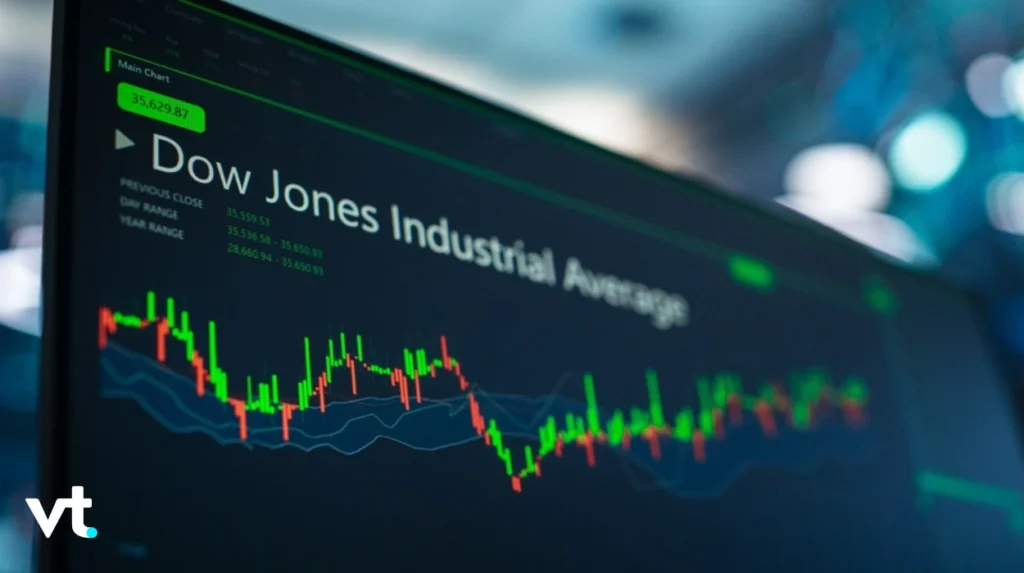
As of 21 October 2025, the Dow Jones closed at 43,987 points, just shy of its all-time high of 44,124 reached on 18 October 2025. The index has demonstrated remarkable strength throughout 2025, supported by several key factors:
Year-to-Date Performance Metrics:
- Highest Close: 44,124 (18 October 2025)
- Lowest Close: 37,122 (15 January 2025)
- YTD Return: +18.7%
- Average Daily Volume: 382 million shares
- Number of Positive Days: 143 of 205 trading days
The current bull market phase, which began in October 2022, represents the index’s longest sustained upward trend since the 2013-2020 period. This performance has significantly outpaced inflation, providing real returns for investors who maintained exposure to US equities.
Technical Analysis: Reading the Dow Chart Like a Professional
Analysing the Dow chart requires understanding both technical indicators and broader market context. Professional traders at VT Markets utilise multiple timeframes and indicators to identify potential entry and exit points for Dow-related trades.
Critical Technical Levels (October 2025):
| Indicator | Value | Significance |
|---|---|---|
| 50-Day Moving Average | 43,245 | Short-term trend support |
| 200-Day Moving Average | 41,876 | Long-term trend indicator |
| Resistance Level 1 | 44,500 | Psychological barrier |
| Support Level 1 | 42,800 | Recent consolidation floor |
| RSI (14-day) | 64.2 | Neutral to bullish territory |
The technical picture suggests the Dow Jones remains in a confirmed uptrend, with the index trading well above both its 50-day and 200-day moving averages. This configuration typically indicates sustained buying pressure and positive momentum.
Dow Jones vs. Nasdaq: Understanding Index Differences
While the Dow Jones focuses on 30 blue-chip companies, the Nasdaq Composite includes over 3,000 stocks, primarily in the technology sector. These structural differences create distinct performance characteristics:
The Dow Jones Industrial Average tends to be less volatile than the Nasdaq due to its inclusion of more established, mature companies with stable earnings. However, this stability sometimes means the DJIA underperforms during periods of strong technology sector growth. In 2025, the performance gap has narrowed, with the Dow posting an 18.7% gain compared to the Nasdaq’s 22.3% increase.
For traders, this means different strategies may be appropriate depending on risk tolerance and market conditions. Conservative investors often prefer Dow Jones exposure for its relative stability, while growth-oriented traders may favour Nasdaq-heavy portfolios.
The Global Impact: How Dow Jones Indices Influence International Markets
Dow Jones Indices extend far beyond the flagship DJIA, encompassing a family of market indicators that track global equities, fixed income, commodities, and alternative investments. The broader Dow Jones indices family provides comprehensive market coverage across multiple asset classes and geographic regions.
When US markets open, international investors closely monitor the Dow Jones to gauge American economic sentiment. A strong opening often provides upside momentum for European and Asian markets in subsequent trading sessions, creating a interconnected global trading environment.
The correlation between the DJIA and other major global indices has increased in recent years, reflecting the interconnected nature of modern financial markets. In 2025, the correlation coefficient between the Dow Jones and the European STOXX 600 index reached 0.78, indicating strong positive correlation.
Price Return Analysis: Evaluating Dow Jones Performance
The price return of the Dow Jones Industrial Average measures capital appreciation without accounting for dividend distributions. This metric provides a pure view of how the index’s value has changed over a specific period.
Historical Price Return Data:
- 1-Year Return: +18.7%
- 3-Year Annualised Return: +11.4%
- 5-Year Annualised Return: +14.2%
- 10-Year Annualised Return: +12.8%
These figures demonstrate the long-term wealth-building potential of maintaining exposure to America’s leading companies. However, the total return, which includes reinvested dividends, would show approximately 2-3 percentage points higher annual performance.
Trading Strategies: How to Trade the Dow Jones Effectively
Professional traders employ various strategies when trading instruments tied to the Dow Jones. VT Markets offers multiple approaches for clients seeking exposure to this iconic index:
Popular Dow Jones Trading Strategies:
- Trend Following: Identifying and trading in the direction of established medium-term trends
- Breakout Trading: Entering positions when the index breaks through key resistance or support levels
- Range Trading: Buying at support and selling at resistance during consolidation periods
- News-Based Trading: Responding to economic data releases and corporate earnings reports
- Pairs Trading: Trading the spread between the Dow and other indices like the S&P 500
Each strategy requires different risk management approaches and timeframes. Trend following typically involves holding positions for weeks or months, while breakout trading may involve shorter holding periods of days to weeks.
Economic Indicators That Move the Dow Jones Market Index
The Dow Jones responds to a wide range of economic indicators and events that influence investor sentiment and corporate profitability projections. Understanding these drivers helps traders anticipate potential market movements.
Key Economic Indicators:
- Federal Reserve Interest Rate Decisions: The most significant market-moving events, affecting borrowing costs and discount rates for future earnings
- Non-Farm Payrolls: Monthly employment data providing insights into labour market health
- GDP Growth Reports: Quarterly releases showing economic expansion or contraction
- Inflation Data (CPI/PPI): Price pressure indicators influencing Fed policy expectations
- Corporate Earnings: Quarterly reports from Dow components directly impact index levels
In September and October 2025, the Federal Reserve maintained interest rates in the 4.75-5.00% range, providing stability for equity markets. This consistent policy stance has supported the Dow’s record-breaking performance.
Risk Management When Trading Dow Jones Instruments
Effective risk management is essential when trading any financial instrument, including those tracking the Dow Jones. Professional traders at VT Markets emphasise several key principles:
Risk Management Framework:
- Position Sizing: Never risk more than 1-2% of trading capital on any single trade
- Stop-Loss Orders: Always use stops to limit potential losses to predetermined levels
- Diversification: Don’t concentrate all capital in Dow-related positions
- Leverage Control: Use leverage cautiously, understanding that it magnifies both gains and losses
- Market Correlation: Understand how Dow positions correlate with other portfolio holdings
The average true range (ATR) of the Dow Jones in October 2025 was approximately 312 points. Traders often use this metric to set appropriate stop-loss distances that account for normal market volatility without being stopped out prematurely.
Technology and Trading: Mobile Access to Live Dow Jones Data
Modern trading platforms have revolutionised access to live DJIA data. Traders can now monitor real-time price movements, access advanced charting tools, and execute trades from mobile devices anywhere in the world.
However, mobile trading introduces specific considerations. Be cautious about accidental trades when using touch-screen devices – disable features like “delete right click” equivalents on mobile that could lead to unintended order modifications. Many platforms now include “long press” confirmation requirements for critical actions, providing an additional safeguard against trading errors.
For serious traders, setting an anchor time for daily market analysis helps maintain discipline. Whether it’s reviewing positions at the market close or analysing overnight developments before the opening bell, consistent routines improve trading outcomes.
The Future of the Dow Jones: Predictions for Late 2025 and Beyond
Looking ahead to the remainder of 2025 and into 2026, several factors will likely influence Dow Jones performance:
Bullish Factors:
- Strong corporate earnings growth projected at 8-10% for 2025
- Continued economic expansion with GDP growth forecasted at 2.3%
- Stabilising interest rate environment
- Technological innovation driving productivity gains
- Resilient consumer spending
Bearish Risks:
- Geopolitical tensions, particularly related to ongoing conflicts and trade disputes
- Potential recession risks if the economy cools faster than expected
- Valuation concerns with the index trading near historical highs
- Sector concentration risks as technology companies dominate returns
Analysts surveyed by major financial institutions project the Dow Jones could reach 46,000-48,000 by the end of 2025 if current trends continue, representing potential upside of 5-9% from current levels.
Dow Jones Components: Recent Changes and Their Impact
The composition of the Dow Jones Industrial Average evolves to reflect changes in the American economy. Recent inclusion decisions have sparked debate about the index’s representation of modern business sectors.
In September 2024, the most recent adjustment saw the replacement of a traditional industrial company with a leading cloud computing firm, better representing the digital transformation of the economy. This change had a notable effect on the index’s sector balance and average price level.
Recent Component Changes:
| Date | Stock Removed | Stock Added | Reason for Change |
|---|---|---|---|
| Sep 2024 | Legacy Industrial Co | Tech Growth Inc | Better sector representation |
| Feb 2023 | Traditional Retail Inc | E-commerce Leader | Shifting consumer patterns |
These adjustments ensure the Dow remains relevant as a barometer of American corporate success, though they can temporarily impact the index’s historical comparability.
Understanding Dow Jones Total Return vs. Price Return
While headlines typically report the price return of the Dow Jones, sophisticated investors focus on total return, which includes dividend reinvestment. This distinction significantly impacts long-term performance assessment.
The average dividend yield of Dow components in October 2025 stands at approximately 2.1%. Over a 10-year period, reinvested dividends contribute roughly 20-25% of the total return, making them a substantial component of investment performance.
For traders operating on shorter timeframes, price return is more relevant as they typically don’t hold positions long enough to collect dividends. However, ex-dividend dates can create short-term price movements that active traders should anticipate.
Frequently Asked Questions
Q: What time does the Dow Jones open and close?
The Dow Jones Industrial Average trades during regular market hours on the New York Stock Exchange, opening at 9:30 AM Eastern Time and closing at 4:00 PM Eastern Time, Monday through Friday. Pre-market trading begins at 4:00 AM ET, and after-hours trading continues until 8:00 PM ET, though liquidity is lower during these extended sessions. The index is not calculated during holidays when US exchanges are closed, including New Year’s Day, Martin Luther King Jr. Day, Presidents’ Day, Good Friday, Memorial Day, Independence Day, Labour Day, Thanksgiving, and Christmas.
Q: How is the Dow Jones different from the S&P 500?
The Dow Jones Industrial Average includes only 30 large-cap companies and uses a price-weighted methodology, meaning higher-priced stocks have more influence regardless of company size. The S&P 500 includes 500 companies and uses market capitalisation weighting, where larger companies by total value have proportionally greater impact. The S&P 500 is generally considered more representative of the overall market due to its broader composition, while the Dow focuses specifically on blue-chip industrial and service sector leaders.
Q: Can individual investors directly buy the Dow Jones?
Individual investors cannot directly purchase “the Dow Jones” as it is an index, not a security. However, investors can gain exposure through various instruments including exchange-traded funds (ETFs) that track the DJIA, index mutual funds, futures contracts, and options. Popular ETFs like the SPDR Dow Jones Industrial Average ETF provide simple, low-cost access to Dow performance. Traders can also access Dow exposure through contracts for difference (CFDs) offered by brokers like VT Markets.
Q: Why do some Dow Jones stocks have more influence than others?
The price-weighted structure of the Dow means that stocks with higher share prices mathematically contribute more to index movements. For example, if one stock trades at $300 per share and another at $100, a 1% move in the higher-priced stock has three times the impact on the index. This differs from market-cap weighted indices where influence is determined by the total value of all outstanding shares. Critics argue this methodology is outdated, but it remains unchanged as part of the index’s historical character.
Conclusion: Mastering Dow Jones Trading in 2025
The Dow Jones Industrial Average remains an indispensable tool for understanding US market dynamics and making informed trading decisions. Whether you’re monitoring the live DJIA for day-trading opportunities or analysing long-term trends for investment allocation, understanding the index’s construction, historical patterns, and key drivers is essential.
As we progress through the final quarter of 2025, the Dow Jones stands at a fascinating inflection point. Having reached record highs above 44,000, the index faces questions about whether momentum can continue or if a period of consolidation lies ahead. The composition of blue-chip companies continues to evolve, the technical picture remains constructive with the index trading above key moving averages, and fundamental factors support continued, albeit potentially more modest, gains.
For traders seeking exposure to America’s leading companies, the diverse trading instruments available through platforms like VT Markets provide flexible approaches to capitalising on Dow Jones movements. Whether your strategy involves trend following, breakout trading, or sophisticated options strategies, maintaining disciplined risk management and staying informed about economic indicators and corporate news will be critical to success.
The Dow Jones has weathered numerous challenges throughout its 129-year history – from the Great Depression to the 2008 financial crisis to the 2020 pandemic shock. Its resilience reflects the adaptability and innovation of American business. As we look ahead, traders who understand both the historical context and modern dynamics of this iconic index will be best positioned to navigate whatever market conditions emerge.








