




Gold has staged a strong recovery after rebounding from its late-October lows, but the upcoming US inflation reports could determine whether the rally has enough momentum to continue. With the Consumer Price Index (CPI) and Producer Price Index (PPI) scheduled for release this week, investors are preparing for potential volatility across gold, the US dollar and Treasury yields.
The reports arrive at a crucial time for financial markets, as stronger employment figures and persistent inflation have reinforced expectations of another Federal Reserve interest rate hike in December. For gold traders, the focus will be on whether inflation is cooling sufficiently to support a sustained recovery or remains elevated enough to strengthen the US dollar and challenge gold’s recent gains.
Why US CPI and PPI Matter for Gold Prices
The Consumer Price Index measures changes in the prices paid by consumers for goods and services, making it one of the Federal Reserve’s most closely monitored inflation indicators. Core CPI, which excludes volatile food and energy prices, is particularly important because it provides a clearer indication of underlying inflation pressures.
The Producer Price Index measures changes in prices received by domestic producers and provides insight into inflationary pressures within the supply chain. Rising production costs can eventually be passed on to consumers, making PPI a useful indicator when evaluating future inflation trends. Traders looking to understand how producer inflation fits into the broader economic picture can explore the relationship between PPI and Core PCE.
Both reports can influence gold prices through their impact on interest rate expectations. Stronger-than-expected inflation generally increases the likelihood of tighter monetary policy, potentially pushing Treasury yields and the US dollar higher. Since gold does not generate interest, higher yields can make the precious metal less attractive relative to interest-bearing assets. Conversely, weaker inflation may reduce expectations of further rate hikes, creating a more supportive environment for gold.
However, gold’s relationship with inflation is not always straightforward, as its performance also depends on real interest rates, monetary policy and investor sentiment. Understanding whether gold is an effective inflation hedge can provide additional context when analysing its response to economic announcements.
US Inflation Outlook: What Markets Expect
September’s inflation figures highlighted the persistence of price pressures across the US economy, with headline CPI increasing 0.6% month-on-month and 3.7% year-on-year. Core inflation also remained elevated, rising 0.3% during the month as higher energy costs contributed to broader inflationary pressures.
The Producer Price Index presented a similar picture, with September’s headline PPI increasing approximately 1.3% month-on-month. Much of the increase was linked to the earlier surge in energy prices, reflecting the impact of geopolitical tensions involving Iran and higher costs throughout the production chain.
For October, economists expect inflation to moderate, although the extent of the slowdown remains uncertain.
| Inflation Indicator | Previous Reading | October Forecast |
| Headline CPI m/m | 0.60% | 0.2%–0.3% |
| Core CPI m/m | 0.30% | 0.20% |
| Headline PPI m/m | 1.30% | 0.40% |
Core CPI will likely attract the greatest attention, particularly if the reading deviates significantly from the anticipated 0.2% increase. Meanwhile, the absence of an annual October comparison due to missing historical data associated with the government shutdown means investors may place greater emphasis on monthly changes when assessing the inflation outlook.
Why Falling Oil Prices May Not Immediately Ease Inflation
Oil prices have recently declined amid hopes of improving diplomatic relations between the United States and Iran, raising expectations that energy-related inflation pressures could eventually ease. However, lower crude oil prices do not necessarily translate into an immediate reduction in consumer inflation, particularly when businesses are still absorbing the effects of earlier price increases.
Higher transportation, manufacturing and distribution costs can take several months to work through the economy, meaning inflation data may continue reflecting previous energy shocks even after oil prices retreat. This delay is particularly relevant for PPI, where changes in production costs can provide an indication of potential pressure on consumer prices.
For the Federal Reserve, the persistence of these effects may complicate monetary policy decisions. Although declining oil prices could improve the longer-term inflation outlook, policymakers may require clearer evidence that underlying price pressures are easing before reconsidering their restrictive stance. Beyond inflation, geopolitical developments, supply disruptions and global demand remain important factors influencing crude oil prices.
Federal Reserve Interest Rate Expectations Remain in Focus
The Federal Reserve has maintained its benchmark interest rate at 3.75%–4.00%, while recent economic developments have strengthened expectations of further monetary tightening. Following the latest US employment report, market-implied probabilities of a December interest rate hike increased to approximately 75%–80%, reflecting concerns that resilient economic activity could keep inflation elevated.
A stronger-than-expected CPI report could reinforce these expectations and support further gains in the US dollar and Treasury yields. However, softer inflation may encourage investors to reassess the likelihood of a December hike, potentially reducing downward pressure on gold.
The relationship between US Treasury yields and gold prices is particularly important because changes in real yields can influence the opportunity cost of holding non-yielding assets. Higher real yields generally create a less favourable environment for gold, while declining real yields may support investment demand.
Beyond the immediate data releases, remarks from Federal Reserve officials and the upcoming December 8–9 policy meeting will provide further insight into how policymakers interpret the inflation outlook. Understanding how to trade interest rate expectations can also help traders assess how changes in monetary policy outlooks influence different financial markets.
Gold Price Technical Analysis: Can XAUUSD Sustain Its Recovery?
Gold has recovered more than $250 from the $3,870–$3,890 demand zone established in late October, with prices advancing towards $4,140. The rebound has pushed XAUUSD above a descending trendline and brought prices back towards the 200-period simple moving average (SMA) near $4,110 on the four-hour chart.
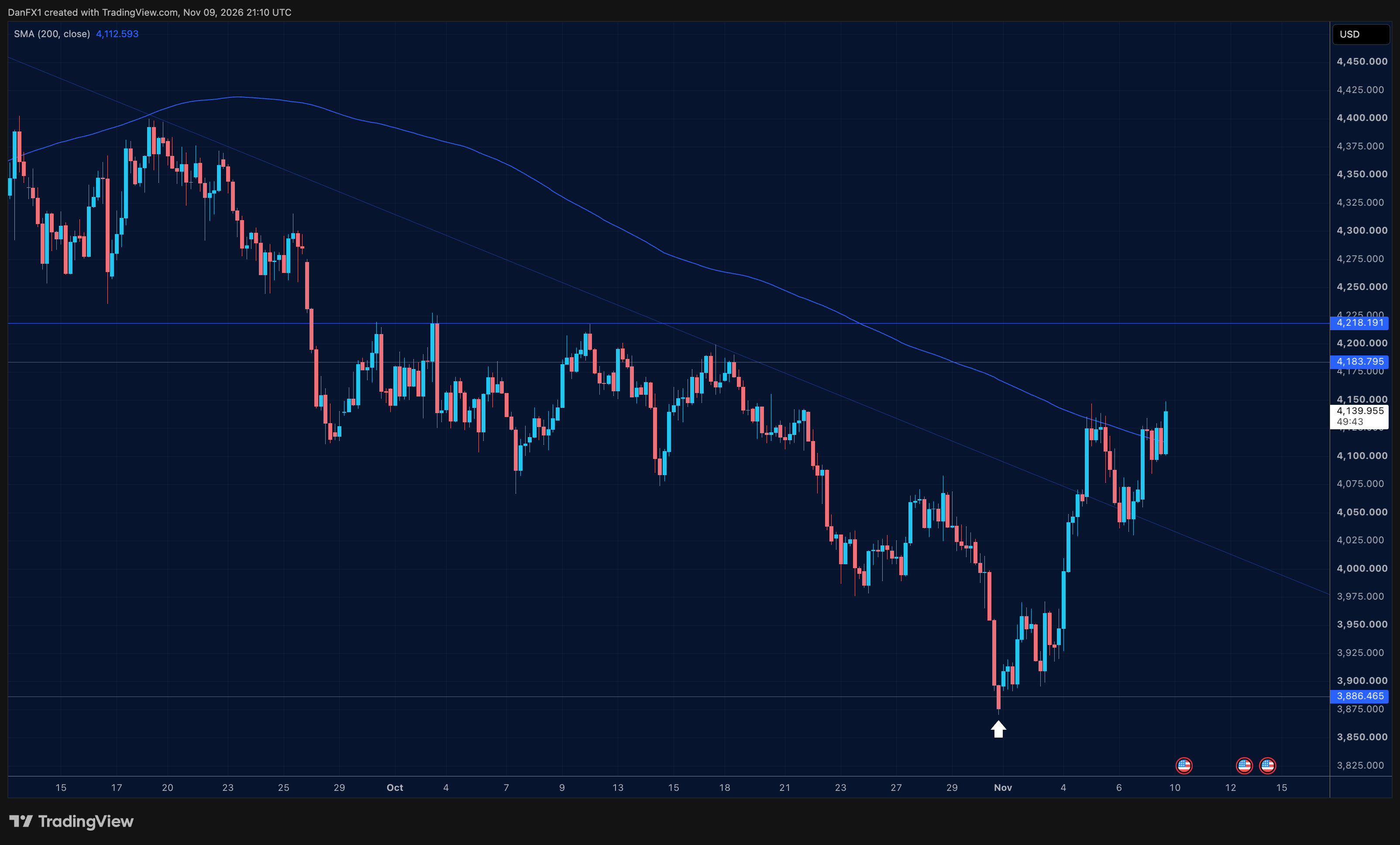
Despite the recovery, gold has yet to establish a confirmed bullish reversal, as significant resistance remains between $4,200 and $4,220. A sustained breakout above this region would provide stronger evidence of improving buying momentum and could indicate that the broader downtrend is losing strength.
Conversely, failure to overcome resistance could leave gold vulnerable to renewed selling pressure, particularly if stronger inflation data reinforces expectations of further Federal Reserve tightening. The $3,870–$3,890 demand zone remains an important longer-term support area, with a sustained breakdown potentially undermining the recovery.
Traders analysing these price movements can also examine how XAUUSD trading works, including the factors influencing gold’s price and the characteristics of trading the precious metal against the US dollar.
Key Gold Price Levels to Watch
| Price Level | Technical Significance |
| $4,200–$4,220 | Major resistance and potential bullish breakout zone |
| $4,180 | Near-term resistance |
| $4,110 | 200-period SMA and near-term technical reference |
| $3,870–$3,890 | Major support and demand zone |
How Gold Could React to the US CPI Report
Gold’s immediate direction may depend on how October’s core inflation reading compares with market expectations, although the reaction will also be influenced by changes in Treasury yields, the US dollar and broader investor sentiment.
Scenario 1: Inflation Meets Market Expectations
If core CPI increases approximately 0.2%, the report may provide limited justification for a significant change in Federal Reserve interest rate expectations. Under this scenario, gold could remain within its existing trading range, with investors monitoring resistance near $4,180 while awaiting Friday’s PPI release for additional confirmation of inflation trends.
Scenario 2: Inflation Falls Below Expectations
A core CPI reading below 0.2% could weaken expectations of further monetary tightening, potentially encouraging a decline in Treasury yields and the US dollar. Such conditions may support gold’s recovery and create an opportunity for XAUUSD to test the $4,200–$4,220 resistance zone, where a sustained breakout would strengthen the case for a broader bullish reversal.
Scenario 3: Inflation Exceeds Expectations
If core CPI reaches 0.3% or higher, markets could interpret the report as evidence that underlying inflation remains persistent, reinforcing expectations of a December interest rate hike. Higher Treasury yields and a stronger US dollar may weigh on gold, increasing the possibility of rejection near resistance or a pullback towards $4,110. A substantially stronger reading could also revive expectations of additional monetary tightening in 2027.
What Gold Traders Should Watch Next
While CPI represents the immediate market catalyst, Friday’s PPI report will provide another important assessment of inflationary pressures within the US economy. A stronger-than-expected PPI reading following elevated CPI could reinforce expectations of restrictive monetary policy, while softer producer inflation may support hopes that price pressures are gradually easing.
Investors should also monitor movements in the US Dollar Index and Treasury yields, alongside Federal Reserve commentary and geopolitical developments affecting energy markets. Understanding what correlates with gold can help traders identify relationships between precious metals, currencies, yields and broader market sentiment when evaluating the sustainability of price movements.
Major economic announcements can also generate sudden price swings, particularly when reported figures differ significantly from market forecasts. Recognising why trading the news can be challenging is therefore important when preparing for potential volatility around CPI and PPI releases.
The Bottom Line
The upcoming US CPI and PPI reports represent an important test for gold’s recovery, particularly as markets continue to assess the likelihood of further Federal Reserve monetary tightening. While softer inflation could improve the outlook for the precious metal, persistent price pressures may strengthen the US dollar and Treasury yields, creating additional challenges for buyers.
Rather than focusing solely on the headline inflation figures, traders should assess how the results compare with expectations and whether the subsequent market reaction confirms the prevailing technical trend. Combining macroeconomic analysis with key support and resistance levels can provide a more structured approach to navigating volatility, while disciplined risk management remains essential around major economic announcements.
Frequently Asked Questions (FAQ)
- How does US CPI inflation affect gold prices?
US CPI inflation can influence gold prices by affecting Federal Reserve interest rate expectations, Treasury yields and the US dollar. Higher-than-expected inflation may strengthen the dollar and increase yields, placing downward pressure on gold. Conversely, softer inflation can reduce expectations of further monetary tightening, potentially supporting gold prices.
- What is the difference between CPI and PPI?
The Consumer Price Index (CPI) measures changes in prices paid by consumers for goods and services, while the Producer Price Index (PPI) tracks price changes received by domestic producers. CPI reflects consumer inflation, whereas PPI provides insight into inflationary pressures within the production process that may eventually affect consumer prices.
- Why is core CPI important for gold traders?
Core CPI excludes food and energy prices, providing a clearer indication of underlying inflation trends. Federal Reserve policymakers monitor core inflation when assessing the persistence of price pressures. A stronger-than-expected core CPI reading could increase expectations of higher interest rates, potentially weighing on gold prices through a stronger US dollar and higher Treasury yields.
- Will gold prices rise if US inflation falls?
Gold prices may benefit from lower inflation if it reduces expectations of further Federal Reserve interest rate hikes. Lower Treasury yields and a weaker US dollar can make gold relatively more attractive. However, gold’s direction also depends on economic growth, geopolitical developments, investor sentiment and technical market conditions.
- What are the key gold price levels to watch after CPI and PPI?
Gold faces significant resistance around $4,200–$4,220, where a sustained breakout could strengthen the bullish outlook. The $4,110 area serves as an important near-term technical reference, while the $3,870–$3,890 demand zone represents major support. Traders can monitor these levels alongside inflation results and movements in the US dollar and Treasury yields.
- How could the upcoming CPI and PPI reports affect Federal Reserve interest rates?
Stronger-than-expected CPI and PPI readings could reinforce expectations of further Federal Reserve monetary tightening, particularly if underlying inflation remains persistent. Softer inflation may reduce the likelihood of additional rate hikes. The Federal Reserve will also consider employment conditions, economic growth and broader financial developments before making its next interest rate decision.





