



Key Takeaways
- Trading the news means opening positions around scheduled or breaking events, such as jobs data, inflation prints, or central bank decisions.
- Markets often move on the gap between the consensus forecast and the actual figure, not the figure alone.
- Slippage, gapping, and spread widening can turn a correct call into a losing trade, which is why news trading is harder than it looks.
- A sound plan, an economic calendar, and strict risk management matter more than raw speed when you trade around events.
On paper, trading the news sounds almost too easy. A big number lands, the chart jumps, and you ride the move. In practice, it is one of the trickiest things a trader can attempt. Prices can spike, reverse, and spike again within seconds. Spreads widen, orders fill at worse levels than expected, and the “obvious” reaction often fails to show up at all.
This guide breaks down what news trading really involves, which events tend to move markets, and how a disciplined approach can help you manage the chaos. Whether you trade CFD forex, indices, commodities, or shares through a MetaTrader 4 or MetaTrader 5 platform, the same core principles apply.
What is Trading the News?
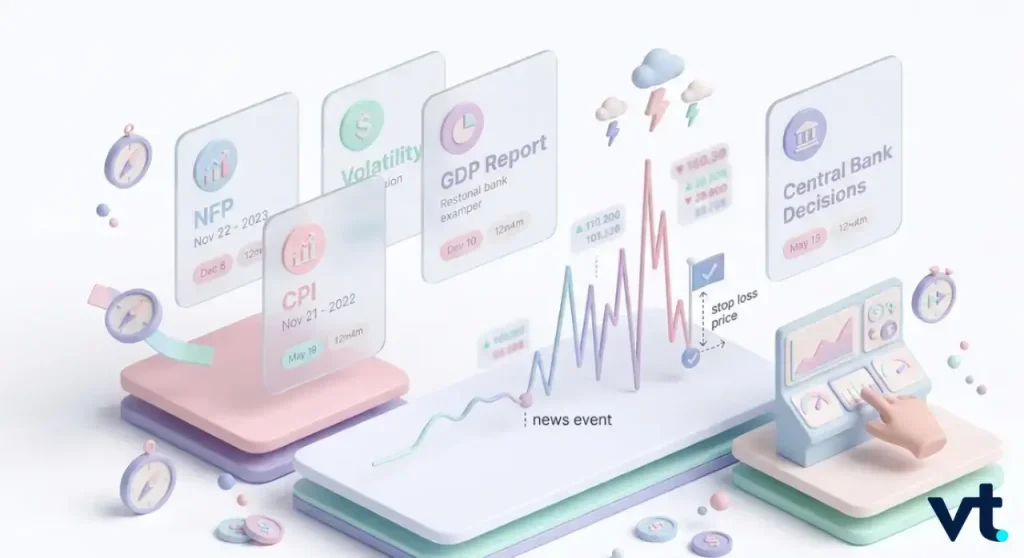
Trading the news means making decisions based on economic data, company updates, and political events that move prices. This section covers what news trading is, how a typical release plays out, how it compares with technical trading, and which markets, from forex to shares, react most to the headlines.
What does Trading the News Mean?
News trading is the practice of taking positions based on economic data, company announcements, or political developments that can move prices. Instead of waiting for a chart pattern to form, the news trader plans around a known event, or reacts quickly to an unexpected one.
The logic is simple. New information changes how the market values an asset. A stronger-than-expected jobs report can lift a currency. A surprise interest rate hike can sink a stock index. The trader’s job is to anticipate, or react to, that repricing.
How does News Trading Work?
In most cases, the sequence looks like this:
- A scheduled release is published, for example inflation or employment data.
- The market compares the actual figure with the consensus forecast.
- If there is a gap, traders rush to reprice the asset, creating a fast move.
- Liquidity thins out for a few seconds or minutes, then normal conditions return.
Here’s the catch:
It is that the move is not always in the “logical” direction. Markets price in expectations long before the release. So a good number that is still weaker than the whisper number can send a currency lower, not higher. This is one reason news-based trading strategies demand more than a quick read of the headline.
News Trading vs Technical Trading: What is the Difference?
| Approach | News trading | Technical trading |
| Main driver | Economic data and events | Price action and chart patterns |
| Timeframe | Often seconds to hours | Minutes to weeks |
| Key skill | Interpreting data vs expectations | Reading indicators and levels |
| Main risk | Slippage and whipsaws | False breakouts and lag |
Most experienced traders blend the two. They use the calendar to know when volatility is likely, and use technical levels to plan entries, stops, and targets.
What Markets can You Trade the News on?
News moves nearly every asset class, though some react more sharply than others:
- Forex: the most news-sensitive market, driven by rate decisions and economic data.
- Indices: equity benchmarks react to growth, inflation, and central bank guidance.
- Commodities: gold and oil respond to inflation, the US dollar, and geopolitical shocks.
- Cryptocurrency: highly reactive to macro sentiment and regulatory headlines.
- Shares: individual stocks move on earnings, guidance, and company-specific news.
What News Moves the Markets?
The events most worth watching tend to fall into a few clear categories:
High-Impact Economic Releases (NFP, CPI, GDP, Interest Rate Decisions)
These scheduled releases are the backbone of the economic calendar. The most market-moving include:
- Non-Farm Payrolls (NFP): US jobs data, released on the first Friday of each month.
- Consumer Price Index (CPI): the headline inflation gauge that shapes rate expectations.
- Gross Domestic Product (GDP): the broadest measure of economic growth.
- Interest rate decisions: arguably the single biggest driver of currency and bond moves.
A clear example came on 5 June 2026:
US Non-Farm Payrolls rose by 172,000 in May 2026. This is well above consensus estimates (which ranged from roughly 80,000 to 88,000, with ~85,000 a common figure). Meanwhile, the unemployment rate held at 4.3%. With a forecast near 85,000 against an actual of 172,000, the upside surprise was roughly 87,000 jobs (or ~92,000 against the Dow Jones consensus of 80,000).
The report’s strength supported a dollar-positive reaction. Thus, a figure roughly double the forecast is exactly the kind of surprise that makes news trading so fast and so unforgiving.
Central Bank Announcements and Forward Guidance (Fed, ECB, BoE)
Central banks set the cost of money, so their words can move markets as much as their actions. As of June 2026, the policy backdrop looks like this:
| Central bank | Policy rate | Recent stance (June 2026) |
| US Federal Reserve | 3.50–3.75% | Held on 17 June amid an internal split, with markets pricing a chance of hikes later in 2026 |
| European Central Bank | 2.25% (deposit) | Raised by 0.25% on 11 June, citing energy-driven inflation |
| Bank of England | 3.75% | Watching Middle East energy risks closely, with CPI at 2.8% in May |
Source: US Federal Reserve; European Central Bank (ECB); Bank of England (BoE); Office for National Statistics UK
The lesson is that the actual decision is only half the story. Traders dissect the statement, the projections, and the press conference for clues on what comes next. A hold paired with hawkish language can move a currency more than a rate change itself.
Geopolitical Events and Unscheduled News
Unscheduled events are the hardest to trade because there is no forecast to lean on. In the first half of 2026, the Strait of Hormuz crisis sent Brent crude to a peak of around $138 a barrel in early April (crossing $125 only briefly), lifting energy prices and forcing central banks to rethink their plans.
Conflicts, elections, and sudden policy shifts can gap markets through stops before anyone has time to react. This is a core reason news trading around geopolitics carries outsized risk.
Earnings Reports and Company-Specific News
For share traders, the corporate calendar matters as much as the economic one. Quarterly earnings, profit warnings, dividend changes, mergers, and management shake-ups can all trigger sharp single-stock moves. A company can beat on profit yet fall hard if its guidance disappoints, mirroring the expectations gap seen in macro data.
How to Read an Economic Calendar
An economic calendar is the news trader’s map. To use one well:
- Filter by impact: focus on high-impact (often red) events first.
- Check three numbers: previous, consensus forecast, and actual.
- Note the time zone: convert release times to your local clock to avoid surprises.
- Watch related events: a CPI print the day before a rate decision can shape both.
How Do You Trade the News?

So, how can I trade news without simply gambling on a number? The answer is a repeatable process. Here is a simple framework many traders follow.
Step 1: Identify High-Impact Events Ahead of Time
Each week, scan the economic calendar and mark the releases that matter for the assets you trade. Knowing that NFP, a CPI print, or a rate decision is due lets you prepare rather than react in panic. Many traders simply stand aside during the biggest events until they have a clear plan.
Step 2: Understand Consensus vs Actual Figures
The market reacts to surprises, not absolutes. Before any release, note the consensus forecast. Then judge the result against it:
- Actual far above forecast: a strong, often currency-positive surprise.
- Actual far below forecast: a weak, often currency-negative surprise.
- Actual in line with forecast: limited reaction, since it is already priced in.
Using the May 2026 NFP again:
With a forecast near 85,000 and an actual of 172,000, the upside surprise was roughly 87,000 jobs. That is the kind of gap that drives a sharp, dollar-positive reaction.
Step 3: Choose your Approach (trade before, during, or after the release)
There are three broad timing choices, each with a different risk profile:
| Timing | Idea | Main trade-off |
| Before the release | Position early based on your forecast | Highest uncertainty, full event risk |
| During the release | React to the actual figure as it lands | Slippage and the widest spreads |
| After the release | Wait for the dust to settle, then trade the trend | You may miss the first burst, but with less noise |
Many beginners find the “after” approach the most forgiving, since the wildest volatility has usually passed.
Common News Trading Strategies (Breakout, Fade, Straddle)
Three news-based trading strategies appear again and again:
- Breakout: trade in the direction of the move once price clears a key level after the release.
- Fade: bet against an overdone first reaction, expecting a pullback once emotion cools.
- Straddle: place orders on both sides of the market so you catch the move whichever way it breaks.
None of these is foolproof. Each depends on tight execution and disciplined stops, which is exactly where many traders come unstuck.
What are the Risks of News Trading?
The reason trading the news is harder than it looks comes down to a handful of risks that can quietly wreck an otherwise good trade.
Slippage and Price Gaps
Slippage is the difference between the price you expect and the price you get. In fast markets, your order may fill several pips away from your intended level.
Let’s suppose this:
You aim to buy EUR/USD at 1.1400 but the market is moving so quickly that you fill at 1.1408. On a standard lot, where one pip is worth about $10, that 8-pip slippage costs roughly $80 before the trade even starts working.
Spread Widening Around Releases
In calm conditions a major pair might trade on a spread of well under a pip. Seconds before and after a big release, that spread can widen sharply as liquidity dries up. A quick illustration:
| Condition | Typical EUR/USD spread | Cost on 1 lot |
| Normal market | ~0.8 pips | ~$8 |
| Around a major release | ~4 pips or more | ~$40 or more |
That wider spread is a real cost that eats into any edge, especially for short-term trades.
Volatility and Whipsaws
A whipsaw is when price lurches one way, triggers your stop, then snaps back the other way. Around news, an asset can spike up, reverse, and spike again in moments. Traders who chase the first move are often stopped out just before the “real” direction reveals itself.
Why News Trading can be Difficult for Beginners
New traders face a tough combination during major events:
- Speed leaves little time to think clearly.
- Slippage and wide spreads raise the cost of every trade.
- Emotional pressure encourages overtrading and revenge trades.
- The “obvious” reaction often fails, punishing simple logic.
So is news trading profitable? It can be, but rarely for those who treat it as a shortcut. Consistent results come from preparation, realistic expectations, and tight risk control, not from guessing which way a number will jump.
Tools and Tips for News Trading
The right setup will not remove risk, but it does tilt the odds in your favour. These tools and habits help when you trade around major events.
Essential Tools (Economic Calendar, News Feeds, Volatility Filters)
- Economic calendar: your schedule of upcoming high-impact events.
- Real-time news feed: for breaking, unscheduled headlines.
- Volatility filters: indicators such as Average True Range (ATR) that flag when conditions are stretched.
- A reliable platform: fast execution matters most when seconds count.
A stable trading environment is part of your strength. Platforms such as MetaTrader 4 and MetaTrader 5, available through brokers like VT Markets, give traders charting, one-click execution, and access to the data that drives news events.
Risk Management for News Events (Position Sizing, Stop Placement)
Risk management is what separates survivors from casualties. A few core rules:
- Risk a small, fixed percentage per trade: Many traders cap risk at 1–2%. On a $5,000 account, 1% is just $50 at risk.
- Size positions to the stop, not the other way round: Decide your stop distance first, then calculate the lot size.
- Allow for slippage: Give stops a little extra room, or trade smaller, around major releases.
- Avoid over-leverage: High leverage magnifies both gains and losses when prices gap.
A quick example:
If you risk 1% of a $5,000 account ($50) on a trade with a 25-pip stop, and each pip on your chosen size is worth $2, your position is sized so a 25-pip loss equals exactly $50. The maths is done before you click, not after.
Tips for Beginners
- Practise on a demo account before risking real money.
- Start with the “after the release” approach to avoid the worst volatility.
- Trade one or two assets you understand well, rather than chasing every headline.
- Keep a journal of each news trade, including the figure, your reasoning, and the result.
- Accept that standing aside is a valid, and often profitable, decision.
Frequently Asked Questions (FAQs)
Q1: What is trading the news?
Trading the news is opening positions around economic releases, central bank decisions, earnings, or breaking events. The aim is to profit from the price move that fresh information creates, usually by judging the actual figure against the market’s forecast.
Q2: Which markets are best for trading the news?
Forex is the most popular market for news trading because currencies react sharply to rate decisions and economic data. Indices, gold, oil, and individual shares also respond strongly, especially around inflation prints, central bank meetings, and earnings.
Q3: What is the best news to trade?
High-impact, scheduled releases tend to offer the clearest opportunities. These include Non-Farm Payrolls, CPI inflation, GDP, and interest rate decisions, because forecasts exist and the market reaction is easier to frame than with random, unscheduled headlines.
Q4: What time are major economic releases published?
Release times vary by country but are fixed and published in advance. US data such as NFP and CPI is typically released at 8:30 a.m. Eastern Time, while central bank decisions follow each bank’s own schedule. Always check your economic calendar in your local time zone.
Q5: Should you trade before or after a news release?
Both are possible, but they carry different risks. Trading before means taking on full event risk and uncertainty. Trading after lets the first burst of volatility pass, which many beginners find safer, even if it means missing the very first move.
Start Trading the News with Confidence at VT Markets
Trading the news rewards preparation. The traders who do well are the ones who understand the data, respect the risks, and manage every position with discipline. The fast moves will always be there. Your job is to meet them with a plan rather than a guess.
With VT Markets, you can put these ideas into practice on MetaTrader 4 and MetaTrader 5, with fast execution, an economic calendar at your fingertips, and the tools to manage risk like a professional. Sharpen your edge on a demo account, then trade the events that matter, your way.
Open your live account with VT Markets today and turn market-moving news into a clear, confident plan.










