




The 2026 US midterm elections have significantly altered Washington’s political landscape, with Democrats securing control of both the House of Representatives and the Senate. The November 3 victory represents a major political setback for President Donald Trump, whose final two years in office will now be shaped by a Congress seeking to challenge several of his economic policies, particularly on trade, healthcare spending and technology regulation.
Wall Street initially welcomed the outcome, with the S&P 500 gaining 1.6% on November 4, while the Dow Jones Industrial Average surged 3% and the Nasdaq Composite advanced 0.88%. However, optimism quickly faded as technology stocks experienced renewed selling pressure in the following session, highlighting growing concerns over the potential implications of Democratic policies for corporate profitability and the artificial intelligence industry.
While investors often examine historical stock market performance following US elections to understand potential trends, the broader economic implications of this particular result will depend on how the new political landscape influences inflation, government spending, corporate earnings and investor confidence.
How Will Democratic Control of Congress Change US Economic Policy?
When the newly elected Congress convenes on January 3, 2027, Democrats will gain greater influence over federal spending, legislative priorities and congressional oversight. However, controlling both chambers does not automatically allow them to reverse Trump’s existing policies, as the president retains veto power and considerable executive authority over trade, regulation and foreign affairs.
Most major legislation would still require 60 votes in the Senate to overcome a filibuster, while overriding a presidential veto requires two-thirds support in both chambers. Without sufficient bipartisan cooperation, Democrats may struggle to implement sweeping reforms, creating a divided government in which neither party can easily advance its economic agenda.
For financial markets, this political arrangement presents a mixed outlook. Congressional gridlock could limit additional tax cuts or spending programmes that increase the federal deficit, potentially easing concerns about government borrowing. However, prolonged disagreements over fiscal priorities could delay important policy decisions, weaken business confidence and create uncertainty surrounding future economic growth.
Consequently, the most likely scenario is not a complete reversal of Trump’s economic agenda, but a period of selective policy compromises alongside continued political confrontation.
Can Democrats Reverse Trump’s Tariffs and Lower Consumer Prices?
Trade policy is expected to become one of the most closely watched economic issues following the Democratic victory, particularly as Trump’s tariffs have increased costs for import-dependent businesses and placed additional pressure on household purchasing power.
Although the Supreme Court ruled in February 2026 that the International Emergency Economic Powers Act did not authorise Trump’s sweeping emergency tariffs, the administration subsequently relied on alternative legislation, including Section 301 of the Trade Act of 1974 and Section 232 of the Trade Expansion Act of 1962, to maintain or introduce import duties.
As a result, Democrats cannot simply eliminate existing tariffs through congressional control. Instead, they may pursue selective reductions through negotiations, investigations and pressure from industries affected by higher import costs. However, divisions within the Democratic Party over protecting domestic manufacturing suggest that targeted tariff relief is more plausible than a complete reversal of US protectionist policies.
Should negotiations successfully reduce tariffs on consumer goods or industrial inputs, American businesses could benefit from lower production costs, while households may experience some improvement in purchasing power. Nevertheless, the eventual impact on inflation would depend on which tariffs are reduced, whether businesses pass those savings to consumers and whether lower import duties intensify competition for domestic manufacturers.
Why Did US Stocks Rally After the Democratic Victory?
The initial market reaction was considerably stronger than anticipated, with the S&P 500 rising 1.6% to 7,711.68 on November 4, exceeding the upper end of JPMorgan’s projected trading range of a 0.25% decline to a 0.50% gain. Meanwhile, the benchmark 10-year Treasury yield declined by approximately six basis points to 4.89%, broadly consistent with expectations of easing bond yields following the election.
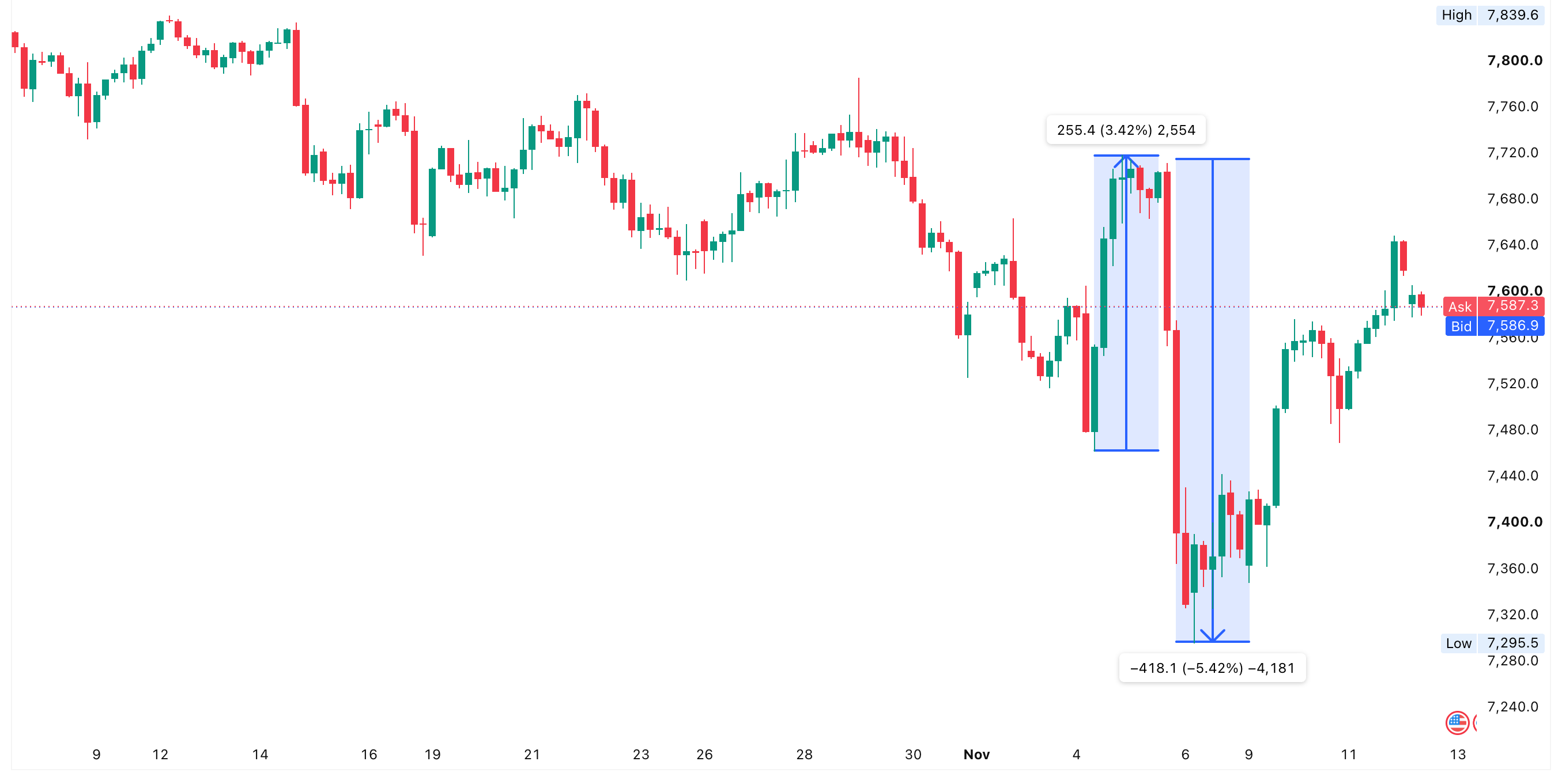
Several factors contributed to the stronger-than-expected performance, beginning with reduced political uncertainty as investors gained greater clarity over Washington’s future balance of power. Divided government also raised expectations that major legislative changes could become more difficult to implement, potentially improving policy predictability for businesses. This relationship between politics and financial markets is also reflected in the broader US presidential election cycle and its historical stock market patterns, although previous trends do not guarantee similar outcomes.
Another important development was the sharp decline in energy prices, with Brent crude falling 8.7% to $94.62 per barrel amid growing optimism about a possible reduction in hostilities involving Iran. Lower energy costs can ease inflationary pressure, improve household purchasing power and reduce operating expenses for businesses, while declining Treasury yields generally provide additional support for equity valuations.
The relationship between interest rates and stock valuations is particularly important, as movements in US 10-year Treasury yields influence borrowing costs and the discount rates used to value future corporate earnings.
However, the rally was uneven across sectors, suggesting investors were already reassessing the potential winners and losers of the new political landscape rather than interpreting the Democratic victory as universally positive for US stocks.
Why Did Technology and AI Stocks Fall After the Election?
Despite the initial rally, US equities reversed sharply on November 5 as investors reassessed the potential impact of Democratic policies on the technology sector. The S&P 500 declined 3.2%, while the Nasdaq Composite plunged 4.9%, with Nvidia falling 6.3%, AMD losing 13.1% and CoreWeave declining 10%.
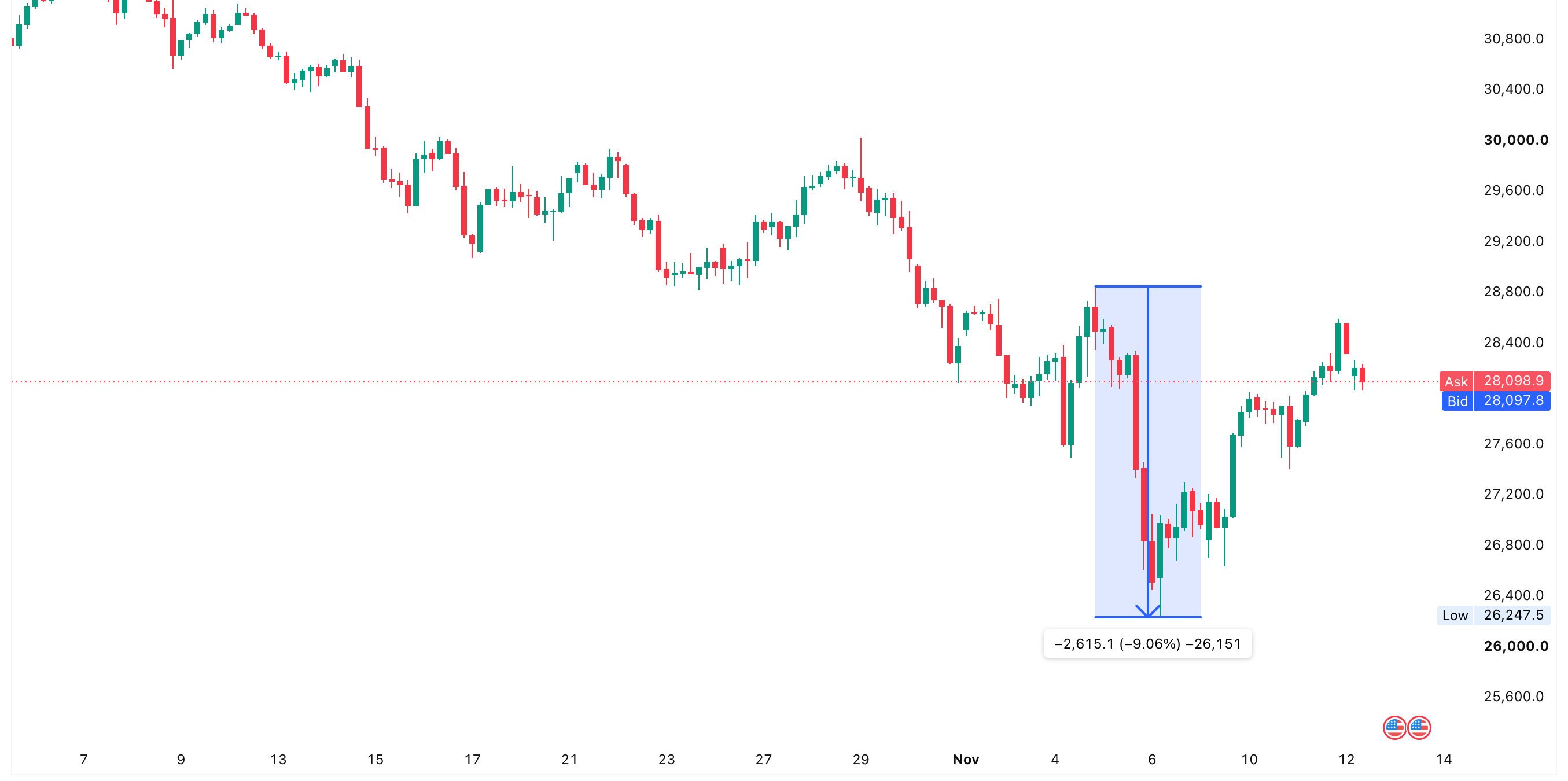
The sell-off reflected growing concerns surrounding the profitability and sustainability of the artificial intelligence investment boom, particularly as major technology companies have committed substantial capital to data centres, semiconductor infrastructure and computing capacity. These developments have also intensified the debate over whether an AI bubble is forming in the stock market, especially as investors increasingly question whether aggressive spending can translate into sustainable earnings growth.
Democratic proposals involving tighter environmental regulations, restrictions on data-centre construction and potential changes to corporate subsidies introduced additional uncertainty over the cost and pace of future AI infrastructure expansion. These concerns emerged at a time when investors were already questioning whether rising capital expenditure could generate sufficient long-term returns.
Disappointing corporate earnings further weakened sentiment, with Qualcomm shares falling 9.5% following weaker-than-expected smartphone chip revenue. Although the company’s performance was unrelated to the election, it intensified existing pressure across semiconductor stocks.
Nevertheless, the implications of tighter regulation may differ considerably between companies. While highly leveraged infrastructure operators could struggle with rising costs and project delays, financially stronger technology companies may be better positioned to maintain investment discipline without significantly compromising their long-term AI strategies.
The election may therefore reshape the pace and distribution of AI investment rather than necessarily ending the industry’s expansion.
What Does the Democratic Victory Mean for Inflation and Economic Growth?
Affordability was a central issue throughout the midterm elections, with Democrats prioritising measures aimed at reducing financial pressure on American households. Proposed initiatives include restoring Affordable Care Act subsidies, reversing Medicaid spending cuts and strengthening financial support for lower-income consumers.
These policies could provide targeted relief to households whose disposable incomes have been squeezed by rising living costs, potentially supporting consumer spending and broader economic activity. However, their effectiveness would depend heavily on how the programmes are financed, as additional government spending without corresponding revenue increases could contribute to higher federal borrowing.
Democrats may also pursue higher taxes on corporations and wealthy households to finance their proposals, although such measures could face significant political resistance and potentially influence private-sector investment decisions.
For the Federal Reserve, the election does not change its responsibility for maintaining price stability and supporting maximum employment. Nevertheless, changes in tariff policy, government spending and energy prices could influence the inflation outlook, which in turn would affect expectations surrounding future US interest rates.
Investors seeking to understand this relationship can examine how interest rate expectations influence financial markets, particularly as changes in monetary policy expectations can influence currencies, equities and bond yields simultaneously.
Could the 2027 US Debt Ceiling Become the Next Major Market Risk?
Beyond the immediate election reaction, investors face an increasingly important fiscal challenge as Washington approaches another round of government funding and debt-ceiling negotiations.
With the US fiscal deficit for 2026 estimated at approximately $2 trillion, concerns surrounding government borrowing remain significant. The first major test will arrive on December 11, 2026, when temporary government funding authority expires, potentially forcing both parties into negotiations over a spending extension.
A larger confrontation could emerge in 2027 as the government approaches its statutory debt ceiling. According to the Bipartisan Policy Center’s projections cited in the underlying analysis, borrowing constraints could become increasingly significant during the year, although Treasury cash management and extraordinary measures may influence the timing.
A timely bipartisan agreement could reassure investors and support financial stability. Conversely, prolonged negotiations could increase uncertainty around US government borrowing, place pressure on Treasury markets and contribute to volatility across equities, currencies and other financial instruments.
These concerns are especially relevant to the relationship between Treasury borrowing and bond yields, as changes in government debt issuance, interest rate expectations and investor demand can influence the cost of financing the federal deficit.
How Could the Election Affect Oil Prices and Global Markets?
Foreign policy remains another important variable, particularly given the economic consequences of the conflict involving Iran. Although Democrats may intensify congressional scrutiny of military spending and push for diplomatic negotiations, the president retains substantial authority over foreign-policy decisions.
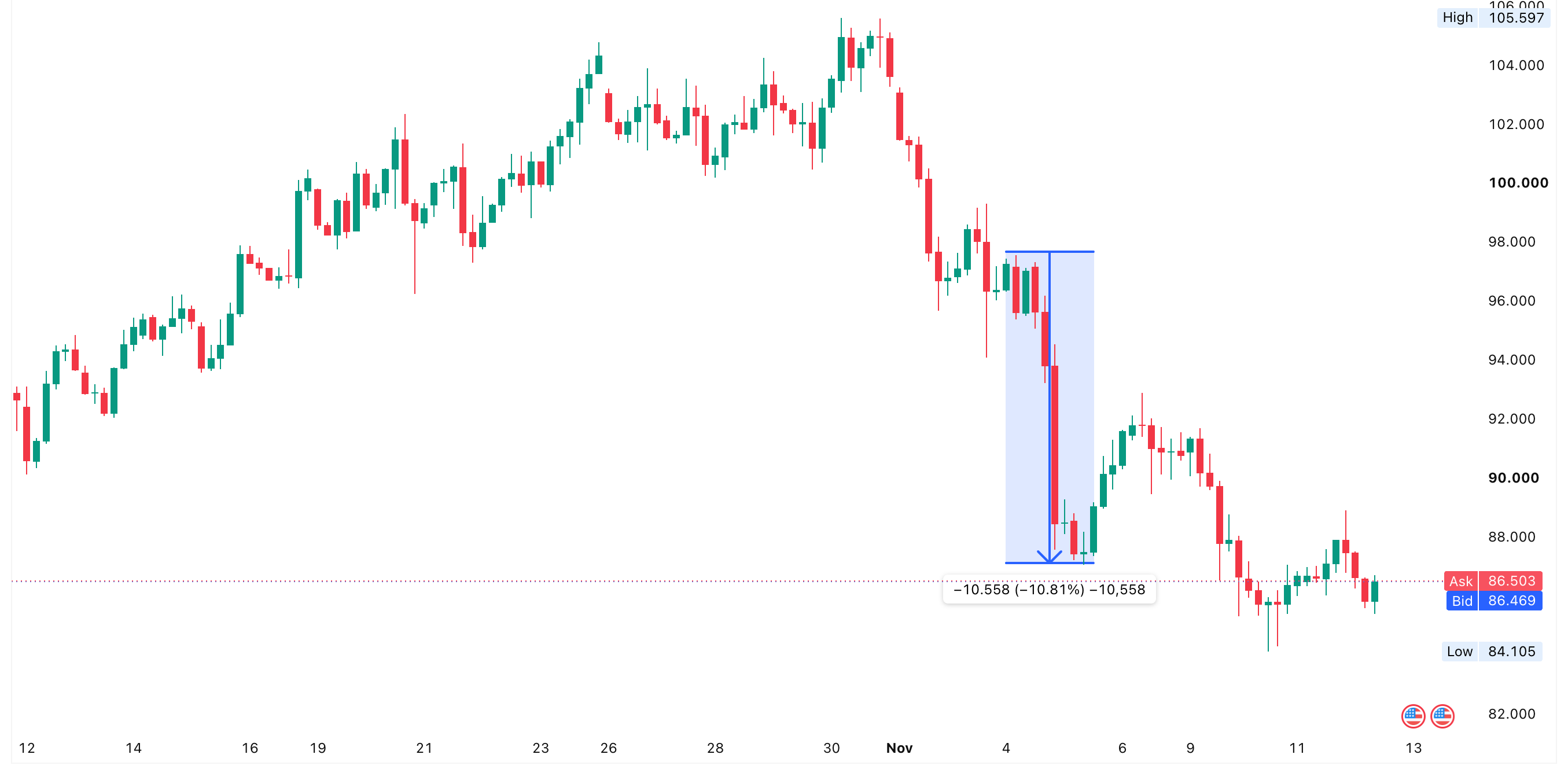
Any sustained reduction in regional hostilities could improve confidence in energy supplies passing through the Strait of Hormuz, potentially easing oil prices and reducing inflationary pressure on energy-importing economies. The relationship between geopolitical developments and energy markets is particularly relevant when examining how US elections can influence oil prices, as changing expectations surrounding foreign policy can affect supply risks and market sentiment.
For global financial markets, developments in the conflict could influence Brent crude, US Treasury yields, the US dollar and gold. Investors may also monitor how US elections affect the dollar worldwide, particularly when political uncertainty changes expectations for economic growth, capital flows and Federal Reserve policy.
Gold could become another important market to watch, as changes in Treasury yields, geopolitical risks and currency expectations may influence safe-haven demand. However, the relationship is not always straightforward, and understanding why gold prices can fall during geopolitical crises can help explain why precious metals do not necessarily rise during every period of uncertainty.
What Should Investors Watch Following the US Midterm Elections?
The Democratic victory has introduced a new set of economic uncertainties that extend well beyond the immediate stock market reaction. While divided government could limit major policy changes and provide some degree of predictability, disagreements over tariffs, government spending and regulation may continue influencing investor sentiment.
Attention will increasingly shift towards US inflation and employment data, corporate earnings, AI investment trends and the upcoming government funding negotiations. Developments involving Iran and the 2027 debt ceiling will also remain important considerations for the outlook.
Beyond equities, the election’s implications for gold prices and Bitcoin deserve attention, particularly as political uncertainty, changing risk appetite and monetary policy expectations may influence demand for alternative assets.
Ultimately, the election’s economic impact is unlikely to be uniformly positive or negative. Instead, differences in sector exposure, corporate financial strength and sensitivity to government policy could become increasingly important in determining how individual businesses and financial markets perform.
For traders and investors, understanding how political developments interact with inflation, interest rates and corporate earnings will be essential when assessing opportunities and risks in the changing US economic landscape.
Frequently Asked Questions (FAQ)
- How will the Democratic victory in the 2026 midterm elections affect the US economy?
The Democratic victory could influence the US economy through changes in fiscal policy, trade regulations and government spending priorities. With Democrats controlling both chambers of Congress, greater scrutiny of President Trump’s economic policies is expected, particularly regarding tariffs, healthcare funding and technology regulation. However, divided government may limit major legislative changes, meaning the overall economic impact will depend on bipartisan negotiations and existing economic conditions.
- Will Democrats remove Trump’s tariffs after winning Congress?
Democrats may attempt to reduce or challenge certain tariffs, but a complete reversal is unlikely because President Trump retains significant executive authority over trade policy. Instead, selective tariff reductions affecting consumer goods, industrial materials or specific trading partners may emerge through negotiations. Such changes could lower costs for import-dependent businesses and ease consumer price pressures, although the eventual impact would depend on which tariffs are adjusted.
- Why did US stocks fall after initially rallying following the midterm elections?
US stocks initially rallied as investors welcomed greater political clarity and expectations of policy stability under a divided government. However, the optimism faded as concerns surrounding artificial intelligence valuations, potential technology regulations and corporate earnings triggered selling pressure. The reversal demonstrated that political developments were only one of several factors influencing market sentiment, particularly within the technology sector.
- How could the Democratic victory affect inflation and Federal Reserve interest rates?
Democratic proposals involving tariff reductions and greater household financial support could influence inflation and consumer spending, although their effects would depend on implementation and funding. Lower tariffs and energy prices may ease certain price pressures, while additional government spending could support demand and potentially complicate inflation management. The Federal Reserve will continue setting interest rates according to economic data, particularly inflation and employment conditions, rather than election results alone.
- Which US stock market sectors could benefit from Democratic control of Congress?
Healthcare, consumer discretionary and selected clean-energy businesses could benefit from expectations of more supportive policies under a Democratic Congress. Meanwhile, AI infrastructure operators, semiconductor manufacturers and industries exposed to regulatory changes may face additional uncertainty. However, political expectations do not guarantee stronger or weaker stock performance, as corporate earnings, valuations and broader economic conditions remain important drivers of market returns.
- What are the biggest economic risks following the 2026 US midterm elections?
The main risks include prolonged government funding negotiations, potential disputes over the 2027 debt ceiling, uncertainty surrounding trade policy and tighter regulation of AI infrastructure. Developments involving Iran could also influence global energy prices and inflation expectations. Investors will therefore need to monitor fiscal negotiations, Federal Reserve policy, corporate earnings and geopolitical developments to understand how the changing political environment may affect financial markets.



