





Key Takeaways
- Swing trading sits between day trading and long-term investing, with traders holding positions for days or weeks to capture short term price swings.
- Swing traders rely on technical analysis — including moving averages, the relative strength index, and chart patterns — to identify entry and exit points.
- Core swing trading strategies include breakout trading, trend trading, support and resistance plays, and Fibonacci retracement setups.
- Risk management is non-negotiable: position sizing and stop-loss placement protect open position capital from sudden overnight risk.
- A demo account lets you practise and refine your swing trading strategies without risking real money.
The Dirty Little Secret Wall Street Doesn’t Want You to Know About Swing Trading
If you have ever glanced at a price chart and thought, “That move was predictable — why didn’t I catch it?” — swing trading might be exactly what you have been missing. It is not day trading, and it is not the slow patience game of long term investors. It sits squarely in the middle: a trading style that captures meaningful price movements over days or weeks, without demanding you stare at a screen every minute of the trading day.
In 2026, retail participation in financial markets continues its upward climb. According to data from the World Federation of Exchanges, retail investors now account for over 25% of equity trading volume in many developed stock markets — up from roughly 15% in 2019. More importantly, a growing share of those retail participants identify as active tactical traders rather than passive holders. That is the world swing traders live in, and the opportunity has never been more visible.
This guide breaks down exactly what swing trading is, how it works, which strategies experienced swing traders use, and how to approach it with discipline and confidence.
What Is Swing Trading?
Swing trading is a trading strategy where a trader holds a position — either a long position or a short position — for anywhere from just a few days to several weeks. The goal is to capture a “swing” in price: one directional move within a larger market trends context, whether that is a bullish trend pushing prices higher or a bearish trend pulling them lower.
Unlike day traders, who open and close every trade within a single trading day, swing traders accept overnight risk in exchange for larger potential price movements. Unlike long term investors, who may hold for years, swing traders focus on medium-term price action and use technical indicators to time their entry and exit points with precision.
The core premise is elegantly simple: markets do not move in a straight line. Even within a strong trend, price moves in waves — it surges, pulls back, consolidates, then surges again. Swing trading work revolves around identifying those waves and riding them.
How Does Swing Trading Work?
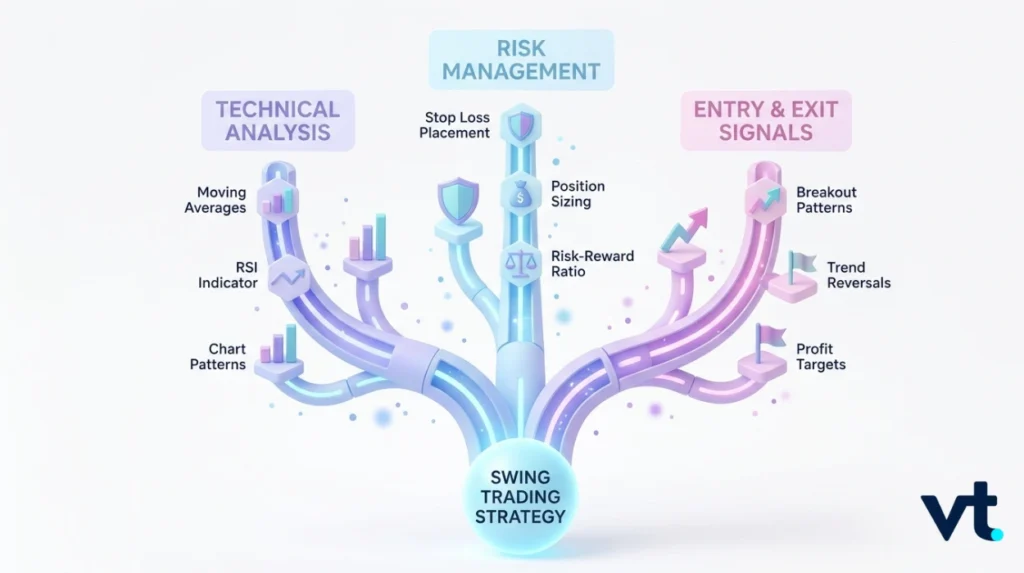
At its heart, swing trading works by combining technical analysis with a clear framework for trade entry and exit. Here is the typical flow:
- Identify the overall trend — Is the market in a bullish trend, a bearish trend, or choppy sideways territory? Knowing the longer term trend provides context for every trade.
- Wait for a swing setup — Within the trend, the trader looks for a pullback, breakout, or consolidation that signals the next directional move.
- Enter the trade — A trade entry is made when technical indicators confirm the setup. This could be a moving averages crossover, a bounce off a support and resistance level, or a momentum indicator signal.
- Set exit points — Before entering, the trader defines both a profit target and a stop-loss. These pre-defined exit points remove emotion from the decision.
- Monitor and exit — Positions are typically held for days or weeks, with the trader monitoring price movements and adjusting stops if needed.
One key distinction: swing traders rely far less on fundamental analysis (earnings, balance sheets, macroeconomic data) and far more on price chart reading. The question is not “Is this company a good business?” but rather “Is this price likely to move in my favour over the next one to two weeks?”
Swing Trading vs. Day Trading: What Is the Difference?
It is worth clarifying how swing trading differs from day trading, since many newcomers conflate the two.
| Feature | Swing Trading | Day Trading |
|---|---|---|
| Holding period | Days or weeks | Within a single trading day |
| Trading frequency | Lower (a few trades per week) | High (multiple trades per day) |
| Overnight risk | Yes | No |
| Time commitment | Moderate (analysis after hours) | Full-time screen monitoring |
| Capital requirements | Flexible | Often requires significant capital minimums |
| Stress level | Generally slower pace | High intensity |
| Primary tools | Technical indicators, chart patterns | Level 2 quotes, trading signals, order flow |
Day traders must be glued to their screens. Swing traders, by contrast, can conduct their analysis in the evening, place orders, and check in periodically. This slower pace makes swing trading particularly attractive for those who trade alongside other professional or personal commitments.
That said, it is worth noting that transaction costs accumulate over time regardless of trading style — always account for spreads and commissions when calculating expected returns.
Key Swing Trading Strategies Every Trader Should Know
Experienced swing traders do not rely on guesswork. They use systematic, repeatable swing trading strategies to identify trading opportunities with a defined risk-reward profile. Below are the most widely used approaches.
1. Breakout Trading
Breakout trading involves entering a trade when price moves decisively above a resistance line or below a key support level, accompanied by strong trading volume. The theory: when price breaks out of a consolidation zone, it often continues in the breakout direction as trapped traders scramble to cover their positions.
A swing trading example: a stock has been trading between $48 and $52 for three weeks. Trading volume surges and price closes at $53.50. A breakout trader enters a long position, targeting a move to $58–$60 based on the measured move technique, with a stop-loss just below $52.
2. Trend Trading (Riding the Swing)
Trend trading means aligning with the trend’s momentum and entering during pullbacks within a larger upward and downward trends context. Swing traders focus on buying dips in an uptrend and short sell rallies in a downtrend.
Moving averages are the primary tool here. Many swing traders use the 20-day and 50-day moving averages — or the exponential moving average — to define the overall trend and identify pullback entry zones.
3. Support and Resistance Reversals
Support and resistance levels are price zones where buying or selling pressure has historically been significant. Swing traders look for price to bounce off these zones, confirmed by candlestick patterns or a momentum indicator reading.
For instance, in a bullish trend, a trader might wait for price to retrace to the 50-day moving average (acting as dynamic support), then enter a long position when a reversal candlestick appears.
4. Breakout from Chart Patterns
Chart patterns — including head and shoulders, flags, pennants, and cup-and-handle formations — signal potential price changes with measurable targets. Swing traders monitor these patterns across multiple timeframes to identify opportunities where the pattern aligns with the larger market trends.
5. Fibonacci Retracement Levels
Fibonacci retracement is a popular tool that identifies potential reversal zones at mathematically derived levels (23.6%, 38.2%, 50%, 61.8%) within a prior price swing. Swing traders often combine Fibonacci retracement with support and resistance and candlestick confirmation to fine-tune their trade entry.
Technical Indicators Swing Traders Use Most
Swing traders rely on a core toolkit of technical indicators to read price movements and time entry and exit points. Here are the most commonly used:
Moving Averages
Moving averages smooth out price data to reveal the underlying trend direction. The 20-day, 50-day, and 200-day moving averages are standard reference points. When a shorter average crosses above a longer one, it may signal a bullish trend; the reverse may indicate a bearish trend.
Relative Strength Index (RSI)
The relative strength index is a momentum indicator that measures whether a market is overbought or oversold on a scale of 0 to 100. An RSI above 70 often indicates overbought conditions; below 30 suggests oversold. Many swing traders use RSI divergence — where price makes a new high but RSI does not — as an early warning of a potential reversal.
Stochastic Oscillator
The stochastic oscillator compares a closing price to its price range over a set period, generating high value and low value signals. It works particularly well in range-bound markets, helping swing traders identify when price is approaching an extreme (high value or low value) and likely to reverse.
Average True Range (ATR)
The average value of true range measures market volatility. Swing traders use ATR to size their stop-loss appropriately — placing stops a multiple of ATR away from entry to give the trade room to breathe without risking excessive capital.
Swing Trading Strategies: Putting It All Together
Successful swing trading is not about using one tool in isolation. It is about convergence — when multiple technical indicators and chart patterns agree, confidence in the trade setup increases.
A practical checklist for a long position swing setup:
- ✅ Price is above the 50-day moving average (bullish trend confirmed)
- ✅ Price has pulled back to a key support and resistance zone
- ✅ Relative strength index is between 40–50 (not overbought, in a bullish trend reset zone)
- ✅ Stochastic oscillator is in low value territory and turning upward
- ✅ A bullish reversal candlestick (pin bar or engulfing) has formed
- ✅ Risk-reward ratio is at least 2:1 based on defined exit points
When all these elements align, many swing traders would consider this a high-probability setup. Conversely, they would reduce position size or pass entirely when signals conflict.
Risk Management in Swing Trading: Your Most Important Edge
Take note: no trading strategy works 100% of the time. Risk management is not optional — it is the foundation of every successful swing trading approach.
Key principles:
- Define downside risk before entering. Know your stop-loss level before placing the trade. This protects your open position from runaway losses.
- Position sizing. Never risk more than 1–2% of total trading capital on a single trade. This preserves capital through losing streaks.
- Overnight risk awareness. Reminder: holding positions overnight or over weekends exposes swing traders to gap risk — price may open significantly higher or lower than it closed. Earnings announcements, economic data, and geopolitical events can all cause sharp price movements.
- Do not over-leverage. Leverage amplifies both gains and losses. Precaution: ensure your leverage level is appropriate for your experience and risk tolerance.
- Keep transaction costs in mind. Higher trading frequency means higher cumulative transaction costs. Always net out costs when evaluating a strategy’s profitability.
Swing Trading Example: A Real-World Scenario
Here is a simplified swing trading example to illustrate how these concepts work together.
Setup: A trader is monitoring a technology stock. The longer-term trend is bullish — the price is above the 200-day moving average. The stock has pulled back for five days, retracing to the 38.2% Fibonacci retracement level, which also coincides with a prior resistance line now acting as support.
Entry: The relative strength index reads 42 (not overbought), and the stochastic oscillator has crossed upward from oversold territory. A bullish engulfing candle forms on the daily price chart. The trader enters a long position at $95.
Exit points: Profit target at $104 (the prior swing high), stop-loss at $91.50 (below the support zone). Risk-reward ratio: approximately 2.4:1.
Outcome: Over the next nine days, price rises to $103.80. The trader exits just below target for a solid return — achieved without monitoring intraday price swings or sitting in front of a screen all day.
Who Is Swing Trading Suited For?
Swing trading is not for everyone, but it suits a broad range of traders:
- Busy professionals who cannot monitor screens during a trading day but can dedicate time in the evenings for analysis
- Technically minded individuals who enjoy reading price chart data and identifying patterns
- Those with moderate risk tolerance who are comfortable holding positions for days or weeks
- Traders seeking a middle ground between the frenetic pace of day trading and the passivity of being long-term investors
It is less suited for those who need immediate liquidity, are uncomfortable with overnight risk, or prefer to base investment strategies on fundamental analysis.
Common Mistakes Swing Traders Make
Even experienced traders fall into these traps:
| Mistake | Why It Hurts | How to Avoid It |
|---|---|---|
| Ignoring the overall trend | Trading against a strong trend leads to repeated small losses | Always align with the longer term trend direction |
| Moving stop-losses further away | Hoping a losing trade recovers increases downside risk | Set stops based on technical levels, not emotions |
| Overtrading | High trading frequency inflates transaction costs | Focus only on high-probability setups |
| Neglecting trading volume | Low-volume breakouts often fail | Confirm breakout trading signals with above-average volume |
| Ignoring overnight risk | Earnings gaps or news events can hit stop-losses | Caution: reduce position size ahead of known risk events |
Swing Trading in 2026: What Has Changed?
The landscape for swing traders continues to evolve rapidly. Key developments in 2026:
- Algorithmic market participation has increased, making stock prices more likely to snap back quickly to moving averages — a dynamic that can tighten the window for manual entry.
- Retail tools have democratised access to professional-grade technical analysis. Charting platforms now provide real-time relative strength index, stochastic oscillator, and Fibonacci retracement overlays on mobile devices.
- Volatility conditions in 2026 remain elevated relative to the 2010s average, creating more price swings — and therefore more potential trading opportunities — for disciplined swing traders.
- AI-assisted pattern recognition is becoming mainstream, helping swing traders identify chart patterns and trading signals at scale across multiple instruments.
For swing traders, these shifts mean both more opportunity and more competition. The traders who succeed are those with a clear, rules-based trading strategy, sound risk management, and the patience to wait for setups that genuinely meet their criteria.
Frequently Asked Questions (FAQs)
Q1: How much capital do I need to start swing trading?
There is no universal minimum — it depends on the markets you trade and the instruments available through your broker. However, because swing trading strategies carry overnight risk and require meaningful position sizing to produce worthwhile returns, many experienced practitioners suggest starting with at least $5,000–$10,000 in dedicated risk capital. Always begin with a demo account to test your approach before committing real funds.
Q2: Is swing trading more profitable than day trading?
Neither trading style is inherently “more profitable” — profitability depends on execution, discipline, and market conditions. Day traders can generate returns from smaller price movements through high trading frequency, while swing traders aim for larger moves per trade at a slower pace. Swing trading typically involves lower transaction costs per week and is generally considered more accessible for part-time traders.
Q3: What is the best timeframe for swing trading?
Most swing traders primarily use daily charts for identifying setups and confirming the overall trend, then may drop to the 4-hour or 1-hour chart to refine their trade entry. The daily chart provides enough data to identify meaningful price swings while filtering out the noise found on shorter timeframes.
Q4: Can swing trading strategies be used in Forex and commodities, not just stocks?
Absolutely. Swing trading is a trading style, not an asset-class-specific approach. The same principles — identifying entry and exit points using technical indicators, aligning with the longer term trend, managing downside risk — apply equally to Forex pairs, commodities, indices, and other financial markets instruments. Many swing traders actually prefer Forex for its 24-hour liquidity and tight spreads.
Start Your Swing Trading Journey With VT Markets
Swing trading performs best when supported by fast execution, reliable market access, and powerful analytical tools. VT Markets provides a trading environment built for active, tactical strategies — offering advanced charting, real-time technical indicators, stable connectivity, and full support for both manual and automated trading on MT4 and MT5.
If you are not yet ready for the live market, you can practise and refine your swing trading strategies using the VT Markets demo account. This lets you test different swing trading strategies – breakout trading setups, support and resistance plays, Fibonacci retracement entries – with confidence before transitioning to real capital. For additional guidance, the VT Markets Help Centre provides clear resources and support at every stage of your trading journey.
Create your account today and start exploring the full range of swing trading opportunities across global financial markets — equipping yourself with the skills, tools, and discipline to trade with intention.








