





Chart Patterns: The Complete Guide to Reading Market Signals
Key Takeaways
- Chart patterns are visual formations created by price movements that help traders predict future market behaviour with success rates exceeding 70% for certain patterns
- Three main categories exist: continuation patterns (flags, pennants), reversal patterns (head and shoulders, double tops), and bilateral patterns (symmetrical triangles)
- Volume confirmation is essential for validating pattern breakouts and distinguishing genuine signals from false breakouts
- Proper risk management, including 2% maximum risk per trade and strategic stop-loss placement, separates successful pattern traders from unsuccessful ones
- Higher timeframes (daily and weekly charts) produce more reliable patterns than intraday charts due to reduced market noise
- Modern AI-powered tools and automated scanners enhance pattern recognition, but combining technology with manual analysis yields optimal results
- Market context significantly impacts pattern reliability—bull markets favour bullish patterns whilst bear markets increase bearish pattern success rates
Understanding Chart Patterns in Modern Markets
Chart patterns represent one of the most powerful analytical tools available to traders and investors across global financial markets. These visual formations, created by price action on trading charts, offer systematic approaches to understanding market behaviour and anticipating future price movements. Whether you’re analysing equities on the Toronto Stock Exchange, forex pairs, or cryptocurrency markets, mastering pattern recognition can significantly enhance your trading decisions.
According to research by Thomas Bulkowski, certain chart patterns demonstrate success rates exceeding 70%, making them invaluable additions to any trading strategy. At VT Markets, we’ve observed that traders who properly identify and trade these patterns consistently outperform those relying solely on fundamental analysis or gut instinct.
What Are Chart Patterns?
Chart patterns are visual formations that emerge when prices consolidate within specific boundaries before breaking out in a particular direction. These formations appear when buyers and sellers reach equilibrium points during consolidation periods, creating recognisable geometric shapes on price charts.
At their core, patterns form during phases when the market tests support and resistance levels repeatedly. These serve as essential tools in technical analysis for predicting future market behaviour, helping traders identify when a trend might continue or reverse direction.
Universal Application Across Markets
Chart patterns work across all financial markets—stocks, forex, crypto, and commodities—making them universally applicable regardless of asset class. A symmetrical triangle pattern on an equity chart follows identical principles as one on a currency pair or cryptocurrency, demonstrating the universal nature of market psychology.
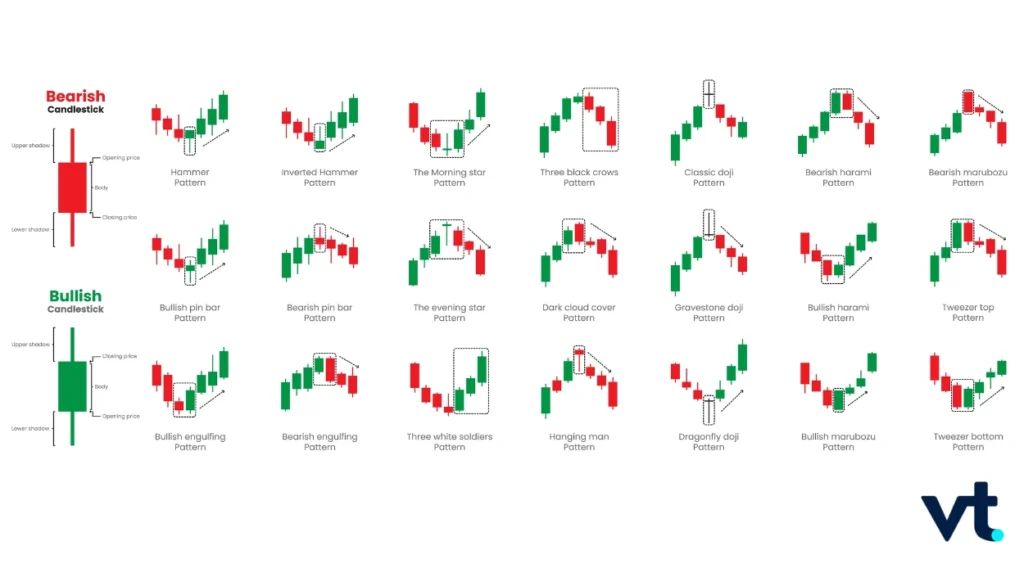
The Psychology Behind Chart Patterns
Chart patterns reflect collective market psychology and investor sentiment at key price levels. Every pattern tells a story about trader emotions—whether participants are optimistic about future prospects or concerned about potential downturns.
These formations reveal the ongoing battle between bulls (buyers) and bears (sellers) as they compete for control of price direction. When bulls dominate, prices form bullish continuation or reversal patterns. Conversely, bear control produces bearish patterns and downward-trending formations.
| Market Phase | Characteristics | Pattern Types |
|---|---|---|
| Accumulation | Institutional buying, low volume | Continuation patterns, bullish reversals |
| Distribution | Institutional selling, high volume at tops | Bearish reversals, distribution patterns |
| Trending | Clear directional movement | Continuation patterns dominate |
| Consolidation | Indecision, converging price ranges | Bilateral patterns, triangles |
The reason patterns repeat consistently across different markets and timeframes is that human psychology remains constant. Fear, greed, hope, and panic drive market participants to react predictably when facing similar circumstances.
Types of Chart Patterns
Chart patterns fall into three main categories based on their implications for future price movements: continuation patterns, reversal patterns, and bilateral patterns.
Continuation Patterns
Continuation patterns signal that the current trend will resume after a brief consolidation, providing traders with opportunities to enter existing trends at favourable prices. Common formations include:
- Flags: Rectangular consolidations with parallel support and resistance lines sloping against the prevailing trend
- Pennants: Small symmetrical triangles with converging trend lines following significant price moves
- Wedges: Converging trend lines that slope in the same direction
- Ascending triangles: Horizontal resistance with rising support
- Rectangular patterns: Horizontal support and resistance boundaries
Volume typically decreases during formation and increases on breakout, providing important confirmation of the pattern’s validity. These patterns provide high-probability trade setups when properly identified, often offering favourable risk-reward ratios.
Reversal Patterns
Reversal patterns indicate a change in prevailing trend direction from bullish to bearish or vice versa. Major reversal patterns include:
- Head and shoulders: Three peaks with the middle peak (head) higher than two shoulders
- Double tops and bottoms: Two similar peaks or troughs at key support/resistance levels
- Triple tops and bottoms: Three similar peaks or troughs signal strong trend exhaustion.
Reversal patterns take longer to develop than continuation patterns, often requiring weeks to months for completion on daily charts. These patterns require strong volume confirmation at the breakout to validate the reversal.
Bilateral Patterns
Bilateral patterns show market indecision with potential breakouts in either direction. Common bilateral patterns include symmetrical triangles, diamonds, and some rectangular formations. The breakout direction often follows the prevailing longer-term trend, though the outcome isn’t guaranteed.
Essential Chart Patterns Every Trader Should Know
Head and Shoulders Pattern
The head and shoulders pattern stands as the most reliable bearish reversal pattern, featuring three distinct peaks: left shoulder, head (highest point), and right shoulder. This formation typically develops at trend ends when buying momentum weakens.
The neckline connects the two troughs between shoulders and head, serving as the critical support level that must be broken to confirm the pattern. Price breaks below the neckline with increased volume to confirm the bearish reversal.
Price Target Calculation: The distance from head to neckline projected downward from the breakout point. For example, if the head reaches £50 and the neckline sits at £45, the minimum target would be £40.
The inverse head and shoulders works identically but signals a bullish reversal, forming at market bottoms instead of tops.
Double Top and Double Bottom
Double tops and bottoms represent reliable reversal patterns signalling trend changes at key support and resistance levels. The double top resembles an “M” shape, signalling bearish reversal, whilst the double bottom resembles a “W” shape, indicating bullish reversal.
For valid double tops, both peaks should reach similar price levels, typically within 3-5% of each other. The pattern requires a minimum 10% decline between the two peaks to ensure sufficient separation.
Key Volume Indicator: Volume typically decreases on the second peak compared to the first, confirming weakness in the prevailing trend.
Triangular Patterns
Triangular patterns represent some of the most common and reliable formations in technical analysis. These patterns form when price action creates converging trend lines that gradually narrow the trading range.
| Triangle Type | Characteristics | Typical Outcome |
|---|---|---|
| Ascending | Horizontal resistance, rising support | Bullish continuation (75% success) |
| Descending | Horizontal support, falling resistance | Bearish continuation (75% success) |
| Symmetrical | Converging trend lines | Follows existing trend (65% success) |
Volume decreases as triangles form and increases significantly on breakout. Breakouts usually occur in the final third of the triangle formation, between 50% and 75% of the distance from base to apex.
Cup and Handle Pattern
The cup and handle pattern represents a reliable bullish continuation pattern resembling a coffee cup with a handle. Popularised by William O’Neil, this formation proves particularly effective in identifying securities poised for significant upward moves.
The cup forms a rounded bottom over 7 to 65 weeks, showing gradual accumulation. The decline should be between 15% and 50% from the prior high. The handle forms as a brief pullback (typically 10-15%), creating a flag or pennant shape on the cup’s right side.
Volume decreases during cup formation and handle development, then increases dramatically on breakout above the handle’s resistance.
Flags and Pennants
Flags and pennants represent short-term continuation patterns following strong price movements. These patterns typically develop after sharp moves (the flagpole) and provide brief consolidation before trend resumption.
Both patterns typically last 1-3 weeks and slope against the prevailing trend. Volume decreases during formation and surges on breakout in the trend direction. These patterns rank amongst the most reliable continuation patterns, with success rates above 80% when properly identified.
How to Identify Chart Patterns
Drawing Trendlines and Support/Resistance
Drawing accurate trendlines forms the foundation of pattern recognition. Proper line drawing separates valid patterns from random price formations.
Key Guidelines:
- Connect at least three significant highs or lows to draw valid trendlines
- Use closing prices rather than wicks for more reliable trendlines on daily charts
- Support levels form by connecting ascending lows in uptrends
- Resistance lines are created by connecting descending highs in downtrends
- Multiple touches of trend lines increase their significance and reliability
Horizontal support and resistance at previous significant price levels often prove more reliable than angled trendlines. Round numbers, previous highs and lows, and psychological levels frequently serve as strong horizontal areas.
Volume Analysis
Volume analysis provides crucial confirmation for chart pattern validity, helping traders distinguish between genuine breakouts and false signals.
Volume Behaviour Guidelines:
- Volume typically decreases during pattern formation as uncertainty increases
- Breakout volume should be 50% above average volume for confirmation
- Declining volume on pullbacks within patterns suggests continuation
- Exhaustion patterns often show climactic volume at turning points
- Volume-price divergence provides early warning of pattern failure
At VT Markets, we emphasise that specific volume indicators, like on-balance volume (OBV) and volume moving averages, provide additional confirmation tools beyond simple volume analysis.
Timeframe Considerations
Timeframe selection significantly impacts pattern reliability and trading success. Higher timeframes such as daily and weekly charts produce more reliable patterns due to increased statistical significance and reduced market noise.
| Timeframe | Reliability | Best Use Case |
|---|---|---|
| Weekly | Highest | Major trend identification, long-term investing |
| Daily | High | Swing trading, position trading |
| 4-Hour | Moderate | Active trading, balanced reliability |
| Hourly | Lower | Day trading, short-term opportunities |
Pattern significance increases with formation time—longer development periods typically lead to more substantial and sustained moves upon completion.
Trading Chart Patterns Effectively
Entry Strategies
Choosing the right entry strategy significantly impacts overall profitability. Different entry methods suit different market conditions and trader personalities.
Breakout Entry: Entering when the price closes beyond the pattern boundary with confirming volume provides clear signals but potentially higher entry prices.
Pullback Entry: Waiting for a retest of the broken trendline offers better entry prices but requires additional patience. After the initial breakout, price often returns to test the broken level from the opposite side.
Early Entry: Entering within pattern boundaries in anticipation of eventual breakout offers excellent entry prices but a higher risk of pattern failure.
Confirmation Entry: Waiting for sustained movement beyond pattern boundaries for higher probability trades, sacrificing some profit potential for increased reliability.
Risk Management
Proper risk management forms the cornerstone of successful pattern trading. Without effective risk controls, even accurate pattern recognition cannot ensure long-term profitability.
Essential Risk Management Rules:
- Stop-loss placement typically occurs below support for long trades and above resistance for short trades
- Risk no more than 2% of total account value per trade regardless of pattern strength
- Position sizing calculations based on distance to stop loss and predetermined risk amount
- Trailing stops help protect profits as patterns develop favourably
- Pattern failure recognition requires quick exit strategies when formations don’t develop as expected
Price Targets and Profit Taking
Setting realistic price targets and implementing systematic profit-taking strategies maximise potential from successful pattern trades.
The measure rule provides minimum price targets by projecting pattern height from the breakout point. Fibonacci extensions provide additional target levels beyond measured moves, using mathematical relationships to identify potential reversal points.
Profit-Taking Strategies:
- Previous support and resistance levels act as natural profit-taking zones
- Scaling out of positions allows locking in profits whilst maintaining trend exposure
- Psychological price levels such as round numbers often provide resistance
- Target achievement requires patience—markets rarely move in straight lines
Common Chart Pattern Mistakes
Pattern Recognition Errors
Identifying patterns that don’t actually exist represents one of the most costly mistakes. This phenomenon, known as apophenia, leads traders to see meaningful patterns in normal price fluctuations lacking statistical significance.
Common errors include:
- Trading on timeframes too short for reliable pattern analysis
- Forcing patterns to fit when market conditions don’t support them
- Ignoring volume confirmation when patterns break out
- Over-analysing and creating complex patterns where simple interpretations would be more accurate
Execution and Management Mistakes
Placing stops too close to entry points results in premature exits from trades that would ultimately prove profitable. Stops should account for typical price movement within pattern boundaries.
Not waiting for pattern completion before entering trades increases the probability of trading false signals. Over-leveraging positions because patterns appear certain ignores the reality that even the most reliable patterns fail approximately 20-30% of the time.
Advanced Pattern Recognition Tools
Automated Pattern Scanning
Pattern scanning software available on major trading platforms like TradingView offers comprehensive pattern recognition across multiple markets and timeframes simultaneously. These tools can monitor thousands of securities, alerting traders when specific pattern criteria are met.
Modern pattern recognition scanners can identify dozens of different pattern types, from simple support and resistance breaks to complex formations. Automated alerts for pattern completion across multiple markets ensure traders never miss potential opportunities.
Artificial Intelligence and Machine Learning
AI-powered pattern recognition tools utilise machine learning capabilities to identify patterns with greater accuracy and consistency than traditional rule-based systems. These systems process vast amounts of historical data to identify subtle pattern variations that human analysts might miss.
Machine learning algorithms continuously improve their pattern recognition accuracy by analysing outcomes of previous identifications, learning from both successful and failed pattern predictions.
Benefits of AI Tools:
- Processing vast datasets across global markets simultaneously
- Identifying complex pattern relationships beyond simple geometric formations
- Continuous improvement through adaptive learning
- Backtesting capabilities for strategy validation
- Integration with existing trading platforms
At VT Markets, we recognise that combining manual and automated approaches often produces the best results—using technology for initial screening whilst applying human judgement for final validation.
Pattern Reliability and Market Context
Market Environment Impact
Chart pattern success rates vary significantly based on market conditions. Bull markets strongly favour bullish continuation and reversal patterns, whilst bear markets increase the reliability of bearish patterns.
Sideways or range-bound markets make bilateral patterns more effective whilst reducing the reliability of directional patterns. Volatility levels significantly impact pattern formation and breakout reliability.
Statistical Performance Data
Research by Thomas Bulkowski reveals:
- Head and shoulders patterns achieve approximately 70% success rates
- Double top and bottom patterns demonstrate success rates around 65%
- Flag and pennant patterns achieve success rates exceeding 75%
- Triangle pattern performance varies by type, with ascending triangles showing 75% success rates
- Cup and handle patterns demonstrate success rates around 80% when strict criteria are applied
Optimization Strategies
Combining multiple patterns across different timeframes increases overall success rates by providing additional confirmation. When daily and weekly patterns align, the probability of successful trades typically increases significantly.
Optimisation Approaches:
- Volume confirmation requirements adjusted based on pattern type
- Market regime analysis helps adapt pattern selection to current conditions
- Focus on highest-reliability patterns rather than trading every formation
- Position sizing optimisation based on pattern reliability
- Continuous pattern performance tracking
Frequently Asked Questions
Q1: How long does it take to become proficient at identifying chart patterns?
Most traders require 3-6 months of consistent practice to develop reliable pattern recognition skills. Start by mastering high-probability patterns like head and shoulders, double tops/bottoms, and flags before attempting complex formations. At VT Markets, we recommend analysing at least 100 historical charts across different markets to build pattern recognition muscle memory.
Q2: Can chart patterns be used for day trading, or are they only effective for longer timeframes?
Chart patterns work across all timeframes, but reliability increases with timeframe duration. Daily and weekly charts produce success rates 15-20% higher than hourly charts due to reduced noise. For day trading, focus on 4-hour and hourly patterns whilst ensuring they align with higher timeframe trends for optimal results.
Q3: What’s the most important factor in successful pattern trading—pattern selection, entry timing, or risk management?
Risk management is paramount. Even with perfect pattern identification and optimal entry timing, poor risk management leads to account depletion. The 2% risk rule and proper stop-loss placement protect capital during inevitable losses, allowing traders to remain in the game for winning opportunities.
Q4: Should I rely solely on automated pattern scanners or combine them with manual analysis?
Combining both approaches yields optimal results. Automated scanners excel at processing large datasets and identifying potential patterns across numerous securities. However, manual analysis provides crucial context regarding market conditions, volume characteristics, and overall trend alignment that algorithms may miss. Use scanners for initial screening, then apply human judgement for final trade decisions.
Conclusion
Chart patterns remain a cornerstone of technical analysis because they reflect the unchanging nature of human psychology in financial markets. Whether analysing equity charts, forex movements, or cryptocurrency trading charts, the same psychological forces that created these formations decades ago continue driving market behaviour today.
Success with chart patterns requires patience, practice, and disciplined execution of predetermined trading plans. Start by mastering the most reliable formations like head and shoulders, double tops and bottoms, and flag patterns before attempting more complex setups.
Remember that no pattern works 100% of the time, making risk management and proper position sizing essential components of any pattern-based trading strategy. Focus on quality over quantity—it’s better to wait for high-probability setups with clear confirmation signals than to force trades on marginal patterns.
Consider incorporating pattern recognition scanners and technological tools to enhance your analysis, but maintain a fundamental understanding of why patterns work and what they represent about market psychology. Whether you’re building an investment strategy around long-term patterns or seeking short-term trading opportunities, chart patterns provide a time-tested framework for understanding market behaviour across all financial instruments and timeframes.








