



Key Takeaways
- Polygon is a blockchain network designed to make Ethereum faster and cheaper to use.
- POL is the token that powers Polygon, and it replaced the older MATIC token in 2024.
- The network is used for payments, DeFi, NFTs, gaming, and tokenised real-world assets.
- Polygon’s AggLayer connects different blockchains so they can work together more easily.
- POL can be bought on crypto exchanges, or traded as a CFD through brokers like VT Markets.
Ethereum is one of the most widely used blockchains in the world, supporting thousands of applications across finance, gaming, and digital identity. But its growth has come with a cost. When demand is high, transactions slow down and fees rise, sometimes to the point where small payments are no longer practical. This has been one of the biggest barriers to mainstream blockchain use.
That is where Polygon comes in. Over the past several years, it has become one of the most active networks in crypto, attracting major brands such as Visa, Stripe, and Reddit. Its native token, POL, sits at the centre of this growth.
This guide will explains what Polygon is, how it works, what it is used for, and how traders can start exploring it.
What Is Polygon Crypto?
Polygon is a blockchain network built to make Ethereum more practical for everyday use. The simplest way to picture it is to think of Ethereum as a busy main road. As more cars try to use it, traffic builds up, journeys take longer, and tolls become expensive. Polygon is like a separate, faster road that runs alongside the main one. Most of the traffic moves over to Polygon for the journey, then rejoins the main road at the end to be officially recorded. This setup keeps things moving smoothly while still relying on the security of the main road.
The project started in 2017 under the name Matic Network. It was founded by four developers from India, Jaynti Kanani, Sandeep Nailwal, Anurag Arjun, and Mihailo Bjelic, who recognised early on that Ethereum would struggle to scale as adoption grew. In February 2021, the project rebranded to Polygon. The new name reflected a broader plan, not just a single solution for cheaper transactions, but an entire ecosystem of connected, Ethereum-compatible networks.
Here are the basic details at a glance:
| Detail | Information |
| Launched as | Matic Network (2017) |
| Rebranded to | Polygon (February 2021) |
| Native token | POL (previously MATIC) |
| Type | Layer 2 scaling network |
| Consensus | Proof-of-Stake |
| Main use cases | Payments, DeFi, NFTs, gaming, tokenisation |
| Founders | Jaynti Kanani, Sandeep Nailwal, Anurag Arjun, Mihailo Bjelic |
The native token that powers Polygon is called POL. It is used to pay transaction fees, to secure the network through staking, and to vote on changes to how the network operates.
Matic to Pol: The Token Upgrade
If you have come across Polygon before, you may have seen its token referred to as MATIC. In September 2024, Polygon completed a full token migration, replacing MATIC with a new token called POL.
How the Migration Worked
1. One-for-one exchange
Every MATIC token was swapped for one POL token. The amount of value held by each owner did not change. If a user held 1,000 MATIC before the migration, they held 1,000 POL after it.
2. Near-complete migration
Within months of the launch, almost all MATIC in circulation had been converted to POL. The remaining MATIC sits in unused wallets or on platforms that have yet to process the change.
3. POL is the active token
Every transaction fee, staking reward, and governance vote on Polygon now uses POL. MATIC no longer plays a functional role on the network.
Why the Change Happened
MATIC was built for a single purpose, which was to help scale Ethereum at a time when Polygon operated as just one blockchain. As Polygon grew, its vision expanded to include multiple connected chains and a much wider role across the crypto industry. The old token simply was not designed to support all of that.
POL was created from the start as a more flexible token. It can help secure several chains at once, support activity that moves between chains, and adapt as the network continues to develop.
Polygon vs Ethereum
Polygon and Ethereum are often discussed as if they were rivals, but the relationship is closer to a partnership. Polygon was built specifically to support Ethereum, not to replace it.
Ethereum is what is known as a Layer 1 blockchain, meaning it is a base network that handles its own security and settlement. Every transaction is verified by a large network of validators across the world, which makes it secure but also limits how many transactions can be processed at once.
Polygon is a Layer 2 network, which means it sits on top of Ethereum, handles transactions on a separate chain, and then records the results back to Ethereum. The two networks work as a team rather than as competitors.
| Feature | Ethereum | Polygon |
| Layer type | Layer 1 (base network) | Layer 2 (scaling network) |
| Transaction fees | Can be high during busy periods | Usually a fraction of a cent |
| Speed | Slower block times | Faster block times |
| Security | High, fully independent | Strong, anchored to Ethereum |
| Native token | ETH | POL |
| Best for | Settlement, larger transactions | Everyday use, payments, gaming |
A useful way to think about it is that Ethereum is the foundation, and Polygon is the layer that makes Ethereum practical for daily activity. Most serious crypto activity ends up touching both networks at some point.
How Does Polygon Work?
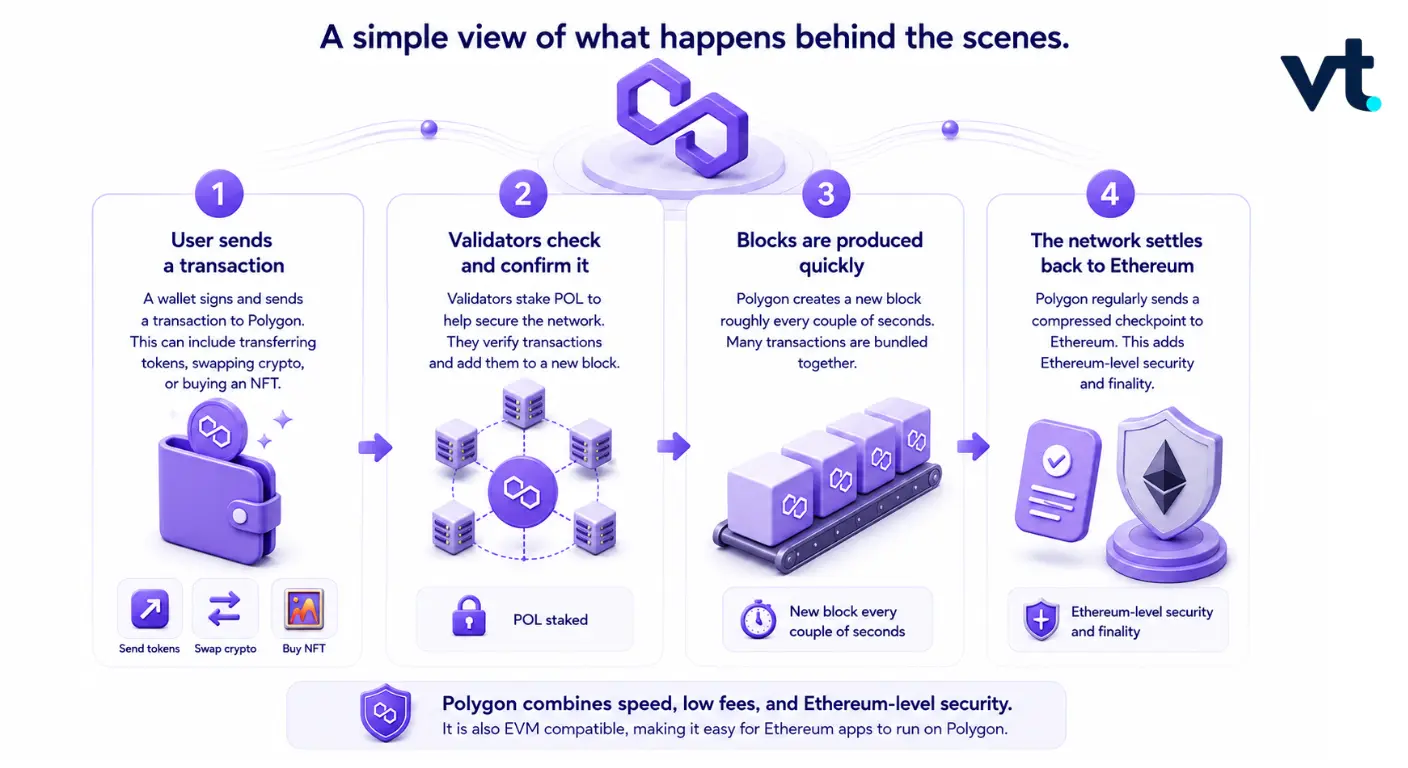
1. The user sends a transaction
This could be transferring tokens, swapping one cryptocurrency for another on a decentralised exchange, or buying an NFT. The transaction is signed by the user’s wallet and sent to the Polygon network.
2. Validators check and confirm the transaction
Validators are participants who help run the network. To become a validator, a person or organisation must stake POL tokens, which means locking them up as a kind of deposit. This deposit gives them a reason to behave honestly, because dishonest behaviour can lead to losing part of their staked tokens. Validators check the transaction and add it to a new block.
3. New blocks are produced quickly
Polygon creates a new block roughly every couple of seconds. Each block contains many transactions bundled together. Because blocks come so frequently, users see their transactions confirmed almost immediately.
4. The network settles back to Ethereum
At regular intervals, Polygon sends a checkpoint to Ethereum. This checkpoint is a compressed summary of all the activity that took place on Polygon during that period. Once it is recorded on Ethereum, that activity inherits Ethereum’s security and cannot easily be reversed.
The combined result is a network where most transactions cost a fraction of a cent and complete within seconds. There is also one more feature worth understanding, which is compatibility.
Polygon uses the same underlying technology as Ethereum, known as the Ethereum Virtual Machine. This means any app built for Ethereum can be deployed on Polygon with very little extra work, and is one of the main reasons Polygon has grown so quickly.
The AggLayer And Polygon 2.0
One of the biggest challenges in crypto today is that different blockchains do not easily communicate with each other. Moving assets from one chain to another usually requires a bridge, which is a separate piece of software that locks tokens on one chain and creates new ones on the other. Bridges have historically been one of the most exploited parts of the crypto industry, with several large hacks causing significant losses over the years.
Polygon’s answer to this problem is the AggLayer, short for Aggregation Layer. It is a system designed to link different blockchains so they can share information and assets more safely. Rather than acting as a bridge between two separate networks, the AggLayer works as a shared coordination layer that many chains can plug into. Chains that join the AggLayer keep their independence in how they operate, but become part of a wider, connected network.
This broader plan is sometimes called Polygon 2.0. It captures Polygon’s shift from being a single blockchain to becoming a coordinated group of chains, all linked through POL. The simplest way to think about the difference is that the first version of Polygon was about making Ethereum faster, while the new version is about making the wider crypto landscape easier to use as a whole.
For POL specifically, this expanded role matters because the token is no longer just used to pay fees on one chain. It plays a part in securing and coordinating activity across the entire connected ecosystem, which gives it more potential utility over time.
What Is Polygon Used For?
Polygon is one of the more actively used blockchain networks in the world. Its low fees and fast transactions make it suitable for a wide range of applications.
1. Stablecoin payments
Stablecoins are cryptocurrencies designed to hold a steady value, usually tied to a real-world currency. Polygon has become one of the most active networks for stablecoin transfers. Visa added Polygon to its global stablecoin settlement system, which allows businesses to move money using stablecoins on Polygon’s network.
2. Decentralised finance (DeFi)
DeFi covers financial services that run on blockchains rather than through traditional banks. This includes lending, borrowing, trading, and earning interest. Polygon hosts a wide range of DeFi platforms, and because fees are so low, even small trades remain practical.
3. NFTs and digital collectibles
Polygon has become a popular choice for NFT projects. Major brands such as Reddit, Starbucks, Adidas, Disney, and Nike have used the network for digital collectibles and loyalty programmes.
4. Blockchain gaming
Games that use blockchain technology often need to record many small transactions, such as players trading items or earning rewards. Polygon’s low fees make it a natural fit.
5. Prediction markets and consumer apps
Polymarket, one of the largest prediction market platforms, runs on Polygon. Users can take positions on the outcomes of real-world events, from elections to sports to economic data.
6. Real-world asset tokenisation
This is one of the faster-growing areas in crypto. It involves taking traditional assets, such as government bonds or private credit, and representing them as tokens on a blockchain. Polygon is one of the networks being used for this purpose.
Advantages and Risks of Polygon
A balanced view helps before making any decisions. Polygon has clear strengths but also carries risks that any beginner should weigh up carefully.
Advantages
- Low fees: Transactions usually cost less than a cent, which makes the network practical for everyday use cases including small payments and frequent trades.
- Quick confirmations: New blocks are produced every couple of seconds, which means most transactions are confirmed almost immediately.
- Ethereum compatibility: Applications built for Ethereum can run on Polygon with very little adjustment, which has helped the network attract a large and varied set of projects.
- Established adoption: Polygon has partnerships with major companies including Visa, Meta, and Stripe, which shows that the network is being taken seriously beyond the crypto industry.
- Wide range of uses: The network supports DeFi, gaming, NFTs, payments, real-world asset tokenisation, and consumer apps, which reduces its dependence on any single area.
Risks
- Competition: Other Layer 2 networks such as Arbitrum, Optimism, and Base are growing quickly, which could affect Polygon’s market share if they attract more users and developers.
- Bridge and cross-chain risk: Connecting blockchains adds security considerations. Cross-chain systems have historically been one of the most exploited parts of the crypto industry, and the AggLayer’s design helps reduce this risk but does not remove it entirely.
- Token inflation: POL has a yearly emission rate, meaning new tokens are added to circulation each year. This increases supply over time and can weigh on the price unless demand keeps up.
- Regulation: Rules around staking, Layer 2 tokens, and crypto more broadly are still being developed in many countries. Changes in regulation could affect how POL is used or traded in different regions.
- Market volatility: Like all cryptocurrencies, POL’s price can move significantly over short periods. Beginners should be ready for sharp swings, as crypto markets behave very differently from traditional ones.
How to trade Polygon (POL)
There are two main ways to take a position on POL or related parts of the crypto market. Each approach suits different goals, and beginners should think about which one fits their situation before getting started.
Option 1: Buying POL directly
Buying POL directly means becoming the actual owner of the token. The general steps are:
1. Choose a crypto exchange
Common options include Binance, Coinbase, and Kraken. When choosing an exchange, look for one that is available in your country, supports your local currency, and has a good security record.
2. Create and verify an account
Most exchanges require identity verification before allowing you to trade. This usually involves providing personal details and a copy of an official document such as a passport or driving licence.
3. Deposit funds
You can fund your account using a bank transfer, debit card, or other supported payment methods. Fees and processing times vary depending on the method and the exchange.
4. Buy POL
Search for POL on the exchange and place a buy order. You can usually choose between a market order, which buys at the current price, or a limit order, which buys only if the price reaches a level you set.
5. Store your tokens safely
Once you own POL, you can leave it on the exchange or transfer it to your own wallet. Storing tokens in a personal wallet, such as MetaMask or a hardware wallet like Ledger, gives you more control but also makes you fully responsible for keeping your access keys safe.
This option is well suited to people who want to hold POL for the long term, stake it to earn rewards, use it in DeFi applications, or take part in governance votes. It also makes sense for users who want the actual experience of using the Polygon network, not just exposure to the price.
Option 2: Trading POL as a CFD with VT Markets
If you prefer to trade price movements without holding crypto, a Contract for Difference (CFD) is another option. A CFD is a financial product that allows you to trade the price movement of an asset without owning the asset itself. Instead, you enter an agreement with the broker to exchange the difference in price between when you open and close the position.
With VT Markets, you can gain access to over 60 crypto pairs covering Bitcoin, Ethereum, and selected altcoins. While Polygon (POL) is not currently among the available pairs, traders interested in the Layer 2 and Ethereum scaling story can still gain exposure to closely related parts of the market, such as ETHUSD.
A CFD account gives you the ability to:
- Go long: If you expect prices to rise. A long position profits when the price moves higher.
- Go short: If you expect prices to fall. A short position profits when the price moves lower, which is something you cannot do easily when holding the token directly.
- Use leverage: To open larger positions with less capital, subject to your local regulations and the broker’s risk management rules. Leverage can magnify both gains and losses, so it should be used carefully.
- Skip wallet setup: There is no need to manage private keys, secure a wallet, or transfer tokens between addresses. All trading happens through the broker’s platform.
- Diversify within one account: Crypto CFDs sit alongside forex, indices, commodities, and shares, which makes it easier to spread exposure across different markets from a single account.
CFD trading is generally more suited to active traders who want to take positions over shorter timeframes, hedge other holdings, or take advantage of price movements in either direction. It is not suitable for everyone, particularly those new to leveraged products.
Interested in learning further about CFD trading? Read our complete guides to VT Markets CFD Trading.
Step Into The Crypto Market
Open a live account with VT Markets today and access a wide range of crypto CFDs alongside forex, indices, and commodities, all from a single trading platform built for speed and flexibility.
Frequently Asked Questions
1. What is Polygon crypto used for?
Polygon is used for stablecoin payments, DeFi applications, NFTs, blockchain gaming, prediction markets, and tokenising real-world assets such as bonds and private credit. Major companies including Visa, Reddit, Disney, and Starbucks have built on the network.
2. Is Polygon the same as MATIC?
Yes. Polygon is the network, and MATIC was its original token. In September 2024, MATIC was replaced by POL on a one-for-one basis, so the value held by each owner did not change. POL is now the active token used for transaction fees, staking, and governance.
3. Is Polygon a Layer 2 blockchain?
Yes. Polygon is a Layer 2 scaling network for Ethereum. It processes transactions on its own chain and then records the results back to Ethereum for security. This setup gives users the speed and low cost of a separate network while still relying on Ethereum’s underlying protection.
4. Why is Polygon cheaper than Ethereum?
Polygon handles transactions on its own chain rather than directly on Ethereum’s main network. This means fees are not affected by Ethereum’s congestion, and they remain typically below one cent per transaction.
5. Is Polygon good for NFTs and gaming?
Yes. Low fees and fast confirmations make Polygon a suitable choice for NFTs and games, where users often make many small transactions in a short space of time. Several major brands and game developers have chosen Polygon for this reason, including Reddit, Adidas, and Nike.
6. How is Polygon different from Solana?
Polygon and Solana both aim to make blockchain transactions faster and cheaper, but they take different approaches. Solana is a Layer 1 blockchain with its own consensus and security model, while Polygon is a Layer 2 that works alongside Ethereum. Each has its own strengths, and they often appeal to slightly different users and developers.
7. How fast are Polygon transactions?
Polygon produces new blocks roughly every couple of seconds, so most transactions are confirmed quickly. The exact time depends on network conditions, but in practice, transactions usually feel almost instant from the user’s perspective.
8. Which wallets support Polygon?
Most major Ethereum-compatible wallets support Polygon. Popular options include MetaMask, Trust Wallet, Ledger, Trezor, Exodus, and Coinbase Wallet. Setting up Polygon in MetaMask usually takes only a few clicks.










