





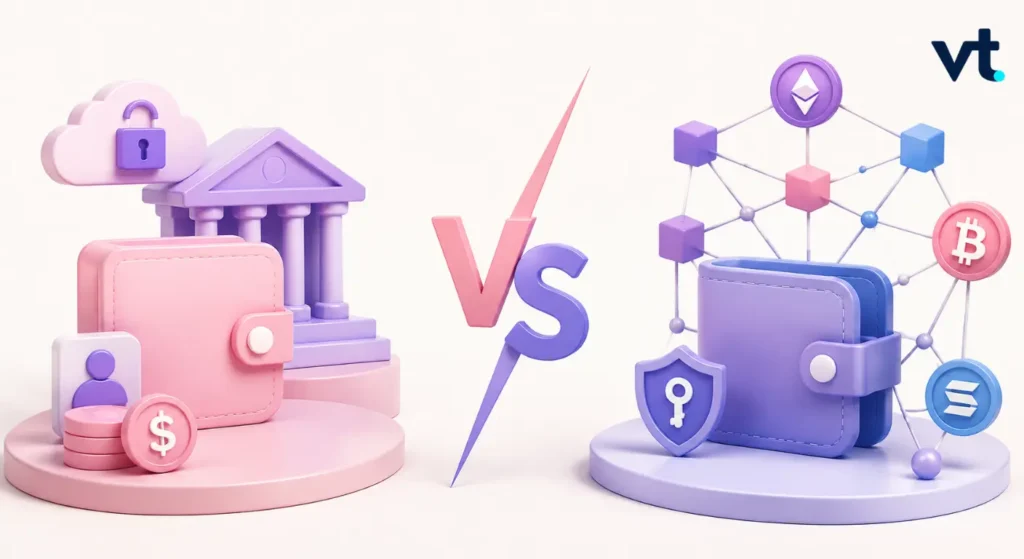
Key Takeaways
- Centralised wallets are easier to use for trading because a third-party platform helps manage access and private keys.
- Decentralised wallets give users full control, but also require stronger personal security responsibility.
- The best choice depends on experience level, trading activity, security needs, and comfort with self-custody.
- Many crypto users combine both wallet types to balance convenience, flexibility, and control.
Cryptocurrency has introduced a new way to store and move value. Unlike traditional finance, where banks manage funds on behalf of customers, crypto gives users more choice. Assets can be managed through a third-party platform, or users can take direct control through self-custody.
This decision often depends on the type of wallet being used. Centralised and decentralised wallets offer two different ways to access, store, and manage crypto. Understanding how they work can help users choose a setup that better fits their needs.
What Is a Centralised Wallet?
A centralised wallet is managed by a third party, typically a cryptocurrency exchange, broker, or trading platform. When funds are deposited into this type of wallet, the platform holds the assets on behalf of the user and manages the private keys that control access to them.
In simple terms, a centralised wallet works more like a traditional financial account. The platform provides the interface, manages account access, and supports transactions within its ecosystem.
Account holders usually log in with an email and password, view balances through a dashboard, and perform actions such as transfers, conversions, or trades with a few clicks. There is no need to manage blockchain addresses, store private keys, or sign transactions manually.
This makes centralised wallets a common entry point for people who are new to crypto.
Benefits of Centralised Wallets
- Simple access: The platform handles much of the technical process, making it easier for beginners to start using crypto without needing to learn every blockchain detail.
- Account recovery support: If login details are forgotten or device access is lost, the platform may offer account recovery through verification steps.
- Integrated trading tools: Many centralised wallets are connected to trading platforms, allowing users to buy, sell, convert, and transfer assets in one place.
- Fiat deposit and withdrawal options: Centralised platforms often support traditional payment methods, making it easier to move between fiat currency and crypto.
- Convenience for active traders: Since funds are already held within the platform, trading and conversion can often be completed without transferring assets from an external wallet first.
Limitations of Centralised Wallets
- Platform-managed access: Since the platform controls the private keys, access to funds depends on the provider’s systems, security standards, and operational stability.
- Counterparty risk: If the platform experiences a cyberattack, outage, insolvency issue, or internal restriction, users may face delays or limitations when accessing funds.
- Possible withdrawal restrictions: Transfers may be delayed, paused, or limited due to compliance checks, technical issues, platform policies, or regulatory requirements.
- Less direct asset control: Assets can be accessed through the platform, but users do not control the private keys directly.
- Less privacy in many cases: Centralised platforms often require account registration and identity verification before users can access full services.
What Is a Decentralised Wallet?
A decentralised wallet, also known as a non-custodial wallet, gives users direct control over their crypto assets. Instead of relying on a third party to manage access, the user holds the private keys.
In this model, the wallet does not “hold” crypto in the traditional sense. Crypto assets remain recorded on the blockchain. The wallet acts as a tool that allows users to access those assets, sign transactions, and interact with blockchain networks.
Access is secured through a private key or a seed phrase. A seed phrase is a series of recovery words that can restore access to the wallet. Whoever possesses this information has full control over the funds.
Popular examples include software wallets like MetaMask and hardware wallets such as Ledger Nano X, which store keys offline for added security.
Benefits of Decentralised Wallets
- Full asset control: Users hold their own private keys, so access does not depend on an exchange, broker, or platform.
- Direct ownership: This wallet type supports self-custody, allowing users to manage assets directly without relying on an intermediary.
- Access to DeFi and Web3: Many decentralised wallets can connect to decentralised applications, including DeFi platforms, NFT marketplaces, blockchain games, and other Web3 tools.
- Greater privacy in many cases: Some decentralised wallets can be created without account registration or identity verification.
- Useful for long-term storage: Users who plan to hold crypto for the long term may prefer decentralised wallets because assets can be kept outside a centralised platform.
Limitations of Decentralised Wallets
- No standard account recovery: If a private key or seed phrase is lost, access to the wallet may be permanently lost.
- Higher personal responsibility: Recovery phrases must be stored securely. Devices must be protected, and suspicious links or fake wallet prompts must be avoided.
- More technical knowledge required: Users need to understand the principles of wallet addresses, blockchain networks, gas fees, transaction approvals, and confirmations.
- Risk of irreversible mistakes: Sending assets to the wrong address, selecting the wrong network, or approving a malicious transaction can lead to permanent loss.
- Exposure to scams and phishing: Fake websites, fake support accounts, and malicious smart contracts are common risks in decentralised wallet environments.
Side-by-Side Comparison of Decentralised vs Centralised Wallets
Both wallet types help users access and manage crypto, but they are designed around different priorities.
Below is a simple comparison:
| Feature | Centralised Wallet | Decentralised Wallet |
| Private key control | Managed by the platform | Managed by the user |
| Ease of use | Easier for beginners | Requires more learning |
| Account recovery | Usually available | Not available if the seed phrase is lost |
| Asset control | Accessed through a platform | Controlled directly by the user |
| Privacy | Usually requires identity verification | Often more private |
| Trading access | Convenient for active trading | Depends on network and dApp access |
| DeFi and Web3 access | Limited | Strong access to dApps, DeFi, and NFTs |
| Security responsibility | Shared with provider | Fully user-managed |
| Main concern | Platform and counterparty risk | User error and self-custody risk |
| Best suited for | Beginners and active platform users | Experienced users and self-custody holders |
Which Crypto Wallet Fits Your Needs?
The right wallet depends on how crypto will be used. Some users need convenience and support, while others prefer direct control and self-custody. For many, the best setup may involve both.
| User Need | Better Fit | Why |
| New to crypto | Centralised wallet | Easier login, customer support, and simpler asset management |
| Active trading | Centralised wallet | Faster access to trading, conversion, and platform tools |
| Long-term holding | Decentralised wallet | Greater control over private keys and asset storage |
| DeFi, NFTs, and Web3 access | Decentralised wallet | Direct connection to decentralised applications |
| Convenience plus control | Both wallet types | Centralised wallet for activity, decentralised wallet for storage |
Why Many Users Use Both
Many crypto users do not rely on one wallet type only. A combined approach can be more practical because trading, storage, and Web3 access often require different levels of speed, control, and security.
For example, a user may keep a smaller amount of crypto in a centralised wallet for regular trading or quick conversions. This makes it easier to react to market movements or access platform tools.
At the same time, longer-term holdings may be stored in a decentralised wallet. This gives the user direct control over private keys and keeps those assets separate from platform-based activity.
In practice:
- Centralised wallet: for frequent activity.
- Decentralised wallet: for longer-term storage.
This creates a balanced setup where active funds remain accessible, while longer-term assets are managed with greater personal control.
Final Thoughts
Centralised and decentralised wallets each offer unique benefits. Centralised wallets are ideal for those seeking convenience and platform support, while decentralised wallets provide more control and privacy.
Choosing the right wallet depends on your crypto usage, desired level of control, and comfort with managing security. Many users find that combining both wallet types creates an optimal balance.
New to crypto trading? Check out our comprehensive guide to start trading with confidence:
- How to Trade Crypto for Beginners
- Trading Cryptocurrency: Complete Guide to Crypto Day Trading & Best Exchanges
Ready to Get Started?
Open a live account with VT Markets today and explore the potential of crypto trading!
Frequently Asked Questions
1. What is the difference between a centralised and decentralised wallet?
The key difference is private key control. In a centralised wallet, the platform manages the private keys on behalf of the user. In a decentralised wallet, the user controls the private keys directly, which means full ownership but also full responsibility.
2. Is a centralised wallet better for beginners?
Yes, a centralised wallet is often better for beginners. It offers a familiar login process, customer support, and built-in tools for buying, selling, and managing crypto. This makes the learning curve easier.
3. Is a decentralised wallet safer?
Not necessarily, a decentralised wallet is not guaranteed to be safer. It provides more control, but safety depends entirely on how well the private key or seed phrase is stored or managed. Poor storage or exposure can lead to permanent loss of funds.
4. Can both wallet types be used together?
Yes, both wallet types can be used together. A centralised wallet is often used for trading and quick access, while a decentralised wallet is commonly used for long-term storage and self-custody.
5. What happens if a seed phrase is lost?
If the seed phrase for a decentralised wallet is lost, the wallet usually cannot be restored. This means the funds may become permanently inaccessible.
6. Do centralised wallets require identity verification?
Yes, many centralised wallets require identity verification, especially for deposits, withdrawals, and regulated services. This is part of compliance requirements and account security measures.
7. Can decentralised wallets connect to DeFi platforms?
Yes, decentralised wallets are commonly used to connect directly to DeFi platforms, NFT marketplaces, and other Web3 applications without relying on an intermediary.
8. Is a centralised wallet better for trading?
Yes, a centralised wallet is generally more convenient for trading because it is usually connected to a trading platform. This makes it easier to execute trades, convert assets, and access liquidity quickly.
9. Is a decentralised wallet better for long-term holding?
Yes, a decentralised wallet can be suitable for long-term holding because it provides direct control over private keys. However, it requires secure storage of the seed phrase and an understanding of self-custody risks.
10. Do crypto wallets protect against market losses?
No, crypto wallets do not protect against market losses. They help users store and manage crypto, but price volatility still applies regardless of the wallet type used.










