





Key Takeaways
- Decentralised exchanges (DEXs) allow users to trade assets directly peer to peer without a centralised intermediary, using smart contracts to automate every step.
- DeFi wallets are non custodial, meaning only you hold your private keys and have full control over your funds — no bank account required.
- The global DeFi market is valued at USD $238.54 billion in 2026 and is projected to reach USD $770.56 billion by 2031.
- DEX trading volume grew approximately 37% in 2025, with over 1,100 decentralised exchanges now tracked by CoinGecko — combined daily volumes exceeded $6.48 billion in April 2026.
- While DEXs offer compelling advantages around transparency, access, and control, users must take note of risks such as impermanent loss, smart contract vulnerabilities, and gas fees before participating.
- For traders seeking regulated, multi-asset exposure alongside DeFi education, platforms like VT Markets offer a bridge between traditional financial services and the evolving digital asset landscape.
What Is DeFi Crypto, and Why Is Everyone Talking About It?
If you have been paying any attention to the cryptocurrency space over the last few years, you have almost certainly come across the term “DeFi”. Short for decentralised finance, DeFi refers to a broad ecosystem of financial services and products built on blockchain networks — without the involvement of banks, brokers, or any centralised authority.
At its core, DeFi crypto is about removing the middleman. Instead of routing your financial transactions through a bank account or a licensed broker, DeFi protocols use self-executing smart contracts on public blockchains to automate processes like lending, borrowing, and trading. Anyone with an internet connection and a crypto wallet can access these services — no identity verification, no credit check, no paperwork.
That is a radical departure from how traditional financial services have always operated. And in 2026, it is no longer a fringe concept.
DeFi by the Numbers: The 2026 Snapshot
The growth figures for decentralised finance are difficult to ignore. Here is a quick summary of where things stand:
| Metric | 2026 Figure |
|---|---|
| Global DeFi Market Size | USD $238.54 billion |
| Projected Market Size by 2031 | USD $770.56 billion |
| CAGR (2026–2031) | 26.43% |
| Total DEX daily volume (April 2026) | $6.48 billion |
| Number of DEXs tracked globally | 1,100+ |
| DeFi Total Value Locked (TVL) Q2 2025 | $123.6 billion |
| Ethereum’s share of total DeFi TVL | ~63% |
| DEX share of total crypto trading volume | ~21% (as of late 2025) |
Source: Mordor Intelligence
The user penetration rate for DeFi is projected at 2.71% globally by 2026, and analysts suggest DEXs could account for up to 50% of all crypto trading by the end of this year. These are not niche numbers — they are mainstream momentum.
Decentralised Exchanges vs. Centralised Exchanges: What Is the Difference?
Before going further, it helps to understand what makes decentralised exchanges fundamentally different from the centralised exchanges most crypto users start out on.
How Centralised Exchanges Work
Centralised exchanges (CEXs) like Binance, Coinbase, or Kraken operate much like traditional brokerages. You create an account, complete identity verification, deposit your funds, and the platform matches your buy and sell orders through an internal order book. The exchange holds your customer funds in custody — you do not directly control your private keys.
This model is convenient and familiar. CEXs typically offer deeper liquidity, faster execution, and robust customer support. As of 2026, centralised exchanges still dominate with approximately 88.4% of total crypto market share.
How Decentralised Exchanges Work
Decentralised exchanges, by contrast, are non custodial platforms where you retain full ownership of your assets at all times. There is no centralised counterpart holding your money. Instead, smart contracts on the blockchain handle everything — from matching trades to settling transactions — without any human or institutional intermediary involved.
Most decentralised exchanges today use an automated market maker (AMM) model rather than a traditional order book. Instead of matching individual buy and sell orders, AMMs rely on liquidity pools — large reserves of token pairs supplied by liquidity providers who earn fees in return. When you trade on a DEX, you are transacting directly against one of these pools.
Side-by-Side Comparison
| Feature | Centralised Exchanges (CEX) | Decentralised Exchanges (DEX) |
|---|---|---|
| Custody of funds | Exchange holds funds | You hold your own funds |
| Identity verification | Required (KYC) | Generally not required |
| Private keys | Exchange controls | You control |
| Intermediary | Centralised intermediary | Smart contracts only |
| Liquidity source | Order book | Liquidity pools / AMM |
| New tokens | Curated listings | Permissionless listings |
| Lower fees | Generally lower | Can vary (gas fees apply) |
| Transparency | Limited (off chain) | Full (on chain) |
Source: Coinlaw
What Is an Automated Market Maker, and How Do Liquidity Pools Work?
An automated market maker is the engine that powers most modern decentralised exchanges. Instead of relying on buyers and sellers to fill orders in real time, the AMM model uses a mathematical formula to determine the price of a token based on the ratio of assets in a liquidity pool.
Here is how it works in practice:
- A liquidity provider deposits an equal value of two tokens (say, ETH and USDC) into a pool.
- When another user wants to trade ETH for USDC, they interact with that pool directly — not with another human trader.
- The AMM formula adjusts the price automatically based on how much of each asset remains in the pool after the trade.
- Liquidity providers earn a share of the transaction fees generated by all trades in the pool.
This model eliminates the need for a centralised order book and ensures that trades can be executed at any time — even for less liquid tokens that might not attract enough buyers and sellers to fulfil orders on a traditional exchange.
What Is Impermanent Loss? (Take Note)
As a reminder for anyone considering becoming a liquidity provider: impermanent loss is a phenomenon where the value of your deposited tokens in a pool diverges from what you would have had by simply holding them. This happens when the price of one token in the pair moves significantly relative to the other. Impermanent loss does not mean you lose money in absolute terms, but it is a real risk that liquidity providers should understand before committing funds.
Understanding DeFi Wallets: Your Gateway to the DeFi Ecosystem
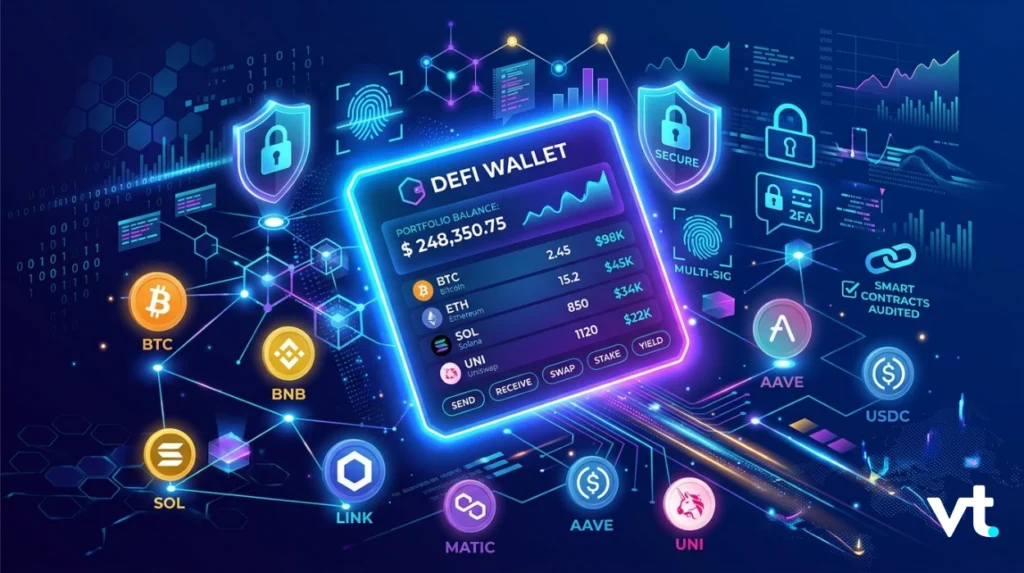
A DeFi wallet is not just a place to store your cryptocurrency assets — it is your identity, your bank, and your brokerage account all rolled into one. Unlike accounts on centralised exchanges, a DeFi wallet is non custodial: only you control your private keys, and only you can authorise transactions.
Popular DeFi wallet options include MetaMask, Trust Wallet, and Phantom (for Solana-based DeFi). Each serves as a direct interface between you and whatever DeFi protocol you want to interact with — whether you want to trade on a DEX, participate in yield farming, or take out flash loans.
Public Keys vs. Private Keys: What You Need to Know
Your crypto wallet operates using a pair of cryptographic keys:
- Public key: This is your wallet address — the equivalent of a bank account number. Share this freely to receive funds.
- Private key (or seed phrase): This is the master password to your wallet. Anyone who has your private keys has full control of your funds. Never share it, never store it online, and never enter it into any website that asks for it.
This is one of the most critical distinctions between DeFi wallets and centralised exchange accounts. On a CEX, the platform can reset your access if you forget your password. With a non-custodial DeFi wallet, if you lose your private keys, your funds are gone permanently — there is no recovery mechanism.
Precaution: Always store your seed phrase (the human-readable version of your private key) on paper or a hardware device, offline and in a secure location. Never take a screenshot or store it in cloud storage.
The Major DeFi Protocols and What They Offer
The DeFi ecosystem is not just about trading. It encompasses a wide range of financial services that were previously accessible only through traditional intermediaries. Here are the major categories of DeFi protocols you should know:
Decentralised Lending and Borrowing
Platforms like Aave and Compound allow users to lend out their digital assets to earn interest rates or borrow funds by posting collateral. These platforms operate without a centralised authority approving loan applications — smart contracts handle everything automatically. As of mid-2025, Aave held approximately $15 billion in total value locked, making it the second-largest DeFi protocol globally.
Yield Farming
Yield farming involves strategically moving funds across different DeFi protocols to maximise returns. Users provide liquidity to various pools and earn rewards in the form of governance tokens or a share of protocol fees. It is a higher-risk, higher-reward approach that has attracted significant attention from crypto-native investors, though it requires careful management.
Flash Loans
Flash loans are one of the most novel innovations in DeFi — uncollateralised loans that are borrowed and repaid within a single blockchain transaction. If the loan is not repaid within that same block, the entire transaction is reversed as if it never happened. Flash loans are used primarily for arbitrage, collateral swapping, and self-liquidation strategies.
Decentralised Derivatives and Perpetuals
Platforms like Hyperliquid have emerged as major venues for on-chain derivatives trading. As of March 2026, Hyperliquid alone reported approximately $208 billion in 30-day trading volume and over 229,000 active traders — a testament to the appetite for decentralised perpetual futures.
Read More: What Is DeFi? The Complete Guide to Decentralised Finance
The Ethereum Blockchain and the Binance Smart Chain: The DeFi Backbone
The vast majority of the DeFi ecosystem was built on the Ethereum blockchain, which continues to host approximately 63% of total DeFi TVL. Ethereum’s robust developer ecosystem, mature smart contract infrastructure, and large user base make it the dominant platform for high-value DeFi transactions — particularly those above $50,000.
The Binance Smart Chain (BSC) emerged as a lower-fee alternative, enabling the growth of platforms like PancakeSwap, which set a monthly trading volume record of $325 billion in June 2025. PancakeSwap V3 on BSC is currently one of the three largest DEXs by trading volume globally.
Solana has also become a significant force, capturing 48% of total DEX market share in 2025 — largely driven by retail activity and meme token trading. Meanwhile, Ethereum and its Layer-2 ecosystem dominate institutional-sized trades, holding 10 of the top 20 DEX liquidity pools.
Top Decentralised Exchanges to Know in 2026
The DEX landscape has matured considerably. Here is a quick overview of the leading platforms:
| DEX | Blockchain | Market Share | Notable Feature |
|---|---|---|---|
| Uniswap V3 | Ethereum / Multi-chain | ~55% | Largest DEX by volume; launched v4 with Hooks |
| PancakeSwap V3 | BSC / Multi-chain | ~20% | Largest quarterly DEX in Q2 2025 |
| Curve Finance | Ethereum | ~15% | Dominant in stablecoin swaps and liquidity |
| Hyperliquid | Proprietary L1 | Growing | Derivatives focus; $208B in 30-day volume |
| Others | Various | ~10% | Niche and emerging DEXs |
Uniswap alone recorded $88.8 billion in trading volume in May 2025. These are not small experiments — they are serious financial infrastructure.
Key Advantages of Decentralised Exchanges
DEXs offer a compelling set of advantages, particularly for users who prioritise control, privacy, and access:
- Full custody of funds: Since DEXs are non custodial, you never relinquish control over your assets. Your crypto remains in your wallet until the moment a trade executes on chain.
- No identity verification required: Most DEXs allow users to transact without any KYC process. This opens up access to financial services for the underbanked and unbanked populations globally.
- Permissionless listings: Anyone can list new tokens on most DEXs without approval from a centralised authority, making them the first place emerging projects are typically traded.
- Transparency: All transactions are recorded on public blockchains and can be independently verified by anyone.
- Peer to peer trading: You trade directly with liquidity pools or other peers, with no centralised counterparts involved in the transaction process.
- Access to DeFi primitives: DEXs are the gateway to the broader DeFi ecosystem — from yield farming to governance token participation.
Important Cautions Before You Trade on a DEX
While the advantages are real, it is equally important to approach decentralised exchanges with clear-eyed awareness of the risks involved. Consider these important precautions:
Smart Contract Vulnerabilities
All DeFi protocols rely on smart contracts, and smart contracts can contain bugs or security flaws. Approximately 80% of total crypto losses in certain periods have originated from DeFi protocols, with exploits from unaudited code hitting smaller DEXs hardest. Before participating in any DeFi protocol, verify that it has undergone formal third-party security audits.
Gas Fees and Transaction Costs
On the Ethereum blockchain particularly, gas fees — the cost of processing a transaction on the network — can vary wildly depending on network congestion. During high-demand periods, gas fees can make small transactions economically unviable. Layer-2 solutions have reduced this issue significantly, but it is still worth accounting for in your cost analysis.
Private Key Responsibility
With great control comes great responsibility. There is no customer support desk to call if you send funds to the wrong address or lose your private keys. Every action on a DEX is irreversible once confirmed on chain. Approach with caution and always double-check wallet addresses before executing trades.
Regulatory Uncertainty
Regulatory frameworks for DeFi are still evolving globally. The U.S. passed the GENIUS Act in July 2025 establishing stablecoin oversight, and the EU’s MiCA framework continues to mature. Users should be aware that the regulatory environment around DEX participation may change and should consult appropriate advice for their jurisdiction.
How to Get Started With DeFi: A Step-by-Step Overview
For those ready to explore the DeFi ecosystem responsibly, here is a simplified starting framework:
- Set up a non custodial DeFi wallet (e.g., MetaMask for Ethereum-based DeFi, or Phantom for Solana). Securely store your private keys.
- Acquire cryptocurrency assets via a regulated centralised exchange or peer-to-peer service, then transfer to your DeFi wallet.
- Connect your wallet to a DEX — platforms like Uniswap support browser-based connections via wallet extensions.
- Select a trading pair and review the estimated transaction cost and price impact before you execute trades.
- Start small. The DeFi ecosystem rewards those who take time to understand how each protocol works before committing significant funds.
- Consider providing liquidity only once you fully understand concepts like impermanent loss and fee structures.
DeFi vs. Traditional Trading: Is One Better Than the Other?
This is not a binary question. Both DeFi and traditional financial markets serve different needs:
| Dimension | DeFi / DEXs | Traditional / CEX-based Trading |
|---|---|---|
| Access | Permissionless, global | Account required; KYC |
| Control | Full (non-custodial) | Limited (funds held by platform) |
| Transparency | Full on chain | Limited |
| Asset range | Broad, including new tokens | Curated |
| Security | Self-managed | Platform-managed |
| Regulation | Emerging | Well-established |
| Fees | Gas fees + protocol fees | Spread + commission |
| Liquidity | Variable | Generally deeper on major CEXs |
For many traders, a hybrid approach makes the most sense: using regulated, centralised platforms for structured trading and risk management, while exploring DeFi protocols for yield opportunities and broader digital asset exposure.
Frequently Asked Questions (FAQs)
1. What is the difference between a DeFi wallet and a regular crypto wallet?
Both are crypto wallets at their core, but the term “DeFi wallet” specifically refers to a non custodial wallet designed to interact with DeFi protocols – decentralised exchanges, lending platforms, and other on chain financial services. A regular crypto wallet (like one provided by a centralised exchange) may hold cryptocurrency, but the exchange retains control of the private keys. With a DeFi wallet, you hold your own private keys and are the sole authority over your funds.
2. Do I need to complete identity verification to use a decentralised exchange?
Most DEXs do not require identity verification. Because they operate via smart contracts on public blockchains without a centralised authority, users can connect their wallets and begin trading without creating an account or submitting personal documents. This is one of the key distinctions from centralised exchanges, where identity verification is standard practice under KYC/AML compliance requirements.
3. What are liquidity pools and how do liquidity providers earn money?
Liquidity pools are reserves of two or more token pairs locked in a smart contract to facilitate trading on a DEX. Liquidity providers deposit an equal value of both tokens and, in return, earn a proportional share of the transaction fees generated every time someone uses that pool to execute trades. Some protocols also offer additional governance token rewards through yield farming incentives. The trade-off is exposure to impermanent loss if token prices diverge significantly.
4. Is DeFi safe for beginners?
DeFi offers tremendous opportunity, but it also demands a higher level of personal responsibility than using a centralised exchange. As a precaution, beginners should start by thoroughly understanding the mechanics of smart contracts, private key security, gas fees, and impermanent loss before committing significant capital. Always use protocols that have been independently audited, start with small amounts, and never invest more than you can afford to monitor and manage actively. The absence of a centralised counterpart means there is no safety net if something goes wrong.
The Road Ahead: DeFi in 2026 and Beyond
The DeFi ecosystem is maturing rapidly. Institutional capital is flowing in through compliant, permissioned DeFi platforms. Real-world asset tokenisation — covering everything from bonds to real estate — is projected to grow at a 39.72% CAGR through 2031. Interoperability between chains is improving, Layer-2 solutions are slashing gas fees, and stablecoin liquidity is becoming increasingly unified across networks.
DEXs could account for half of all crypto trading by the end of 2026. The convergence of decentralised finance with traditional financial services is no longer a distant forecast — it is actively happening. Revolut has integrated Uniswap. Robinhood used Arbitrum to enable tokenised stock trading. Wall Street firms have piled into tokenised assets.
The question for traders and investors is no longer “Should I pay attention to DeFi?” — it is “How do I access it in a way that aligns with my risk tolerance and financial goals?”
Start Trading with Confidence Alongside Your DeFi Journey
Decentralised finance and traditional financial markets are not mutually exclusive — they are increasingly complementary. As the DeFi ecosystem matures, understanding how it works gives any trader a meaningful edge, regardless of what markets they participate in.
For traders who want regulated, professional-grade access to multi-asset markets — including CFDs on currencies, commodities, indices, and more — VT Markets provides the tools, execution quality, and support infrastructure to trade with confidence.
Whether you are building your understanding of digital assets or actively trading multiple markets in parallel, VT Markets provides access to real-time markets, professional-grade charting, and a team of experienced support staff through the MetaTrader 4 and MetaTrader 5 platforms you already know.
Open a VT Markets account and access multi-asset markets with competitive spreads and execution quality. Start with a free demo account to practise your strategy with no capital at risk — no pressure, no commitment. Or speak to the VT Markets support team for guidance on how to integrate market insights from the evolving DeFi landscape into your broader trading approach.
The tools are ready. The markets are open. The next move is yours.








