





Key Takeaways
- DeFi (decentralised finance) is a blockchain-powered ecosystem that replicates financial services — lending, borrowing, trading, and earning interest — without traditional banks or brokers.
- The global DeFi market size reached approximately USD $238.5 billion in 2026, with projections to surpass $770 billion by 2031 at a 26.4% CAGR.
- Total value locked (TVL) across DeFi protocols sits in the $130–140 billion range in early 2026, with Ethereum commanding roughly 68% of that figure.
- Core DeFi components include smart contracts, decentralised exchanges (DEXs), liquidity pools, yield farming, flash loans, and automated market makers.
- DeFi carries real-world precautions around smart contract vulnerabilities, regulatory uncertainty, and asset volatility — always conduct thorough research before allocating capital.
- For traders, DeFi-linked digital assets and crypto CFDs represent an emerging opportunity accessible through multi-asset platforms.
The Financial Revolution Nobody Warned You About
Imagine a world where you can borrow funds, earn interest, trade digital assets, and move money across borders — all without ever walking into a bank, filling out a form, or waiting three business days for approval. That world already exists. It is called DeFi, and it is growing faster than almost any sector in modern finance.
The term DeFi — short for decentralised finance — refers to a set of financial services built on public blockchain networks that operate transparently, automatically, and without centralised institutions controlling the rails. No head office. No account manager. Just code, cryptography, and community governance.
Whether you are a seasoned investor researching your next opportunity, a curious saver wondering where your money could work harder, or a trader looking to understand the assets shaping tomorrow’s markets, this guide breaks down everything you need to know about DeFi, decentralised finance, and what these developments mean for ordinary people around the world.
What Is DeFi? A Plain-English Explanation
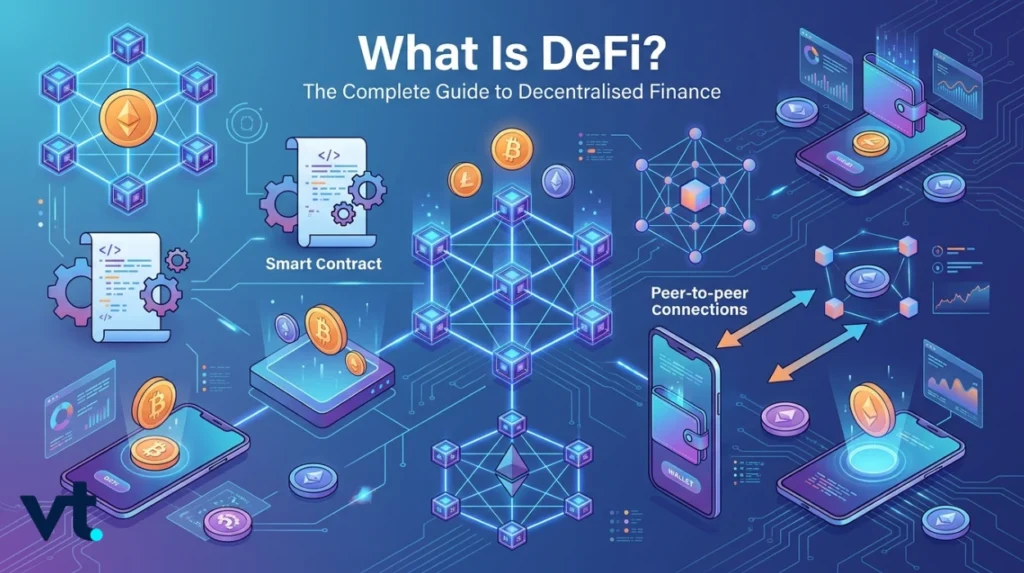
At its core, DeFi decentralised finance, is the practice of delivering financial services through software rather than institutions. Instead of a bank processing your loan application, a smart contract — a self-executing programme stored on a decentralised digital ledger — handles the logic automatically. There is no human intermediary needed for funds to change hands; the rules are written in code, and the code executes precisely when the agreed conditions are met.
The phrase “what is DeFi” has been searched millions of times globally as awareness of this space grows. The simplest answer: DeFi is open-source software that turns financial rules – lending, borrowing, trading, and insurance – into code that runs on a public blockchain, accessible to anyone with an internet connection and a crypto wallet.
📊 2026 Snapshot: The DeFi market is valued at approximately USD $238.5 billion and is forecast to reach $770.6 billion by 2031, expanding at a 26.43% CAGR. (Source: Mordor Intelligence, January 2026)
How Does DeFi Work? The Technology Stack Explained
To understand DeFi, you need to understand the layers beneath it. Every DeFi application runs on top of blockchain technology — a distributed network of computers that validates and records every transaction. Because thousands of independent nodes maintain this record rather than a single server, no single company or government can alter or censor it.
Smart Contracts: The Engine of DeFi
Smart contracts are the key innovation that makes DeFi possible. These are programmes deployed on a blockchain that self-execute when predefined conditions are met — without requiring any third party to enforce the agreement. For example, a lending protocol can automatically release funds when a borrower provides adequate collateral and automatically liquidate positions if that collateral value drops below the required threshold. The entire process of financial transactions is governed by publicly auditable code.
Decentralised Exchanges (DEXs)
Traditional stock and currency trading takes place on centralised exchanges operated by companies that act as custodians of your funds. Decentralised exchanges, by contrast, allow users to swap tokens directly from their wallets. In 2025, DEXs hit a record $462 billion in monthly trading volume — a figure that continues to climb as more users appreciate the self-custody advantages of DeFi platforms over the centralised components of legacy brokers.
Liquidity Pools and Automated Market Makers
Rather than matching individual buyers and sellers (as traditional order books do), most DeFi protocols use liquidity pools — smart contracts that hold reserves of two or more tokens. Liquidity providers deposit their assets into these pools and earn a share of trading fees in return. Automated market makers (AMMs) set the prices of swaps by using algorithms that change the prices based on the ratio of assets in each pool. This mechanism allows transactions to occur around the clock, without the need for a counterparty on the other side of every trade.
DeFi vs. Traditional Finance: A Side-by-Side Comparison
| Feature | Traditional Finance | DeFi |
|---|---|---|
| Intermediaries | Banks, brokers, clearing houses | Smart contracts on blockchain |
| Accessibility | Requires bank account, credit check, ID | Requires only a crypto wallet and internet connection |
| Operating Hours | Business hours, weekdays | 24/7, 365 days a year |
| Transparency | Limited; proprietary systems | Fully on-chain and auditable |
| Settlement Speed | 1–5 business days | Seconds to minutes |
| Custody of Funds | Held by financial institutions | Held by the user (via private key) |
| Transaction Fee | Bank and broker commissions | On-chain gas fees (variable) |
| Collateral Requirement | Credit-based (often unsecured) | Over-collateralised by crypto assets |
Key DeFi Services and What They Do
The DeFi ecosystem is vast, but most activity clusters around a handful of core financial services. Below is an overview of the most widely used DeFi technologies and protocols.
1. Lending and Borrowing
DeFi lending platforms allow users to borrow funds or earn interest on deposited assets — all without credit checks. Borrowers lock up collateral (usually more than the value of their loan) in a smart contract; lenders deposit assets and earn variable interest rates set by supply and demand algorithms. In 2025, DeFi interest rates for stablecoin lending averaged between 6.8% and 13.5%, compared with 4.5%–7.5% on traditional peer-to-peer lending platforms.
Major DeFi protocols such as Aave, which held approximately $27 billion in TVL in early 2026, serve as the primary DeFi platform for both retail and institutional investors seeking on-chain yield. By late 2025, DeFi lending and CDP stablecoins together captured roughly 69% of the total crypto borrowing market.
2. Yield Farming
Yield farming refers to the practice of deploying crypto assets across multiple DeFi protocols to maximise returns. Farmers earn rewards by providing liquidity, staking tokens, or participating in governance. While the returns can be compelling, yield farming strategies require active management — reward rates shift constantly as capital flows in and out of protocols.
3. Flash Loans
Flash loans are a uniquely DeFi innovation with no equivalent in traditional financial intermediaries. They allow a user to borrow an uncollateralised amount and repay it — all within the same transaction block. If the loan is not repaid by the end of the transaction, the entire operation is reversed as if it never happened. Flash loans are used by arbitrageurs to exploit price differences between decentralised exchanges, but they have also been misused in several high-profile exploits. Take note: flash loan attacks remain an active risk vector within the DeFi space.
4. Stablecoins
Stablecoins are digital assets pegged to a stable reference—usually the US dollar—enabling DeFi users to access the benefits of blockchain without exposure to volatile fiat currency fluctuations. By December 2025, 214 stablecoins were tracked on DefiLlama, with 51 exceeding $50 million in supply. Stablecoins now serve as the core liquidity layer for nearly every DeFi application.
5. Decentralised Applications (dApps)
Decentralised applications — or dApps — are user-facing interfaces for DeFi protocols. These DeFi apps allow ordinary users to interact with smart contracts through browser-based interfaces without understanding the underlying code. Revenue generated by dApps in 2025 reached $9.28 billion, and the segment is projected to grow at a 66.8% CAGR through 2033.
Understanding DeFi Protocols: The Building Blocks of On-Chain Finance
The term ‘DeFi protocols’ refers to the underlying rule sets — written as open-source software — that govern how DeFi applications function. These protocols specify everything from how liquidity is priced and how borrow limits are calculated to how governance votes are tabulated. Leading protocols by TVL in early 2026 include the following:
- Lido — approximately $27.5 billion TVL (liquid staking)
- Aave — approximately $27 billion TVL (lending and borrowing)
- EigenLayer — approximately $13 billion TVL (restaking)
- Uniswap — approximately $6.8 billion TVL (decentralised exchange)
- MakerDAO — approximately $5.2 billion TVL (stablecoin issuance)
Ethereum remains the dominant chain, hosting over 63% of total DeFi TVL, with Solana emerging as a strong secondary hub at approximately $9.2 billion.
📊 User Growth: Unique DeFi users surpassed 20 million in 2025, up from just 940,000 in 2021 — a rise of over 2,000% in four years. Retail users held 62.12% of total market share, while institutional participation is growing rapidly at a projected 32.55% CAGR through 2031.
What Is a DeFi Stock? Understanding Exchange Traded Products and Crypto Exposure
Searching for a DeFi stock is one of the most common entry points for investors new to this space. While there is no single DeFi “stock” in the traditional sense, investors can access DeFi-linked exposure through several instruments:
- Native DeFi tokens — Governance and utility tokens of protocols like UNI (Uniswap), AAVE, MKR (MakerDAO), and CRV (Curve) trade on both centralised and decentralised exchanges.
- Exchange-traded products (ETPs) — A growing number of exchange-traded products now track baskets of DeFi tokens or offer synthetic exposure to DeFi indices.
- Blockchain infrastructure equities — Publicly traded companies with significant exposure to blockchain technology or digital asset services (e.g., Coinbase and Galaxy Digital) provide indirect DeFi exposure.
- CFDs on crypto assets — Contract for Difference products allow traders to speculate on the price movements of DeFi tokens without taking direct custody. This is the method most accessible to global retail traders.
The distinction matters: owning a DeFi token means holding actual cryptocurrency assets in a self-custody wallet, managed by a private key only you control. A CFD, by contrast, provides price exposure without custody complexity — suitable for active traders who want to participate in DeFi-driven price movements.
The Role of Blockchain Technology in DeFi’s Architecture
Blockchain technology is the foundational infrastructure that makes DeFi trustworthy. Unlike a traditional database owned by a financial institution or centralised institution, thousands of independent computers collectively maintain a blockchain. Every transaction is cryptographically signed, making the ledger tamper-resistant by design.
The decentralised nature of this architecture means there is no single point of failure — and no single authority that can freeze your funds, alter the rules mid-game, or exclude you based on nationality, credit history, or political affiliation. However, this openness is also a double-edged consideration: because there are no traditional financial intermediaries, there is also no helpline if you lose your private key or fall victim to a scam.
Transaction information on a public blockchain is visible to anyone — a feature that makes transparency one of DeFi’s core value propositions, especially when compared with the opaque risk management practices of traditional banks.
Who Is Using DeFi? From Retail Users to Institutional Investors
The stereotype that DeFi is the exclusive domain of young, tech-savvy speculators is increasingly outdated. Today, the global financial system is watching closely as institutional adoption accelerates. The EU’s MiCA regulatory framework, combined with spot Bitcoin ETF approvals and bank-aligned trust structures, is pulling large-scale capital into compliant, on-chain channels.
Key user segments in 2026 include:
| User Type | Primary Use Case | Tools Used |
|---|---|---|
| Retail savers | Earn interest on idle stablecoins | Aave, Compound, Yearn Finance |
| Crypto traders | Token swaps and arbitrage | Uniswap, Curve, dYdX |
| Institutional investors | Yield strategies, on-chain treasury management | Aave Institutional, Maple Finance, Ondo Finance |
| DeFi developers | Building new DeFi protocols | Ethereum, Solana, Arbitrum |
| Unbanked populations | Access to lending without a bank account | Mobile-first DeFi apps |
One of the most compelling promises of DeFi is financial inclusion: the ability to access financial services — including the ability to borrow, earn interest, and transact — without a bank account. For the estimated 1.4 billion unbanked adults worldwide, DeFi protocols offer something genuinely transformative.
Risks and Precautions: What Every DeFi Participant Should Know
⚠️ Reminder: DeFi carries unique risks not found in traditional investing. The information below is not financial advice. Always conduct your research and consider your risk tolerance before committing any funds.
DeFi’s risks involved are real and should not be underestimated. Here is a measured, honest overview of what to watch for:
Smart Contract Vulnerabilities — A Key Precaution
Because DeFi runs on code, anyone can exploit any bug in that code. Total DeFi exploits in 2024 reached $1.2 billion across 120 incidents. In April 2026, a $292 million exploit of the KelpDAO bridge caused a $13.2 billion drop in total DeFi TVL in just 48 hours, demonstrating how interconnected DeFi protocols can transmit shocks far beyond the original point of failure. Precaution: use only protocols with multiple independent security audits and established track records.
Private Key Responsibility — Take Note
In DeFi, your private key is your identity, your password, and your bank card all in one. If you lose it, there is no password-reset button, no customer service desk, and no regulator to call. Caution: store your private key using hardware wallets and secure offline backups. Never share it with any individual or service.
Regulatory Uncertainty
Regulators around the world are actively defining how DeFi fits within existing financial law. While frameworks such as MiCA in Europe and evolving guidance from the SEC and CFTC in the United States are bringing greater clarity, the landscape remains in flux. Take note: regulatory changes can affect the legality, taxation, or accessibility of certain DeFi applications depending on your jurisdiction.
Liquidity and Market Risk
The liquidity of DeFi markets can vary dramatically. Small liquidity pools may experience significant slippage on larger orders, and sharp market moves can trigger rapid changes in interest rates on lending platforms. DeFi tokens can also experience extreme price volatility, making them unsuitable for consumers who cannot afford to sustain losses.
Caution With Yield Farming Complexity
Multi-protocol yield farming strategies can involve complex interactions between multiple DeFi protocols, smart contract risks stacked on top of each other, and rewards that may diminish rapidly as more capital enters a pool. The risks compound with complexity. Simpler strategies in audited, blue-chip protocols are generally more prudent for most users and investors.
DeFi and the Future of the Global Financial System
DeFi is no longer a niche experiment confined to cryptography conferences. It is actively reshaping how the global financial system operates, from cross-border remittances to institutional asset management. The fastest-growing DeFi segment in 2026 is payments and cross-border treasury, projected to grow at a 34.7% CAGR, driven by stablecoin settlement pilots that integrate directly with bank workflows.
Tokenised real-world assets (RWAs) represent another landmark trend. Bonds, treasury bills, and real estate are bringing DeFi protocols access to yield-bearing instruments backed by traditional financial infrastructure. By the end of 2025, the RWA protocol’s TVL surpassed that of decentralised exchanges, reaching $17 billion. Institutional investors and asset managers are projected to grow their DeFi participation at a 32.55% CAGR through 2031.
At the same time, the rise of Layer-2 networks is reducing transaction costs to near-zero, expanding DeFi’s addressable market to include high-frequency traders, micro-treasury operations, and business treasury management that were simply uneconomical at earlier gas price levels.
Trading DeFi-Linked Assets: What You Need to Know
For traders, the most practical way to gain exposure to the DeFi trend is through cryptocurrency assets, whether they hold them directly or via CFD instruments. Governance tokens such as UNI, AAVE, and CRV behave like equity in their respective protocols: their value reflects the fees generated, the TVL under management, and the broader investment narrative around decentralised finance.
An OTC desk facility offers high-volume traders an efficient route to transact in large blocks of digital assets without moving the market. For retail and professional traders alike, the key considerations are:
- Understanding protocol-specific fundamentals (TVL, revenue, governance health)
- Monitoring on-chain metrics (daily active users, transaction volumes, borrowing rates)
- Using appropriate security measures — stop-losses, position sizing, and diversification across uncorrelated assets
- Staying current with regulators‘ evolving guidance in your jurisdiction
Frequently Asked Questions About DeFi
FAQ 1: Is DeFi safe to use?
DeFi operates on transparent, auditable code, which is a fundamental improvement in security compared to opaque traditional systems. However, smart contract bugs, oracle manipulation, and bridge exploits remain real risks. Precaution: stick to established protocols with multiple independent audits, start with small amounts, and never invest more than you can afford to lose. Security is the primary factor separating reliable protocols from risky ones in 2026.
FAQ 2: Do I need a bank account to use DeFi?
No — this feature is one of DeFi’s most compelling attributes. All you need is a crypto wallet and an internet connection. You do not need a bank account, a credit score, or government-issued identity to access most DeFi protocols. This decentralised nature makes DeFi particularly powerful for financially underserved populations. That said, you will likely need to purchase cryptocurrency through an exchange first, which may require identity verification depending on local regulations.
FAQ 3: What is the difference between DeFi and a centralised exchange?
Centralised exchanges (like Coinbase or Binance) hold your funds in custodial wallets — meaning the exchange controls your private key. Decentralised exchanges allow you to trade directly from your wallet, retaining full custody. The trade-off: DEXs offer greater sovereignty but can have lower liquidity and less consumer protection. Many traders use both centralised platforms for on-ramps and DeFi protocols for yields and advanced financial services.
FAQ 4: Can I earn passive income through DeFi?
Yes — through lending, yield farming, and providing liquidity to liquidity pools, DeFi users can generate yields on idle assets. DeFi stablecoin lending rates averaged 6.8%–13.5% in 2025. However, reminder: yields fluctuate with market conditions, liquidity pool imbalances can affect returns, and smart contract risk is ever-present. Treat advertised yields as variable, not guaranteed, and always factor in the underlying risks before allocating capital.
Start Trading DeFi-Linked Digital Assets with VT Markets
Decentralised finance is more than a technological curiosity — it is reshaping the financial services landscape at speed. For traders who understand how to read on-chain metrics, token fundamentals, and macro conditions, DeFi-linked assets represent a compelling opportunity in both bull and bear markets.
The key to success lies in combining solid research with disciplined risk management. Understand the protocols you are trading. Monitor liquidity and TVL trends. Use stop-losses. Never allocate more than you can afford to monitor and manage.
With VT Markets, you can access crypto CFDs alongside a full suite of multi-asset instruments — including currencies, commodities, indices, and bonds — all from within the MetaTrader 4 and MetaTrader 5 platforms. Whether you are building exposure to DeFi-driven crypto assets or actively trading price movements across asset classes, VT Markets provides the tools, execution quality, and support to help you trade with confidence.
Open a VT Markets account and access real-time crypto markets, professional-grade charting, and a team of experienced support staff ready to help you every step of the way. Start with a free demo account to get familiar with crypto CFDs — no capital at risk, no pressure.
Final Thoughts: Is DeFi the Future of Finance?
DeFi is not a bubble waiting to burst — nor is it a finished product. It is an infrastructure in active construction, one that is progressively absorbing functions once exclusive to banks, insurers, and asset managers. The technology powering it — blockchain technology, smart contracts, and automated liquidity — is robust, improving rapidly, and attracting capital from some of the most sophisticated institutional investors on the planet.
As DeFi matures, the boundary between it and traditional finance will continue to blur. The financial institutions that once dismissed cryptocurrency as a fringe experiment are now actively exploring on-chain settlement, tokenised bonds, and compliant DeFi lending rails. Regulatory clarity under frameworks like MiCA is accelerating this convergence, not reversing it.
For individual investors and traders, the message is clear: DeFi is no longer optional knowledge. Understanding what it is, how it works, and where the risks lie is becoming as fundamental to financial literacy as understanding how interest rates or equity investing works. The world of money is changing — and those who understand the change earliest will be best positioned to benefit from it.








