





Key Takeaways
- Tether is the company behind USDT, a stablecoin designed to maintain a value close to $1.
- USDT is backed by Tether’s reserves, which include US Treasury bills, cash equivalents and other assets.
- It is widely used for crypto trading, transfers, payments and holding dollar-denominated value on blockchain networks.
- USDT operates across several blockchains, including Ethereum, Tron, Solana, TON and Aptos.
- USDT is designed for price stability rather than long-term capital growth.
- It is not legal tender, a bank deposit or protected by government-backed deposit insurance.
- Holding USDT and trading crypto CFDs are different activities with separate risks and purposes.
Cryptocurrency markets are known for their volatility, with prices often changing significantly within a short period. Stablecoins were created to provide greater price stability by tracking the value of traditional assets, such as the US dollar.
Tether’s USDT is one of the most widely used stablecoins, designed to maintain a value close to $1. It is commonly used for crypto trading, transfers and accessing blockchain-based financial services.
This guide covers how Tether works, how USDT is designed to maintain its value, its role in the crypto market, and the potential risks users should consider.
What Is Tether Crypto?
Tether is a blockchain-based platform that issues tokens linked to traditional assets. Its best-known token is USD₮, commonly written as USDT, which is designed to maintain a value close to $1.
A simple way to understand USDT is to think of it as a digital representation of dollar-denominated value that can move across supported blockchain networks. Holding 20 USDT is intended to represent approximately $20 in value, although the market price can occasionally move slightly above or below its target.
Tether launched in 2014, making USDT one of the longest-running stablecoins in the cryptocurrency market. The token was created to help users transfer dollar-linked value between crypto platforms without repeatedly moving funds through the traditional banking system.
Below are the details:
| Detail | Information |
| Launch year | 2014 |
| Token type | Fiat-referenced stablecoin |
| Main token | USDT |
| Target value | Approximately $1 |
| Issuer | Tether |
| Reserve model | US Treasury bills, cash equivalents and other reserve assets |
| Main uses | Trading, settlement, transfers, payments and decentralised finance |
| Supported networks | Ethereum, Tron, Solana, TON, Aptos and other supported blockchains |
Tether also offers tokens linked to other assets, including the Mexican peso and physical gold. However, USDT remains its primary dollar-linked token and the focus of this guide.
How Tether Maintains Its Dollar Peg
USDT is designed to maintain a value close to $1, a process known as maintaining its peg. Several mechanisms help support this stability
Reserve Backing
Tether states that each USDT in circulation is backed by reserves of equal or greater value. These reserves are not held entirely as cash, but include US Treasury bills, cash equivalents and other assets.
Tether’s Q1 2026 attestation reported significant exposure to short-term US Treasury assets, alongside smaller holdings such as physical gold and Bitcoin. As of March 31, 2026, Tether reported around $183 billion in token liabilities and $8.23 billion in excess reserves.
USDT is therefore backed by a portfolio of reserve assets rather than individual dollars held separately for each token.
Issuance and Redemption
Verified Tether customers can receive USDT by providing eligible funds to Tether, while eligible users can redeem USDT for fiat currency through approved channels.
Direct issuance and redemption are mainly designed for larger customers, with verification requirements, minimum transaction amounts and fees. Most retail users obtain USDT through cryptocurrency exchanges and other platforms.
Market Activity
USDT trades continuously across cryptocurrency exchanges. When its price moves slightly away from $1, market activity can help bring it back towards its target.
However, USDT is not guaranteed to trade at exactly $1 at all times, and temporary price differences can occur during periods of market stress or changing demand.
Tether’s Attestations and Audit Status
Tether publishes regular reserve reports supported by independent attestations. These provide assurance on reported assets and liabilities at specific points in time but are different from a full financial statement audit.
Tether announced plans in 2026 to complete its first full independent audit with a Big Four accounting firm. Until completed, its reserve reporting remains based on periodic attestations.
How Does Tether Work?
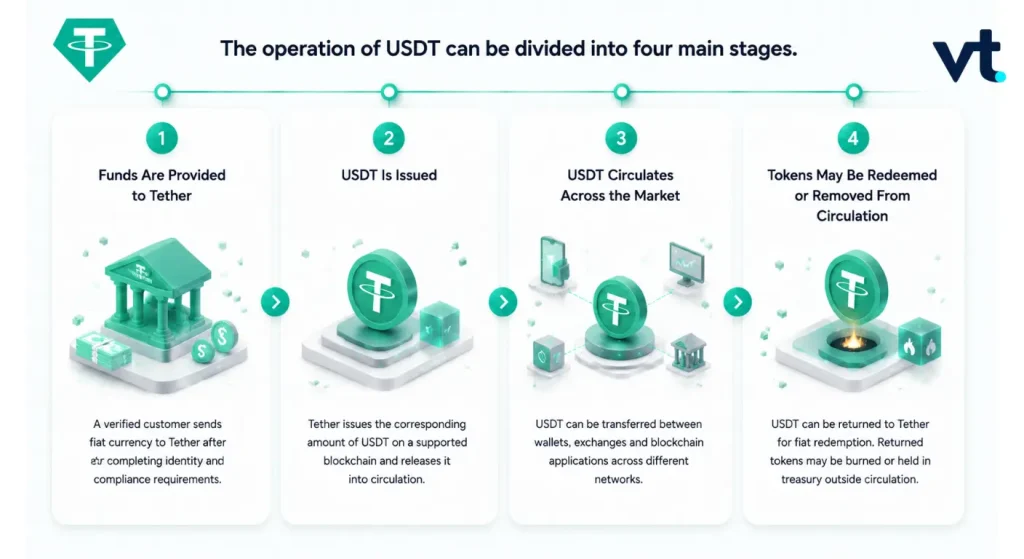
1. Funds Are Provided to Tether
A verified customer sends eligible fiat currency to Tether after completing the company’s identity and compliance requirements.
Retail users usually bypass this stage by purchasing USDT from an exchange or another supported provider.
Discover the difference between fiat currency vs crypto.
2. USDT Is Issued
Tether issues the corresponding quantity of USDT on a supported blockchain. Some tokens may also be authorised and held in Tether’s treasury before being released into circulation.
Tokens held in the treasury are not treated as circulating supply until they are issued to customers.
3. USDT Circulates Across the Market
Once issued, USDT can be transferred between compatible wallets, exchanges and blockchain applications.
The network matters because USDT exists in different technical forms. For example, USDT on Ethereum uses a different network from USDT on Tron or Solana. The token aims to represent the same dollar-linked value, but each version uses a separate blockchain infrastructure.
4. Tokens May Be Redeemed or Removed From Circulation
Eligible verified customers can return USDT to Tether and request fiat currency through a bank account, subject to Tether’s terms, minimum amounts and fees.
The returned tokens may be burned, which permanently removes them from the blockchain supply, or held outside circulation in Tether’s treasury.
Which Blockchains Support USDT?
USDT is available across several blockchain networks. Major supported networks include Ethereum, Tron, Solana, TON, Aptos, Avalanche, Celo, Kaia, Tezos and Polkadot AssetHub.
Each network has its own transaction fees, processing capacity and wallet requirements. Users must confirm that both the sending and receiving platforms support the same network before transferring funds.
Sending USDT through an incompatible network may result in delayed access or permanent loss. The wallet address alone is not enough. The token, network and receiving platform must all be compatible.
Tether ended support for several legacy networks, including Omni Layer, Bitcoin Cash SLP, Kusama, EOS and Algorand, from September 1, 2025. Users should therefore check Tether’s current supported-protocol list instead of relying on older wallet or exchange information.
What Is Tether Used For
USDT is widely used across the cryptocurrency market for trading, transfers and accessing blockchain-based financial services.
| Use Case | How USDT Is Used |
| Crypto Trading | USDT is commonly used as a quote currency for crypto pairs such as BTCUSDT and ETHUSDT. Traders can move funds into USDT to reduce exposure to market volatility without converting back to traditional currencies. |
| Exchange Transfers | Users can transfer USDT between compatible exchanges, wallets and platforms. Speed and fees depend on the blockchain network and service provider. |
| Holding Dollar-Linked Value | USDT allows users to hold dollar-denominated value within the crypto ecosystem. However, it is not the same as holding US dollars in a bank account and is not covered by government-backed deposit insurance. |
| Payments and Transfers | Some individuals and businesses use USDT for cross-border payments and transfers, although availability depends on local regulations and platform support. |
| Decentralised Finance (DeFi) | USDT is used in DeFi applications for activities such as lending, borrowing, liquidity provision and collateral. These services involve additional risks, including smart contract and platform risks. |
Tether vs Bitcoin
Tether and Bitcoin are both blockchain-based assets, but they were created for different purposes.
Bitcoin has a market-determined price and a limited issuance schedule. Its value can move significantly in response to demand, market sentiment, liquidity and broader economic conditions.
USDT is issued by a central company and is designed to remain close to $1. Its usefulness comes primarily from stability and transferability rather than potential price appreciation.
Here is the comparison:
| Feature | Bitcoin | Tether USDT |
| Main purpose | Decentralised digital asset | Dollar-linked settlement token |
| Price behaviour | Market-driven and volatile | Designed to remain close to $1 |
| Issuance | Governed by the Bitcoin protocol | Managed by Tether |
| Supply | Limited to 21 million BTC | Changes according to issuance and redemption |
| Reserve backing | No external reserve portfolio | Backed by Tether’s reserves |
| Main uses | Investment, payments and value transfer | Trading, settlement, payments and transfers |
| Central control | No central issuer | Issued and managed by Tether |
Bitcoin may be held by users seeking exposure to long-term price movements. USDT is generally used when someone wants to keep value relatively stable while remaining within the digital asset ecosystem.
Advantages and Risks of Tether
USDT offers practical benefits, but those benefits should be considered alongside its limitations.
| Area | Potential advantage | Main risk |
| Price behaviour | Usually less volatile than Bitcoin and altcoins | The market price can move away from $1 |
| Liquidity | Widely available across crypto platforms | Liquidity can vary by exchange and network |
| Transfers | Can move between compatible wallets at any time | Transfers are normally irreversible |
| Network access | Available on several blockchains | Using the wrong network may result in lost funds |
| Dollar exposure | Provides dollar-linked value within crypto markets | It is not a bank deposit or legal tender |
| Reserve backing | Supported by a portfolio of reserve assets | Users depend on Tether’s reserve management |
| Central management | The issuer can respond to certain compliance incidents | Tether can freeze or restrict specific token addresses |
| Stability | Useful for settlement and temporary positioning | USDT is not designed to appreciate |
| DeFi access | Can be used in lending and liquidity applications | Smart contract and platform risks remain |
How to Access Tether (USDT)
There are two main ways to access USDT, depending on whether you want to own the token directly or trade its price movement through a financial product.
Option 1: Buying USDT Directly
Buying USDT directly means owning the stablecoin and using it for transfers, payments, trading or holding dollar-linked value within the crypto ecosystem.
The general steps are:
1. Choose a crypto exchange Select a platform that supports USDT in your region and review its fees, security features and supported blockchain networks.
2. Create and verify an account Most exchanges require identity verification before you can deposit funds, purchase cryptocurrency or withdraw assets.
3. Purchase USDT Deposit funds using a supported payment method and buy USDT through an available trading pair.
4. Store your USDT securely You can keep USDT on an exchange or transfer it to a compatible wallet. Personal wallets provide more control but require you to manage private keys and recovery phrases securely.
Before transferring USDT, always confirm that the sending and receiving platforms support the same blockchain network.
This option is suitable for users who want to own USDT and use it within the broader cryptocurrency ecosystem.
Option 2: Trading USDT as a CFD with VT Markets
If you want exposure to the USDT and Japanese yen exchange rate without owning the cryptocurrency itself, you can trade USDTJPY as a CFD with VT Markets.
A Contract for Difference (CFD) allows you to speculate on price movements without holding the underlying asset. Instead, your position is settled based on the difference between the opening and closing price.
With VT Markets, traders can access USDTJPY and take positions based on their market outlook.
A CFD account allows you to:
- Go long: Open a position if you expect USDTJPY to rise.
- Go short: Open a position if you expect USDTJPY to fall.
- Use leverage: Gain exposure with less capital, although leverage can magnify both gains and losses.
- Trade without a crypto wallet: No need to manage private keys or transfer USDT across blockchain networks.
- Access multiple markets: Trade USDTJPY alongside forex, indices, commodities and other available instruments through one account.
Trading USDTJPY as a CFD does not provide ownership of USDT. It is designed for traders who want exposure to the price movement between USDT and the Japanese yen rather than holding the stablecoin itself.
Interested in learning further about CFD trading? Read our complete guides to VT Markets CFD Trading.
Ready to Explore the Crypto Market?
Open a live account with VT Markets to access crypto CFDs alongside other global markets, including forex, indices, commodities and shares.
Frequently Asked Questions
What Is Tether Crypto Used For?
Tether is primarily used for cryptocurrency trading, exchange settlement, payments, transfers and holding dollar-linked value within blockchain markets.
It is also used in decentralised finance applications such as lending and liquidity pools.
Is Tether the Same as USDT?
Tether is the company and platform behind several digital tokens. USDT is its main token linked to the US dollar.
People often use the terms Tether and USDT interchangeably, although they do not technically refer to the same thing.
Why Does Tether Stay Close to $1?
Tether supports USDT with reserve assets and provides issuance and redemption services to eligible verified customers.
Market trading and arbitrage also help bring the price back towards $1 when temporary differences appear.
What Blockchains Does Tether Use?
USDT is supported on multiple networks, including Ethereum, Tron, Solana, TON, Aptos, Avalanche, Celo, Kaia and Tezos.
The supported network list may change, so users should check official information before transferring tokens.
What Is the Difference Between Tether and Bitcoin?
Bitcoin has a market-driven price, a decentralised network and a limited issuance schedule.
USDT is issued by Tether, backed by reserve assets and designed to remain close to the value of one US dollar.
Which Wallets Support Tether?
Many software, exchange and hardware wallets support USDT. Support depends on the blockchain network rather than the USDT name alone.
Before transferring funds, confirm that the wallet supports the specific version of USDT being sent and verify the correct network and contract information.








