





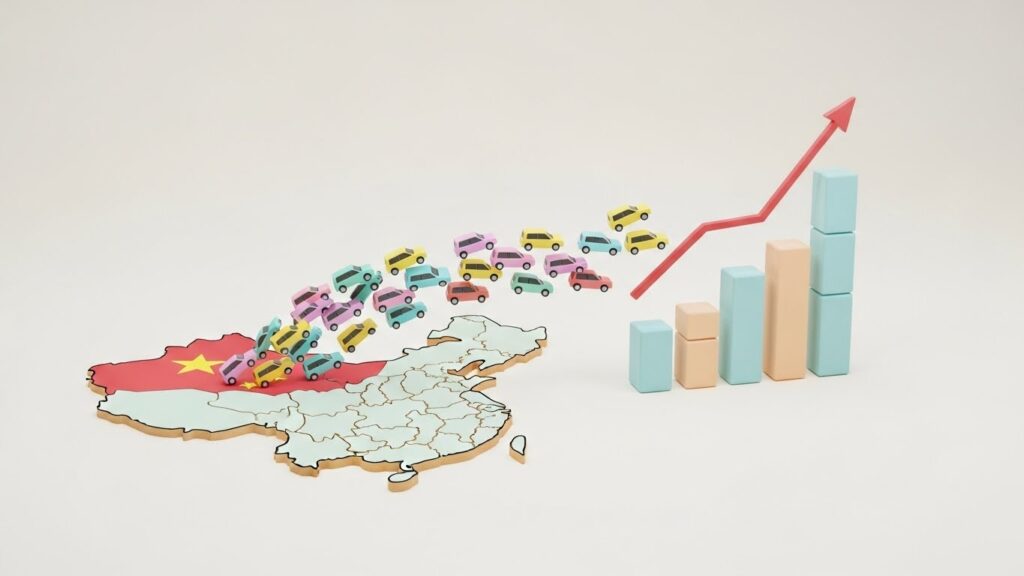
China’s auto industry is undergoing a dramatic transformation. As electric vehicles (EVs) rapidly take over domestic demand, traditional gasoline cars are increasingly viewed as overcapacity. To avoid idle factories and unsold inventory, Chinese automakers have turned to exporting gasoline vehicles overseas. This shift carries significant implications not just for the global auto market but also for traders tracking energy, commodities, currencies, and equities.
China’s Gasoline Cars Are Going Global
Chinese gasoline-powered vehicles are becoming the backbone of the country’s global auto-export surge. According to recent industry data, fossil-fuel vehicles have comprised 76% of Chinese auto exports since 2020.
Annual shipments of gasoline cars have surged from roughly 1 million units a few years ago to an estimated 6.5 million units as of 2025.
These cars are being shipped to emerging markets across Latin America, Eastern Europe, Africa, Southeast Asia, and other regions where EV infrastructure remains limited.
This export wave has transformed China into the world’s largest auto exporter by volume, surpassing traditional powerhouses.
Domestic EV Boom Reshapes the Auto Market
The export surge is a direct consequence of China’s fast-growing EV adoption and domestic policy. Within recent years, EVs and other “new energy vehicles” have captured a growing share of domestic car demand, squeezing the market for gasoline models.
With domestic buyers increasingly favouring EVs, demand for conventional fuel cars has collapsed. Many factories are now underutilised, creating a production surplus.
To keep operations viable and utilise capacity, automakers began redirecting output toward export markets. This shift from domestic consumption to export-driven sales has gained pace over the past 1–2 years.
Why Exporting Gasoline Cars Has Become a Strategic Priority
Exporting gasoline cars abroad has become a strategic lifeline for Chinese automakers as domestic demand for fuel-driven cars shrinks. By targeting overseas markets where EV adoption remains low, these companies salvage profitability and maintain economies of scale.
In many emerging-market countries, lower production costs give Chinese gasoline cars a competitive edge over older imported or locally produced models. Competitive pricing and availability combine to undercut traditional players, especially where EV infrastructure is lacking.
Moreover, exporting these cars helps relieve pressure domestically by reducing idle capacity and potential losses from unsold inventory. This allows automakers to invest more freely in EV development while monetising their existing gasoline-car capacity.
Global Ripple Effects on Supply Chains and Competitors
The surge in China’s vehicle exports is reshaping global auto competition. Traditional automakers from Japan, Korea, Europe, and other regions now face price pressure and market-share erosion in emerging markets, which were previously underserved by major brands.
Lower-priced Chinese gasoline cars are likely to trigger pricing competition, potentially forcing other automakers to cut prices or exit certain markets. This could lead to margin compression across the global auto industry.
Beyond vehicles themselves, demand for raw materials, steel, aluminium, rubber, and other auto-manufacturing inputs may shift, affecting commodity markets. Shipment volumes and global logistics flows could also intensify, possibly benefiting shipping and freight firms.
At the same time, increased exports may influence currency flows. A stronger export profile can support the Chinese yuan (CNY) and affect forex pairs of CNY versus major currencies, with ripple effects on forex-sensitive trades.
What This Means for Traders Watching the Auto and Energy Markets
For traders, this structural shift presents several key opportunities and risks you can explore on the VT Markets Platform:
1. Indices
Major global indices that include automotive manufacturers or suppliers could move as China’s export presence grows. Indices such as the Hang Seng Index, China A50 Index, Nikkei 225, and US equity benchmarks may see increasing volatility linked to global competition.
2. Forex (FX)
Export momentum may support the Chinese yuan over time. Currencies connected to trade or energy-driven economies could also react. Traders can watch popular forex pairs involving the Chinese yuan, the Japanese yen, and the euro to capture moves linked to shifting auto trade flows.
3. Commodities
Gasoline consumption trends may shift in regions receiving more Chinese vehicles. Commonly traded commodities such as crude oil and industrial metals like copper might experience price effects from changes in automotive demand and production costs.
4. Risk considerations
Potential tariffs, local regulatory restrictions, and political tensions could quickly affect export volumes and disrupt global supply chains. These factors may drive short-term price swings across the assets above.
The Outlook: Transition Phase or Long-Term Export Strategy?
In the near term, gasoline-car exports are likely to remain strong. Automakers appear to be capitalising on excess capacity while EV strategies mature. Export markets still offer price-sensitive demand, and many emerging economies lack EV infrastructure.
However, over the medium to long term, this might not evolve into a sustainable global gasoline-car export strategy. As EV adoption increases worldwide and regulatory pressure on emissions grows, demand for fuel vehicles could decline even in developing markets.
For Chinese automakers, gasoline exports may ultimately serve as a transition buffer while they ramp up EV production and global EV export ambitions.
Conclusion
China’s export-led gasoline car strategy is a key storyline shaping global automotive and energy markets. The trend creates ripple effects across equity indices, forex markets, and commodity prices. This is an important period for traders to watch policy decisions, competitive responses, and transport demand because these factors could influence price opportunities long before the broader market reacts.
Capture New Market Trends with VT Markets
The surge in China’s gasoline car exports is influencing global indices, forex markets, and key commodities. VT Markets provides access to these opportunities across our full suite of trading platforms and the VT Markets App, supported by fast execution and advanced trading tools designed for every trading style.
Explore real market conditions with a free demo account and visit our Help Centre anytime for platform guidance and trading support.
Create your live account when you are ready to trade global opportunities with VT Markets.








