





Key Takeaways
- Slippage is the difference between the price you expected to trade at and the price you actually received — it occurs in every financial market, including forex, equities, futures, and crypto.
- Negative slippage means a worse fill than intended (e.g., buying at £50.07 instead of £50.00); positive slippage means a better one.
- The five core causes are: market volatility, low liquidity, order type, large order size, and routing latency.
- Limit orders, guaranteed stop-losses, slippage tolerance settings, and trading during peak liquidity windows are the most effective controls.
- Ignoring slippage in your trade planning distorts your risk-reward ratio — building realistic assumptions in before you enter a position is essential.
What Is Slippage?
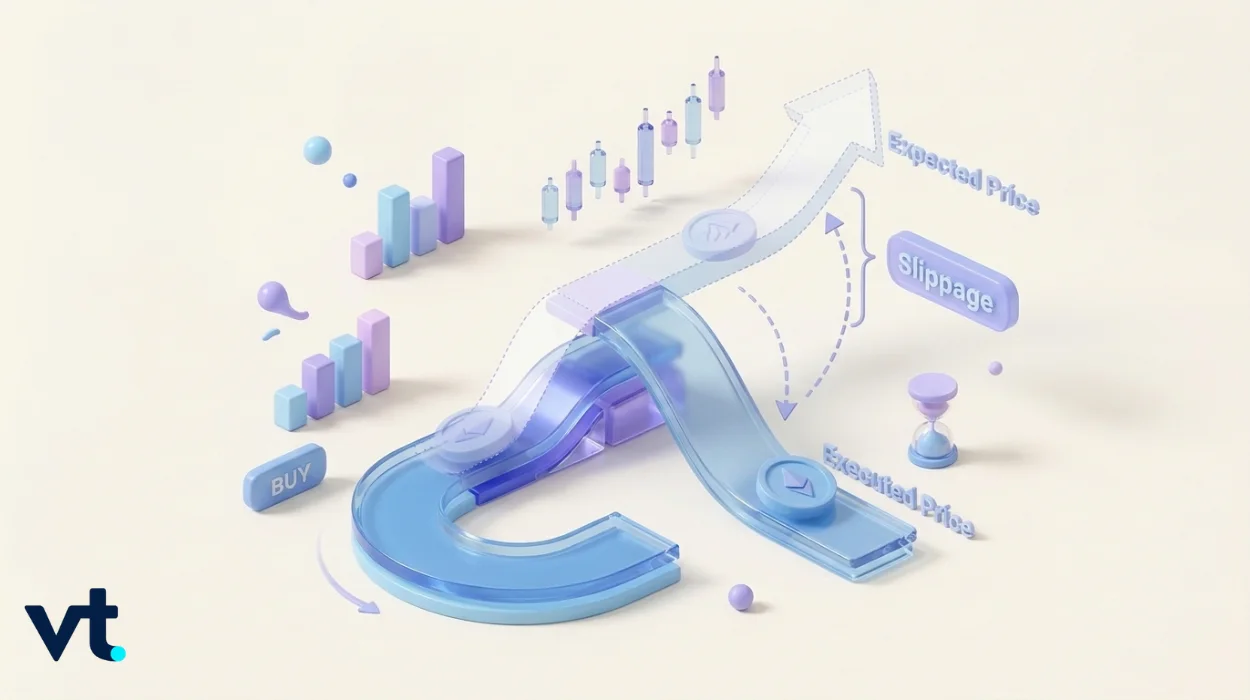
Slippage is the gap between the price you intended to trade at and the price at which your order actually executed. It is not a broker error or a glitch — it is a natural consequence of how live financial markets work.
When you place a market order on EUR/USD at 1.0850 and the confirmation shows 1.0854, the four-pip difference is slippage. The underlying market moved in the fraction of a second it took your order to travel from your platform to the execution venue.
Slippage affects every asset class — forex, stocks, futures, and cryptocurrency — and every type of trader. Understanding what it is, why it happens, and how to account for it is a core part of managing your trading costs.
How Does Slippage Work in Practice?
The sequence is straightforward: you submit an order, the market price shifts whilst your order travels to the venue, and the exchange or market maker executes your trade at the next available price. If the price has moved in that interval, your fill differs from your intention.
The order book plays a central role. At any moment, there is a finite amount of size available at each price level. If your order is larger than what is offered at the best price, the remainder fills at the next level, then the next — each step adding to your slippage.
A Forex Trading Example
A trader places a market buy on GBP/USD at 1.3050 seconds before a Bank of England announcement. As the data crosses, quotes reprice rapidly. The fill comes in at 1.3057. That seven-pip difference is slippage in forex trading — driven by volatility and near-instant repricing around a high-impact event.
A Stock Market Example
A trader submits a market buy for 1,000 shares at £50.00. Only 400 shares are available at that price. The next 400 fill at £50.08, the final 200 at £50.15. The average execution price is roughly £50.07 — 7p per-share slippage totalling £70. This is a textbook case of a single order exhausting available depth across multiple price levels.
Positive Slippage vs. Negative Slippage: What Is the Difference?
| Type | What Happens | Example |
|---|---|---|
| Negative slippage | Worse fill than expected | Buying at £100.12 instead of £100.00 |
| Positive slippage | Better fill than expected | Buying at £99.88 instead of £100.00 |
| Zero slippage | Filled at exactly your intended price | Buying at exactly £100.00 |
Data from FXCM found that across a large sample of retail forex orders, 73% saw zero slippage, 15% experienced positive slippage, and 12% negative. In calm market conditions, zero or positive outcomes are common. During fast, one-sided moves — a sudden rate decision, a geopolitical shock — negative slippage dominates the distribution.
Take note: Even a small average slippage per trade compounds across hundreds of positions. A strategy that tests profitably on historical data can underperform in live execution if slippage costs are not factored into the model.
Why Does Slippage Happen? The Five Core Causes
1. Market Volatility
Rapid price moves around central bank decisions, NFP releases, inflation data, or unexpected news cause quotes to change faster than orders can be processed. The larger the gap between price ticks, the greater the potential slippage on any order that reaches the book during that window.
2. Low Liquidity
Fewer buyers and sellers at a given price level means your order may exhaust the available size and push into progressively worse levels. Exotic currency pairs, penny stocks, and smaller crypto tokens carry materially more slippage risk than deeply traded major instruments.
3. Order Type
Market orders prioritise execution speed over price — they fill at whatever the best available quote is at the moment they arrive. Limit orders cap your execution price but carry the risk of non-execution if the market never reaches your level. Stop orders convert to market orders when triggered, exposing them to slippage in fast-moving conditions.
4. Order Size
Large orders in thinly traded instruments consume the displayed depth and walk the execution price through multiple levels. The same position that fills cleanly in EUR/USD could cause significant slippage in a thinly traded exotic pair or micro-cap stock.
5. Latency and Routing
Delays between your trading platform and the execution venue — caused by network speed, server location, or order routing complexity — give the market time to move before your order lands. This matters most for high-frequency and algorithmic strategies.
How Slippage Differs Across Asset Classes
Slippage varies significantly across asset classes like equities, futures, and forex because each has unique trading hours, liquidity patterns, and market participants.
Forex. Major currency pairs like EUR/USD have lower slippage due to extremely high liquidity-often under 0.5 pip in calm conditions. Exotic pairs (USD/MXN, USD/ZAR) can see 5–10 pips of price slippage even in normal sessions, with fewer participants on each side of the book. Slippage is more common in forex markets during high volatility events like FOMC or NFP releases.
Equities. Mega-cap stocks enjoy deep order books and tight spreads, keeping per-share slippage minimal. Penny stocks, by contrast, trade with wide spreads and sporadic volume. Even a few thousand shares can move the market, causing a higher price fill on buys and a lower price fill on sells.
Futures. Highly liquid contracts like the E-mini S&P 500 see minimal slippage during regular trading hours. Less liquid commodity contracts or niche futures near roll dates can suffer more, as higher liquidity evaporates.
Crypto. Cryptocurrency markets experience higher slippage due to extreme volatility and fragmented liquidity pools. Slippage can reach extreme levels during flash crashes. On decentralized exchanges, setting slippage tolerance is a common practice to prevent fills far from the specified price.
Slippage Across Different Markets
What Is Slippage in Forex Trading?
In the forex market, slippage varies significantly between instrument types. Major pairs — EUR/USD, GBP/USD, USD/JPY — typically see under 0.5 pip of slippage in calm conditions, thanks to deep liquidity and tight spreads. Exotic pairs such as USD/ZAR or USD/MXN can produce five to ten pips of slippage even in normal sessions, with far fewer participants on each side of the book.
Slippage in forex is most pronounced around scheduled data releases: NFP, CPI, GDP prints, and central bank rate decisions. Many experienced traders reduce position size or widen their stop placement during these windows to account for increased execution variance.
What Is Slippage in Crypto Trading?
Cryptocurrency markets combine extreme volatility, 24/7 trading without centralised clearing, and liquidity fragmented across dozens of exchanges. All three factors amplify slippage. During flash crashes or sudden volume spikes, slippage can reach several percentage points on altcoins or less liquid tokens.
On decentralised exchanges (DEXs), setting a slippage tolerance before confirming a swap is a standard part of the interface. Users define a maximum acceptable percentage — often 0.5–1% for major pairs, higher for illiquid tokens — and the transaction reverts automatically if execution would exceed that threshold.
What Is Price Slippage in Equities and Penny Stocks?
Blue-chip stocks on major exchanges enjoy deep order books, multiple market makers, and tight spreads. Per-share slippage is minimal under normal conditions. Penny stocks present a very different picture — wide spreads, sparse displayed volume, and sporadic liquidity mean that even modest orders can walk the book.
Research from Alvarez Quant Trading found that strategies profitable in backtests lost approximately 8% in live trading over equivalent periods, largely because unmodelled slippage in thinly traded equities consumed the apparent edge.
How Slippage Affects Day Traders and Scalpers
For short-term strategies where profit targets measure a handful of pips or pence per trade, slippage is not background noise — it is a material execution cost.
Consider a scalper who shorts a momentum stock at 1240p with a stop at 1250p and a target of 1230p. That is a 10p reward against 10p risk — a 1:1 ratio. A 3p slip on the entry and a 5p slip on the stop exit reduces the trade from break-even to a loss of 8p per share. Scale that across 50 trades per week and the aggregate impact is significant.
Reminder: When backtesting or paper trading a scalping or intraday strategy, always include a realistic slippage assumption — even one or two pips or pence per side — to pressure-test whether the edge holds in real execution conditions. A model that only tests well without slippage costs may not hold up in live markets.
Order Types That Help You Manage Slippage
| Order Type | Slippage Risk | Trade-off |
|---|---|---|
| Market order | High | Guaranteed execution; no price control |
| Limit order | None (or positive only) | May not execute if price doesn’t reach your level |
| Stop order | Moderate to high (converts to market at trigger) | Automatic trigger; exposed to gaps |
| Guaranteed stop-loss | None (locked exit price) | Requires a premium or minimum distance |
Limit orders are the most direct tool for controlling slippage on entries. By specifying the maximum price you will accept (buy) or minimum price you will accept (sell), you prevent fills beyond your chosen level. The trade-off is execution certainty — in a rapidly moving market, the price may not return to your limit.
Guaranteed stop-loss orders lock your exit at a specified price regardless of gaps or extreme volatility. They are particularly valuable around scheduled announcements. A small premium or minimum distance from the current price is typically required. Not all platforms or instruments support this feature — check your deal ticket.
Six Practical Ways to Reduce Slippage Risk
- Trade during peak liquidity windows. For forex, the London–New York overlap (approximately 1:00–5:00 pm BST) offers the tightest spreads and deepest order books. For equities, the opening and closing hours of the main session typically carry the most volume. More participants mean better fills.
- Avoid major news events unless your strategy is built for them. Scheduled releases — NFP, CPI, rate decisions, earnings — produce the most acute slippage conditions. Unless you are running a news-specific strategy with appropriate risk controls, reducing exposure during the release window is a sensible precaution.
- Size orders relative to available liquidity. For thinly traded assets, reduce position size or scale in gradually. This prevents a single large order from consuming multiple price levels in the book.
- Use limit orders where your strategy permits. Switching from market to limit orders on entries reduces slippage exposure, at the cost of some missed opportunities when price moves quickly through your level.
- Set a slippage tolerance on your platform. Many platforms allow you to cap the maximum slippage you will accept on a market order. If the fill would exceed your tolerance, the order is cancelled rather than executed at an unfavourable price. Use this selectively — a tolerance of zero can cause excessive order rejections.
- Review your execution data regularly. Track your expected versus actual fill prices across at least 50–100 trades. This reveals which instruments, times of day, and market conditions produce the most slippage for your specific approach. OANDA’s publicly available quarterly best-execution slippage reports, broken down by instrument, provide a useful industry benchmark for comparison.
Understanding Slippage Tolerance: Balancing Control and Execution
Slippage tolerance is both a platform feature and a risk planning concept. As a platform setting, it defines the maximum price change you will accept before an order is rejected. As a planning tool, it means estimating realistic slippage costs before entering a trade and factoring them into your risk-reward ratio.
A practical starting point: assume 0.1–0.3% slippage on highly liquid instruments (major forex pairs, large-cap equities), and 0.5–1%+ on less liquid ones (exotic pairs, small caps, low-volume crypto). Apply these assumptions to your position sizing and profit targets before entering, not after a fill surprises you.
Caution: Setting tolerance to zero avoids bad fills but also causes frequent order rejections and missed entries — itself a form of execution risk. The right tolerance level reflects the instrument’s typical variance rather than a blanket zero-or-unlimited default.
Test and adjust your slippage parameters in a demo environment before applying them to full-size positions. The data you collect will reveal what is typical for your broker, instruments, and preferred market hours.
Frequently Asked Questions About Slippage in Trading
Is all slippage harmful, or can it sometimes work in your favour?
Slippage is neutral by definition — it simply measures the gap between intended and actual price. Positive slippage reduces your costs; negative slippage increases them. Over many trades, the realistic goal is to minimise average negative slippage rather than eliminate all slippage on every order. Brokers that report execution data transparently typically show a mix of positive, zero, and negative outcomes across their client base.
How much slippage is normal when trading major forex pairs?
In calm conditions, EUR/USD or GBP/USD typically sees zero to 0.5 pip of slippage on small-to-medium market orders with established brokers. During major economic releases, slippage of several pips is not unusual even on the most liquid pairs. Your own execution history — filtered by instrument, session, and market conditions — is a more reliable guide than any single industry average.
Why do penny stocks experience so much more slippage than blue-chip shares?
Penny stocks typically carry wide bid-ask spreads, low displayed volume at each price level, and few active market makers. Even a modest buy or sell order can consume the nearest available price level and push execution to the next one. Blue-chip equities have multiple participants competing to fill orders, keeping spreads tight and slippage minimal under normal market conditions.
Does a faster internet connection meaningfully reduce slippage for retail traders?
For most retail traders, the principal drivers of slippage are liquidity and volatility — not home internet speed. Improving latency through a VPS or co-located server matters most for high-frequency and algorithmic strategies where milliseconds directly affect profitability. For the majority of retail approaches, choosing appropriate order types and trading during liquid market sessions has a significantly larger impact than shaving a few milliseconds off your connection.
Start Trading CFDs with VT Markets
If you are ready to put your understanding of slippage in trading to work in live markets, VT Markets provides access to tools and platforms to help you get started. Trade on powerful platforms like MetaTrader 4 (MT4) and MetaTrader 5 (MT5) , designed for speed, reliability, and advanced execution features — exactly what matters when market conditions shift fast.
New to trading? Practise risk-free with a VT Markets demo account before committing to live capital — ideal for understanding how slippage behaves across currency pairs, indices, and commodities without financial risk.
Open your live trading account with VT Markets today and access secure, transparent, and competitive CFD trading across some of the world’s most popular markets.
CFDs are complex instruments and come with a high risk of losing money rapidly due to leverage. Ensure you understand how CFDs work and whether you can afford to take the high risk of losing your money.



