



You set a stop loss, close your trading app, and return to find that your position closed at a worse price than expected. How could your loss exceed the amount you planned?
During a sell-off, prices can move faster than orders can be filled, or jump past levels altogether. For CFD traders, understanding that process matters as much as choosing an entry.
This guide explains what happens to open positions, why stop losses can slip, and how VT Markets’ negative balance protection may apply.
What Happens to My CFD Positions During a Market Gap?
A market gap happens when the next available price is different from the previous price, leaving a visible space on the chart. A gap down means the market opens or resumes trading lower; a gap up means it moves higher.
Gaps can follow earnings announcements, unexpected economic decisions, or weekend headlines. Your CFD follows its quoted market price, so an open position’s unrealised profit or loss changes when pricing resumes.
For a long position, a gap down increases losses or reduces profits. For a short position, it can increase profits. A gap up reverses those effects.
Your position does not automatically close simply because a gap occurs. However, a stop loss may trigger, or deteriorating account equity may lead to a stop-out.
Gap risk is the possibility that prices skip levels where you expected to enter or exit. The trading hours of your specific CFD matter: do not assume its availability exactly matches the underlying market.
For more information, read Gap Trading: Overnight Price Gaps in Shares & Indices
What Is Slippage in Trading?
Slippage is the difference between an order’s expected price and its actual execution price. It can happen when opening or closing a trade, including when a stop loss triggers.
A gap describes a jump between prices. Slippage describes the difference between the price you expected and the fill you received. A gap can cause slippage, but slippage can also occur while a market trades continuously.
During a sell-off, many participants may try to sell simultaneously. If insufficient buying interest is available at a particular price, execution may occur lower.
Slippage can be:
- Negative: Your order fills at a less favourable price.
- Positive: Your order fills at a more favourable price.
Why Was My Stop Loss Filled at a Worse Price?
A standard stop loss is a trigger to close a position, rather than a guarantee of the final execution price.
Consider this hypothetical long index CFD position:
| Detail | Illustrative value |
| Entry price | 5,000 |
| Position value per point | USD 1 |
| Stop-loss level | 4,950 |
| Expected loss at the stop price | USD 50 |
| First available executable price after a gap | 4,900 |
| Actual closing loss | USD 100 |
The market skipped the stop level. If the position closes at 4,900, the loss is 100 points rather than the planned 50 points, excluding fees and other costs.
The stop triggered, but its execution price slipped. A trailing stop can face the same problem.
Can a Sell-Off Trigger a Margin Call or Stop-Out?
Yes. Losing positions reduce account equity, which includes your balance and floating profit or loss. As equity falls relative to used margin, your margin level declines.
A margin call warns that your account is approaching its required limits. A stop-out means positions are automatically closed when the applicable threshold is reached.
During a sudden gap, your account may pass through warning and stop-out levels too quickly for you to react. Forced closures can also experience slippage.
Check the current requirements for your account type and entity rather than assuming one threshold applies to everyone.
What Is Negative Balance Protection?
Negative balance protection, or NBP, is a safeguard that can reset an eligible negative trading account balance to zero under the applicable terms.
VT Markets offers negative balance protection, which automatically or manually restores your balance to zero.
You can either perform an automatic reset, or a manual reset of your account:
- Automatic Reset: The system automatically scans accounts and resets negative balances back to zero every 3 minutes.
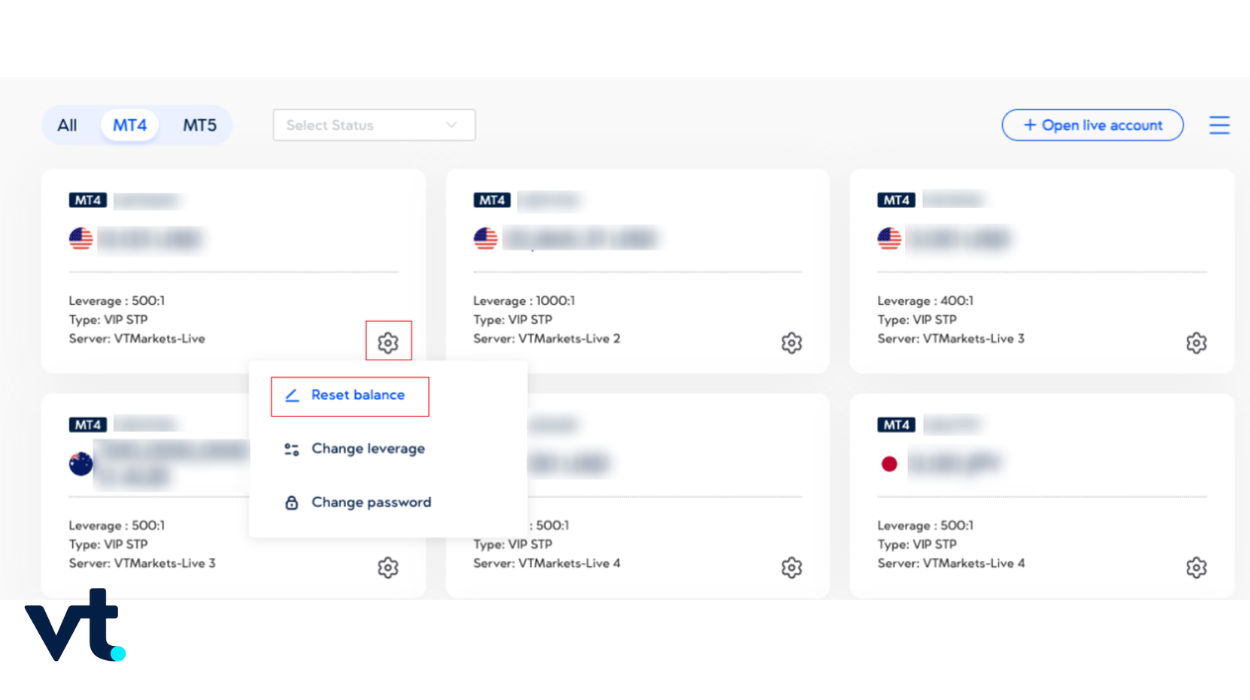
- Manual Reset (via Client Portal): If the automated reset is delayed and your balance remains negative for more than 1 hour, a manual option becomes available:
- Log in to the VT Markets Client Portal.
- Navigate to Accounts.
- Locate the affected MT4/MT5 trading account, click the Settings (gear) icon, and select Reset balance.
Does a Stopped-Out Trade Mean Stop Loss Hunting?
A price briefly crossing your stop before reversing can feel frustrating. Traders sometimes describe this as stop loss hunting, meaning price movement toward areas where stop orders are believed to cluster.
However, a stopped-out trade or sharp reversal alone does not establish manipulation. Rapid repricing, spread widening, and differences between bid and ask prices can help explain an unexpected closure.
How to Prepare Before the Next Sell-Off
If you are learning how to trade gap up and gap down movements, begin with exposure management rather than assuming every gap will reverse.
Use this checklist before holding through a major event:
| ✓ | Checklist item | What to review |
| ☐ | Check the catalyst | Review earnings, economic releases, and scheduled announcements. |
| ☐ | Confirm trading hours | Know when your specific CFD closes and reopens. |
| ☐ | Stress-test the position | Calculate the effect of a move beyond your stop. |
| ☐ | Review combined exposure | Several correlated positions can lose together. |
| ☐ | Keep a margin buffer | Available margin is not a target to use fully. |
| ☐ | Consider reducing exposure | Closing or partially closing before an event reduces the amount exposed. |
Stops, margin controls, and eligible negative balance protection serve different purposes. Understanding their limits helps you plan for the price you might receive, alongside the price you hope to receive.
Frequently Asked Questions
- Can my VT Markets balance become negative with NBP?
Yes. Extreme movements can leave a negative balance after positions close. Negative balance protection provides a reset process for eligible accounts.
- How often does VT Markets reset negative balances?
The system scans accounts every three minutes. If a negative balance persists beyond one hour, a manual reset option becomes available.
- Can I reset my balance with trades still open?
No. All active trades must be fully closed before using the manual balance-reset feature.
- Will a balance reset restore my deposit?
No. A reset clears an eligible negative balance. It does not refund deposits or compensate for trading losses.
- Will VT Markets cover my stop-out loss?
No. VT Markets does not compensate or reimburse losses caused by a stop-out. Certain accounts may be eligible for Negative Balance Protection (NBP), under which a negative balance resulting from stop-out may be reset to zero following an internal review, subject to the applicable terms and conditions and the regulatory requirements of the entity your account is held with. NBP should not be viewed as compensation.



