





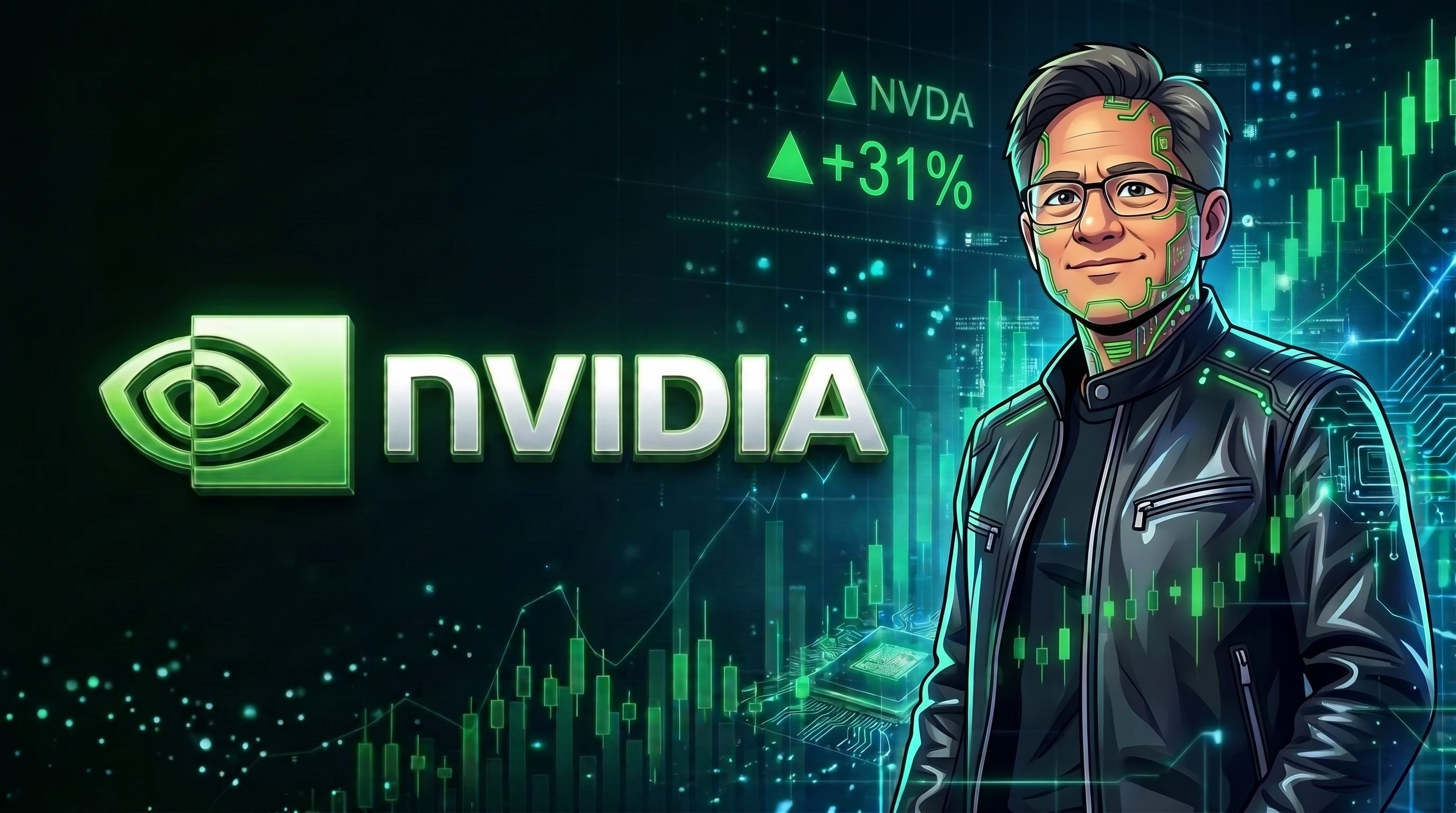
Nvidia’s board voted unanimously on 23 November 2026 to reinstate Jensen Huang as President, CEO and board director, just 11 days after his resignation, and NVDA shares responded with the largest single-day market-capitalisation gain by any company in history. This article explains what actually happened, how Nvidia’s stock and the broader market reacted, and the factors traders and investors are watching as the story develops.
This article is for informational purposes only and does not constitute investment advice or a recommendation to trade any instrument. For a deeper look at the leadership story itself, see our analysis: Jensen Huang Returns as Nvidia CEO: Can His Return Revive the Stock Market?
Key takeaways
- Jensen Huang resigned as Nvidia CEO on 12 November 2026 amid a board investigation into a reported foreign intelligence effort targeting him, before being reinstated unanimously on 23 November 2026.
- NVDA closed at $165.05 on 23 November 2026, up 31.48% on the day, adding roughly $950 billion to $1 trillion in market value, reportedly the largest single-day market-cap gain for any company on record.
- The rally extended well beyond Nvidia: Nasdaq 100 futures jumped around 7% and briefly hit circuit breakers, with other chip and AI-adjacent names rallying alongside NVDA.
- This rebound followed a sharp selloff just days earlier, driven by broader concerns about AI-spending valuations, not by the leadership story alone, meaning Huang’s return did not resolve every concern weighing on AI-related stocks.
- Nvidia’s internal investigation continues, and the company is forming a new National Security and Export Control Committee alongside a Chief Compliance Officer role, both worth watching for updates.
What happened: Jensen Huang’s return as Nvidia CEO
The story began on 12 November 2026, when Jensen Huang resigned as Nvidia’s CEO following reports that he had been the target of a foreign intelligence effort. The board launched an independent investigation into the matter, and Chief Financial Officer Colette Kress stepped in as interim CEO for the roughly eleven days that followed.
As recently as six days before Huang’s reinstatement, board chair Harvey Jones had publicly stated that the board had no intention of bringing him back. That changed on 23 November 2026, when Nvidia’s board voted unanimously to reinstate Huang as President, CEO and board director, effective immediately. According to Nvidia’s own announcement, the board reached this decision after consulting senior US government officials and concluding that reinstating Huang posed no national-security risk. US President Trump also voiced public support for Huang’s return.
Importantly, the underlying investigation has not been closed. Nvidia is establishing a new National Security and Export Control Committee, and creating a Chief Compliance Officer position that will report to that committee rather than to Huang directly, a structural signal that oversight of the original concerns is continuing even as Huang resumes his role.
Nvidia’s stock price reaction
Markets responded to the reinstatement news immediately and dramatically. NVDA closed trading on Monday 23 November 2026 at $165.05, up $39.52, or 31.48%, from the prior close of roughly $125.53. That single-day move is reported to have added somewhere between $950 billion and $1 trillion to Nvidia’s market capitalisation, which several outlets described as the largest one-day market-cap gain for any public company on record, pushing Nvidia’s valuation back up toward the $4 trillion mark.
Intraday, NVDA shares traded as high as $171.45 before easing back into a consolidation range in the $164 to $166 area by the close. Traders watching the chart afterward pointed to resistance in the $170 to $171.45 region (the intraday high) and support in the $160 to $162.64 area as levels worth monitoring in subsequent sessions. These are reference points being discussed around the move, not a forecast of where the price will go next.
How the broader market and AI stocks reacted
The reaction extended well beyond Nvidia itself. Nasdaq 100 futures jumped around 7% intraday and briefly triggered circuit-breaker trading halts. By the close, major indices posted some of their strongest single-day gains in recent memory, with reported moves in the Nasdaq Composite and S&P 500 each advancing several percent on the day. Other chipmakers such as Micron and AMD rose alongside Nvidia, as did AI-infrastructure names like CoreWeave, which reportedly gained around 20%. Measures of expected market volatility fell sharply as the rally built, a pattern sometimes described as a “volatility crush.”
Context matters here. Just three trading days earlier, on Friday 20 November 2026, markets had suffered a severe selloff: the S&P 500 fell around 3.7% and the Nasdaq Composite around 5.3%, pushing both the S&P 500 and the Dow Jones Industrial Average into correction territory. NVDA itself had dropped roughly 14% in that single session, and the Nasdaq 100 had fallen around 20% from its October peak near 31,400 down to roughly 24,900, slipping below its 200-day moving average. That prior selloff was driven primarily by concerns over stretched AI-related valuations, heavy capital spending commitments across the sector, and expectations around further Federal Reserve interest-rate moves, not by Nvidia’s leadership situation specifically.
That context is important for understanding Monday’s rally: a large part of the bounce reflected relief that a specific, company-level uncertainty (Huang’s status) had been resolved, layered on top of a market that was already technically oversold after a sharp prior decline. Whether the broader AI-valuation and rate concerns that drove the original selloff have actually been addressed is a separate question from the leadership story itself.
What is Nvidia?
Nvidia Corporation (ticker: NVDA) is a Santa Clara, California-based technology company founded in 1993. It designs graphics processing units (GPUs) and the broader computing hardware and software stack used in gaming, professional visualisation, and increasingly in AI and data-centre workloads, where demand for its chips has driven much of its growth in recent years. Nvidia is a constituent of both the Nasdaq-100 and S&P 500 indices, and its scale means its share-price moves can have an outsized effect on both benchmarks, as this episode demonstrated.
For a broader look at Nvidia’s business segments, financial performance and longer-term growth drivers independent of this specific leadership story, see our separate guide: NVIDIA Stock Price: Complete NVDA Analysis, Chart & Forecast.
Why the move was described as a “circuit breaker” event
Several reports described Nasdaq 100 futures as hitting circuit breakers during the rally. Circuit breakers are automatic, exchange-mandated trading halts triggered when an index or futures contract moves by a predefined percentage within a set period, designed to give the market a brief pause to absorb fast-moving information rather than to prevent a move altogether. Their use here, on the way up rather than the more commonly discussed scenario of a sharp decline, underscores just how unusual the scale and speed of Monday’s rally was, not only for Nvidia itself but for the index futures market tracking the broader technology sector.
Factors to watch going forward
The unresolved internal investigation. The original inquiry into the foreign intelligence allegations against Huang has not been closed, and updates on its progress, or on the new National Security and Export Control Committee and Chief Compliance Officer roles, are worth monitoring.
Whether this is a sustained recovery or a relief rally. Analysts have flagged that a single strong session does not necessarily resolve the broader worries that triggered the prior selloff. Continued buying participation across mega-cap technology names, and improving technical structure in the Nasdaq 100 more broadly, are among the signals commentators are watching for evidence of a more durable recovery versus a short-lived bounce.
Broader AI-capex and valuation concerns. The concerns that drove the prior week’s selloff, elevated AI-related capital spending, stretched valuations across the sector, and the prospect of fewer Federal Reserve rate cuts, predate and are separate from the leadership story, and remain relevant regardless of how the Huang situation develops.
Upcoming earnings and guidance. As with any individual stock, Nvidia’s next quarterly results and forward guidance on data-centre and AI-chip demand will be a significant data point for assessing whether current price levels are supported by underlying business performance.
These are factors market participants are citing as relevant, not predictions of how Nvidia’s stock will perform.
The bull case for Nvidia stock
Supporters of the stock point to Nvidia’s central position in AI infrastructure build-out, its dominant market share in AI-training and inference chips, and the market’s apparent relief that a specific leadership overhang has been lifted. The scale of Monday’s rally, and the fact that it extended across the broader chip and AI sector rather than being confined to Nvidia alone, is cited as evidence that underlying demand expectations for AI infrastructure remain intact.
The bear case: points to note
Sceptics point out that the same AI-capex and valuation concerns that triggered the prior week’s sharp selloff have not disappeared simply because a leadership question was resolved. The ongoing internal investigation, the newly created compliance and national-security oversight structures, and the general difficulty of distinguishing a genuine recovery from a short-covering or relief-driven bounce are all cited as reasons for caution. Significant single-day moves in either direction, as seen both in the prior selloff and in Monday’s rebound, are themselves a sign of a stock trading with elevated volatility.
How to trade or invest in Nvidia stock
- Research the company and the sector. Understand Nvidia’s business segments, its role in the AI and semiconductor supply chain, and how this specific leadership story fits into the broader picture before making any decision.
- Choose a regulated broker. Confirm the regulatory status of whichever platform you plan to use before funding an account.
- Decide how to gain exposure. Buying shares directly involves ownership of the underlying stock; CFDs instead track the price movement without ownership and can involve leverage, allowing positions in either direction.
- Apply risk management tools. Given the scale of recent single-day moves in NVDA, position sizing, stop-loss levels, and an awareness of overnight financing costs on leveraged positions are all worth planning in advance.
- Monitor developments on an ongoing basis. This is an actively developing story; new information on the investigation, compliance structure, or upcoming earnings could all move the stock further.
Tips for following NVDA amid volatility
- Separate company-specific news (the Huang story) from sector-wide news (AI-capex and valuation concerns) when trying to understand why the stock is moving on a given day.
- Treat single-session resistance and support levels mentioned by commentators as reference points for context, not as guaranteed turning points.
- Keep an eye on how other chip and AI-infrastructure names move alongside Nvidia, since recent sessions have shown moves propagating across the sector rather than staying isolated to one stock.
- Review the size of any position relative to your overall portfolio in light of how quickly NVDA has moved in both directions over the past several trading sessions.
Conclusion
Jensen Huang’s reinstatement as Nvidia’s CEO, after an eleven-day absence tied to a national-security investigation, triggered one of the largest single-day stock-market reactions on record, both for Nvidia specifically and for AI-related names more broadly. That reaction came on the heels of a sharp prior selloff driven by separate concerns about AI spending and valuations, concerns that this news does not, on its own, resolve. The investigation into Huang continues, and Nvidia’s new compliance and national-security oversight structures are worth watching as the story develops further.
Start trading Nvidia and global markets with VT Markets today
VT Markets offers CFD access to Nvidia and a wide range of other global shares, indices and ETFs through MT4 and MT5. If you are new to trading, a demo account lets you practise placing trades before moving to a live account.
Open a VT Markets account today to access transparent and competitive trading conditions across global markets.
Frequently Asked Questions (FAQs)
Why did Jensen Huang leave and then return as Nvidia CEO?
Huang resigned on 12 November 2026 following reports he was the target of a foreign intelligence effort, which prompted an independent board investigation. The board reinstated him unanimously on 23 November 2026 after concluding, with input from senior US government officials, that his return posed no national-security risk. The underlying investigation continues.
How much did Nvidia’s stock price rise on the news?
NVDA closed on 23 November 2026 at $165.05, up 31.48% from the prior close, in a move reported as the largest single-day market-capitalisation gain for any company in history.
Did the whole stock market react to this news?
Yes. Nasdaq 100 futures rose around 7% and briefly hit circuit breakers, and other chip and AI-related names rallied alongside Nvidia, though the rally also followed, and partly reflected relief after, a sharp broader selloff the previous week.
Is Nvidia stock a good buy after this rally?
That depends on an individual investor’s own research, risk tolerance and objectives. The rally resolved a specific leadership uncertainty, but separate concerns about AI-sector valuations and spending that drove the prior selloff remain relevant and have not disappeared.
What is Nvidia’s internal investigation about?
It concerns reports that Jensen Huang was the target of a foreign intelligence effort. Nvidia’s board investigated the matter before reinstating Huang, and the company is creating new national-security and compliance oversight structures as the investigation continues.
Can I trade Nvidia stock via CFDs?
Yes, where offered by a regulated broker like VT Markets. CFDs let traders take a position on Nvidia’s share-price movement, including the ability to go short, without owning the underlying shares, though they can involve leverage and carry higher risk.
What should traders watch next for Nvidia stock?
Updates on the ongoing investigation and new compliance structures, whether the broader AI-sector rally proves durable or fades, and Nvidia’s next quarterly earnings and guidance are among the key things market participants are watching.
What is a circuit breaker, and why did it trigger during Nvidia’s rally?
A circuit breaker is an automatic trading halt triggered when an index or futures contract moves by a set percentage within a defined window, intended to let markets pause and absorb fast-moving news. Nasdaq 100 futures reportedly triggered one during Monday’s rally, which is unusual given circuit breakers are more commonly discussed in the context of sharp declines rather than rapid gains.
How does Nvidia’s size affect the wider stock market?
Because Nvidia is one of the largest constituents of both the Nasdaq-100 and S&P 500, large moves in its share price can meaningfully influence those indices’ overall performance on a given day, which is part of why Monday’s rally was felt across the broader market and not just in Nvidia’s own stock.
Has Nvidia’s leadership issue been fully resolved?
Not entirely. While Jensen Huang has been reinstated as CEO, the underlying investigation into the foreign intelligence allegations against him remains open, and Nvidia is still in the process of establishing its new compliance and national-security oversight structures.
Risk warning: CFDs are complex instruments and come with a high risk of losing money rapidly due to leverage. Nvidia stock has shown significant volatility in recent trading sessions, and past price movements do not indicate future results. You should consider whether you understand how CFDs work and whether you can afford to take the high risk of losing your money. This article is for informational purposes only and does not constitute investment advice or a recommendation to trade any instrument. Figures are correct as at 23-24 November 2026 and are subject to change.





