





Key Points
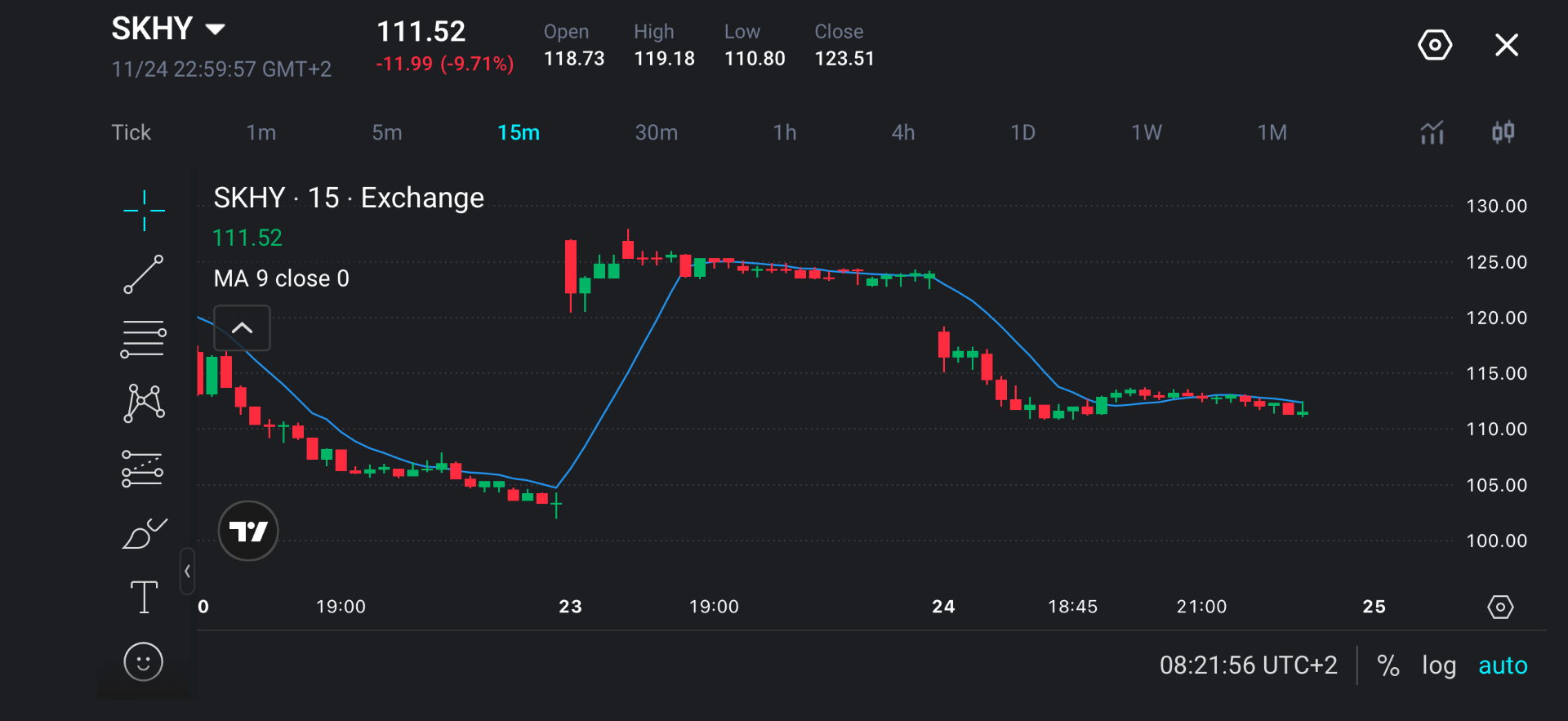
- SKHY is trading at $111.52, down $11.99 or 9.71%, on 24 November.
- Asian semiconductor shares fell sharply on Wednesday as concerns over AI valuations and infrastructure spending returned.
- Taiwan’s Taiex fell as much as 8.6%, while South Korea’s Kospi dropped as much as 6.4%.
- $110.80 is immediate support, while $113.00–$113.50 marks the nearest consolidation resistance.
Market Move
Asian technology stocks reversed direction on Wednesday, 25 November, giving back most of Tuesday’s gains following Jensen Huang’s return to Nvidia. Attention has now shifted back to the sustainability of AI spending.
SK Hynix (SKHY) was trading around $123.51 on Monday, gaining roughly 19% from its previous close of $103.57. However, the market appears to have corrected itself, with SKHY falling to $111.52, down 9.71%.
In its latest session, SKHY was quoted at $111.52, down 9.71%, with a session high of $119.18 and a low of $110.80.
Why Traders Are Watching
SK Hynix supplies the high-bandwidth memory (HBM) used in Nvidia’s AI processors, so its shares tend to move with expectations for data-centre demand, often more sharply than the wider market. That sensitivity rippled across the region. Taiwan’s Taiex fell roughly 8% and South Korea’s Kospi 6%, while Samsung Electronics and SK Hynix each dropped more than 9%.
Investors are debating whether heavy spending on data centres will deliver sustainable earnings. Any pullback in investment by major technology companies could weaken growth expectations for AI suppliers. SK Hynix continues to expand its AI memory business, and traders will be watching these developments and potential earnings growth.
Sharp price swings also suggest fragile market confidence. Short covering can lift shares quickly, but profit-taking and forced selling can reverse those gains. Sustained buying over the coming sessions would provide stronger evidence of stabilisation.
Key Trading Levels
| Level | What Traders Are Watching |
| $123.50–$125.00 | Previous trading shelf before the latest sharp decline. |
| $118.73–$119.18 | Session open and high. |
| $115.00 | Intermediate reference within the recent sell-off. |
| $113.00–$113.50 | Approximate ceiling of the latest consolidation. |
| $111.52 | Latest quoted price. |
| $110.80 | Displayed session low and immediate support. |
| $105.00–$106.00 | Earlier consolidation area. |
| $102.00–$103.00 | Approximate lower swing area preceding the rebound. |
SKHY is trading beneath a declining nine-period moving average, with recent candles clustered near the bottom of the latest range. The earlier recovery towards $125.00 has faded, leaving a weaker short-term structure.
The latest consolidation is relatively narrow compared with the preceding decline. That suggests selling has slowed, although it has not yet developed into a sustained recovery.
Bullish and Bearish Setups
| Setup | Trigger | Confirmation |
| Bullish | Hold above $110.80 and break $113.50 | Price holds above the nine-period MA and semiconductor sentiment stabilises |
| Extended recovery | Sustained move above $115.00 towards $118.73–$119.18 | Buyers establish higher lows and broader chip stocks recover |
| Pullback | Retreat towards $110.80–$111.00 | Buyers defend support and price turns higher |
| Bearish | Break below $110.80 | A failed recovery above that level confirms continued selling pressure |
| Deeper bearish | Sustained move below $105.00 | Earlier support gives way, exposing $102.00–$103.00 |
Bullish scenario: SKHY could recover if buyers defend $110.80 and push above $113.50, reclaiming the nine-period moving average. A sustained break above $115.00 would bring $118.73–$119.18 into focus.
Bearish scenario: SKHY could face renewed pressure if it breaks below $110.80 and fails to reclaim that level. This would bring $108.00, followed by $105.00–$106.00, into focus. A sustained move below $105.00 would expose the earlier swing area around $102.00–$103.00.
Disclaimer
The price levels and market scenarios above reflect the author’s assessment at the time of writing. They do not represent financial advice or an official recommendation from VT Markets. Traders should conduct their own analysis and manage risk carefully.
SKHY Prediction: What’s Next?
Main market drivers include:
- Nvidia and the wider chip sector. A rebound shared by several major chipmakers would be a firmer base than a recovery in SKHY alone. Traders will be watching Nvidia’s direction most closely, given SK Hynix’s HBM link to its processors.
- AI spending and memory demand. These are the main fundamental catalysts. Signs of steady orders, resilient pricing and disciplined capacity expansion could support sentiment, while customer spending cuts or project delays would raise doubts about future earnings.
- Policy support in Asia. Market stabilisation measures could influence volatility. Supportive announcements may prompt short covering, but a lasting recovery would need buying interest to continue beyond the first reaction.
Trade SKHY with VT Markets
SKHY CFDs give traders exposure to SK Hynix price movements without owning the underlying shares. Traders commonly monitor the stock alongside semiconductor peers, AI-related equities, major indices and broader risk sentiment.
Monitor SKHY price action alongside other global share CFDs and indices at VT Markets.
Open a live trading account today and gain access to bonds, indices, gold and market insights.
Frequently Asked Questions (FAQs)
Why is SK Hynix falling despite Jensen Huang’s return?
Huang’s reinstatement eased uncertainty over Nvidia’s leadership. However, concerns about AI valuations, infrastructure funding and the returns on heavy capital spending remain, weighing on related semiconductor stocks.
How does Nvidia affect SK Hynix’s share price?
SK Hynix supplies high-bandwidth memory used in Nvidia’s AI processors. Changes in Nvidia’s production outlook and customer demand can therefore influence expectations for SK Hynix’s memory business.
What would signal that SKHY is stabilising?
Holding the recent low, forming higher lows and reclaiming the nine-period moving average would suggest improving short-term conditions. A recovery accompanied by broader semiconductor strength would offer further support.
Which developments could change the SKHY outlook?
The main catalysts include AI infrastructure spending plans, HBM orders and pricing, Nvidia’s outlook, SK Hynix’s earnings guidance and semiconductor export restrictions.
Start trading now — click here to create your real VT Markets account.





