





Guide to Dow Jones Industrial Average Tracking and Analysis
The ticker symbol indexdjx:dji represents one of the most closely watched financial indicators in the world. For over 125 years, the Dow Jones Industrial Average has served as Wall Street’s premier barometer of American economic health, tracking the performance of 30 major blue-chip companies that represent the backbone of the U.S. economy.
Whether you’re a seasoned investor monitoring market movements hours ago or a financial professional analyzing long-term trends, understanding the indexdjx:dji provides crucial insights into market dynamics. This comprehensive guide covers everything from real-time tracking capabilities to advanced investment strategies, helping you leverage the power of this historic index for informed decision-making.
Introduction to the Dow Jones Industrial Average
The Dow Jones Industrial Average (DJIA) stands as one of the most iconic and widely recognized stock market indices in the world. Comprising 30 of the largest and most influential publicly traded companies in the United States, the DJIA serves as a key benchmark for U.S. equity markets. Its movements are closely watched by investors, analysts, and financial professionals on Wall Street, as the index provides a clear snapshot of the overall health and direction of the market. The Dow Jones Industrial Average is not only a reflection of the performance of its constituent companies, but also a barometer for broader economic trends, making it an essential tool for anyone seeking to understand the dynamics of the U.S. and global markets. The index is calculated and maintained by S&P Dow Jones Indices, ensuring its accuracy and reliability as a measure of market performance.
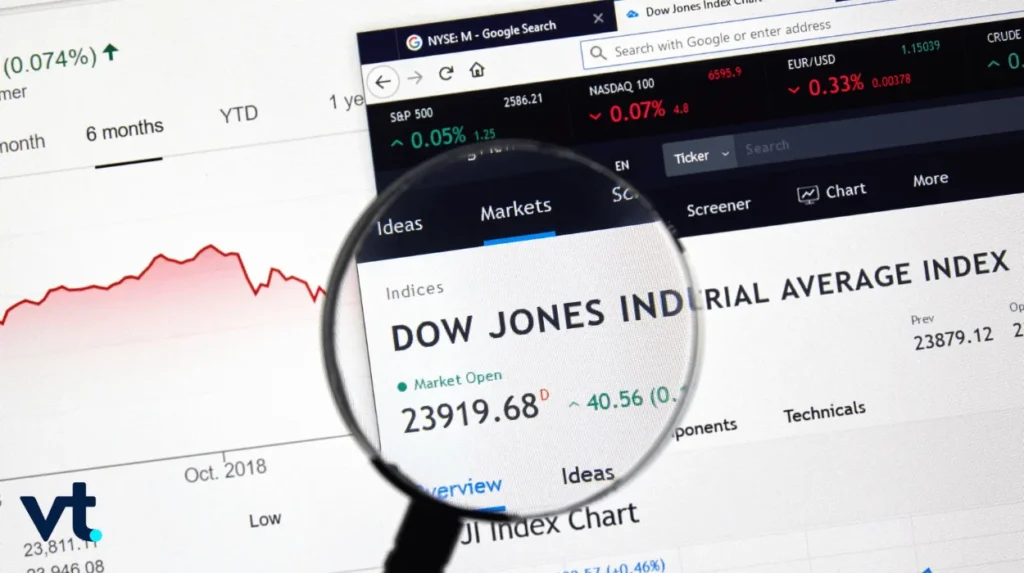
Key Statistics for 2025:
- Current Level: Trading above 42,000 points as of September 2025
- Year-to-Date Performance: The main stock market indices have shown mixed performance, with the US500 up 15.44% compared to the same time last year
- Market Capitalization: Total combined market cap exceeding $12 trillion
- Daily Trading Volume: Averaging over 300 million shares across constituent stocks
History and Evolution
The history of the Dow Jones Industrial Average is a testament to its enduring relevance in the financial world. First introduced on May 26, 1896, the index was created to provide a straightforward measure of the U.S. stock market’s performance. Over the decades, the DJIA has evolved alongside the American economy, with its list of constituents regularly updated to reflect shifts in industry leadership and market trends. The index has been managed by organizations such as Dow Jones & Company and, more recently, S&P Dow Jones Indices, which oversee its ongoing calculation and maintenance. As the market has changed, so too has the DJIA, with companies added or removed to ensure the index remains a true representation of the U.S. economy. As of August 29, 2025, the Dow Jones Industrial Average continues to be a trusted and respected indicator, providing investors and professionals with a reliable gauge of market performance and economic health.
Real-Time DJI Index Tracking and Current Performance
Modern investors demand instant access to market data, and the indexdjx dji delivers real-time price updates that reflect current market conditions. The index provides continuous pricing during regular trading hours from 9:30 AM to 4:00 PM Eastern time, with after-hours trading data extending market visibility.
Key real-time metrics include the current index value, percentage change from the previous close, and point movement calculations. For example, with the current Dow Divisor at approximately 0.16268413125742, every $1 change in any constituent stock translates to roughly 6.15 points in the index value.

Interactive charting tools allow investors to analyze performance across multiple time frames. Short-term traders focus on 1-day and 5-day charts to identify intraday patterns, while long-term investors examine monthly, quarterly, and ytd performance data. The ability to switch between these timeframes—including 1-month, 3-month, 6-month, year-to-date, 1-year, and 5-year views—provides comprehensive market perspective.
Live data widgets integrated into financial platforms display the open, close, high, and low prices for immediate market analysis. These tools often include volume indicators and volatility measurements that help traders assess market sentiment and momentum throughout each trading session.
Trading Hours and Global Access:
- Regular Hours: 9:30 AM – 4:00 PM ET
- Pre-Market: 4:00 AM – 9:30 AM ET
- After-Hours: 4:00 PM – 8:00 PM ET
- Weekend: Futures trading available
Understanding the Dow Jones Industrial Average Index
The Dow Jones Industrial Average stands as America’s oldest continuously calculated stock market index, launched on May 26, 1896, with an initial value of 40.94 points. Created by journalists Charles Dow and Edward Jones, this price-weighted index was designed to provide a clear window into the performance of American industry.
Unlike market-capitalization weighted indices such as the S&P 500, the djia uses a unique price-weighted methodology. This means higher-priced stocks have greater influence on index movements regardless of company size. The calculation involves summing the prices of all 30 constituent stocks and dividing by the Dow Divisor, which adjusts for stock splits, mergers, and other corporate actions.
The index methodology creates interesting dynamics where a $1 price change in a $300 stock has three times the impact of the same change in a $100 stock, even if the lower-priced company has a larger market cap. This characteristic makes the Dow particularly sensitive to movements in its highest-priced components.
The DJIA excludes transportation and utility companies, focusing specifically on industrial, technology, financial, and consumer companies that represent diverse sectors of the American economy. This composition reflects the index’s original purpose of tracking industrial America, though modern constituents include technology giants and service companies that define today’s economy.
Index Calculation and Maintenance
The Dow Jones Industrial Average is unique among major indices due to its price-weighted calculation method. This means that the index’s value is determined by adding up the prices of its 30 constituent stocks and then dividing by a carefully adjusted divisor. The divisor is updated as needed to account for stock splits, dividends, and other corporate actions, ensuring that such events do not artificially distort the index’s value. The DJIA is calculated in real-time throughout the trading day, with prices updated every few seconds to provide investors with the most current view of the market. S&P Dow Jones Indices is responsible for maintaining the index, making sure it remains an accurate and reliable reflection of the U.S. stock market. This meticulous approach to calculation and maintenance allows the DJIA to serve as a trusted benchmark for market performance at any given time.
Market Cap and Index Weighting
Market capitalization, or market cap, plays a significant role in the influence each company has within the Dow Jones Industrial Average. Market cap is determined by multiplying a company’s total outstanding shares by its current stock price, providing a snapshot of its overall value in the market. In the DJIA, companies with higher market caps and stock prices exert a greater impact on the index’s movements, as the price-weighted methodology amplifies the effect of high-priced stocks. As of September 2, 2025, the market cap of DJIA constituents ranges from tens of billions to over a trillion dollars, with the largest companies—often in the technology and healthcare sectors—having a substantial effect on the index’s direction. This structure ensures that the Dow Jones Industrial Average reflects the performance of the most influential companies in the U.S. market, making it a powerful indicator for investors tracking market trends and price movements.
Current DJI Components and Top Holdings
As of September 2025, the Dow Jones consists of 30 carefully selected blue-chip companies representing leadership across vital economic sectors. The Wall Street Journal editors maintain responsibility for constituent selection, prioritizing market prominence and economic significance.
Top 10 Holdings by Index Weight:
| Rank | Company | Symbol | Sector | Approximate Weight | Market Cap |
|---|---|---|---|---|---|
| 1 | UnitedHealth Group | UNH | Healthcare | ~8.5% | $450B+ |
| 2 | Goldman Sachs | GS | Financial | ~7.2% | $167B |
| 3 | Microsoft | MSFT | Technology | ~6.8% | $3.3T |
| 4 | Home Depot | HD | Consumer Discretionary | ~6.5% | $400B+ |
| 5 | Caterpillar | CAT | Industrial | ~6.2% | $180B+ |
| 6 | Salesforce | CRM | Technology | ~5.8% | $250B+ |
| 7 | American Express | AXP | Financial | ~5.5% | $150B+ |
| 8 | Amgen | AMGN | Healthcare | ~5.2% | $140B+ |
| 9 | McDonald’s | MCD | Consumer Discretionary | ~5.0% | $220B+ |
| 10 | Boeing | BA | Industrial | ~4.8% | $120B+ |
Recent Changes and Evolution:
- 2024-2025: Continued emphasis on technology and healthcare leaders
- Sector Rotation: Increased weighting in tech and healthcare services
- Market Adaptation: Regular reviews ensure contemporary relevance
As of March 2025, Goldman Sachs represented the largest component of the index with a market capitalization of ~$167B, while Apple’s market capitalization was ~$3.3T but fell outside the top 10 components due to the price-weighted methodology.
Sector Breakdown and Industry Analysis
The modern DJIA provides diversified exposure across major economic sectors, reflecting the evolution of the American economy from its industrial origins to a technology and services-driven landscape.
2025 Sector Allocation:
| Sector | Weight | Key Companies | Growth Drivers |
|---|---|---|---|
| Technology | 25-30% | Microsoft, Salesforce, Apple, IBM | AI, Cloud Computing, Digital Transformation |
| Healthcare | 20-25% | UnitedHealth, Johnson & Johnson, Merck | Aging Population, Innovation, Telehealth |
| Financial Services | 15-20% | Goldman Sachs, JPMorgan, American Express | Interest Rates, Digital Banking |
| Consumer Discretionary | 12-15% | Home Depot, McDonald’s, Nike | Consumer Spending, E-commerce |
| Industrial | 10-12% | Boeing, Caterpillar, 3M | Infrastructure, Manufacturing Recovery |
| Consumer Staples | 8-10% | Coca-Cola, Procter & Gamble | Defensive Characteristics |
Sector Performance Trends 2025:
- Technology: Leading performance with AI and cloud adoption
- Healthcare: Benefiting from demographic trends and innovation
- Financials: Supported by favorable interest rate environment
- Industrials: Recovery in manufacturing and infrastructure spending
Historical Performance and Market Trends
The indexdjx dji has achieved remarkable long-term growth since its 1896 inception, crossing major psychological milestones that marked different eras of American economic expansion. The index first reached 1,000 points in 1972 during the post-war economic boom, then broke through 10,000 points in 1999 during the dot-com era.
Major market events have tested the index’s resilience and highlighted its role as an economic barometer. During the 2008 financial crisis, the DJIA lost more than 50% of its value, demonstrating the index’s volatility during systemic stress. The 2020 pandemic initially caused sharp declines before unprecedented monetary and fiscal stimulus drove markets to new highs.
Historical analysis reveals the index’s compound annual growth rate (CAGR) of approximately 5-7% over long periods, though individual years show significant variation. The post-pandemic surge from 2021-2023 showcased the index’s ability to reflect economic recovery, with technology and healthcare companies leading gains.
Comparison with other major indices shows the DJIA’s unique characteristics. While the S&P 500 provides broader market representation through 500 companies, the Dow’s concentrated approach often produces different returns. The NASDAQ Composite’s technology focus creates higher volatility but potentially greater growth during tech-favorable periods.
Decade-by-decade analysis reveals changing economic drivers. The 1990s technology boom, 2000s financial expansion, 2010s recovery, and 2020s digital acceleration each left distinct marks on index composition and performance patterns.
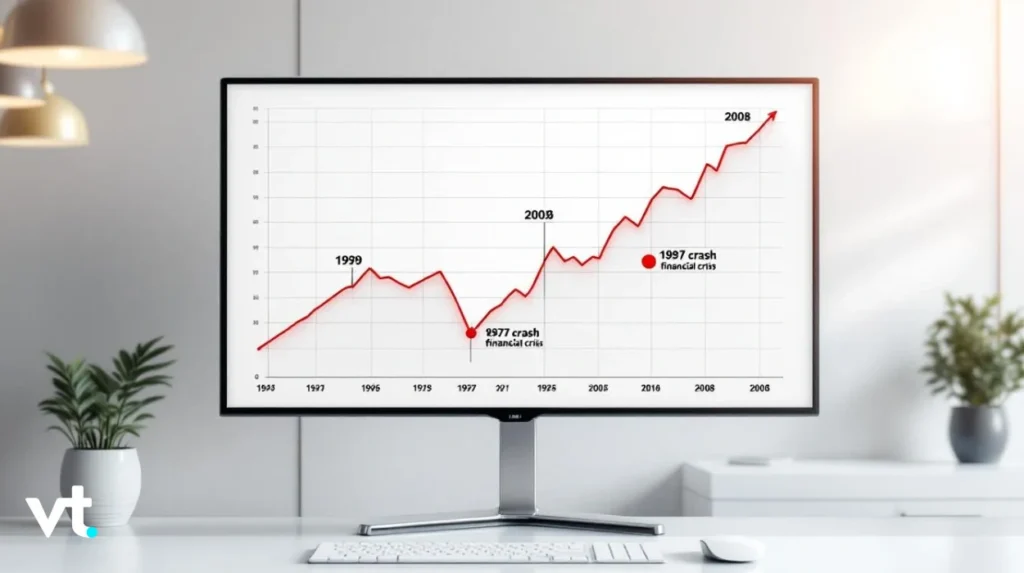
The index has delivered positive returns over most rolling 10-year periods, supporting its use as a long-term investment benchmark. However, shorter periods show the impact of economic cycles, geopolitical events, and technological disruption on market performance.
Investment Products and ETFs Tracking DJI
The SPDR Dow Jones Industrial Average ETF (DIA) serves as the primary investment vehicle for accessing indexdjx dji performance. Launched in January 1998, this ETF maintains the largest assets under management among Dow-focused products and provides liquid exposure to the index’s price movements.
DIA offers several advantages for investors seeking Dow exposure. Its expense ratio remains competitive at approximately 0.16% annually, while daily trading volumes often exceed millions of shares, ensuring tight bid-ask spreads. The ETF distributes dividends quarterly, reflecting the underlying index constituents’ dividend payments.
Alternative investment products provide different risk and return profiles. Leveraged ETFs like the ProShares Ultra Dow30 (DDM) seek to deliver twice the daily return of the DJIA, while inverse products profit from index declines. These products suit short-term trading strategies but carry higher risks due to daily rebalancing effects.
International investors can access Dow exposure through various regional products. European and Asian exchanges offer ETFs tracking the index, often currency-hedged to reduce foreign exchange risk. These products enable global portfolio diversification while maintaining exposure to American blue-chip companies.
| Product | Symbol | Expense Ratio | Strategy | Assets (Approx.) |
|---|---|---|---|---|
| SPDR DJIA ETF | DIA | 0.16% | 1x Long | $25B+ |
| ProShares Ultra Dow30 | DDM | 0.95% | 2x Long | $500M+ |
| ProShares UltraShort Dow30 | DXD | 0.95% | 2x Short | $300M+ |
ETF Performance Comparison
Year-to-date returns among major DJI tracking funds typically align closely, with differences mainly reflecting expense ratios and tracking methodology. The primary DIA ETF generally provides the most precise index replication due to its full replication strategy and large asset base.
Dividend yields across Dow-focused products reflect the underlying index’s current yield, typically ranging from 1.5% to 2.5% annually. Distribution frequencies vary by product, with most paying quarterly dividends that correspond to the index constituents’ payment schedules.
Trading volume and liquidity metrics favor the main DIA ETF, which regularly appears among the most actively traded ETFs. This liquidity supports institutional investors and active traders who require tight spreads and minimal market impact.
Index Applications and Uses
The Dow Jones Industrial Average is more than just a number—it’s a versatile tool used by investors, analysts, and financial professionals for a variety of purposes. As a benchmark, the DJIA allows users to track the performance of the overall U.S. stock market and compare individual stocks or portfolios against a widely recognized standard. The index also serves as the foundation for a range of financial products, including index funds and exchange-traded funds (ETFs), which provide investors with easy access to the performance of the 30 blue-chip companies that make up the DJIA. On company pages, investors can follow the DJIA, select from a list of related products, and access up-to-date information on market events, YTD (year-to-date) performance, and other key metrics. This wealth of information helps investors make informed decisions, stay current with market developments, and respond to changes in the economic landscape. Whether used for tracking, analysis, or investment, the Dow Jones Industrial Average remains an indispensable resource for anyone engaged with the equity markets.
How to Use DJI Data for Investment Decisions
Technical analysis of the indexdjx:dji reveals patterns that guide investment timing and risk management decisions. Moving averages, particularly the 50-day and 200-day lines, provide trend identification signals. When the index trades above these averages, it suggests bullish momentum, while breaks below may indicate bearish shifts.
Support and resistance levels based on historical price action help identify potential entry and exit points. Round numbers like 30,000, 35,000, and 40,000 often serve as psychological barriers that create trading opportunities. These levels frequently coincide with significant market events or economic announcements.
Correlation analysis with economic indicators enhances the index’s utility as a forecasting tool. The DJIA typically correlates positively with GDP growth, employment data, and corporate earnings. Understanding these relationships helps investors anticipate index movements based on economic trends.
The index serves as an effective market sentiment gauge for broader U.S. equity markets. When the Dow outperforms the S&P 500 or NASDAQ, it often signals investor preference for established, dividend-paying companies over growth stocks. This relationship provides insights into market risk appetite and sector rotation trends.
Risk management strategies incorporate the DJIA’s volatility characteristics. The index’s price-weighted structure means that movements in high-priced stocks can create outsized impacts. Investors should monitor the weightings of top components and consider how corporate actions might affect index performance.

Portfolio construction using Dow data involves understanding the index’s sector biases and concentration risks. While the 30-company structure provides blue-chip exposure, it lacks the diversification of broader indices. Combining Dow exposure with other market segments can create more balanced portfolios.
Market News and Economic Impact Factors
Federal Reserve policy decisions significantly impact the IndexDJX: DJI performance through their effects on interest rates and market liquidity. Rate increases typically pressure high-dividend stocks within the index, while rate cuts often boost performance by reducing borrowing costs and increasing equity valuations.
Earnings season creates heightened volatility as the Dow’s 30 constituents report quarterly results. Given the index’s concentration, strong or weak results from major components can substantially move the overall index. Technology giants like Apple and Microsoft often drive index performance during their respective earnings announcements.
Geopolitical events and trade policy developments influence the DJIA through their impact on multinational corporations within the index. Trade tensions, tariff announcements, and international agreements affect companies with significant global operations, creating index-wide implications.
Currency fluctuations impact the Dow through the international revenue exposure of constituent companies. A stronger dollar typically pressures companies with significant overseas sales, while dollar weakness can boost international earnings when translated back to U.S. dollars.
Recent market developments highlight the index’s sensitivity to policy changes and economic data. Infrastructure spending proposals, healthcare reform discussions, and technology regulation debates directly affect major index components. Social media platform companies and technology firms face particular scrutiny regarding data privacy and market competition.
Economic calendar events provide regular catalysts for index movement. Employment reports, inflation data, consumer confidence surveys, and manufacturing indices all influence investor sentiment toward the large-cap companies that comprise the DJIA. Understanding these release schedules helps investors anticipate potential volatility periods.
The time zone considerations become important for global investors tracking the index. Market-moving news can occur outside regular trading hours, creating gaps between closing and opening prices. After-hours trading and international developments during U.S. market closures often set the stage for the next trading session.
Corporate actions within individual constituents continue to require attention from index followers. Stock splits, special dividends, mergers, or spinoffs trigger Dow Divisor adjustments that maintain index continuity. These technical changes, while mathematically neutral, can affect short-term trading dynamics and options pricing.
The page of history shows that major market shifts often begin with changes in the Dow’s behavior relative to other indices. When the price-weighted index diverges significantly from market-cap weighted alternatives, it may signal important structural changes in market leadership or investor preferences.
Successful indexdjx:dji analysis requires combining technical indicators with fundamental economic analysis. The index’s unique construction and historical significance make it both a valuable market barometer and a distinct investment vehicle. Investors who understand its characteristics and limitations can effectively incorporate Dow data into comprehensive market analysis and portfolio management strategies.
Following these insights and maintaining awareness of the index’s ongoing evolution will help investors navigate the complexities of modern market analysis. The DJIA’s blend of tradition and adaptation ensures its continued relevance in an ever-changing financial landscape, making it an essential component of informed investment decision-making.
Frequently Asked Questions
1. What makes the Dow Jones different from the S&P 500?
The key difference lies in methodology: the Dow uses price-weighting (higher stock prices have more influence) while the S&P 500 uses market-capitalization weighting (larger companies by market value have more influence). The Dow contains 30 companies versus 500 in the S&P, making it more concentrated but also more focused on established blue-chip stocks.
2. How often does the composition of the DJIA change?
The Dow’s composition changes infrequently, typically only when companies merge, go bankrupt, or no longer represent leading positions in their industries. Changes are made by the editors of The Wall Street Journal and usually occur every few years rather than on a set schedule. Recent decades have seen more frequent updates to reflect the economy’s shift toward technology and services.
3. Can individual investors directly invest in the Dow Jones?
You cannot directly buy “the Dow” as it’s an index, but you can invest through ETFs like SPDR DIA, index mutual funds, or by purchasing individual stocks of all 30 components. ETFs provide the easiest and most cost-effective access, while CFDs through brokers like VT Markets offer leveraged exposure for more sophisticated strategies.
4. Why do some high-value companies like Berkshire Hathaway not appear in the Dow?
The price-weighted methodology means extremely high-priced stocks (like Berkshire Hathaway Class A shares trading above $500,000) would dominate the index calculation. The Dow focuses on companies with stock prices that allow for balanced representation, typically ranging from $50 to $500 per share, ensuring no single stock overwhelms the index.








