



Key Takeaways:
- A long-short CFD strategy pairs a buy position in one instrument with a sell position in a closely related one.
- Profit comes from the gap between the two legs, not from the direction of the wider market.
- CFDs let you open the short leg without borrowing the underlying asset.
- Costs roughly double, because you pay spread and overnight swap on both sides.
- The approach depends on correlation, so it fails when two instruments stop moving together.
Most traders start by picking a direction. They buy and hope prices rise, or they sell and hope prices fall. That works until the market turns choppy.
A long-short CFD strategy offers a different route. You bet on the relationship between two instruments rather than on the market itself. You buy the one expected to outperform. You sell the one expected to lag. The gap between them is what pays.
This guide covers the mechanics, the maths, the costs and the mistakes. All figures are illustrative and are shown to demonstrate the workings, not to forecast prices.
What Is a Long-Short CFD Strategy?
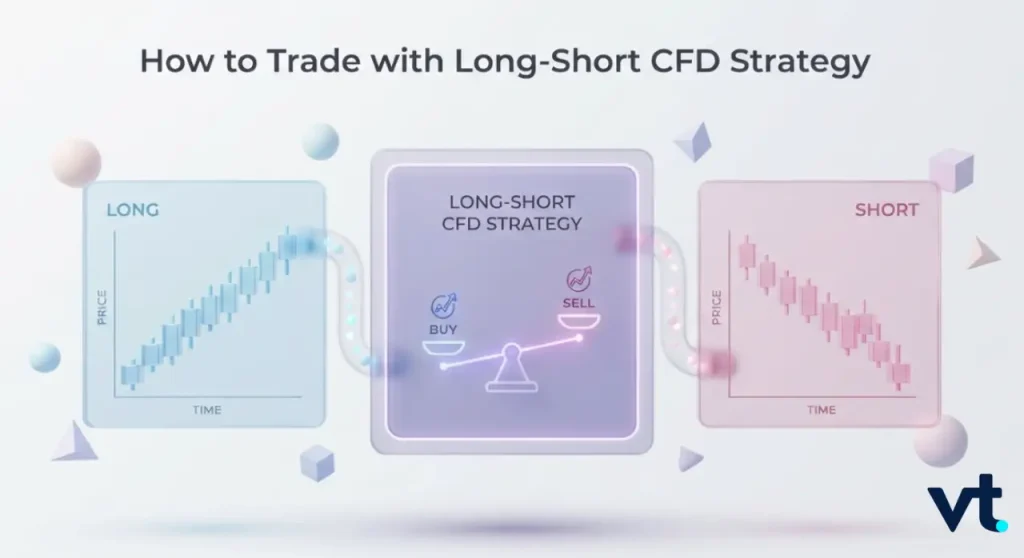
A long-short CFD strategy is a two-leg trade. One leg is a buy, the other is a sell, and both are opened at the same time on instruments that normally move together. The goal is relative performance, not market direction.
Going Long Versus Going Short Explained
What are long and short CFDs? They are the two directions available on a contract for difference, and neither involves owning the asset.
Going long: you buy the CFD and gain as the price rises.
Going short: you sell the CFD first and gain as the price falls.
Both are leveraged, so you post margin rather than full notional value.
Both settle in cash against the price difference between entry and exit.
Long-Short as a Paired, Market-Neutral Approach
When both legs are sized to a similar notional value, the trade becomes broadly market-neutral. What remains is the spread between the two instruments, which is why this is also called pairs trading or a relative value trade.
- A market-wide rally helps the long leg and hurts the short leg.
- A market-wide sell-off hurts the long leg and helps the short leg.
- Your result depends on which leg moved further, not on market direction.
Broad volatility matters far less than the behaviour of your chosen pair.
How a Long-Short CFD Strategy Differs From Hedging
People often ask what is a long-short strategy compared with a hedge. The structures look alike, but the intent differs.
- A hedge protects a position you already hold and aims for neutrality.
- A long-short trade is the position itself and aims to profit from divergence.
- A hedge is usually temporary. A paired trade runs until the spread hits your target.
How a Long-Short CFD Trade Works
Both legs sit in the same account and are managed as ordinary tickets on MetaTrader 4 or MetaTrader 5. At VT Markets, both orders can be placed and monitored from a single terminal.
Opening the Long Leg
The long leg is your expected outperformer. Build it in four steps:
- Decide the notional value you want on this side of the trade.
- Convert that figure into lots using the instrument’s contract size.
- Place the buy order with a stop-loss attached to the leg itself.
- Record the entry price, since your cost calculation depends on it.
Opening the Short Leg Without Borrowing the Asset
Here CFDs are simpler than the traditional route. Going short is just a sell order:
- No stock loan, no borrow fee and no locate requirement.
- Short selling restrictions on the cash market do not apply in the same way.
- Position sizing works exactly as it does on the long side.
Short legs are sometimes credited on overnight financing rather than charged.
How Profit and Loss Is Calculated Across Both Legs
Each leg is priced separately, then netted.
Long leg P&L = (exit price minus entry price) x contract size x lots
Short leg P&L = (entry price minus exit price) x contract size x lots
Gross result = long leg P&L plus short leg P&L
Net result = gross result minus spread costs minus net swap
A Worked Example Using Two Correlated Instruments
Assume both legs are sized at $50,000 notional on two correlated instruments.
| Scenario | Long leg move | Long leg P&L | Short leg move | Short leg P&L | Gross result |
| Market rises, view correct | 0.03 | +$1,500 | 0.012 | -$600 | +$900 |
| Market falls, view correct | -2.00% | -$1,000 | -3.50% | +$1,750 | +$750 |
| Market flat, view wrong | -2.50% | -$1,250 | 0.015 | -$750 | -$2,000 |
The first two rows show the point of the structure. The market moved in opposite directions, yet both trades made money, because the gap moved the right way. The third row is the warning.
Applying costs to scenario one: gross +$900, spread on both legs roughly -$70, net swap over five nights roughly -$45, leaving about +$785 net.
Long-Short CFD Strategy Compared With Other CFD Approaches
Each approach asks you to be right about something different.
Long-Short Versus Single Directional Trading
A directional trade needs you to call the market. A long-short CFD strategy only needs you to rank two instruments correctly. You trade smaller upside for far less exposure to market shocks.
Long-Short CFDs Versus Traditional Short Selling
Traditional short selling means borrowing shares, paying a borrow fee and facing possible recall. A CFD short carries none of that machinery, though the directional risk is identical.
Long-Short Versus Buy and Hold
Buy and hold is long term, unleveraged and fully exposed to the market. A long-short CFD strategy is shorter term, leveraged and deliberately neutral. The two differ in three ways that matter most:
Time horizon: years versus days or weeks.
Funding: no ongoing cost versus nightly financing on both legs.
Objective: capturing long-term growth versus capturing a temporary gap.
| Feature | Long-short CFD strategy | Single directional CFD | Traditional short selling | Buy and hold |
| Must get right | Which instrument outperforms | Market direction | Market direction | Long-term value |
| Market exposure | Low, broadly neutral | Full | Full, inverse | Full |
| Leverage | Yes, on both legs | Yes | Sometimes | Usually none |
| Asset ownership | None | None | Borrowed shares | Yes |
| Typical hold | Days to weeks | Hours to days | Days to weeks | Years |
| Cost drivers | Two spreads, net swap | One spread, swap | Borrow fee, interest | Little or none |
| Main risk | Correlation breakdown | Adverse price move | Short squeeze, recall | Drawdown |
| Suits | Range-bound markets | Trending markets | Overvalued single names | Long-term investors |
How to Build the Best Long-Short CFD Strategy
The best long short CFD strategy depends less on forecasting and more on pair selection, sizing and process.
1. Selecting Correlated Instruments
Correlation is the foundation. Two instruments that drift apart at random will never behave as a pair.
| Correlation coefficient | Relationship | Suitability for a paired trade |
| +0.80 to +1.00 | Strong positive | Best fit, the pair usually moves together |
| +0.50 to +0.79 | Moderate positive | Workable, expect wider spread swings |
| -0.49 to +0.49 | Weak or none | Poor fit, the legs act as separate trades |
| -0.50 to -1.00 | Negative | Unsuitable, you double the same directional bet |
Common starting points include:
- Two precious metals, such as gold and silver.
- Two energy benchmarks, such as Brent and WTI crude.
- Two currency pairs sharing a base currency, or two indices from the same region.
- Two shares in the same sector with similar business models.
Pro tip: Measure correlation over more than one window. A pair scoring +0.90 over three months but +0.40 over twelve is less stable than it first appears.
2. Balancing Position Sizes Across Both Legs
Matching lot sizes is not the same as matching risk. Balance by notional value, not by lot count.
Adjust the more volatile leg down so a 1% move means similar cash on each side. Recheck the balance if one leg runs a long way from entry. Keep combined risk within your usual per-trade limit.
3. Setting Entry and Exit Conditions
Since you are trading a relationship, your triggers should follow the spread rather than price alone.
Entry: when the spread stretches beyond its normal range.
Target: when the spread returns to its historical average.
Stop: when the spread widens past the point where the relationship looks broken.
Time stop: close if nothing happens within a set number of sessions.
4. Testing the Strategy Before Committing Capital
A long short CFD strategy for beginners should always start in a risk-free environment. A VT Markets demo account gives live pricing without live consequences.
- Run 20 to 30 paired trades before going live.
- Log the spread at entry, the spread at exit and the full cost of both legs.
- Track how often correlation held for the whole trade.
- Move to small live size only once results are consistent.
Costs, Margin and Financing in a Long-Short CFD Strategy
Costs deserve close attention, because you pay them twice. This is the most underestimated part of the approach.
Overnight Swap on Long and Short Positions
Overnight swap, or the financing charge, applies to each leg separately. One side may be credited whilst the other is debited, but the two rarely cancel out.
| Item | Long leg | Short leg | Net |
| Swap per night | -$4.20 | +$1.10 | -$3.10 |
| Over 5 nights | -$21.00 | +$5.50 | -$15.50 |
| Over 20 nights | -$84.00 | +$22.00 | -$62.00 |
Holding a paired trade for a month can quietly cost several times what a single-leg trade would.
Spread Costs Across Two Legs
You pay the spread on entry and exit for each leg, which is four crossings in total. A 0.7 pip spread on both legs is roughly 1.4 pips of round-trip cost.
Tight spreads matter more here than in single-leg trading. Session opens and news releases can widen spreads enough to erase a small expected gap.
Compare expected spread movement against total transaction cost before entering.
Margin Requirements for Offsetting Positions
Margin is posted on each leg. Some brokers reduce the requirement for offsetting positions in the same instrument, but a pair built from two different instruments usually needs full margin on both.
Under ESMA rules, retail leverage is capped as follows:
- 30:1 on major currency pairs
- 20:1 on non-major pairs, gold and major indices
- 10:1 on commodities other than gold
- 5:1 on individual shares, and 2:1 on cryptocurrencies
Risks and Common Mistakes in a Long-Short CFD Strategy
The paired structure reduces market risk. It does not remove risk. Around 70% to 85% of retail CFD accounts lose money according to brokers’ own regulatory disclosures, and paired trades are no exception.
1. Correlation Breakdown
This is the primary risk. Instruments that have tracked each other for years can decouple in a single session.
Company-specific news can break a share pair instantly. Policy divergence can break a currency pair relationship. Supply shocks can separate two commodities that normally move together.
2. Losing on Both Legs at Once
Scenario three in the worked example showed this. When the spread moves against you, both legs lose together, and the combined loss is larger than a single-leg trade of the same size would produce.
3. Over-Leveraging a Hedged Position
Many traders treat a paired trade as low risk and size it far larger than usual. Leverage amplifies the spread move, and spread moves can be violent:
- Size the pair as one position, not two independent trades.
- Apply your normal per-trade risk limit to combined exposure.
- Remember that margin close-out applies to the account, not to each leg.
4. Ignoring the Cost Drag on Longer Holds
- Spread convergence can take weeks, and financing accrues every night.
- Estimate the holding period before you enter, not after.
- Multiply net swap by that number of nights.
- Add four spread crossings to the total.
- Enter only if the expected gap still clears the full cost.
When a Long-Short CFD Strategy Suits Your Trading
No approach fits every trader or every market.
Market Conditions That Favour the Approach
- Range-bound markets where directional trades keep getting stopped out.
- Sector rotation, when capital moves between related instruments.
- High-volatility periods where broad market exposure feels uncomfortable.
- Earnings or policy events affecting one instrument in a pair more than the other.
Strong, sustained trends are the exception. In those markets a simple directional trade usually captures more for less cost.
Experience Level and Time Commitment Required
- Suits: traders comfortable with position sizing, margin and correlation analysis.
- Less suitable for: beginners still learning single-leg execution.
- Time needed: daily monitoring, since a pair can decouple without warning.
- Tools needed: a correlation matrix, a spread chart and reliable execution.
Frequently Asked Questions (FAQs)
What Is a Long-Short CFD Strategy?
A long-short CFD strategy is a paired trade where you buy a CFD on one instrument and sell a CFD on a closely related one at the same time. Profit comes from the gap between the two, rather than from the direction of the broader market.
Can You Go Short on a CFD Without Owning the Asset?
Yes. A CFD short is simply a sell order placed on the platform. There is no borrowing, no stock loan and no locate requirement. You never own or deliver the underlying asset, and the trade settles in cash against the price difference at close.
Is a Long-Short CFD Strategy the Same as Hedging?
No. A hedge protects a position you already hold and aims for neutrality. A long-short trade is opened deliberately as the position itself, and it aims to profit from divergence between two instruments. The structures look alike, but the intent behind them differs entirely.
How Do You Choose Pairs for a Long-Short CFD Trade?
Start with correlation. Look for instruments scoring above +0.80 across several time windows. Then confirm they share a real economic link, such as the same sector, region or commodity family. Finally, check that both offer tight spreads and sufficient liquidity.
Do Swap Charges Cancel Out When Holding Long and Short Positions?
Rarely. Swap rates on each side are set separately and are not mirror images. One leg is usually debited more than the other is credited, leaving a net cost. Over a month, that net swap can absorb a meaningful share of expected profit.
Start Building Your Long-Short CFD Strategy with VT Markets
A long-short CFD strategy rewards preparation more than prediction. The traders who do well with it measure correlation properly, size both legs with care, and count every cost before entering.
If you are ready to test the approach, start on demo and run a full set of paired trades end to end. Log your entries, exits and total costs. Once the process feels repeatable, scale into live markets at a size you are comfortable defending.
With VT Markets, you get MT4 and MT5 access, competitive spreads across forex, metals, indices and commodities, and the execution quality a two-leg long-short CFD strategy depends on.
Open your VT Markets account and put the strategy to work.








