



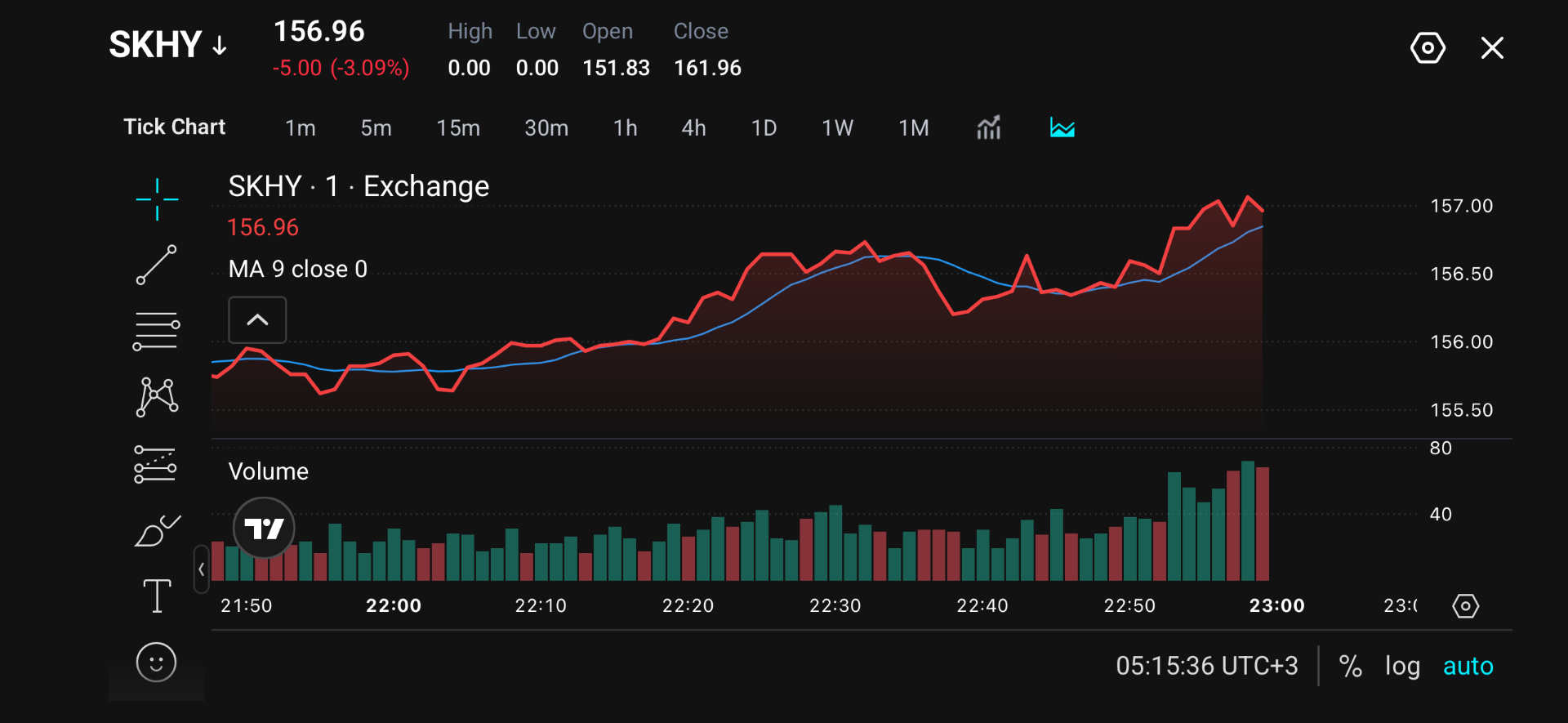
- SKHY traded at $156.96 on 13 October, down $5.00 (3.09%) from the previous close of $161.96, as semiconductor stocks faced renewed selling pressure.
- Concerns over elevated AI stock valuations and rising competition in the global semiconductor industry drove the selloff.
- China’s ChangXin Memory Technologies (CXMT) is emerging as a potential competitor in memory chips, raising concerns about future pricing pressure and market share.
- SK Hynix remains a major supplier of high-bandwidth memory (HBM) chips used in AI infrastructure.
- Upcoming semiconductor earnings and AI infrastructure spending updates are the next catalysts.
Market Move
SKHY came under pressure as selling spread across semiconductor stocks, with AI-linked stocks facing the hardest hit. The stock fell to $156.96 from the previous close of $161.96.
In the latest session, price lowered early in the session, reaching near $155.50 before climbing to test $157.00, where it peaked just above that level. The recovery lifted price above its 9-period moving average, which is now rising and acting as short-term support.
Why Traders Are Watching
SK Hynix is one of the key beneficiaries of global AI investment because of its role as a major HBM supplier. That has made it a barometer for sentiment towards AI infrastructure.
Two factors weigh on the stock: valuations and competition. Despite strong AI-related demand, investors are increasingly questioning whether semiconductor companies can sustain their rapid earnings growth and high valuations. When expectations are this high, even small disappointments can trigger sharp pullbacks. Furthermore, CXMT is emerging as a potential competitor in the memory market. Any sign of greater Chinese supply could raise concerns about future pricing pressure and market share for established producers.
Demand for AI hardware remains strong, but the market is now weighing that demand against high expectations and a highly competitive market.
Key Trading Levels
| Level | Area | Why It Matters |
| Major resistance | $169 | Upper end of the potential recovery zone |
| Near-term resistance | $162 | Previous close of $161.96 and lower end of the recovery zone |
| Resistance | $157.00-$157.10 | Intraday high area on the tick chart |
| Pivot | $156.96 | Current price and short-term directional level |
| Support | $156.00 | Mid-range of the intraday recovery and 9-period MA area |
| Key support | $155.50 | Intraday low region |
| Deeper support | $152 | Immediate downside level to monitor |
The $152 region is important because it corresponds closely to the stock’s intraday low on 13 October. A sustained break below this area could indicate renewed bearish momentum, potentially exposing SKHY to $145 and $140.
On the upside, $162 represents the near-term resistance traders may monitor. A recovery above this level could open the way towards $169.
Bullish and Bearish Setups
| Setup | Trigger | Confirmation |
| Bullish | Hold above $156.50 and break $157.10 | Volume stays elevated and semiconductor sentiment stabilises |
| Extended recovery | Sustained move through $162 towards $169 | Renewed AI investment optimism across chip stocks |
| Pullback | Retreat towards $156.00-$156.50 | Buyers defend the 9-period MA and price turns back higher |
| Bearish | Break below $155.50 | Further weakness across semiconductor stocks |
| Deeper bearish | Sustained move below $152 | Breakdown in short-term structure |
Bullish scenario: SKHY could extend its recovery if buyers hold above $156.50 and break through $157.10 on strong volume. A sustained move above $162 would bring $169 into focus and suggest renewed confidence in AI-related semiconductor names.
Bearish scenario: SKHY could come under renewed pressure if it fails at $157 and slips below $156.00. A break under $155.50 would expose the stock to a move towards $152, particularly if the wider semiconductor sector keeps weakening.
Disclaimer
The price levels and market scenarios above reflect the author’s assessment at the time of writing. They do not represent financial advice or an official recommendation from VT Markets. Traders should conduct their own analysis and manage risk carefully.
SKHY Prediction: What’s Next?
The selloff reflects a market that is still positive on AI demand but increasingly cautious on valuations and competition. SK Hynix’s position in the HBM supply chain remains a strength, but the stock will likely stay sensitive to broader semiconductor sentiment in the near term.
Further weakness across chip stocks could weigh on SKHY, while renewed optimism around AI investment may support a recovery. Upcoming semiconductor earnings and AI infrastructure spending updates could provide fresh direction.
Trade SKHY with VT Markets
SKHY CFDs give traders exposure to SK Hynix price movements without owning the underlying shares. Traders commonly monitor the stock alongside semiconductor peers, AI-related equities, major indices and broader risk sentiment.
Monitor SKHY price action alongside other global share CFDs and indices at VT Markets.
Open a live trading account today and gain access to bonds, indices, gold and market insights.
FAQ
Why did SK Hynix fall?
The stock fell as semiconductor shares faced renewed selling. Investors are worried about elevated AI stock valuations and growing competition in the memory chip market.
What is CXMT and why does it matter?
ChangXin Memory Technologies (CXMT) is a Chinese memory chip maker emerging as a potential competitor. Its growth raises concerns about future pricing pressure and market share for established producers like SK Hynix.
What is HBM and why is it important to SK Hynix?
High-bandwidth memory (HBM) is a type of memory chip used in AI infrastructure. SK Hynix is a major supplier, which makes it a key beneficiary of global AI investment.
What are the key SKHY support and resistance levels?
Immediate resistance is around $157.10, with the previous close near $162 and $169 as the upper end of the recovery zone. Support sits at $156.00 and $155.50, with $152 as the deeper level to watch.
What could move SKHY next?
Upcoming semiconductor earnings, AI infrastructure spending updates and broader semiconductor sentiment are the next likely catalysts.










