






Key Points
- USDINR surged to 90.42, marking a fresh all-time high and extending its year-to-date loss past 5%.
- India’s current account deficit forecast worsened to 1.4% of GDP for H2 FY2026, up from 0.8%.
The rupee extended its downward spiral on Thursday, with the USDINR pair spiking to 90.42, its weakest level ever recorded.
Despite India’s strong economic fundamentals, the external side of the equation continues to weaken—leading to volatility that could stretch toward the 92.00 handle in the absence of policy or trade relief.
Analysts believe delays in finalising the long-anticipated U.S.–India trade deal have created a vacuum in dollar supply at a time when the demand for greenbacks is rising sharply.
Capital Flight, Widening Deficit Weigh Heavily
Foreign investors have pulled more than $17 billion from Indian equities this year, worsening dollar outflows. Simultaneously, India’s current account deficit is projected to widen to 1.4% of GDP in H2 FY2026, from 0.8% in H1—adding further pressure on the rupee.
The selloff reflects more than just global dollar strength. Instead, it exposes a growing gap between India’s resilient domestic economy and deteriorating external metrics, particularly its dependence on foreign capital and trade stability.
Rakshit warned that if a U.S.–India trade deal fails to materialise, USDINR could remain stuck in the 90.00 to 92.00 band for an extended period.
RBI in Focus
Markets now turn their eyes to the Reserve Bank of India, which is set to announce its policy decision on Friday. While some economists had forecasted a dovish tilt or possible rate cut, the rupee’s recent decline has complicated those expectations.
Traders in the rupee swaps market have already pared back bets on near-term easing. Any further policy relaxation risks accelerating capital outflows and pressuring the rupee further, forcing the central bank to walk a careful line.
Technical Analysis
USDINR has broken decisively above the psychological 90.00 mark, reaching 90.493 in a strong continuation of its medium-term uptrend. The pair has been steadily rising since its mid-year base near 83.87, with a clear series of higher lows and higher highs.
Price is currently well above the 5, 10, and 30-day moving averages, all of which are in bullish alignment and steepening — indicating strong directional momentum.
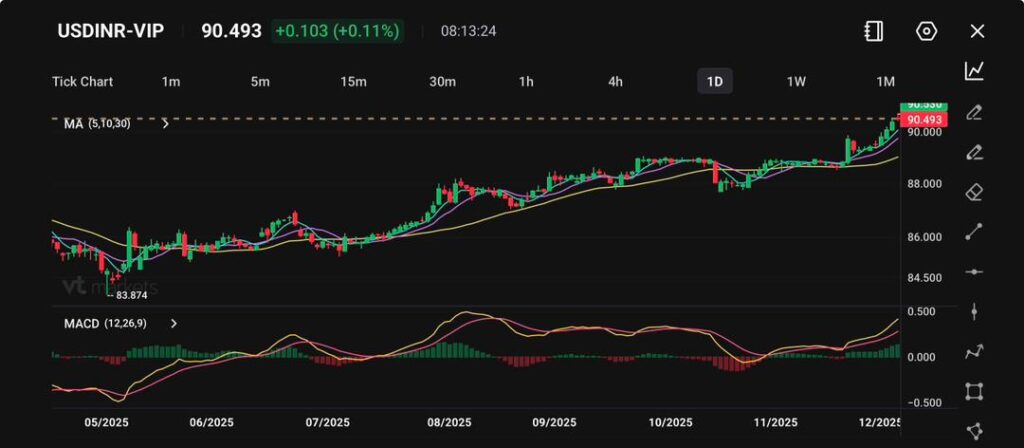
The MACD supports this bullish structure, with a widening spread between the MACD and signal lines and a rising histogram.
This suggests increasing buying pressure and potential for further gains in the short term. If the pair holds above 90.00, the next resistance zone lies near 91.00–91.25, while immediate support is seen at 89.50 and then 88.70.
While overbought conditions may begin to emerge soon, there is currently little sign of weakness. As long as the pair maintains its momentum above key moving averages, the bias remains upward, with only a sharp reversal below 88.50 likely to challenge the prevailing bullish trend.
Cautious Forecast
If the RBI avoids a rate cut and trade negotiations remain in limbo, USDINR could target 91.20–92.00 in the coming sessions. Support is now seen at 89.70, with downside risks contained unless the dollar weakens broadly or a concrete trade deal emerges.
Learn more about trading Forex on VT Markets today.










