




Key Points
- Nvidia shares rose 31% after Jensen Huang returned as CEO, adding nearly $1 trillion of market value.
- Nvidia’s surge also spread across Wall Street as Nasdaq and the S&P500 climbed by 6.5% and 4.75% respectively.
- Other chipmakers, such as Micron and AMD, experienced increases following the announcement from the Nvidia board.
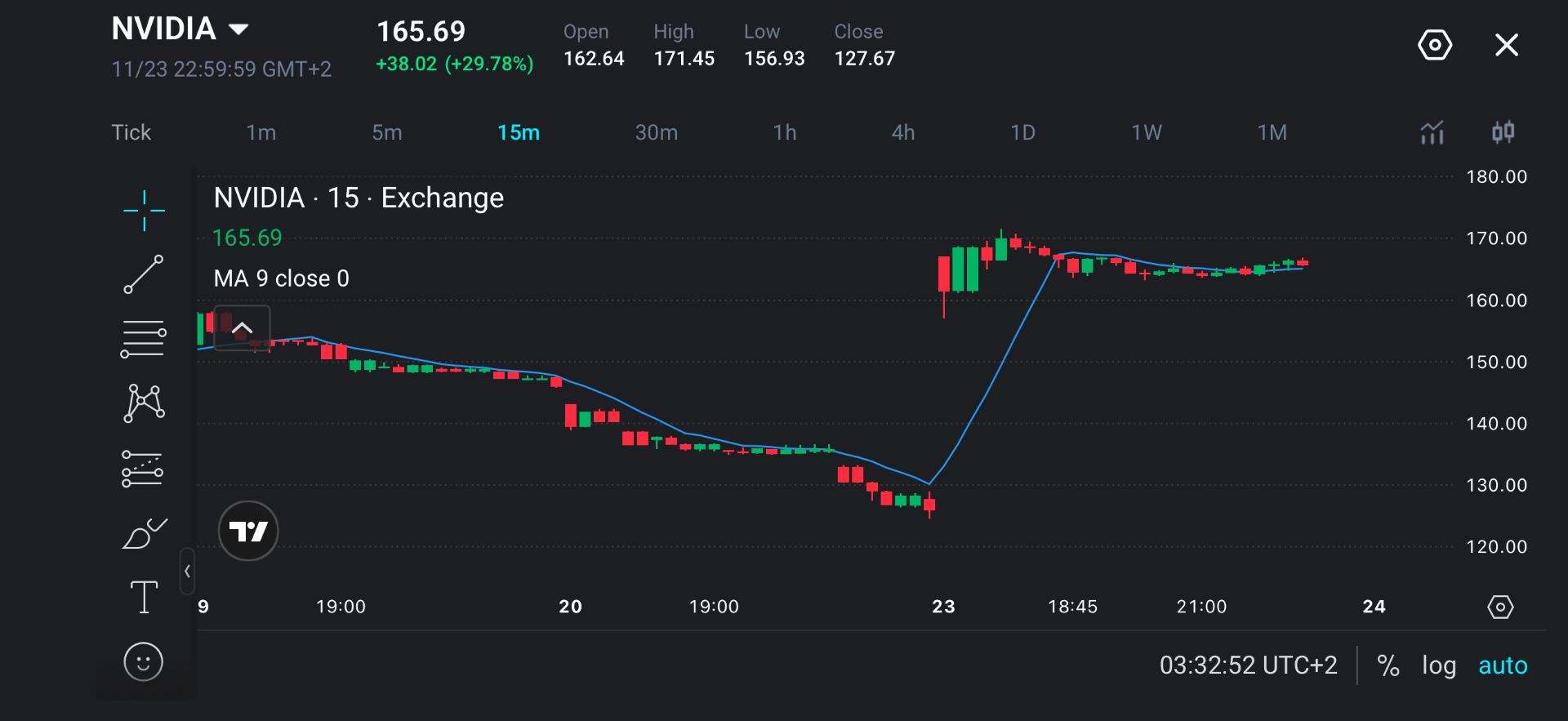
- The latest session shows price consolidating at around $164–$166, below resistance at $170–$171.45.
- A sustained breakout could extend the recovery, while a loss of $160–$162.64 would weaken its immediate technical structure.
Market Move
Nvidia (NVDA) surged as investors welcomed Jensen Huang’s return as CEO on November 23. Shares closed on Monday $165.05, gaining $39.52, or 31.48%, from Friday’s close. The advance added roughly $950 billion to Nvidia’s market value, bringing its valuation back towards $4 trillion.
In its latest session, the stock reached a high of $171.45, then eased around $164–$166. This consolidation shows that buyers retained much of the initial advance. However, the failure to hold above $170 leaves overhead selling pressure unresolved.
Why Traders Are Watching
Huang’s return reduces leadership uncertainty for Nvidia. This comes after US President Donald Trump reportedly convinced Nividia’s board to reinstate Huang. The board states its decision followed discussions with Huang and reflected confidence in his ability to lead the company.
The company’s recovery boosted stocks across Wall Street, as the Nasdaq Composite climbed 6.5%, the S&P 500 gained 4.7% and the Dow Jones Industrial Average jumped 3%. The rebound also extended across semiconductor stocks.Micron gained 19%, while AMD rose around 7%.
Major stocks in Asia and Europe also gained support following the news. Taiwan’s stocks were up by over 9%, while South Korea’s Kospi index increased by 7.2% and the Nikkei 225 in Japan by 4.7%. The pan-European STOXX 600 index climbed 1.6%, ending its losing streak as gains spread across major sectors.
Although investor sentiment has improved following the announcement and subsequent recovery, broader questions surrounding technology and AI-related stocks are still unresolved. Traders are now watching whether the opening surge can develop into sustained buying.
Key Trading Levels
| Levels | Technical role | What it means |
| $175–$180 | Potential upside reference | Round-number objectives beyond the visible high. |
| $170–$171.45 | Main resistance | A sustained break would strengthen the recovery. |
| $167–$168 | Initial resistance | Approximate area of earlier post-surge trading that buyers need to reclaim. |
| $164–$165 | Immediate support | Holding it would preserve the narrow trading range. |
| $160–$162.64 | Secondary support | Opening price of $162.64 and the $160 psychological level. |
| $156.93 | Major near-term support | Displayed session low. A break would materially weaken Monday’s recovery structure. |
| $150 | Lower reference | Round number before the latest sell-off accelerated. |
The first technical decision sits around $164–$168. A recovery through $168 would bring $170–$171.45 back into focus, while repeated rejection would leave the stock vulnerable to another support test.
Below $164, attention shifts towards $162.64 and $160. Losing that zone would increase the risk of a move towards $156.93.
Bullish and Bearish Setups
| Scenario | Confirmation to watch | Potential next levels | What weakens the setup |
| Bullish continuation | A 15-minute close above $168, followed by a successful retest | $170, then $171.45 | A failed breakout followed by a loss of $164–$165 |
| Bullish breakout extension | Sustained trading above $171.45, with the level holding on a pullback | $175, then $180 | A quick return below $170 |
| Bearish consolidation breakdown | A close below $164, followed by rejection when price retests it | $162.64, then $160 | Recovery above $168 |
| Deeper bearish retracement | A sustained break below $160 and an unsuccessful recovery attempt | $156.93, then potentially $150 | Reclaiming $162.64 and holding above it |
The bullish case requires buyers to turn overhead resistance into support. A brief spike above $168 or $171.45 would offer weaker evidence than a close above the level followed by a successful retest.
The bearish case strengthens if the consolidation begins producing lower highs and loses $164. A break below $160 would suggest a deeper retracement of Monday’s advance.
Disclaimer
The price levels and trade scenarios above reflect the author’s view at the time of writing and do not represent financial advice or an official recommendation from VT Markets. Traders should conduct their own analysis and manage risk carefully.
Nvidia Prediction: What’s Next?
Nvidia said its independent investigation would continue. Huang is also scheduled to testify before the US Senate Banking Committee on 3 December, following a closed-door interview with three House committees. The appearances keep national security scrutiny in focus despite his reinstatement.
NVIDIA’s future direction will depend on AI chip demand, earnings growth and spending by major cloud providers. Strong orders and higher revenue guidance could support the stock, while weaker spending could weigh on sentiment.
Traders will also watch for developments involving AI chip exports to China, compliance controls and corporate governance. Broader technology-sector sentiment and interest-rate expectations could amplify price movements.
Trade Nvidia with VT Markets
Markets react swiftly to breaking news as we can see from how Huang’s return bolstered stocks across Wall Street. With VT Markets, traders can access Nvidia share CFDs and monitor price movements in both rising and falling markets without owning the underlying shares.
Monitor NVDAUSD price movements, analyse technical levels and respond to market changes with trading tools designed for global markets.
Create a live VT Markets account today to access market insights, educational content, and new trading opportunities across different markets.
Frequently Asked Questions (FAQs)
Why did Nvidia stock rise sharply?
Nvidia rallied after its board reinstated Jensen Huang as CEO, improving confidence in leadership continuity. The move accompanied a broader rebound in technology stocks following heavy selling.
How much did Nvidia stock gain on Monday?
The underlying US shares closed 31.48% higher at $165.05 on 23 November.
Does NVIDIA’s rebound confirm the downtrend is over?
The rebound interrupts the previous decline, but confirmation requires follow-through. Holding support, forming higher lows and breaking above $171.45 would strengthen the case for a sustained recovery.
What could trigger another decline in NVIDIA shares?
A failed breakout, renewed selling across technology stocks or adverse company developments could pressure NVIDIA. Technically, losing $164, followed by $160, would signal that Monday’s recovery is weakening.





