






Key Points
- EUR/USD dipped 0.15% to 1.1624, extending a mild two-day pullback.
- Markets positioned ahead of the ECB’s blackout period starting Thursday.
The euro slipped to 1.1624 on Tuesday, losing modest ground against the US dollar as investors turned their focus to a series of European Central Bank (ECB) speeches this week for insight into the upcoming policy decision.
The ECB will enter its pre-meeting blackout period on Thursday, limiting public remarks from policymakers. Market participants are watching for final guidance before the 24 October meeting, where expectations have shifted toward a gradual easing bias amid signs of slowing inflation and weak credit growth across the bloc.
In the money markets, traders now fully price in a 25-basis-point rate cut by July 2026, with two additional Federal Reserve cuts seen by year-end, according to swap data.
Dollar Steady as Sentiment Improves
The US dollar held firm as signs of easing US–China trade tensions boosted sentiment. US Treasury Secretary Scott Bessent and Chinese Vice Premier He Lifeng are due to meet in Malaysia this week to prevent the escalation of US tariffs on Chinese goods.
The development follows President Donald Trump’s recent remarks calling the tariff stance “unsustainable,” sparking hopes of a temporary truce.
Meanwhile, optimism around a potential resolution to the US government shutdown also provided limited support for the greenback.
Technical Analysis
The EUR/USD pair traded slightly lower at 1.16240, marking a 0.15% decline, as the U.S. dollar regained traction amid rising Treasury yields and cautious risk sentiment. The pair’s struggle to sustain gains above 1.1700 signals persistent resistance pressure, with investors favouring the greenback ahead of upcoming U.S. macro data releases.
From a technical perspective, the euro remains confined within a mild descending channel since peaking at 1.19186. The daily candles are holding just below the 5- and 10-day moving averages, signalling weakening bullish momentum.
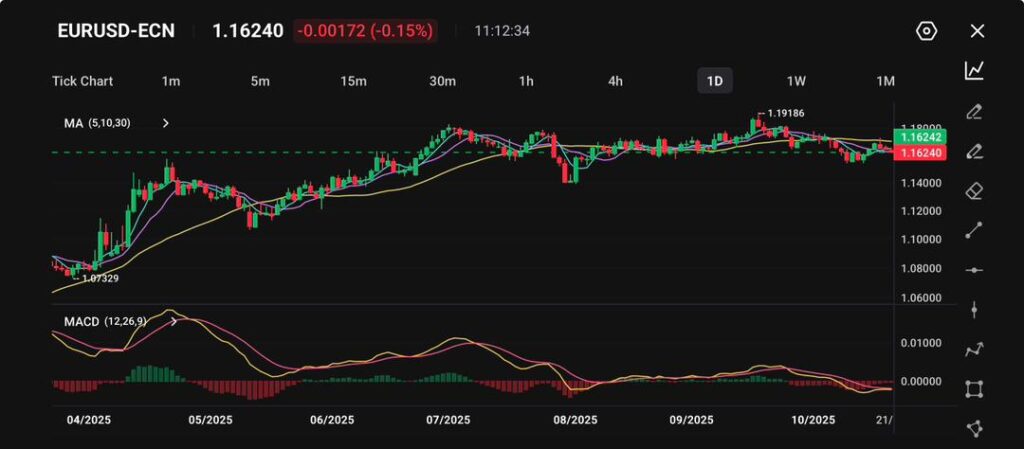
A sustained move below 1.1600 could pave the way toward the next key support at 1.1520, while upside recovery faces a tough ceiling near 1.1700–1.1750.
The MACD indicator reinforces this neutral-to-bearish bias with the MACD line remaining below the signal line, and the histogram continues to show red bars, reflecting downward momentum. Unless the pair breaks above 1.1700, the short-term trend remains tilted to the downside.
On the fundamental side, the euro continues to face pressure from diverging economic and policy outlooks.
While the European Central Bank maintains a cautious tone amid slowing growth and weak inflation, the Federal Reserve’s commitment to holding rates higher for longer supports the dollar.
Broader market focus now turns to upcoming U.S. PMI and GDP data, which could further influence rate expectations and volatility.
Outlook
With the ECB blackout period approaching, volatility in the euro may remain muted until policymakers deliver clearer signals on rate expectations. Broader sentiment remains driven by the balance between European growth risks and Fed easing bets, suggesting EUR/USD may stay rangebound near current levels until fresh catalysts emerge.








