





Key Takeaways:
- Hedging a share portfolio means opening an offsetting position that gains value when your shares fall, so you can ride out a downturn without selling.
- Index CFDs let you short the broad market with a small margin deposit, which makes them a flexible tool for short-term portfolio protection.
- A hedge is sized from two numbers, your portfolio value and its beta, not from guesswork. You can run a full hedge or a partial hedge.
- Hedging has a cost and never removes every risk. It works best as planned insurance around a specific concern, not as a permanent setting.
Hedging a share portfolio offers traders and investors to keep their shares, while adding a temporary position that profits when the market drops. This guide explains how hedging a share portfolio works in practice, with a focus on index CFDs (contracts for difference).
You will learn how to measure your market exposure, calculate a hedge ratio, choose between instruments, and weigh the real costs. Interest in these tools keeps climbing.
How Does Hedging a Share Portfolio Work?
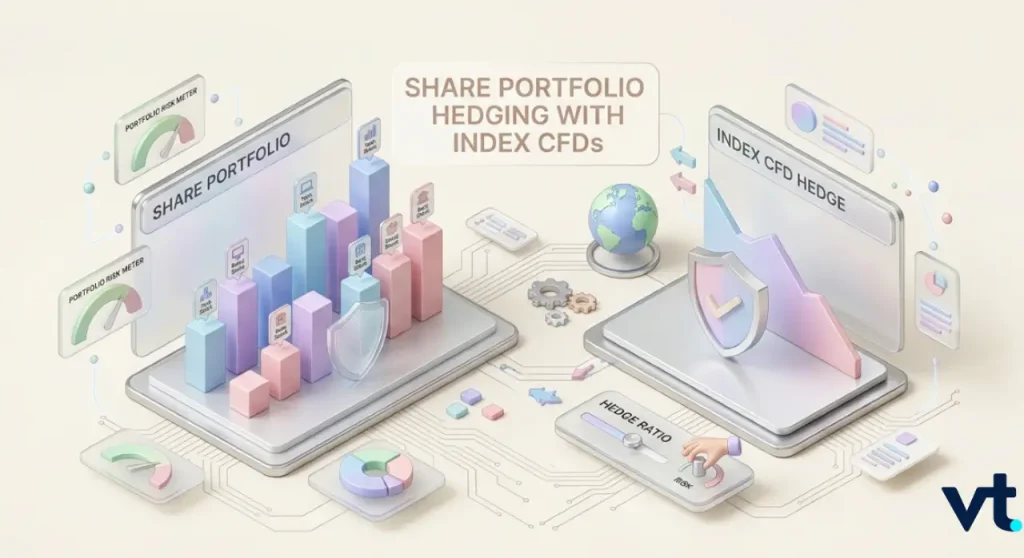
At its core, hedging a share portfolio works by pairing your long shares with a short position of similar size. When you short an index CFD, you profit if the index falls. That profit offsets the loss on your shares, so your combined value barely moves.
When the index rises, the short loses a little, but your shares gain, so again the two largely cancel out. A hedge trades away some upside in return for protection on the downside.
Why Hedge Instead of Selling Out?
Selling feels decisive, but it is often the more expensive choice for a passing storm. Hedging lets you keep the engine running while you fit a temporary shield.
- Keep your dividend income flowing while you are protected.
- Avoid the capital gains tax events that selling can trigger.
- Remove the hedge in seconds once your concern has passed.
- Keep your long-term plan intact, rather than reacting to emotion.
Pro tip: Decide on your exit before you place the hedge. Write down the event or price level that will tell you the danger has passed, then close the hedge when you reach it. A hedge with no plan to remove it quietly becomes a permanent drag on returns.
Market Risk versus Stock-specific Risk
Your total return splits into two parts. One part comes from the market as a whole. The other comes from your individual stock picks. An index hedge targets the first part and leaves the second in place, which is exactly what good risk management intends.
- Market risk(systematic risk): affects almost all shares at once; an index hedge tackles this directly.
- Stock-specific risk(unsystematic risk): affects one company only; this is best managed through diversification, not an index hedge.
How to Hedge a Share Portfolio Step by Step
This is where it becomes practical. Hedging a share portfolio comes down to three numbers: your exposure, your hedge ratio, and how much of the portfolio you want to cover. Get those right and the trade almost builds itself.
How do you Work Out your Exposure?
Your exposure is the total market value of the shares you want to protect. If you are wondering, how do I hedge my shares without selling them, this is where the answer begins. Work through three quick steps:
- Add up the current value of the holdings you want to cover.
- Choose the index that best matches them. The UK 100 suits UK large caps, the US 500 suits US large caps, and the US Tech 100 suits a tech-heavy book.
- Estimate your portfolio beta against that index. A beta of 1.0 means your shares tend to move in line with the index. A beta of 1.2 means they tend to move 20% more.
How do you Calculate a Hedge Ratio?
The hedge ratio tells you how large your short position should be. For a full hedge, the rule is short and simple:
Index CFD contracts = (Portfolio value × Beta) ÷ (Index level × value per point)
Here is a clean hedge a share portfolio example:
Say you hold $40,000 worth of UK shares with a beta of 1.0 to the UK 100. The UK 100 index CFD trades at 8,000 and is valued at $1 per point, so each contract carries a notional value of $8,000. Your hedge needs $40,000 ÷ $8,000, which is 5 short contracts.
The table shows how that plays out if the index moves 10% either way:
| Scenario | Your shares (long $40,000) | 5 short index CFDs | Net result |
| Index falls 10% (800 pts) | −$4,000 | +$4,000 (5 × 800 × $1) | ≈ $0 |
| Index rises 10% (800 pts) | +$4,000 | −$4,000 (5 × 800 × $1) | ≈ $0 |
The hedge neutralises the movement in both directions. If your beta were 1.2 instead of 1.0, your shares would swing 12% for a 10% index move, so you would need a slightly larger hedge of $40,000 × 1.2 ÷ $8,000, which rounds to 6 contracts.
A hedge a portfolio calculator does this math for you in seconds, and many brokers build a position-size tool straight into the platform, so you do not have to reach for a spreadsheet.
How Much of Your Portfolio should you Hedge?
You do not have to hedge everything. The share of your exposure you choose to cover is a judgement call about how cautious you want to be.
- Full hedge: cover 100% of your exposure to neutralise market moves almost entirely.
- Partial hedge: cover, say, 50% to soften a fall while keeping some upside if you are wrong.
- Event hedge: cover a high percentage, but only across a known risk window, then lift it.
| Hedge applied | If the market falls 10% | If the market rises 10% |
| No hedge | Full −10% loss | Full +10% gain |
| 50% partial hedge | Softer −5% loss | Reduced +5% gain |
| 100% full hedge | Near −0% (protected) | Near +0% (upside given up) |
Which Instrument Can You Use to Hedge a Portfolio?

Several tools can hedge a share portfolio. Each one trades off cost, complexity and precision in a different way. However, we will focus on only one, which is the commonly used index CFDs.
Hedging with Index CFDs
Of all the tools available, index CFDs are the one most retail traders reach first, so it is worth understanding them in detail. An index contract for difference is an agreement to exchange the change in value of a stock index, such as the UK 100 or the US 500, between the moment you open the trade and the moment you close it. You never own the underlying shares or the index itself.
You simply gain or lose based on which way it moves. To hedge a share portfolio, you open a short position, so the trade gains value when the index falls. That gain is precisely what offsets the drop in your shares.
The reason index CFDs have become such a popular hedging tool comes down to capital efficiency. As CFDs are traded on margin, you only put down a small fraction of the position’s full value to control it.
A hedge that might otherwise need tens of thousands of pounds in cash can be opened for a far smaller deposit, which leaves the rest of your capital invested in the shares you are protecting.
At VT Markets, index CFDs are available on MetaTrader 4 and MetaTrader 5, so you can hedge on the same platform you already use to read the market.
How an Index CFD Hedge Works in Practice
The mechanics are refreshingly simple once you have seen them. Your profit or loss on the hedge is the number of points the index moves, multiplied by the value per point, multiplied by the number of contracts you hold short. The two legs of the trade, your long shares and your short index, then move in opposite directions.
- If you are short and the index falls, the hedge makes money and cushions your shares.
- If you are short and the index rises, the hedge loses money, but your shares are gaining at the same time.
- The combined value stays far steadier than your shares would on their own, which is the entire purpose of the hedge.
Why Traders Reach for Index CFDs First
- Easy to go short: selling an index CFD is no harder than buying one, so downside protection is a single click.
- Capital efficiency: margin frees up cash that stays invested in your shares rather than parked against the hedge.
- Fast and flexible: positions open and close in seconds, which suits short, event-driven hedges around earnings, elections or rate decisions.
- Precise sizing: you can hold whole or fractional contract sizes to match your exposure closely, rather than over-hedging.
- Broad market coverage: major indices such as the UK 100, US 500, US Tech 100, Germany 40 and Australia 200 are all available.
- No borrowing needed: unlike short selling shares, there is no need to locate and borrow stock before you can go short.
Matching the Right Index to Your Portfolio
An index hedge only works as well as the match between your shares and the index you short. The closer the two move together, the tighter the protection. A poor match leaves basis risk, the gap between how your portfolio behaves and how the index behaves. As a starting point, line your holdings up with their natural index.
| Your portfolio is mostly… | A natural index to short |
| UK blue-chip shares | UK 100 |
| US large-cap shares | US 500 |
| US technology shares | US Tech 100 |
| German or European large caps | Germany 40 |
| Australian large caps | Australia 200 |
If your holdings span several regions, you do not have to choose just one. You can split the hedge across more than one index, weighing each leg to the value you hold in that market, so the protection mirrors the shape of your actual portfolio.
Placing an Index CFD Hedge, Step by Step
- Value the exposure you want to protect.
- Pick the index that best matches those holdings.
- Estimate your portfolio beta to that index.
- Use the hedge ratio formula to find the number of contracts.
- Open a short position of that size.
- Set a clear trigger for removing the hedge, then monitor it.
- Close the short to lift the hedge once the risk has passed.
Pro tip: Keep a margin buffer in your account beyond what the hedge requires. If the market rises while you are short, the hedge will show a running loss, offset by gains on your shares, and that buffer stops a margin call from forcing you out of a hedge that is doing exactly its job.
One caution: Leverage cuts both ways. It makes the hedge cheap to hold, but it also means a wrong-way move shows up quickly in your account. Always size the position to your portfolio, not to the margin you happen to have available.
Is Hedging Worth It, and What Does It Cost?
Hedging a share portfolio is neither free nor magic. The forthright way to judge it is to weigh what it protects against what it costs, then decide whether the trade-off suits your situation.
The Benefits of Hedging a Portfolio
- Caps your downside across a defined risk window.
- Lets you stay invested and keep your dividend income.
- Removes the pressure to sell at the worst possible moment.
- Can be sized precisely to your exposure, rather than guessed.
The Costs and Trade-offs
Every hedge has a price, and with index CFDs the running cost is usually modest, but it pays to understand it line by line. There are three things to budget for when you hedge a share portfolio this way, plus one trade-off that is easy to forget.
- The spread: the small difference between the buy and sell price that you cross when you open and again when you close the hedge. Tighter spreads on major indices keep this cost low.
- Overnight financing: since a CFD is a leveraged position, a financing charge, sometimes called a swap, is applied for each night the hedge is held. The amount depends on prevailing interest rates, so a hedge held for weeks costs more to carry than a quick, event-driven one.
- Margin: strictly this is capital set aside rather than a fee, but it ties up funds while the hedge is open. Planning for it stops a rising market from triggering an unwanted margin call.
The trade-off that catches people out is opportunity cost. When the market rises, your short index CFD loses money and trims the gains on your shares. That is simply the price of protection, and it is exactly why a hedge is best switched on around a specific worry and switched off once that worry has passed. The shorter the hedge, the smaller the drag.
Why Hedging does not Remove All Risk
A hedge reshapes risk; it does not delete it. Several risks remain whatever you do, and it is better to know them up front.
- Basis risk: the index may not move exactly in line with your specific shares.
- Timing risk: hedge too early and you pay for nothing; too late and protection is dear.
- Cost drag: every hedge lowers returns during the periods when markets rise.
- Leverage risk: CFDs can lose money fast. Roughly three in four retail CFD accounts lose money overall.
So is hedging good for beginners? It can be, but only with care. New traders should start small, practise on a demo or cent account first, keep to simple partial hedges, and never risk capital they cannot afford to lose. Master the mechanics on paper before you scale up.
Read more in What Is A Hedge Fund? 2026 Guide to Strategies, Fees & Access
Frequently Asked Questions (FAQs)
Q1: What does it mean to hedge a share portfolio?
Hedging a share portfolio means opening a position that moves opposite to your shares, so it gains value when they fall. The hedge cushions a downturn without forcing you to sell, and you remove it once the risk has passed.
Q2: How do you hedge a share portfolio?
You measure your exposure, estimate your portfolio beta, then short an index that matches your holdings. A common route is to short index CFDs sized with the hedge ratio formula, so the short gain offsets the loss on your shares.
Q3: Can you hedge shares using CFDs?
Yes. Index CFDs are one of the most popular hedging tools, because you can go short with a small margin deposit and close the position quickly. Single-stock CFDs can also hedge one large holding with more precision.
Q4: How much does it cost to hedge a portfolio?
It depends on the instrument. Index CFDs cost the spread plus overnight financing, while continuous put options often run 1.5% to 4% of portfolio value a year. There is also an opportunity cost when markets rise.
Q5: Does hedging remove all investment risk?
No. A hedge reshapes risk rather than deleting it. Basis risk, timing risk, cost drag and leverage risk all remain, and around three in four retail CFD accounts still lose money overall.
Start Hedging With Confidence
Whether you are protecting hard-won gains before a big announcement, or simply want to stay invested through a choppy spell, hedging a share portfolio gives you a way to manage risk without abandoning your plan. The skill lies in sizing the hedge to your exposure, choosing the right instrument, and removing the protection once the danger has passed.
With VT Markets, you can trade index CFDs on MetaTrader 4 and MetaTrader 5, practise first on a risk-free demo account, and build the confidence to hedge like a seasoned trader. Open your VT Markets account today, and take control of your portfolio in any market.








