






Meta’s latest round of AI-related layoffs has sparked debate across Wall Street and Silicon Valley. As 600 roles are cut within Meta’s AI division, the move illustrates the “30% Rule” — the idea that artificial intelligence automates a third of all work while amplifying the rest.
Beyond corporate restructuring, this signals a turning point for the tech sector and global markets, where efficiency, adaptability, and innovation define the next phase of growth. For traders, it offers valuable insight into how automation trends can shape opportunities within the S&P 500 and NASDAQ 100.
Meta’s Restructuring in AI
Meta has confirmed the layoff of around 600 employees from its artificial intelligence division, mainly within Meta Superintelligence Labs and related research units. At face value, it looks like another round of cost-cutting in Big Tech. But the move signals something deeper, a shift toward leaner and more efficient teams that can achieve more through automation.
This aligns with the “30% Rule of AI”, which suggests that around one-third of work can be automated, while the remaining two-thirds are amplified by technology. Meta is not stepping back from its AI ambitions. Instead, it is restructuring to make human expertise and machine learning work in tandem. The same principle applies to the wider economy: automation removes inefficiency, but human adaptability still drives progress.
A Snapshot of a Changing Workforce
The layoffs were announced in late October 2025, a year when US unemployment has held steady near 4.2 percent, yet tech hiring has slowed. Many firms that expanded rapidly during the 2023–2024 AI boom are now prioritising sustainability and profitability.
This trend mirrors an older business model. In previous decades, companies outsourced work to lower-cost regions to manage expenses. Today, automation has become the new outsourcing. Instead of sending tasks abroad, companies hand them to algorithms that can operate around the clock. For traders, this shift is more than an HR story. It influences corporate earnings, inflation trends, and productivity data, all of which move financial markets.
Implications for Workers, the Economy, and the Market
If AI can automate 30 percent of tasks, the remaining 70 percent of workers will need to evolve with it. Jobs that merge human creativity with technical literacy, such as AI integration, data interpretation, and creative design, will rise in demand. In macro terms, that evolution affects consumer confidence, wage trends, and spending behaviour. These are key drivers of both equity and currency markets.
For instance, slower tech hiring could dampen short-term spending, pressuring the S&P 500’s consumer and growth sectors. However, improved productivity and profitability in the long run could lift overall valuations. The NASDAQ 100, which is heavily weighted toward technology and innovation, often reacts sharply to shifts in sentiment around AI, automation, and corporate efficiency. Traders following these indices can use Meta’s restructuring as a proxy signal for broader momentum in the tech cycle.
How the Market Reacted to Meta’s Stock
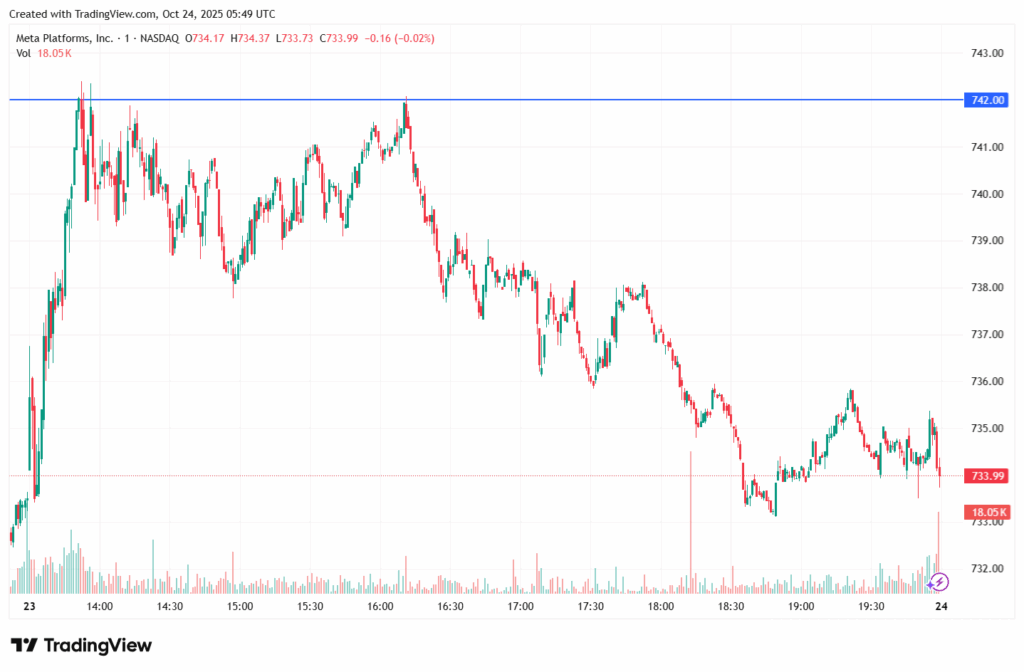
Meta’s stock price showed typical short-term volatility after the news broke. Shares initially fell by about 1 to 2 percent on the day of the announcement but recovered quickly as analysts framed the layoffs as a strategic efficiency move rather than a retreat from AI.
Technically, Meta’s share price remains within its upward channel that started earlier in 2025, supported by strong advertising revenue and expanding AI investments. Institutional investors have viewed the layoffs as a sign of cost control, which may support operating margins and cash flow in upcoming quarters.
This market response reflects a broader pattern in the tech sector. Investors often react cautiously to job cuts at first, then refocus on long-term fundamentals such as profitability and innovation. Within the NASDAQ 100, these shifts are influenced by growing competition in artificial intelligence. Rival developments between models like OpenAI and Gemini continue to shape investor sentiment and determine which companies are best positioned to lead the next phase of AI growth.
The Influence of Meta’s Stock
Meta’s reorganisation carries weight beyond its own valuation. As one of the largest components of both the S&P 500 and NASDAQ 100, its share movements can influence benchmark performance and short-term volatility.
For VT Markets traders, Meta’s restructuring wave opens both volatility and opportunity. Sharp intraday swings in Meta’s share price can spill over to the broader tech sector, especially the Nasdaq and S&P 500 indices.
A similar reaction was seen when Microsoft (MSFT) announced about 9,000 layoffs in July. The stock fell slightly at first, then rebounded within days as investors focused on its strong quarterly earnings and continued growth in cloud and AI revenue. These patterns show how layoff headlines often spark short-term volatility before markets stabilise. Traders should watch for:
- Quick market overreactions that may reverse soon after
- Sector-wide moves across Nasdaq 100 and S&P 500 CFDs
- Volatility spikes that can create both long and short trade opportunities
With $0 commission trading on US Shares, VT Markets traders can act quickly on these price swings — whether in Meta, Microsoft, or Nasdaq CFDs — and turn major news events into potential trading opportunities.
Trade the Technology Cycle Today
For the broader market, this change reflects a structural shift toward productivity-driven growth. Companies that streamline and integrate AI effectively may see improved earnings and higher valuations. Automation, innovation, and adaptability continue to drive market volatility and long-term opportunity. At VT Markets, traders can access global indices such as the NASDAQ 100 and S&P 500, along with leading technology stocks, to capitalise on market shifts driven by the rise of artificial intelligence.
Trade on the VT Markets App, MetaTrader 4 (MT4), or MetaTrader 5 (MT5), each equipped with advanced tools for analysing volatility, managing risk, and tracking market sentiment. New to trading? Try a VT Markets demo account to explore live market conditions in a risk-free environment before moving to a real account, and visit the VT Markets Help Center for platform guides and trading support.
Start trading the future of innovation with VT Markets.








