






Before the Bell, the Story Begins
Before Wall Street traders arrive at their desks, the market is already speaking through futures. The Dow Jones Industrial Average, long seen as a barometer of corporate America, trades around the clock in futures markets, offering the first clues to the day’s risk appetite.
When Dow Jones futures rise overnight, optimism tends to spill across Asia and Europe; when they fall, traders brace for turbulence.
These movements are more than pre-market noise. They capture the market’s interpretation of data releases, earnings forecasts, and global headlines long before the opening bell. For many, Dow Jones futures are the purest reflection of the market’s mood in real-time.
Sentiment Shifts with Every Headline
In recent weeks, Dow Jones futures have swung between mild optimism and defensive caution. Strong US consumer data and firm job numbers have bolstered the view that the economy remains resilient.
Yet persistent inflation worries and shifting Federal Reserve expectations have kept enthusiasm in check.
Each economic print now moves futures almost immediately. A surprise in the Producer Price Index or retail sales can trigger knee-jerk reactions as traders recalibrate expectations for rate cuts.
Futures markets are effectively the market’s live commentary on whether policy is moving too far or not far enough.
The Dow’s Broader Reflection
Unlike the tech-heavy NASDAQ, the Dow Jones remains anchored to industrials, financials, and consumer giants. Its futures, therefore, offer a wider lens on the real economy.
When Dow futures outperform tech benchmarks, it often signals a shift toward defensive positioning. When they lag, it reflects a renewed appetite for growth and innovation.
The divergence between Dow futures and the NASDAQ 100 has widened this month, suggesting investors are hedging tech exposure while rotating into value stocks. That rotation pattern can be tracked directly in futures spreads, giving traders early insight into capital flow trends.
How Traders Can Read the Signals
For active traders, Dow Jones futures serve three practical purposes. They indicate overnight sentiment, highlight volatility thresholds, and reveal correlations with key instruments, such as the dollar index and US Treasury yields.
When Dow futures open higher while the dollar weakens, it often points to a short-term risk-on mood. If both decline together, it hints at global risk aversion.
Watching how futures respond to economic data within the first minutes of release can also help gauge momentum strength ahead of the cash session.
Liquidity typically deepens in the overlap between European and US trading hours, providing cleaner price action for intraday strategies.
What to Watch Next
Traders will be monitoring the coming weeks for fresh inflation readings, corporate earnings, and any renewed tariff rhetoric from Washington. Each could spark swift shifts in Dow Jones futures, testing support levels near 39,000 and resistance toward 40,500.
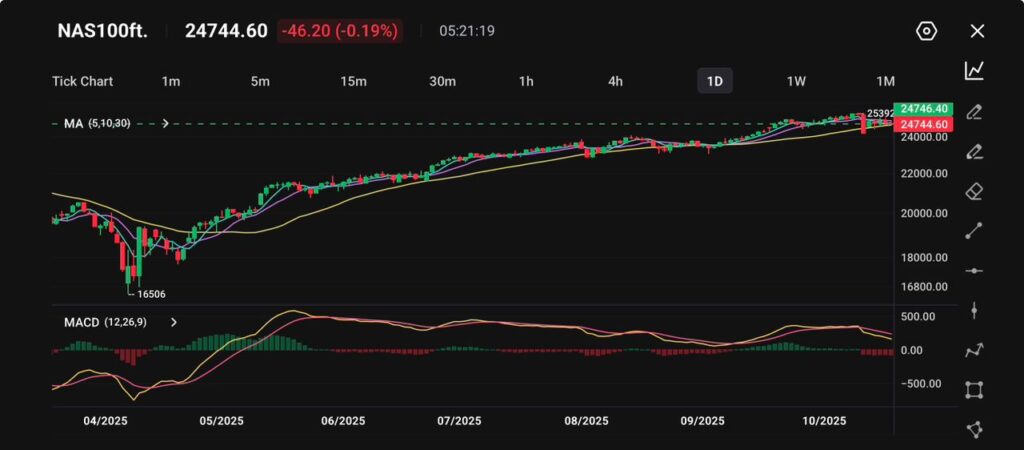
A sustained break above resistance would suggest confidence in the soft-landing narrative. Failure to hold recent gains could signal fatigue, particularly if bond yields rise again or fiscal debates intensify ahead of the election cycle.
A Cautious Perspective
Dow Jones futures continue to mirror the push and pull between optimism and restraint. The resilience of blue-chip stocks shows faith in US corporate strength, but volatility remains one headline away. Traders should approach each pre-market move as a temperature check rather than a forecast.
As 2025 enters its final stretch, the Dow’s futures market remains the market’s early morning mirror — reflecting both its confidence and its caution in equal measure.










