






As the Q4 2025 earnings season gets underway, investors are watching closely to see whether corporate America can justify the record valuations reached at the end of last year.
Heading into Q3, analysts expected S&P 500 earnings growth of 7.9%. Instead, companies significantly outperformed, delivering approximately 13.3% growth.
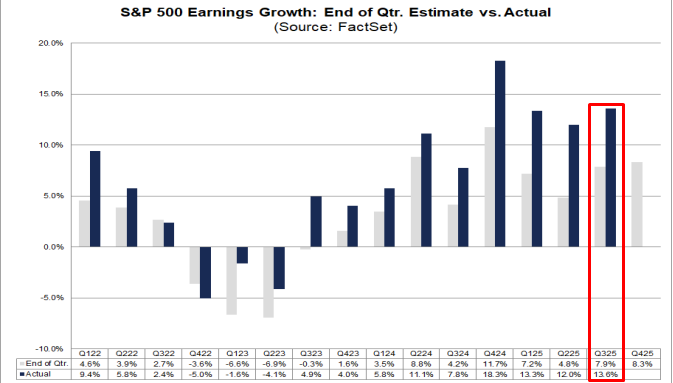
This marked the ninth consecutive quarter of earnings expansion, reinforcing the resilience of corporate profits. However, beneath the headline strength, subtle cracks began to emerge—particularly around the consumer.
While large technology firms continued to thrive, companies exposed to everyday borrowers showed signs of strain.
Forward guidance turned more cautious, suggesting that although the corporate engine remains strong, consumer spending momentum may be fading.
For crypto markets, however, individual earnings-per-share figures matter far less than the macroeconomic signal they collectively generate.
The true transmission mechanism from earnings to crypto runs through a single variable: the US dollar Index (USDX).
A Market Priced for Perfection
According to FactSet, consensus expectations for Q4 2025 earnings growth stand at 8.3%. If achieved, this would mark a tenth straight quarter of expansion.
Analysts are also projecting that this momentum will extend into 2026, with double-digit earnings growth of roughly 15%.
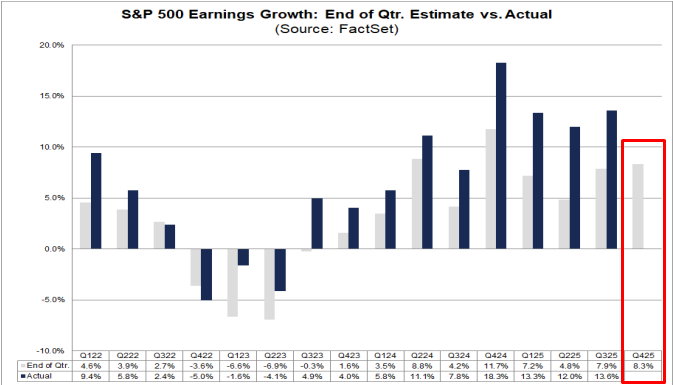
On the surface, this appears constructive for risk assets. However, strong equity fundamentals do not automatically translate into favourable conditions for crypto.
In fact, sustained earnings strength can be a headwind if it reinforces a strong-dollar environment.
This is where traders must move beyond simple correlations and focus on liquidity mechanics.
How the dollar Controls Crypto Prices
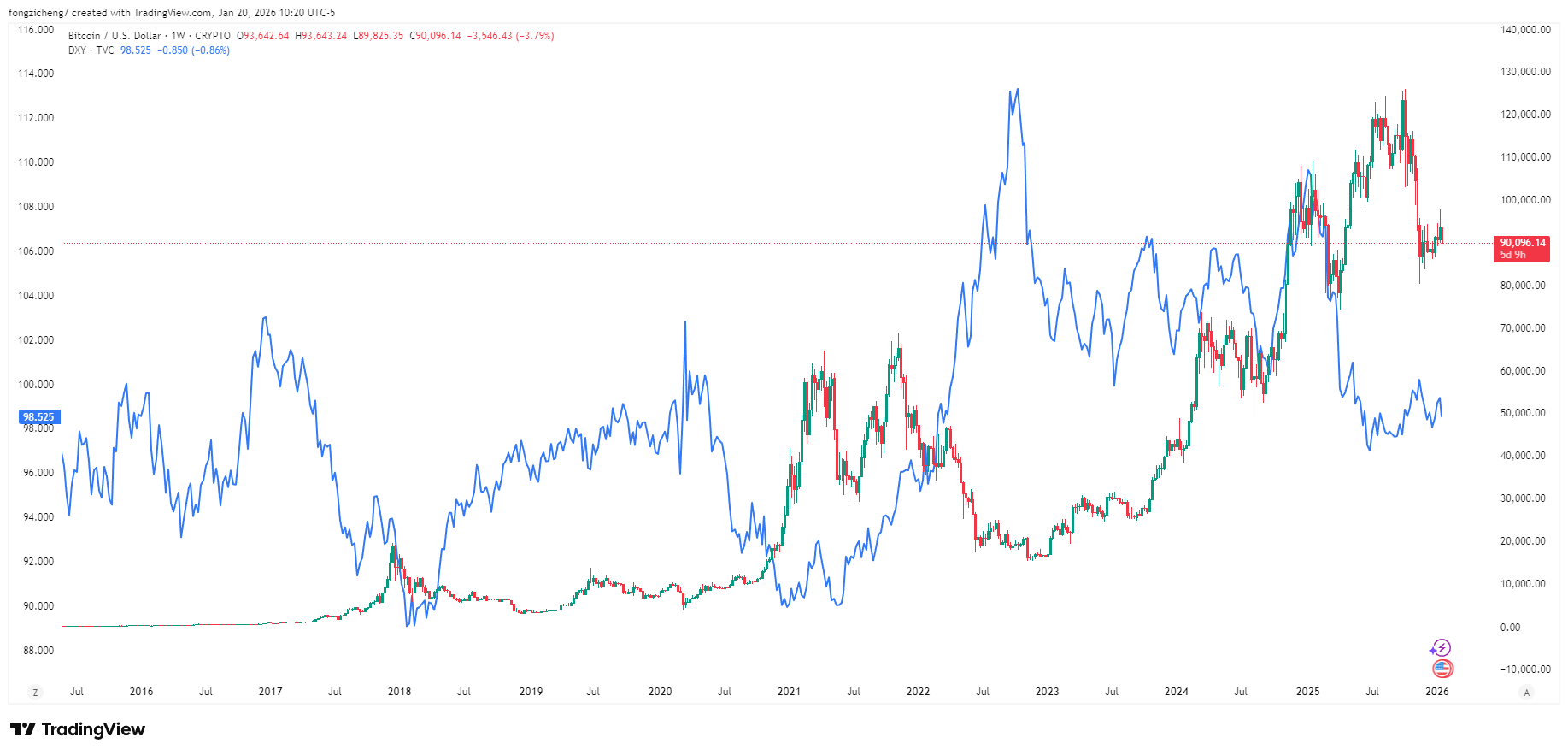
The connection between earnings and crypto lies in the Federal Reserve’s reaction function. Over the last cycle, global liquidityhas been the dominant driver of Bitcoin’s price action. The gatekeeper of that liquidity is the US dollar.
If earnings season delivers another round of upside surprises, with companies reporting strong profits and raising guidance for 2026, it signals that the US economy remains robust.
In this scenario, the Federal Reserve has little incentive to cut interest rates.
As a result, bond yields are likely to rise, making US assets more attractive to global capital. A stronger dollar acts as a liquidity vacuum, pulling capital away from risk assets.
For Bitcoin, which is priced in USD, a rising dollar often functions as a ceiling rather than a catalyst.
When Weak Earnings Become Bullish for Crypto
Historically, the setup that fuels crypto rallies is not strong earnings, but marginal disappointment. If earnings come in slightly below expectations—particularly in retail and consumer discretionary sectors—it signals a cooling economy.
This shifts bond market expectations towards earlier and deeper Federal Reserve rate cuts. When rate cuts are priced in, yields fall, and the dollar typically weakens.
A weaker dollar expands global liquidity, creating what could be described as a Goldilocks environment for crypto: economic growth slows just enough to warrant policy support, but not enough to trigger panic.
In such conditions, stocks may struggle with softer growth, while crypto benefits directly from liquidity injection.
The Line Crypto Bulls Must Not Cross
This dynamic, however, has a clear breaking point. The idea that “bad news is good news” only applies when the economy is bending, not breaking.
If earnings deteriorate sharply—marked by widespread layoffs, collapsing revenues, or severe guidance cuts—markets shift from pricing a slowdown to pricing a recession.
In a genuine risk-off panic, future liquidity promises lose relevance. Investors prioritise immediate cash, selling equities, bonds, gold, and crypto alike.
In that environment, even Bitcoin struggles as the dollar strengthens safe-haven demand. For crypto traders, the ideal outcome is therefore not an earnings collapse, but a controlled softening.
What Traders Need To Know
For traders, this earnings season is less about individual company results and more about second-order market reactions.
- Watch the US dollar Index immediately after major earnings releases, not days later. The initial dollar response often sets the tone for crypto.
- Strong earnings + rising USDX typically suppress crypto volatility and upside.
- Slight earnings misses + falling USDX are the most constructive setup for Bitcoin.
- Falling equities alongside a rising dollar is a warning sign of recession risk, where liquidity conditions deteriorate rapidly.
In short, crypto traders should think in terms of liquidity regimes, not narratives.
The Verdict
This earnings season should be viewed not as a scoreboard of corporate health, but as a real-time liquidity barometer.
If the dollar strengthens following earnings, the economy is likely running too hot for meaningful policy support, limiting crypto upside.
If the dollar weakens, liquidity conditions are improving and the door opens for renewed Bitcoin momentum. However, if equities sell off while the dollar surges, markets are signalling stress—and cash becomes king.
For crypto, the earnings story only matters insofar as it moves the dollar.










