






Every four years, Bitcoin’s block reward is cut in half. This “halving” reduces the flow of new Bitcoin entering circulation and has historically triggered powerful bull runs.
The pattern has been remarkably consistent: Bitcoin rallies first, followed by Ethereum and large-cap altcoins, and finally smaller tokens enter an exuberant “altseason.” The cycle usually ends with a sharp correction roughly 18 months after the halving before the process resets.
The typical flow of capital has long been: Bitcoin → Ethereum → Large Caps → Small Caps. This sequence has made Bitcoin’s halving one of the most anticipated events in crypto.
What does it mean to you? Halving can heighten volatility, especially in the weeks before and after the halving. When you trade crypto CFDs, you can take advantage of short-term price swings in both directions without needing to hold the underlying asset.
2012, 2016, 2020: When History Rhymed
2012 Halving: Bitcoin surged from USD 12 to over USD 1,000 within a year, sparking the first major altcoin boom led by Litecoin and XRP. The cycle ended in a harsh correction by 2014.
2016 Halving: Bitcoin climbed from USD 650 in July 2016 to nearly USD 20,000 by December 2017. Ethereum and the ICO craze took centre stage, and Bitcoin’s dominance dropped to around 30%. By 2018, the bubble burst.
2020 Halving: From USD 3,800 to USD 69,000 by late 2021, Bitcoin’s rise was accompanied by explosive growth in Ethereum, DeFi, NFTs, and meme coins. Retail participation hit a fever pitch before a 70% market-wide collapse in 2022.
Across all three cycles, the rhythm was familiar: Bitcoin rallied first, altcoins outperformed later, and the entire market eventually corrected.
Bitcoin’s Halving Timeline
The chart below tracks Bitcoin’s halving history from 2012 to 2024, showing how each reduction in block rewards has preceded massive price expansions. Notice how the rallies tend to accelerate within 12–18 months after each halving, followed by a pronounced correction before the next cycle begins.
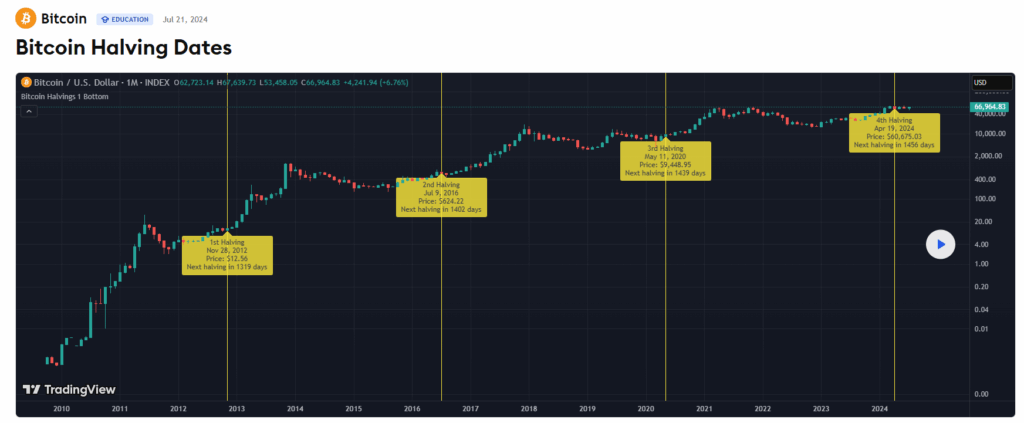
This visual makes clear that while the exact numbers change, the cyclical heartbeat of Bitcoin has remained remarkably consistent until now. The question is whether 2024 will mark another repetition or a structural break from the past.
2024: Same Halving, Different Market
The April 2024 halving is playing out under entirely new conditions.
- A Flood of New Tokens
In 2013, there were only a few hundred cryptocurrencies. By 2017, that number had climbed into the thousands. Today, there are tens of thousands.
This abundance spreads investor capital thin, making a broad-based “everything rallies” altseason less likely. Instead, gains are becoming concentrated in sectors or coins with real utility and adoption.
- Institutional Capital Redefines the Cycle
The introduction of spot Bitcoin ETFs in early 2024 brought billions in institutional inflows from pension funds, hedge funds, and retail brokerages. Bitcoin quickly surged past USD 100,000, supported by large-scale buying and long-term holding strategies.
Ethereum, meanwhile, is emerging as a co-leader rather than a follower. Its proof-of-stake yields, pivotal role in DeFi, and strong ETF inflows have more than doubled ETH’s price from its lows.
Unlike past cycles, though, retail-driven rotations into smaller altcoins have yet to appear. Flows remain concentrated at the top of the market, with Bitcoin and Ethereum absorbing most attention.
- A More Mature Market
Futures, options, and miner hedging have made Bitcoin’s price swings less extreme. Macro factors like Federal Reserve policy now drive crypto sentiment more than retail hype.
Corporations are also playing a bigger role. The firm formerly known as MicroStrategy (now Strategy Inc)continues its dollar-cost-averaging approach, amassing roughly 640,000 BTC. Other firms are quietly following suit, locking away supply and reinforcing the idea of Bitcoin as a treasury reserve asset.
Will the Cycle Repeat?
So far, the 2024 cycle looks different. Bitcoin has hit new highs, Ethereum is sharing the leadership role, and smaller altcoins are lagging.
Two possible outcomes lie ahead:
- Delayed Rotation: Bitcoin’s dominance may simply be delaying altseason. Once BTC peaks, capital could shift into other large-cap names, such as Solana or Avalanche, especially in late 2025.
- New Reality: Institutional money may have permanently changed market behaviour. Instead of “everything goes parabolic,” only select, fundamentally strong projects may outperform.
Current Market Snapshot
As of early October 2025, Bitcoin is trading around USD 124,500, continuing to hover near all-time highs following months of steady accumulation and institutional inflows.
The chart below highlights this sustained upward movement since mid-2025, with bullish momentum confirmed by rising moving averages and a recovering MACD crossover, consistent with previous mid-cycle strength phases seen in earlier halvings.
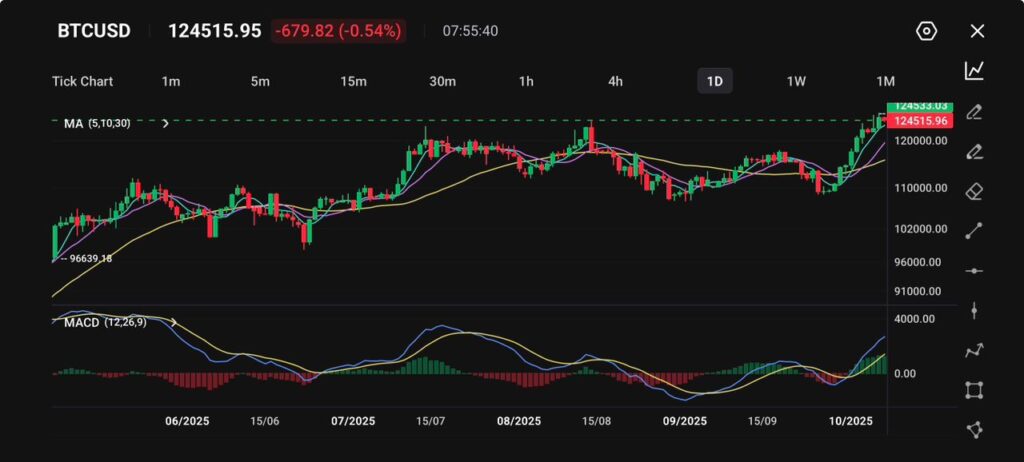
If this pattern holds, the market could be approaching a stage where Bitcoin dominance peaks before potentially rotating into large-cap altcoins later in the year.
The 18-Month Question: Will There Be a Crash?
In previous cycles, markets peaked 12–18 months after the halving before entering deep corrections. If the pattern holds, this cycle could top out in late 2025.
Why a correction could still happen:
- Speculative excess always unwinds, even with institutional involvement.
- Late-cycle retail mania could inflate smaller-cap assets.
- Miner profit-taking tends to accelerate after major rallies.
Why this time might be different:
- Institutional hedging could soften volatility.
- Supportive liquidity and Fed policies may extend risk-on conditions.
- Corrections might come in smaller waves, rather than one steep crash.
A correction remains likely, though it may be less severe than the 80–90% drawdowns of past cycles.
What to watch before and after the halving
- Mining activity: If miners slow down or switch off machines, it can affect Bitcoin’s supply and price.
- Trading activity: Watch open interest and funding rates — they show how much money is flowing into crypto trades.
- Market mood: Bitcoin often moves in line with tech stocks and overall risk appetite.
- Economic news: U.S. rate cuts, inflation data, or ETF inflows can all impact crypto liquidity and short-term moves.
Crypto and Stocks: Converging Behaviour
Bitcoin now behaves much like a high-beta tech stock, rising faster in bull markets and falling harder in downturns. Its growing correlation with equities reflects the influence of ETFs and corporate treasuries treating it as a mainstream asset class.
This has a double edge. Mainstream adoption could stabilise Bitcoin and attract long-term capital, but it may also temper the explosive, retail-driven rallies that once defined crypto.
Conclusion: The Halving Cycle Evolves
The 2024 halving has reaffirmed Bitcoin’s supply logic but revealed how much the surrounding market has matured. Institutional flows dominate, volatility has softened, and crypto’s link to traditional finance is tightening.
Altseason may still come, but later, and more selectively. Corrections are inevitable but likely milder.
The halving cycle isn’t dead. It’s simply evolving. As 2025 unfolds, traders should respect historical patterns while recognising that this maturing market no longer plays by the same rules.










