







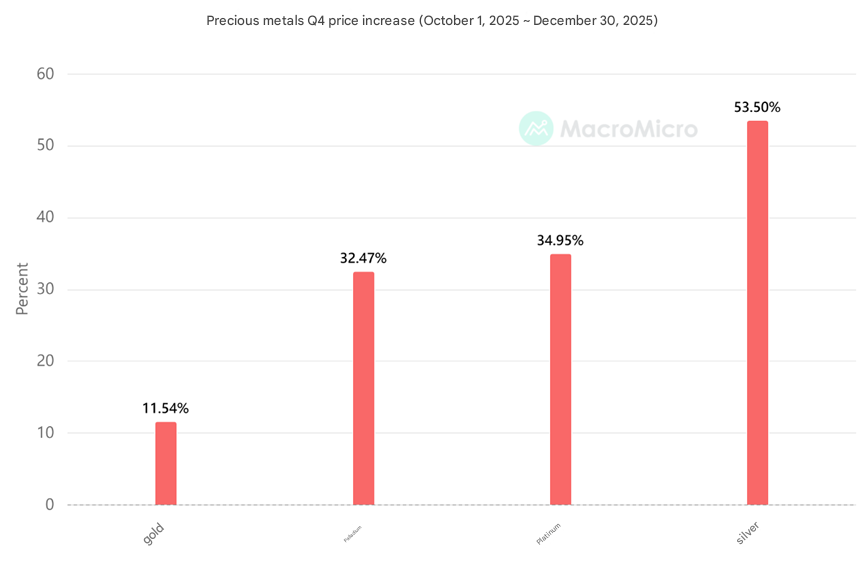
In the final quarter of 2025, gold once again reached new heights. After a steady climb through Q3, the metal entered a high-volatility, high-momentum phase, hitting a record US$4,380 per ounce in mid-October before undergoing a brief technical correction to around US$3,900.
Source: MacroMicro
By late December, gold had not only recovered but surged further, approaching US$4,550 per ounce and marking an annual gain of more than 70%.
This powerful rally was driven by a mix of structural factors:
- Rising safe-haven demand amid U.S. credit concerns.
- China’s rare earth export restrictions triggered supply anxieties.
- Looser U.S. monetary policy, which reduced the opportunity cost of holding gold.
Together, these forces created a wave of capital inflows into precious metals, making Q4 one of the strongest quarters for the asset class in recent years.
China’s Role in Gold’s Upswing
China has played a critical role in shaping gold’s recent trajectory. In early Q4, Beijing announced an expansion of export controls on rare earths and strategic minerals, a move widely interpreted as a response to U.S. semiconductor restrictions. This escalation added a new layer of uncertainty to already fragile global risk sentiment.
Against this backdrop, gold benefited from its status as a hedge against geopolitical confrontation and trade fragmentation. Although short-term pullbacks occurred as markets digested the news, the broader bullish structure remained intact — a signal that demand was being driven by strategic allocation rather than reactionary flows.
Source: Goldhub.com
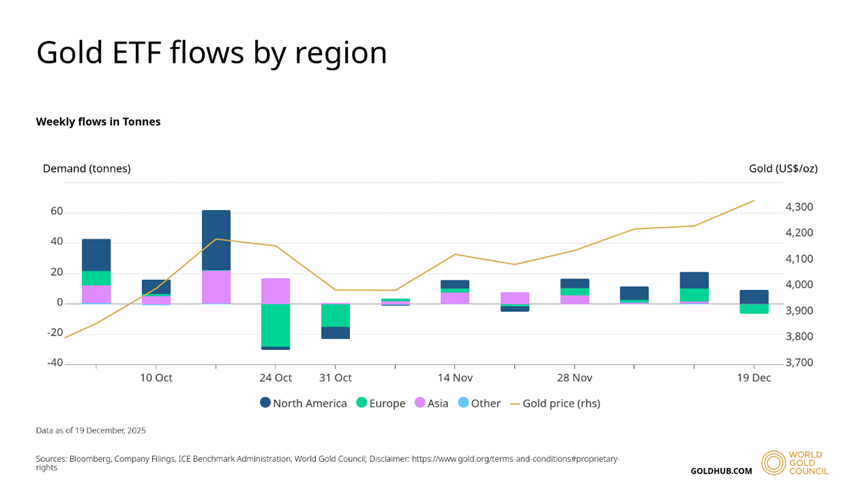
According to WCG data, global central banks made net gold purchases of 53 tonnes in October, a 36% increase month-on-month, marking the highest single-month total of 2025. The year’s cumulative net purchases reached 254 tonnes — slightly slower than in the past three years, but still underscoring gold’s growing strategic importance.
China played a crucial role. The People’s Bank of China has increased its gold reserves for 13 consecutive months, reinforcing the metal’s role as a hedge against uncertainty.
Meanwhile, gold ETFs attracted strong inflows, with November alone seeing a net US$5.2 billion added globally — the sixth straight month of growth. Total assets under management climbed to a record US$530 billion.
Asia contributed US$3.2 billion of those inflows, of which China accounted for US$2.2 billion, highlighting the country’s growing appetite for gold investment amid geopolitical tension and robust private demand.
Looking Ahead in 2026: A More Mature Bull Cycle
Looking ahead to 2026, gold remains in a structural bull market, though the pace of gains is likely to moderate. Periods of consolidation or technical pullbacks may occur, especially after such a steep rally in 2025.
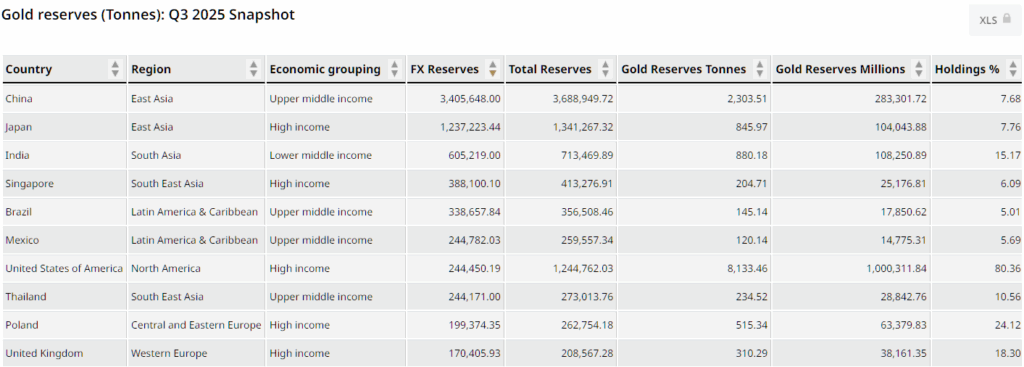
China’s long-term accumulation strategy is expected to continue. The People’s Bank of China now holds the sixth-largest gold reserves globally, but gold still represents only around 10% of its total foreign reserves, compared to roughly 70% for the U.S., Germany, and France.
Source: gold.org
Analysts at Goldman Sachs and J.P. Morgan believe this accumulation has evolved into a long-term strategic policy, with consistent monthly purchases likely to persist through 2026, providing a natural floor for prices during downturns.
J.P. Morgan also notes that large Chinese insurers and institutional investors are reallocating capital into gold, potentially injecting billions of dollars in liquidity into the global market.
In the U.S., the 2026 midterm elections are expected to drive volatility.
Historically, election years coincide with rising VIX levels, as investors trim exposure to risk assets and seek refuge in defensive holdings such as gold. This could serve as a key catalyst for another upward leg in prices.
However, there are risks to monitor. If the U.S. economy posts stronger-than-expected growth early in 2026, rate-cut expectations may be delayed, prompting short-term corrections in gold.
What Traders Need to Know
This gold cycle is being driven less by short-term macro surprises and more by long-term structural change. Central banks are redefining gold’s role within reserves, China is using it as a strategic hedge against geopolitical and financial risk, and institutional investors are embedding it into portfolio construction rather than treating it as a tactical trade.
For traders, this means gold may behave differently than in past cycles.
Volatility is increasingly shaped by policy signals, geopolitical developments, and capital allocation trends rather than traditional inflation or currency drivers alone.
Understanding these forces is critical to contextualise market moves, manage risk effectively, and align trading strategies with the evolving role of gold in the global financial system.
Disclaimer
The views and opinions expressed in this article are those of Ray Yang, Market Analyst at VT Markets. They reflect his professional analysis and insights on current market conditions and do not necessarily represent the official position of VT Markets. This commentary is provided for informational purposes only and should not be construed as financial advice.










