





Crude oil has long been one of the most politically sensitive and volatile assets in global financial markets. Oil prices have historically reacted sharply to uncertainty from geopolitical conflicts to supply disruptions. Headlines often amplify these movements, creating the perception that price spikes are not only dramatic but also sustainable.
However, a deeper analysis tells a more nuanced story.
The real question for traders and investors is not whether oil spikes during crises but rather the following:
Do these spikes sustain, or does oil eventually return to its fair value zone?
To answer this, we step back and examine nearly four decades of price behavior through the lens of volume profile analysis and futures market expectations.
The Big Picture: A 40-Year Perspective
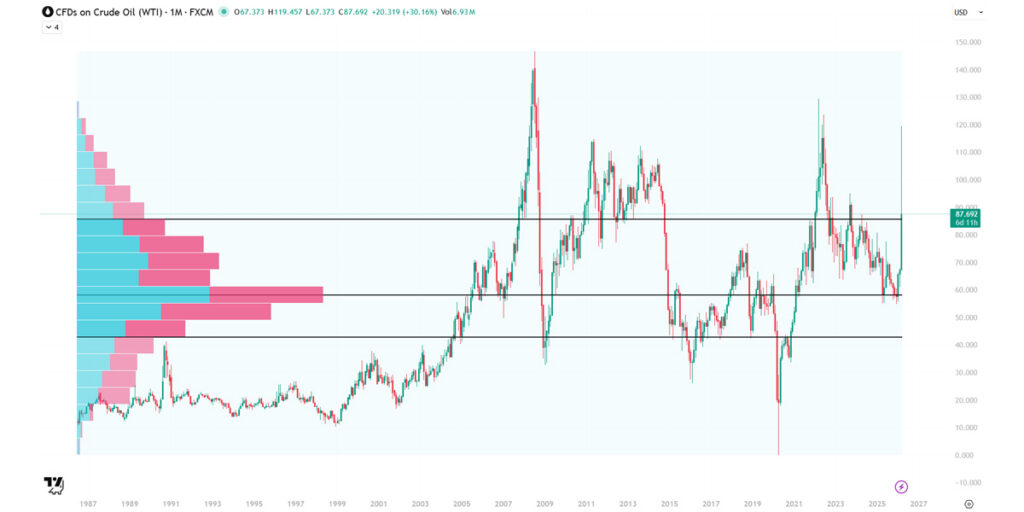
When we analyze crude oil prices from 1987 to 2026, a clear structural pattern is visible. Despite periods of extreme volatility, oil prices have spent most of their time within a relatively stable range.
The largest traded price zone (Point of Control) sits approximately in the $57–$58 range, representing the level where the most market activity has historically occurred. Expanding this view, the broader value area that encompasses roughly 70% of trading activity lies between $42 and $86.
This insight is critical & suggests that for most of the last four decades, crude oil has consistently gravitated toward this value zone. Prices may temporarily deviate, but they rarely remain outside this range for extended periods. More specifically, oil tends to revert to equilibrium.
What Happens During Geopolitical Conflicts?
Geopolitical tensions like the Gulf War, the Iraq War, the Russia–Ukraine conflict, or broader Middle East instability have historically triggered sharp upward movements in oil prices.
These events often push prices above the Value Area High (VAH), creating spikes that are driven by fear, supply concerns, and speculative momentum.
But here lies the critical observation:
- Over the past 40 years, crude oil has spent only 5–6 years above the VAH, that means roughly 10–15% of the total time period.
- So while war-driven price surges are dramatic, they are also statistically rare and typically short-lived.
The market reacts quickly to uncertainty, but it does not stay irrational forever.
The Mean Reversion Reality
Whenever crude oil prices move above their fair value range, a series of balancing forces begins to take effect.
First, demand destruction starts to occur. Higher energy costs reduce consumption, impacting industries and economic activity. Second, alternative energy adoption increases, as consumers and businesses look for cost-efficient substitutes. Third, supply dynamics adjust, whether through increased production from OPEC or rising output from shale producers.
Over time, these forces work collectively to bring prices back toward equilibrium. This phenomenon is known as mean reversion, and it is one of the most consistent characteristics of commodity markets.
Simply put:
War may drive prices higher, but economics eventually brings them back.
What Is the Market Expecting Now?
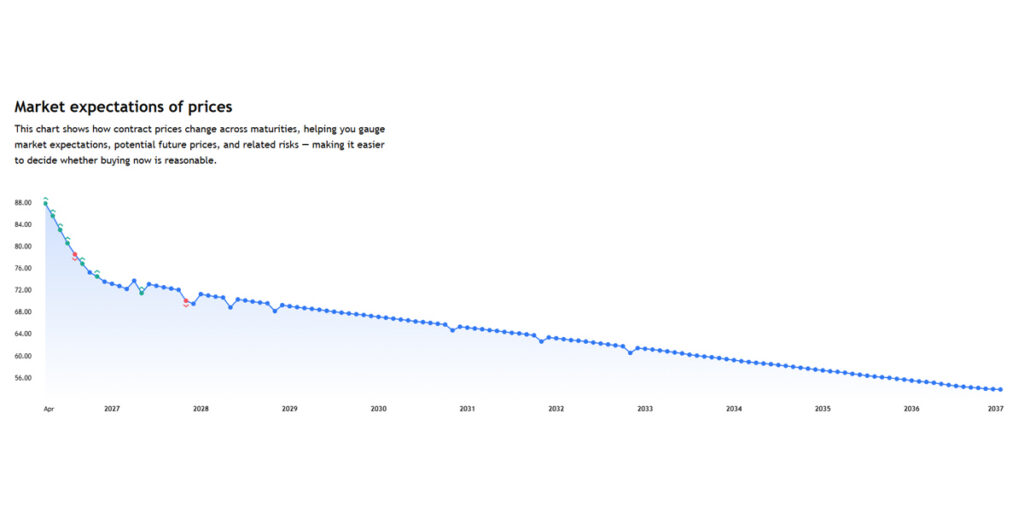
To complement historical analysis, it is equally important to examine forward-looking indicators. The NYMEX futures curve (2026–2037) provides valuable insight into how the market is pricing oil in the long term.
Currently, prices are hovering around the $85–$88 range, reflecting short-term tightness and geopolitical premiums. However, the forward curve gradually trends downward, pointing toward a $55–$60 range over the coming decade.
This structure is known as backwardation transitioning into normalization & signals two key expectations:
- The market acknowledges short-term supply constraints and geopolitical risks
- But it also anticipates a long-term return to historical equilibrium levels
Conclusively, the futures market is aligning closely with historical data.
Connecting the Dots: History Meets Expectations
When we combine both perspectives (historical behavior and forward expectations), a consistent narrative emerges.
From a volume profile standpoint, oil spends nearly 70% of its time within its value area, with price excursions above this range being rare and temporary.
From a futures market perspective, prices are expected to gradually decline over time, stabilizing near long-term averages.
Both lenses point to the same conclusion:
High oil prices driven by fear are not structurally sustainable.
What If Geopolitical Tensions Ease?
If current geopolitical tensions begin to subside, the implications for oil markets could be significant.
The risk premium embedded in prices would likely diminish, supply chains could stabilize, and market focus would shift back to core fundamentals such as demand, production, and inventory levels.
Under such conditions, the probability increases for oil prices to:
- Move back toward the $70 range in the medium term
- Gradually stabilize closer to the $60 range over time
This scenario aligns with both historical patterns and forward market expectations.
Key Takeaways for Traders and Investors
More than just a technical observation, it reflects a deeper structural behavior of the market.
- Oil rallies driven by geopolitical fear are often unsustainable
- Long-term pricing is governed by economic equilibrium
- Futures markets already incorporate expectations of normalization
- Current elevated price levels may represent a temporary dislocation rather than true value
For traders, this insight highlights the importance of distinguishing between short-term narratives and long-term market structure.
Final Thoughts
Crude oil offers a classic example of how markets behave under stress. In the short term, prices are influenced by headlines, fear, and supply shocks. But over the long term, markets consistently gravitate toward value.
Nearly 40 years of data point to one clear conclusion: the oil may spike on fear, but it stabilizes on fundamentals. And today, both history and market expectations suggest the same possibility: Current price levels may not reflect where oil ultimately belongs.
Create a live VT Markets account today to access our platform features, including market insights and educational content.








