






Gold has always held a certain fascination for traders. It’s one of the actively traded financial instruments, & it reacts to a complex mix of market sentiment, inflation expectations, central-bank decisions, economic data and geopolitical developments.
For traders working with limited capital, that appeal can be even stronger. Gold’s liquidity, sharp price movements and the availability of leverage can make larger market exposure seem accessible with a relatively small account. Social media can also reinforce this perception, with stories of traders turning modest accounts into substantial fortunes in only a few trades. But its considerably more nuanced.
Trading gold with a small account is not about finding the right entry. It is a test of risk management, discipline, patience and psychological control. Many traders do not struggle because they cannot identify market direction; they struggle because they underestimate gold’s volatility and overestimate what leverage can do for them.
Leverage

Leverage is one of the biggest attractions of gold trading for small-capital traders. It allows traders to control a position larger than the capital available in their account, giving them access to market movements that requires more funds otherwise.
Yet leverage comes with a fundamental trade-off: it amplifies losses as readily as it amplifies gains.
A small account does not make the market move any differently. When leverage is used to take on an oversized position, even a relatively small adverse price movement can have a strong impact on the account.
The perception of leverage goes wrong here. It is to increase capital efficiency, not to manufacture faster returns. Using maximum exposure in pursuit of rapid account growth can turn a few unsuccessful trades into losses capable of erasing months of gains.
Risk Management

Traders can spend countless hours searching for the perfect strategy, indicator or entry signal while overlooking the foundation that supports them all: risk management.
Even experienced traders encounter losing trades. The distinction lies not in avoiding losses altogether, but in containing them when they occur. For a small account, this becomes particularly important because recovering from a substantial drawdown requires disproportionately larger gains. For example, a 50% loss requires a 100% gain simply to return to the original balance.
The pressure to grow a small account quickly can encourage traders to take excessive risks. Ironically, that pursuit of faster growth can have the opposite effect.
The objective should not be to maximise the outcome of the next trade. It should be to remain capable of taking the next trade after a series of losses.
Gold’s Volatility: Opportunity and Threat
Gold is not a quiet market. Employment data, inflation figures, Federal Reserve statements, interest-rate expectations, currency movements, geopolitical developments and central-bank activity can all influence its price. Most of the time, these catalysts can trigger significant moves within minutes.
Volatility can create attractive setups for traders. But for those with limited balances, it can also expose weaknesses in position sizing and risk management.
A strategy that performs well in calmer conditions may become harder to execute when volatility suddenly accelerates. Sharp reversals and rapid price movements can challenge even carefully planned trades.
The important distinction is that volatility itself is neither inherently good nor bad. It is simply a defining feature of the market. The trader’s ability to navigate it determines whether it becomes an opportunity or a threat.
The Overtrading Trap
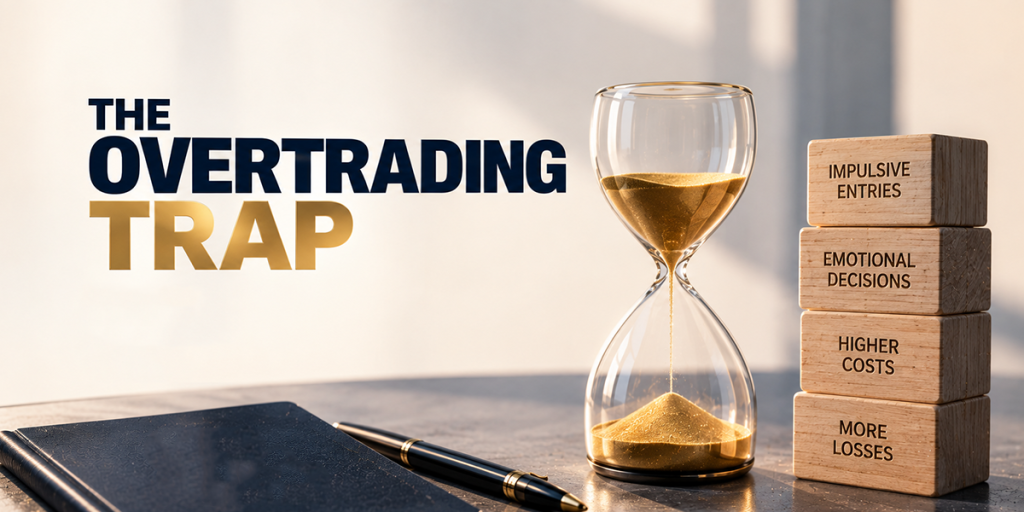
The most common challenge for small-capital traders is the temptation to overtrade. The kind of impatience can lead traders to force entries whenever the market moves, even when there is no clear setup.
The pressure can become even greater when the account is small. The desire to generate returns quickly can turn every breakout, price movement or news event into a perceived opportunity.
But excessive activity can come at a cost:
- Higher transaction costs
- Emotional fatigue
- Lower-quality decisions
- Greater exposure to market noise
- Larger cumulative losses
Professional trading is not defined by constant activity. There are times when staying out of the market is the more deliberate choice.
The Mindset Shift
Perhaps the challenge of trading gold with limited capital is more psychological.
Beginners focus on the numbers: How much can the account make today? How quickly can it grow? When can trading become a source of financial independence?
A more disciplined approach asks a different question:
Did I follow my process today?
That subtle shift changes the way a trader interprets both wins and losses. A losing trade becomes an opportunity to evaluate execution rather than an invitation to chase the next position. A winning trade becomes evidence of a well-executed process rather than a reason to become overconfident. Over time, sustainable progress is generally built through hundreds of disciplined decisions rather than a handful of exceptional trades.
Rules Every Small-Capital Gold Trader Should Know:
- Define your risk before entering: Know how much capital is at risk if the trade moves against you.
- Have a stop-loss strategy: Markets can remain irrational longer than a trader can remain solvent.
- Avoid revenge trading: Increasing position size after a loss can quickly compound the damage.
- Watch high-impact economic events: Major news can produce volatility strong enough to invalidate otherwise sound technical setups.
- Prioritise quality over quantity: A well-executed trade can be more valuable than a series of impulsive positions.
- Keep a trading journal: Reviewing past decisions can reveal patterns that are difficult to recognise in the moment.
- Think long term: The goal is not to win every trade, but to preserve the financial and emotional capacity to participate in future opportunities.
The Bigger Picture

The celebrated misconception about trading gold with small capital is that the right strategy alone determines the outcome.
In real risk management, self-control, patience and psychological resilience are equally central to navigating the market. Gold may offer more opportunities, but its volatility can be unforgiving when leverage is misused or risk is underestimated.
The goal is not to make money on the next trade. It is to build the habits and discipline needed to stay in the game long enough for your approach to work.
In gold trading, survival is more than a prerequisite for growth. It is the foundation on which growth is built.
Create a live VT Markets account today to access our platform features, including market insights and educational content.








