







Key Points
- The Nasdaq Composite advanced 1% on Monday as investors returned to semiconductor and AI-related stocks following last week’s decline.
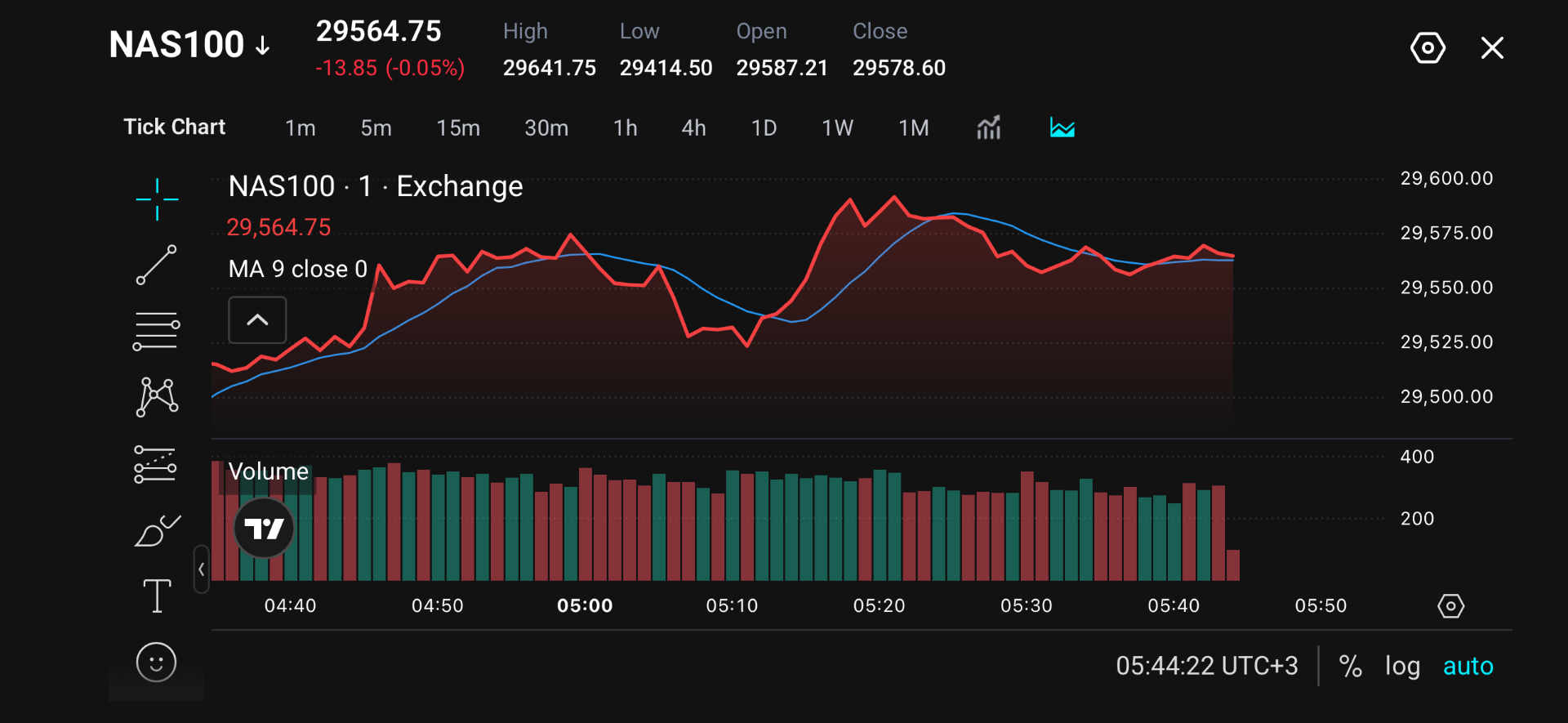
- NAS100 trades near 29,564.75 with immediate resistance around 29,575 to 29,600.
- US crude oil futures rose 2.2% to $103.66 per barrel, adding another potential source of inflation pressure.
- Upcoming corporate earnings could determine whether the technology-sector rebound develops into a sustained recovery.
Market Move
US technology stocks recovered on Monday as investors returned to semiconductor manufacturers and AI-related companies following a difficult week for Wall Street. The Nasdaq Composite led the major US indices with a 1% advance, recovering part of the losses recorded during the previous week. Both the Nasdaq and S&P 500 had suffered their largest weekly declines since late June as concerns over interest rates and technology-sector valuations weighed on sentiment.
However, the rebound was concentrated among heavyweight stocks. Major indices also retreated from their intraday highs, suggesting that buying momentum remained uneven despite the broader improvement in sentiment. The NAS100 chart reflects this cautious recovery. The index was trading at 29,564.75, down 13.85 points. During the session, NAS100 reached a high of 29,641.75 and a low of 29,414.50.
Why Traders Are Watching
Last week’s selloff raises concerns about how technology companies will finance increasingly expensive AI infrastructure projects. Chip manufacturers and other companies supporting AI development have faced pressure as higher interest rates raise the cost of financing AI-related investments.
Although investors returned to the sector on Monday, the recovery does not indicate that these concerns have disappeared as the approaching earnings season places additional attention on major technology companies. Traders will assess whether revenue and profit growth can justify elevated valuations, especially for companies that have benefited from heavy AI demand.
Energy markets continue to influence the index as US crude oil futures settled 2.2% higher at $103.66 per barrel. The advance followed reports of attacks involving Yemen’s Iran-aligned Houthis and renewed attacks on Saudi energy, airport and military facilities.
Key Trading Levels
| Level | Price | Technical significance |
| Resistance 2 | 29,600 | Psychological resistance above the recent rebound |
| Resistance 1 | 29,575–29,590 | Immediate resistance and recent local highs |
| Current price | 29,564.75 | Short-term consolidation area |
| Support 1 | 29,550 | Nearby reaction level |
| Support 2 | 29,525 | Previous pullback support |
| Support 3 | 29,500 | Psychological support and earlier chart base |
The index is consolidating near 29,565 after retreating from an intraday recovery towards 29,590. The immediate resistance zone lies between 29,575 and 29,590, where the latest recovery lost momentum.
On the downside, 29,550 provides the first support. The nine-period moving average remains close to the current price, while the latest price swings have narrowed.
Bullish and Bearish Setups
| Scenario | Confirmation | Potential targets |
| Bullish breakout | Sustained move above 29,590 | 29,600, followed by 29,641.75 |
| Bullish pullback | Price holds above 29,550 and rebounds | 29,575–29,590 |
| Bearish breakdown | Price falls below 29,550 | 29,525, then 29,500 |
| Bearish rejection | Repeated failure near 29,590 | 29,550, followed by 29,525 |
A bullish scenario could develop if NAS100 maintains support above 29,550 and breaking through the resistance zone would indicate renewed buying interest following the recent consolidation. The next immediate target would be 29,600, with the session high of 29,641.75 becoming a broader upside reference.
A bearish scenario could emerge if NAS100 fails to overcome 29,590 and subsequently breaks below 29,550. This would suggest that the latest rebound is losing strength, potentially exposing support at 29,525 and 29,500. A move below that would weaken the immediate recovery structure and increase the risk of a deeper retracement.
Disclaimer
The price levels and market scenarios above reflect the author’s assessment at the time of writing. They do not represent financial advice or an official recommendation from VT Markets. Traders should conduct their own analysis and manage risk carefully.
NAS100 Prediction: What’s Next?
NAS100’s near-term outlook depends on whether renewed buying interest in AI stocks can offset rising infrastructure costs and upcoming corporate earnings. Stronger-than-expected earnings and positive guidance from major technology companies could restore investor confidence, supporting further gains in the index. However, disappointing results or increased AI-related spending without clear improvements in profitability could renew selling pressure.
Meanwhile, rising oil prices and persistent inflation concerns could influence Federal Reserve policy expectations and US Treasury yields. Higher borrowing costs may continue to weigh on technology valuations.
Trade NAS100 with VT Markets
Market volatility following major economic releases can create opportunities for traders looking to respond to movements in US technology stocks.
With VT Markets, traders can discover Nasdaq-related index CFDs and other assets through a range of trading platforms. VT Markets provides access to global markets, advanced charting tools, educational content and more.
Start a live trading account and explore trading opportunities at VT Markets.
Frequently Asked Questions
Why is NAS100 recovering after last week’s selloff?
NAS100 is benefiting from renewed interest in semiconductor and AI-related stocks. The broader Nasdaq Composite gained approximately 1.1% on 19 October as investors returned to technology shares ahead of corporate earnings. However, concerns about borrowing costs and AI infrastructure spending remain unresolved.
What happens if NAS100 falls below 29,550?
A sustained move below 29,550 could indicate weakening short-term buying momentum. Traders may then monitor 29,525 and 29,500 as the next potential support levels.
How do higher interest rates affect NAS100?
Higher interest rates can increase borrowing costs for technology companies and reduce the present value of expected future earnings. This can place pressure on growth-stock valuations, particularly among companies investing heavily in AI infrastructure.
Can upcoming technology earnings push NAS100 higher?
Stronger-than-expected earnings, improving profit margins and constructive AI-related guidance could support NAS100. However, disappointing revenue forecasts or rising capital expenditure without corresponding profit growth could renew selling pressure.
Start trading now — click here to create your real VT Markets account.



