





Ask any experienced trader what separates a long, sustainable career in the financial markets from a short, painful one, and most will say the same thing: it’s rarely the entry. It’s what happens after — specifically, whether you had a stop loss and take profit plan in place before you ever clicked “buy” or “sell.”
This guide is a genuinely evergreen, stop loss basic to advanced walkthrough covering exactly how to calculate stop loss and take profit, why both matter for every trading strategy, and how to apply them whether you’re a short-term scalper or a long-term position holder. Written for anyone opening a trading account for the first time, right through to experienced traders looking to sharpen their approach.
Key Takeaways
- A stop loss automatically closes a trading position once the market price hits a predetermined level, helping to limit losses and remove emotional decision making from the equation.
- A take profit order does the opposite — it automatically closes a position once your target price is reached, helping to lock in profits before the market moves against you.
- How to calculate stop loss and take profit usually starts with your entry price, your risk tolerance, and nearby support and resistance levels.
- A sound risk reward ratio — commonly at least 1:2 — means you can be wrong more often than you’re right and still stay profitable over the long term performance of your trading account.
- Position size, not just the exact stop loss distance, is what ultimately determines how much capital is genuinely at risk on any single trade.
- Managing risk with stop loss and take profit orders is a foundational skill across every asset class, from forex trading to shares, indices, and precious metals.
A Brief History of Trading and Risk Management
The instinct to manage risk while selling assets and selling financial instruments is far older than any trading platform. Historians trace bartering back to early humans in the Stone Age, long before ancient history gave us the first organised marketplaces. By the Middle Ages, trade fairs across Europe, Central Asia, and the Middle East had grown into genuine economic centres, connecting merchants through hand to hand markets and early forms of credit.
As extensive trade networks expanded across global currencies during the Industrial Revolution, the need for formal risk management tools grew alongside them – merchants needed ways to manage risk on shipments that might take months to arrive. Modern efforts to promote free trade and the rise of standardised exchanges eventually gave today’s retail traders and hedge funds the same basic tools once used informally: a plan for what happens if the market moves against you, and a plan for what happens if it moves in your favour. That’s essentially what stop loss and take profit orders formalise today.
What Are Stop Loss and Take Profit Orders?
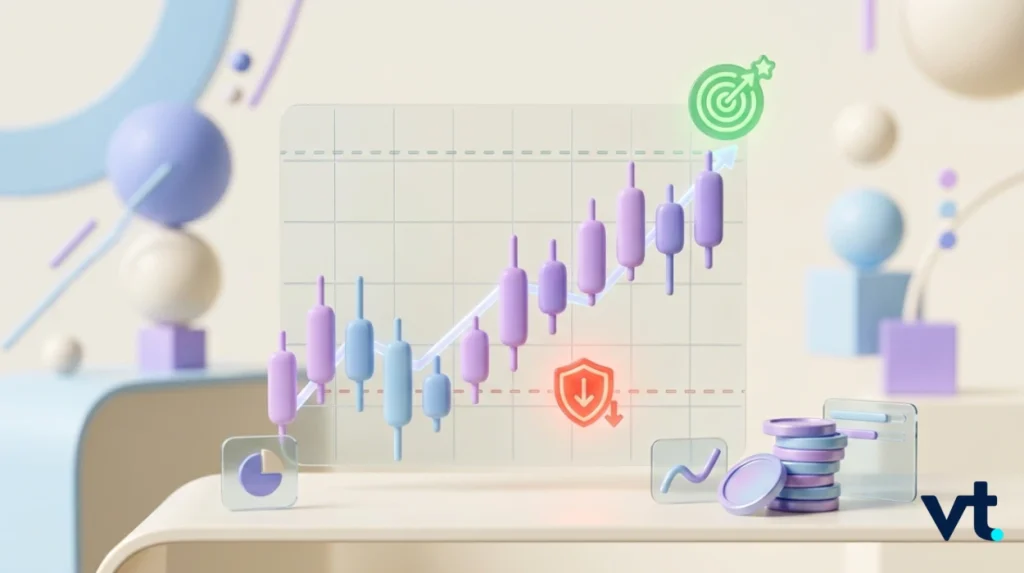
At its core, a stop loss is a pending order that automatically closes your trading position once the market price reaches a level you’ve defined in advance. Think of it as a safety net: once the market moves a certain distance against you, the position shuts down without further input, removing emotion from the decision.
A take profit works in the opposite direction. It’s an order that automatically closes your position once the market price reaches a profit target you’ve set — securing gains before a favourable move has the chance to reverse. Together, stop loss and take profit define both ends of a trade before you’ve even opened it, which is precisely why so many traders treat this pairing as a basic, non-negotiable part of any trading strategy. VT Markets’ guide on effective stop loss strategies for smarter risk management covers this same foundation with additional platform-specific detail.
Stop Loss (SL)
A Stop Loss order instructs your broker to close a trade at a predetermined price level to limit potential losses. For example, if you buy EUR/USD at 1.1000 and set a Stop Loss at 1.0950, your trade will automatically close if the price drops to 1.0950, preventing further losses.
Take Profit (TP)
A Take Profit order is the opposite of a Stop Loss order. It instructs your broker to close a trade at a specific price level to lock in profits. For example, if you buy EUR/USD at 1.1000 and set a Take Profit at 1.1100, your trade will automatically close when the price reaches 1.1100, securing your profit.
Stop Loss (SL) and Take Profit (TP) orders are essential for disciplined trading. They help you adhere to your trading plan, avoid emotional decision-making, and manage risk effectively.
How Stop Loss Orders Work
A stop loss is typically placed below the entry price on a long position, or above it on a short position. Once the current price touches that set price, the order triggers and the position closes — locking in a defined, known loss rather than an open-ended one.
- On MT4 and MT5, you can set a stop loss directly when opening a new order, or attach one afterwards to an open position.
- Trailing stops adjust automatically as a trade moves in your favour, helping to secure profits while still allowing further upside.
- During major news releases, market conditions can occasionally cause slippage, where a stop loss fills at a slightly worse price than requested — a reasonable precaution to keep in mind rather than a reason to avoid using them.
How Take Profit Orders Work
A take profit order functions as a type of limit order — it seeks to close your position at the best price available once the market reaches a specific, favourable price, whether you’re online to see it happen or not. This is particularly valuable for short term traders, and a TP order is especially well suited to short-term trading strategies if they can’t watch every tick, while still being equally useful for long term traders who want to lock in profits at a target profit level without needing to check their trading account constantly.
Setting a take profit point in advance also protects against a common pitfall: watching a winning trade drift back to breakeven, or worse, simply because there was no plan to secure profits at the right moment.
How to Calculate Stop Loss and Take Profit
How to calculate stop loss and take profit doesn’t need to be complicated. Here’s a straightforward, repeatable process.
Step 1: Determine Entry Price and Risk Tolerance
Start with your entry price — the price at which you plan to open the trade — and decide your risk tolerance in cash or percentage terms. Many experienced traders cap risk at 1–2% of total trading account equity per trade, regardless of how confident they feel about the setup.
Step 2: Set Your Stop Loss Using Support and Resistance
Rather than picking an arbitrary distance, look at support and resistance levels on the chart. A stop loss placed just beyond a recent swing low (for a long position) or swing high (for a short position) respects the market’s own structure, rather than an emotional guess. This is where technical analysis and technical indicators — moving averages, RSI, or trendlines — can help refine exactly where that level sits.
Step 3: Calculate Your Take Profit Using Risk Reward Ratio
Once your stop loss distance is set, apply a risk reward ratio to calculate your take profit. A minimum ratio of 1:2 is common practice — if you’re risking 30 pips or points, your profit target sits at 60 or more. This single habit means you can lose more trades than you win and still stay net profitable over time.
Worked Example: Calculating Stop Loss and Take Profit
| Step | Detail |
|---|---|
| Entry price | 1.0850 (EUR/USD long position) |
| Stop loss | 1.0820 (30 pips risk) |
| Reward ratio | 1:2 |
| Take profit | 1.0910 (60 pips reward) |
| Maximum loss | 30 pips if stop loss is hit |
| Potential profit | 60 pips if take profit is hit |
If the market falls to 1.0820, the trade closes automatically, preserving capital for the next opportunity. If it instead rallies to 1.0910, the take profit order locks in gains without you needing to watch the market in real time. This is the practical value of combining stop loss and take profit — both outcomes are decided in advance, calmly, rather than under pressure while price movements are actually happening.
Stop Loss and Take Profit in Different Trading Styles
Not every trading style applies these tools the same way.
For Short-Term Traders
Short term traders — scalpers and day traders — often use tighter stop loss distances and correspondingly closer take profit points, reflecting smaller expected price movements over short trading windows. Precision around support and resistance levels and current price action matters more here than on longer timeframes.
For Long-Term Traders
Long term traders typically set wider stop loss and take profit levels to accommodate normal market noise, focusing more on the broader market trends and the underlying asset’s fundamentals than short-term price movements. Both approaches rely on the same underlying principle: define risk and reward before entering, not after.
Common Cautions to Note When Using Stop Loss and Take Profit
While stop loss and take profit orders are valuable risk management tools, a few precautions are worth keeping in mind:
- Market conditions can shift quickly around major news events, and even a well-placed stop loss can occasionally fill at a less favourable price than expected during high volatility.
- Setting a stop loss too tight can result in being stopped out by ordinary market noise before a trade has a chance to play out — worth weighing against typical volatility for that asset class.
- Relying on take profit orders alone without periodically reviewing broader market trends can mean leaving additional gains on the table during a strong, sustained move.
- Emotional decision making — moving a stop loss further away “to give the trade room” after it’s already in the trade — tends to undermine the very discipline these tools are meant to provide.
VT Markets’ piece on long vs short: how to profit when markets fall explores similar disciplined risk practices specifically for short positions, where losses can theoretically run further than on a long trade.
Why Are Stop Loss and Take Profit Important?
- Risk Management: Stop Loss orders and protect your capital by limiting potential losses. Losing trade without SL could wipe out your account.
- Profit Locking: Take Profit orders to ensure you lock in gains before the market reverses. You might miss out on profits without a TP if the price suddenly moves against you.
- Emotional Control: SL and TP orders remove the emotional aspect of trading. You don’t have to constantly monitor the market or make impulsive decisions.
- Discipline: These tools enforce discipline by ensuring you stick to your trading strategy and risk-reward ratios.
Tips to Manage Risk with Stop Loss and Take Profit Orders
- Always calculate position size based on your stop loss distance and risk tolerance, rather than fixed lot sizes.
- Combine stop loss and take profit with a consistent risk reward ratio, ideally 1:2 or better, across your trading strategy.
- Use trailing stops to secure profits as a trade moves in your favour, without capping the upside entirely.
- Review your stop loss and take profit placements against updated support and resistance levels if market conditions change materially before the trade is closed.
Start Online CFD Trading with VT Markets Today
If you are ready to put your understanding of stop loss and take profit orders to work in live markets, VT Markets provides access to tools and platforms to help you get started. Trade on powerful platforms like MetaTrader 4 (MT4) and MetaTrader 5 (MT5), designed for speed, reliability, and advanced trading features — exactly what you need to set precise stop loss and take profit levels when financial markets move fast.
New to trading? Practise risk-free with a VT Markets demo account before committing to a live account — ideal for simulating how stop loss and take profit orders behave across currency pairs, indices, and commodities without financial risk.
Open your live account with VT Markets today and access secure, transparent, and competitive CFD trading across some of the world’s most popular markets.
Frequently Asked Questions About Stop Loss and Take Profit
1. What is the difference between stop loss and take profit?
A stop loss automatically closes a losing trading position once price reaches a defined level, limiting downside. A take profit does the reverse, closing a winning position once your target price is reached, helping to lock in profits before the market can reverse.
2. How to calculate stop loss and take profit correctly?
Start from your entry price, define your risk tolerance, place your stop loss near a relevant support and resistance level, then apply a risk reward ratio (commonly 1:2) to work out your take profit distance.
3. Can I use stop loss and take profit in every asset class?
Yes. These tools apply across forex trading, shares, indices, commodities, and precious metals — any market where price movements and market conditions create genuine two-sided risk.
4. Do professional traders always use a stop loss and take profit?
Most experienced traders treat both as basic, standard practice, since they remove emotional decision making from the equation and turn an open-ended risk into a clearly defined one before the trade is even placed.








