





Key Takeaways
- The risk reward ratio compares how much you stand to lose versus how much you aim to gain on any given trade.
- A 1:2 risk reward means you profit twice your risk — you can lose 60% of trades and still be profitable.
- Combining a solid ratio with an appropriate win rate is what builds consistent net profits over time.
- Setting a stop loss and take profit level before you enter is the simplest, most powerful discipline in trading.
- Your personal risk tolerance and financial situation should always shape the ratio you target — no one-size-fits-all rule applies.
- Even in volatile markets, a pre-planned ratio keeps emotional decision-making in check.
Most traders focus obsessively on finding the perfect entry point, the ideal indicator, or the hottest trading tip. Yet research consistently shows that how much you risk relative to how much you aim to gain is far more predictive of long-term success than any single trade entry point. That relationship is captured in one deceptively simple concept: the risk reward ratio.
In 2026, with financial markets more accessible than ever and day trading participation at record highs globally, understanding this ratio isn’t optional — it’s foundational. Whether you’re looking to trade stocks, forex, indices, or commodities, the reward ratio you set on every trade quietly determines whether your trading account grows or shrinks over time.
This guide unpacks everything you need to know: what the ratio is, how to calculate risk reward, how to apply it across different trading styles, and how to align it with your own risk tolerance for the best possible outcomes.
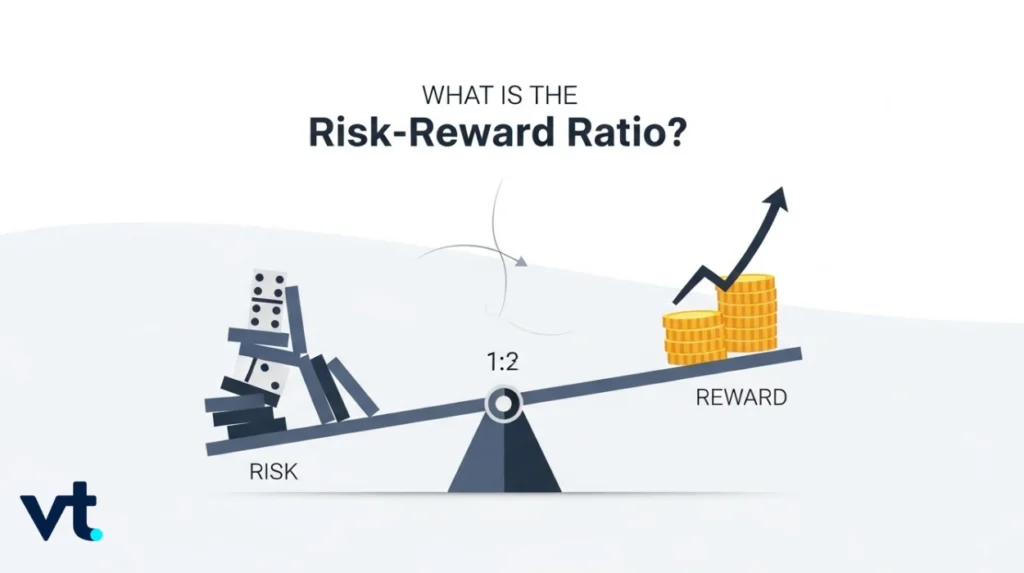
What Is the Risk Reward Ratio?
The risk reward ratio (also written as risk/reward or R:R) is a measure that compares the potential loss of a trade to its potential profit. It answers one fundamental question before you commit any capital: “For every dollar I might lose, how many dollars do I stand to gain?”
In its simplest form, the ratio is expressed as 1:X, where 1 represents one unit of risk and X represents the expected return in reward. A ratio of 1:2 means you’re risking $1 to potentially make $2. A 1:3 ratio means risking $1 to potentially earn $3.
The Simple Formula to Calculate Risk Reward
The calculation is straightforward. To calculate risk reward, you need three values for any particular trade:
- Entry price — the price at which you open the position
- Stop loss price — the level at which you’ll exit to limit loss
- Profit target (take profit) — the target price at which you’ll lock in gains
Trading Example — Long Position
Suppose a stock price is sitting at $100. You believe the stock rises to $110 based on technical analysis and a positive earnings report. You set:
- Entry price: $100
- Stop loss price: $95 (risk = $5 per share)
- Take profit: $110 (reward = $10 per share)
Risk = $100 − $95 = $5
Reward = $110 − $100 = $10
Risk reward ratio = 1:2
You’re risking $5 to potentially gain $10. Even if you only win half your trades, your net profits remain positive.
Why the Risk Reward Ratio Is the Foundation of Any Good Trading Strategy
Here’s a truth that surprises many beginners: you can lose the majority of your trades and still be profitable, provided your risk reward ratio is sufficiently favourable. This is the mathematical reality that the ratio reveals.
- 40% win rate is all you need to break even at a 1:2 R:R — meaning you can lose 6 out of every 10 trades and still not lose money.
- 25% win rate is sufficient to break even at a 1:3 R:R — winning just 1 in 4 trades can keep you in the black.
- 1:2 is the ratio most recommended for beginner traders — it balances achievability with meaningful protection against losses.
- 70%+ of retail traders report losing money when trading without a clearly defined risk reward ratio, underscoring why this metric matters from day one.
The table below shows how win rate and reward ratio interact. Understanding this relationship is central to building a durable trading strategy and making informed decisions about the trades you take.
| Risk:Reward Ratio | Break-Even Win Rate | Profit at 50% Win Rate | Suitable For |
|---|---|---|---|
| 1:1 | 50% | Flat (no profit) | Scalpers, short-term positions |
| 1:1.5 | 40% | Small net profit | Swing traders, moderate market |
| 1:2 | 33% | Solid net profit | Beginners, most trading styles |
| 1:3 | 25% | Strong net profit | Trend traders, patient strategies |
| 1:5 | 17% | Very high potential | Advanced traders, volatile markets |
📝 Take Note
A higher ratio like 1:5 looks attractive on paper, but it typically requires a much wider profit target. In volatile markets or during periods of tight price action, such targets are harder to reach. Always align your reward ratio with realistic market conditions rather than wishful thinking.
How to Set Your Stop Loss and Take Profit Correctly
The risk reward ratio only works if your stop loss and take profit levels are placed with intention — not arbitrarily. Poor stop loss placement is one of the most common reasons traders lose money even when they have a sound overall trading strategy.
Placing Your Stop Loss
A stop loss order should be positioned at a level that invalidates your trade idea. This means placing it below a key support level (for long trades) or above a key resistance level (for short trades), rather than at a fixed pip or dollar distance from your entry price.
- Place your stop loss beyond a structural level — a recent swing high or low in the price action
- Account for typical spread and slippage, especially during high volatility sessions
- Avoid clustering your stop loss at obvious round-number price points where many stop loss orders tend to be triggered simultaneously
- Review your stop loss price against average daily trading ranges for the asset
⚠️ Caution
Moving your stop loss further away after entering a trade — in the hope that the market will reverse — is one of the most damaging habits in trading. Your stop loss is your risk boundary; respect it as you would any hard limit on potential loss.
Setting a Realistic Take Profit Order
Your take profit level should be set at a point where actual market structure supports a reversal or consolidation. A profit target placed in the middle of a major resistance zone, for example, is more likely to be reached than one set far beyond any logical price target.
To determine a realistic take profit:
- Identify the next significant support/resistance level beyond your trade entry point
- Ensure the distance to your take profit is at least twice (preferably three times) your stop loss distance
- On day trading positions, consider time-of-day liquidity when setting targets — the take profit order should be reachable within your intended trade duration
- Use prior price action — previous highs, lows, or measured moves — to anchor your target price
Understanding Risk Tolerance: How Much Risk Should You Accept?
The “best” risk reward ratio is not a universal number. It depends heavily on your personal risk tolerance, your trading style, account size, and your financial situation. Two traders using the same trading system can have completely different optimal ratios.
Defining Your Own Risk Tolerance
Risk tolerance refers to the degree of variability in returns — and the degree of potential loss — that you are psychologically and financially able to absorb. A risk averse trader with a small account and limited capital reserves requires a very different approach to someone with a large account and a high-income backstop.
Before entering any trade, ask yourself:
- What percentage of my account am I comfortable losing on a single position?
- Does the potential reward justify the investment risk?
- Can I absorb this potential loss without it affecting my financial situation or emotional state?
- Am I chasing a winning trade from yesterday, or does this setup genuinely meet my criteria?
🔔 Reminder
Most risk management guidelines suggest risking no more than 1–2% of your total account on any single trade. At this level, even ten consecutive losing trades — an extreme scenario — leaves you with 80–90% of your capital intact and your trading plan still viable.
Matching Your Ratio to Your Trading Style
| Trading Style | Typical Hold Time | Suggested R:R Range | Key Consideration |
|---|---|---|---|
| Day Trading | Minutes to hours | 1:1.5 – 1:2 | Market conditions shift quickly; keep targets tight |
| Swing Trading | Days to weeks | 1:2 – 1:3 | External factors like macro data affect positions |
| Position Trading | Weeks to months | 1:3 – 1:5 | Investment returns compounded; higher patience required |
| Scalping | Seconds to minutes | 1:1 – 1:1.5 | Win rate must be high to compensate for lower ratio |
The Relationship Between Win Rate and Reward Ratio
Many traders make the mistake of evaluating their trading strategy purely on win rate — the percentage of trades that close in profit. But a high win rate tells you very little without the context of your reward ratio.
Consider this: a trader with a 70% win rate using a 1:0.5 ratio (risking $2 to make $1) will still lose money over time. Conversely, a trader with only a 35% win rate and a consistent 1:3 ratio will generate positive net profits.
“A consistent 1:2 ratio means you can be wrong 65% of the time — and still end up ahead.”
The mathematically sound approach is to always assess these two metrics together. Your expected return per trade can be approximated as:
Formula — Expected Return
Expected Return = (Win Rate × Reward) − (Loss Rate × Risk)
Example: Win rate 40%, R:R 1:2, risking $100 per trade:
(0.40 × $200) − (0.60 × $100) = $80 − $60 = +$20 per trade on average
This trader wins less than half the time yet generates consistent profit — because the reward ratio works in their favour.
What Is a Good Risk Reward Ratio?
The most widely cited benchmark for a good risk reward ratio among retail traders is 1:2 — that is, targeting twice as much reward as you risk. A 1:3 ratio is often considered excellent, offering strong expected returns even at moderate win rates.
However, a “good” ratio is ultimately relative to your specific trading plan, your win rate, and market conditions. The key is consistency. An advanced traders’ edge often comes not from a higher ratio, but from a well-tested system applied with discipline across hundreds of trades.
When a Lower Ratio Can Be Acceptable
A lower ratio — such as 1:1 — is not inherently bad. In certain market conditions, particularly during high-volume day trading sessions or when trade entry point signals are extremely reliable, traders may accept a lower ratio in exchange for a substantially higher win rate. The key is that your expected return across all trades remains positive over time.
When High Risk Is a Signal to Step Back
There are scenarios where high risk is simply unavoidable — such as ahead of major economic data releases, during geopolitical shocks, or in thinly traded markets with wide spreads. In these situations, the potential downside to your position may expand significantly, rendering your pre-planned ratio inaccurate.
⚠️ Precaution
If your stop loss price and take profit order were placed under normal market conditions, be aware that volatile markets can cause slippage — meaning your actual exit prices may differ from your intended levels. This is especially relevant in fast-moving sessions around key economic events. Always consider whether more risk is introduced by the timing of your trade, not just the structure of it.
Common Risk Management Mistakes to Avoid
Understanding the ratio is one thing; applying it under the pressure of live markets is another. The following mistakes cause traders to lose money even when they intellectually understand risk reward principles.
- Entering without a defined plan: Every trade should have a clearly defined stop loss, take profit, and resulting ratio before you commit. Trading without a trading plan means you’re reacting rather than executing.
- Ignoring position sizing: Your ratio only protects you if the position size is calibrated to your account. Using excessive leverage can mean that even a “safe” 1:2 ratio results in catastrophic loss if position size is too large.
- Chasing trades after missing the entry price: Entering late at a less favourable entry price distorts your ratio — you take on more risk without a proportional increase in potential reward.
- Letting winners turn into losers: Not using a trailing stop loss or failing to take profit at your target, hoping for further gain, often results in a winning trade reversing back to a loss.
- Overtrading in volatile markets: Market volatility can make price action erratic. More trades in a volatile session often means lower-quality setups and eroded ratios.
- Confusing a positive earnings report with guaranteed upside: Fundamental catalysts like a positive earnings report can cause a share price to move sharply in either direction. High risk remains even on seemingly bullish news.
Applying the Risk Reward Ratio Across Different Financial Markets
The ratio applies universally across all financial markets — whether you trade stocks, forex, commodities, indices, or ETFs. The principles remain the same, but the typical trading ranges, liquidity, and price action behaviour differ by asset class.
Forex Markets
Forex is popular for day trading and swing trading alike. In major currency pairs, tight spreads allow for closer stop loss placement, making 1:2 and 1:3 ratios achievable without requiring very wide targets. Traders should be attentive to how session timing (London open, New York overlap) affects intraday range and the viability of their profit target.
Equities — Trade Stocks and CFDs
When you trade stocks or equity CFDs, the potential for share price gaps — especially overnight — introduces an additional layer of investment risk. Setting stop loss orders without accounting for gap risk means your actual potential loss may exceed what the ratio suggests. This is particularly relevant for positions held over earnings announcements or macro events.
Commodities and Indices
These markets often exhibit strong trending behaviour, making 1:3 or greater ratios achievable during sustained directional moves. However, sudden reversals driven by external factors — geopolitical news, central bank decisions, supply shocks — can invalidate well-planned positions rapidly. Keeping your stop loss proportionate to the asset’s average true range is an important precaution.
Practising With Virtual Funds Before Risking Real Capital
One of the most effective ways to internalise the risk reward ratio — and test your trading system — is to use a demo account with virtual funds. This gives you the opportunity to practise placing stop loss and take profit orders, assess how your ratios perform in real market conditions, and develop the discipline to stick to your trading plan without the emotional pressure of actual monetary loss.
Platforms like those offered by VT Markets allow traders to open a demo account and experience live market conditions using virtual funds, enabling them to build confidence in their risk management framework before committing real capital. This is particularly valuable for beginners learning to calibrate their own risk tolerance and test their reward ratio assumptions across different market conditions.
💡 Note
When practising with virtual funds, treat each trade with the same seriousness as a live trade. The habits you build in demo trading — including consistently setting a stop loss and respecting your take profit levels — are the habits that will define your real-money performance.
Building a Complete Risk-Reward Trading Plan
A trading plan is the document — formal or informal — that governs every decision you make in the market. The risk reward ratio should sit at the heart of it. Here’s a framework for integrating the ratio into a complete, actionable plan:
| Plan Component | What to Define |
|---|---|
| Market Selection | Which financial markets and instruments you’ll trade |
| Trade Entry Point Criteria | Specific conditions (technical, fundamental, or both) that must be met to enter |
| Stop Loss Rules | How you determine stop loss placement — structure-based, ATR-based, or fixed |
| Profit Target Rules | How you identify take profit levels and minimum acceptable reward ratio |
| Position Sizing | Maximum % of account risked per trade, adjusted for volatility |
| Win Rate Tracking | Regular review of actual win rate vs expected return to validate the system |
| Review Process | Weekly/monthly analysis of net profits, losing trades, and plan adherence |
A well-constructed trading plan ensures you don’t make decisions based on emotion or in-the-moment impulse. It converts abstract principles like risk management into specific, repeatable actions — which is precisely how successful traders maintain an edge over time.
The Role of Risk Reward in Long-Term Profitability
Trading success is not determined by any single winning trade or any particular brilliant call — it’s determined by consistent execution across hundreds or thousands of trades. The risk reward ratio is the mechanism through which that consistency becomes mathematically meaningful.
Consider two traders over the course of 100 trades, both risking $100 per position:
| Trader | Win Rate | R:R Ratio | Total Profit | Total Loss | Net Profits |
|---|---|---|---|---|---|
| Trader A | 60% | 1:1 | $6,000 | $4,000 | +$2,000 |
| Trader B | 40% | 1:2 | $8,000 | $6,000 | +$2,000 |
| Trader C | 35% | 1:3 | $10,500 | $6,500 | +$4,000 |
| Trader D | 65% | 1:0.5 | $3,250 | $3,500 | −$250 |
Trader D wins the most often — yet loses money. Trader C wins barely a third of trades — yet generates the most profit. This is the power of the reward ratio in action, and why it must be central to every trading strategy you build.
It’s also worth emphasising that future results are never guaranteed. No ratio protects against all potential loss, and future outcomes in financial markets are inherently uncertain. The ratio is a tool for probability management, not a promise of gain.
How to Use Trading Tools to Apply the Ratio in Practice
Understanding the theory of risk reward is only part of the equation — you also need a reliable trading environment to execute it. VT Markets provides a suite of tools that help traders apply risk management principles efficiently: from one-click stop loss and take profit order placement to real-time price action charting, economic calendars for tracking potential risk events, and copy trading features for those who want to learn from the positioning of experienced traders.
Whether you’re using MetaTrader 4, MetaTrader 5, or TradingView — all available through VT Markets — you’ll find the exclusive features needed to set precise entry price, stop loss price, and profit target levels on every trade, ensuring your reward ratio is always accurately reflected in your open positions. The platform’s transparent pricing and deep liquidity also mean that your intended levels are more likely to be executed at the price you’ve planned, which is essential for maintaining ratio integrity.
Frequently Asked Questions
What is a good risk reward ratio for beginner traders?
A ratio of 1:2 is widely recommended as the starting point for beginners. It means you risk one unit of capital to potentially gain two units. At this ratio, you only need to win approximately 34% of your trades to break even — providing a meaningful buffer for the learning curve that all new traders experience. As your win rate improves through experience and refined strategy, you may find opportunities to target 1:3 or higher.
Can I have a high win rate and still lose money?
Yes — and this surprises many traders. If your reward ratio is below 1:1 (meaning you lose more on losers than you gain on winners), a high win rate simply isn’t enough to generate positive net profits. For example, if you win 65% of trades but risk $200 to make $100, your expected return per trade is negative: (0.65 × $100) − (0.35 × $200) = $65 − $70 = −$5 per trade on average. Always evaluate win rate and reward ratio together.
How does market volatility affect my risk reward ratio?
Market volatility can significantly impact your ratio in practice. In volatile markets, price action can move sharply through your stop loss price or profit target before settling, resulting in actual exits that differ from your planned levels — a phenomenon called slippage. This is especially relevant in fast-moving sessions. A precaution worth considering is widening your stop loss slightly during high-volatility periods (while reducing position size accordingly) to prevent being prematurely stopped out of an otherwise valid trade setup.
How does own risk tolerance affect which ratio I should use?
Your own risk tolerance shapes everything from your stop loss placement to the profit target you’re comfortable holding towards. A risk averse trader may prefer a tighter ratio with more frequent, smaller wins — accepting less potential reward in exchange for greater certainty. A trader with higher risk tolerance and a longer-term horizon may hold positions through normal fluctuations to target a higher ratio. Neither approach is inherently better — the key is alignment between your financial situation, your emotional resilience, and the ratio you’re targeting.
Make Every Trade Count — Not Just Every Win
The risk reward ratio is not a magic formula, but it is the closest thing to one that exists in trading. It doesn’t predict the future, and it doesn’t guarantee you’ll never lose money. What it does do is provide a mathematical framework that, applied consistently, shifts the probabilities in your favour over time.
The traders who succeed long-term in financial markets are not necessarily the ones who predict the market most accurately. They’re the ones who, trade after trade, maintain the discipline to define their risk before they enter, respect their stop loss when the market moves against them, and take profit at their planned target when the trade works.
That discipline begins with understanding — truly internalising — the risk and reward relationship at the heart of every position you take. Build it into every trade, every day, and the results will follow.
Disclaimer: Trading contracts for difference (CFDs) and other leveraged products carries high risk and may not be suitable for all investors. Past performance is not indicative of future results. Ensure you fully understand the risks before trading and seek independent advice where necessary.








