





Key Takeaways
- Precious metals trading spans gold, silver, platinum, and palladium — four distinct metals with different demand drivers, price behaviours, and roles in a portfolio.
- Precious metals ETFs allow investors to gain exposure to physical metals without the logistical challenges of buying, storing, or insuring bullion directly.
- As of early 2026, precious metals have delivered historic returns: gold surpassed USD 4,500 per ounce, silver exceeded USD 80 per ounce, and platinum hit its first record highs since 2007.
- Nearly USD 93 billion poured into precious metals ETFs globally through 2025 alone — roughly USD 82 billion into gold funds, over USD 10 billion into silver ETFs, and growing flows into platinum and palladium vehicles.
- Precious metals serve as a hedge against inflation, economic uncertainty, and currency devaluation — making them a core consideration in any portfolio diversification strategy.
- Always review a fund’s documentation carefully, consider your own investment portfolio objectives, and seek independent financial guidance before investing. Past value is not a guarantee of future performance.
They Called It a “Boring” Investment — Then Precious Metals Returned Up to 170% in One Year
For years, precious metals sat quietly in the background of most investors’ portfolios — sometimes dismissed as a relic of an older financial era. Then came 2025, and everything changed.
According to CME Group, gold gained 65%, palladium surged 95%, platinum climbed 150%, and silver soared an extraordinary 170% between the end of 2024 and early 2026. These were not speculative micro-cap stocks or experimental cryptocurrencies. These were precious metals — one of the oldest and most reliable store of wealth in human history.
Yet for many investors, particularly those in Canada and other developed markets, the mechanics of precious metals trading remain surprisingly misunderstood. This guide breaks down everything you need to know: what drives the four primary metals, how precious metals ETFs work, why gold silver platinum and palladium behave so differently, and how to approach investing in this space with clarity and confidence.
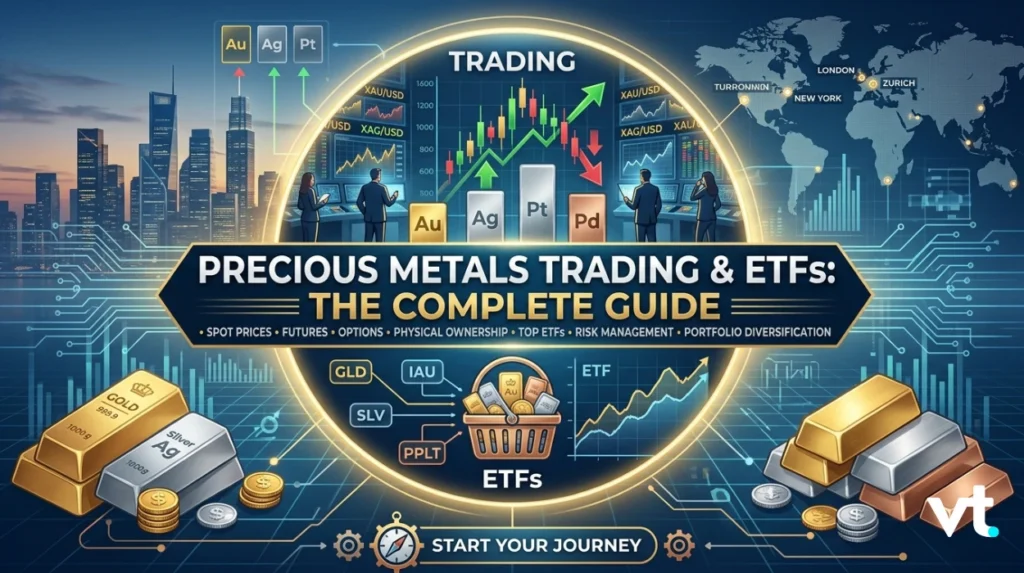
What Are Precious Metals and Why Do They Matter?
Precious metals are naturally occurring metallic elements that are rare, durable, and valued for both their industrial applications and their role as stores of wealth. The four primary precious metals traded on global metals markets are gold, silver, platinum, and palladium.
Each of these metals carries a distinct profile:
| Metal | Primary Uses | Key Demand Drivers | 2026 Price Forecast (Heraeus) |
|---|---|---|---|
| Gold | Jewellery, central bank reserves | Safe haven, inflation hedge, investment | USD 3,750–5,000/oz |
| Silver | Electronics, solar panels, jewellery | Industrial + investment dual demand | USD 43–62/oz |
| Platinum | Catalytic converters, fuel cells, jewellery | Automotive industry, industrial use | USD 1,300–1,800/oz |
| Palladium | Automotive catalytic converters, electronics | Auto sector, supply constraints | USD 950–1,500/oz |
Sources: Heraeus Precious Metals 2026 Forecast | CME Group
The value of precious metals as an investment stems from this dual nature: they are simultaneously industrial inputs and financial assets — which means demand comes from two distinct directions at once.
Gold: The Original Safe Haven
Gold is the anchor of the precious metals complex. Its role as a financial store of wealth predates modern currency systems by millennia. Today, central banks around the world continue to hold gold as a reserve asset, reflecting its status as a neutral store of value across political systems and economic regimes.
For investors in Canada and globally, gold serves primarily as a hedge — a protective asset that tends to hold or increase in value during periods of market volatility, inflation, and economic uncertainty. Gold bullion — whether held as coins, bars, or through ETFs — is the most common way individual investors access this market.
Gold‘s supply is remarkably stable. In 2025, the world‘s miners extracted approximately 95 million troy ounces of gold, according to CME Group data. Because gold mining output grows slowly and predictably, the market cannot flood itself with new supply in response to rising prices — one reason gold retains its value so reliably over time.
Silver: The Dual-Purpose Metal
Unlike gold, silver occupies a unique position in the precious metals universe — it is simultaneously one of the most important industrial inputs and a widely held investment asset. This dual nature makes silver‘s demand profile more complex and its prices more volatile than gold‘s.
Silver‘s industrial applications span electronics, solar panels, fuel cells, medical equipment, and water purification. According to Aberdeen Investments, silver‘s demand has grown by 17% since 2016, driven largely by a 143% increase in demand from solar panels producers. Meanwhile, supply fell by 8.8% over the same period, pushing the silver market into deficit.
Silver‘s demand from the solar panels sector alone represents one of the most compelling structural stories in commodities investing today. As renewable energy infrastructure scales globally, silver consumption in solar panels is expected to continue rising — creating a sustained tailwind for silver prices that operates largely independently of investment sentiment.
For investors, silver offers direct exposure to both the investment and industrial sides of the precious metals complex in a single asset — which is part of why the iShares Silver Trust (SLV) extended its year-to-date gain to 142% by late 2025, per ETF.com.
<h2>Platinum and Palladium: The Industrial Precious Metals</h2>
Platinum and palladium are the most industrial of the four major precious metals, and their prices are more directly tied to the health of the automotive industry than gold or silver.
Both metals are critical components of catalytic converters — devices fitted to internal combustion engine vehicles that reduce harmful exhaust emissions. Platinum is used predominantly in diesel automotive catalytic converters, while palladium is the key metal in petrol-powered catalytic converters.
Platinum prices hit their first record highs since 2007 in late 2025, surging 150% over the prior year. The abrdn Physical Platinum Shares ETF (PPLT) climbed 144% over the same period, according to ETF.com.
Palladium presents a more nuanced picture. Historically, palladium was among the most valuable metals in the complex, having spiked dramatically during supply constraints. However, the global shift toward battery electric vehicles (BEVs) has begun to erode demand for catalytic converters and, by extension, palladium. Heraeus forecasts a widening palladium market surplus in 2026 as BEVs reduce demand for auto catalysts.
Platinum, by contrast, is finding new demand in fuel cells — an emerging clean energy technology — which could partially offset declines from traditional automotive applications. This makes platinum a particularly interesting rare metal to watch for investors with a longer investment horizon.
What Are Precious Metals ETFs?
Precious metals ETFs are funds that allow investors to gain exposure to precious metals — gold, silver, platinum, or palladium — without having to purchase, insure, or store physical metals directly.
Most precious metals ETFs hold physical precious metals in secured bank vaults. When you buy shares of one of these ETFs, you are purchasing a fractional, undivided interest in those physical precious metals — meaning your investment tracks the market price of the underlying metal directly. This structure provides direct exposure to metals prices without any of the logistical complexity of owning physical precious metals personally.
As Motley Fool notes, most major precious metals ETFs are structured as grantor trusts rather than registered mutual funds — an important structural distinction that affects how they are taxed and regulated.
Types of Precious Metals ETFs
Single Metal ETFs
These metals ETFs focus exclusively on one metal:
- Gold ETFs — The SPDR Gold Shares (GLD) was the first physically backed gold ETF in the US and remains the largest today, with the vast majority of global ETFs inflows directed toward gold funds.
- Silver ETFs — The iShares Silver Trust (SLV) is the largest silver ETF, holding physical metals in the form of silver bars in bank vaults. It is one of the most cost-effective ways to invest in precious metals for silver-specific exposure.
- Platinum ETFs — The Aberdeen Physical Platinum Shares ETF (PPLT) provides physically backed exposure to platinum, with holdings stored at ICBC Standard Bank in the UK and audited regularly for transparency.
- Palladium ETFs — The abrdn Standard Physical Palladium Shares ETF gives investors direct exposure to palladium, whose price is closely tied to automotive catalytic converters and industrial applications.
Multi-Metal Basket ETFs
These precious metals ETFs hold a blend of gold silver platinum and palladium in a single vehicle. The abrdn Standard Physical Precious Metals Basket Shares ETF (GLTR) is the leading example: it holds physical precious metals across all four metals, with allocations as of May 2026 approximately split at gold 59%, silver 34.1%, and platinum 3.3% of net assets, according to Motley Fool.
Mining Company ETFs
Rather than holding physical metals, these metals ETFs invest in shares of mining companies and mining stocks involved in the extraction of precious metals. Mining stocks tend to offer leverage to metals prices — meaning they can amplify returns when gold and silver rise — but they also carry company-specific risks that physical metals ETFs do not, including mining companies‘ operational costs, management quality, and geopolitical exposure.
Why Investors Use Precious Metals ETFs for Portfolio Diversification
Precious metals ETFs have become one of the most popular vehicles for portfolio diversification because they offer several structural advantages over other approaches to invest in precious metals:
- No storage or insurance costs: Unlike owning gold bullion, coins, or physical metals directly, ETFs eliminate the need to store or insure the underlying metals.
- High liquidity: Precious metals ETFs trade on stock exchanges throughout the day, just like stocks — making it easy to sell your position quickly if market conditions change.
- Low minimum investment: You can access precious metals ETFs for the cost of a single share, making them far more accessible than purchasing gold bullion or coins directly.
- Hedge against inflation and economic uncertainty: Gold and silver have historically maintained their value during inflationary periods and market volatility — making precious metals a natural hedge within a broader investment portfolio.
- Portfolio diversification: Precious metals tend to have a low or negative correlation to stocks and bonds, which means they can help cushion an investment portfolio during equity market downturns.
Precious Metals vs. Mining Stocks: Key Differences
| Feature | Physical Precious Metals ETFs | Mining Stocks / Mining Company ETFs |
|---|---|---|
| Underlying asset | Physical metals (gold, silver, etc.) | Shares in mining companies |
| Leverage to metal prices | Direct (1:1) | Amplified (can be 2–3x) |
| Company-specific risks | None | Yes — management, costs, jurisdiction |
| Inflation hedge quality | Strong | Moderate (offset by expenses) |
| Volatility | Moderate | Higher |
| Income (dividends) | None | Possible from mining stocks |
| Best for | Portfolio diversification, hedge | Growth-oriented exposure |
What to Be Mindful of When Investing in Precious Metals
Take note: Precious metals and precious metals ETFs carry risks that every investor should understand before committing capital.
Price Volatility Is Real
While precious metals are often seen as a stabilising force in a portfolio, individual metals — particularly silver, platinum, and palladium — can experience significant volatility. Metals prices can swing sharply in response to several factors, including changes in interest rates, shifts in automotive industry demand, supply disruptions, and broader market volatility.
Reminder: ETFs Are Not the Same as Physical Ownership
Precious metals ETFs are financial funds — they are not the same as owning physical precious metals. If you wish to hold gold bullion, coins, or other physical metals as part of your wealth preservation strategy outside the financial system, ETFs may not fulfil that objective. Understand what you are buying and why.
Precaution on Mining Stock Leverage
Mining stocks and mining company ETFs amplify both gains and losses relative to metals prices. In periods where gold or silver decline, mining companies‘ stocks can fall significantly more. This is not a reason to avoid them — but it is a reason to size positions appropriately relative to your portfolio and volatility tolerance.
Tax and Regulatory Caution
Take note: Most precious-metals ETFs structured as grantor trusts are treated differently for tax purposes compared to regular stocks or mutual funds. In Canada, gains from precious metals ETFs may be subject to specific tax treatment. This article does not constitute tax advice — always consult a qualified tax professional regarding your specific situation. Review the sources believed reliable in a fund’s documentation, including its net assets disclosures, before investing.
How to Access Precious Metals Trading
For investors in Canada and globally, there are several practical paths to invest in precious metals:
- Physical precious metals — Buying gold bullion, silver coins, or gold and silver bars directly from a dealer or mint. Requires store solutions (a vault or safety deposit box) and insurance.
- Precious metals ETFs — Purchasing ETFs on a stock exchange through a brokerage account. The most accessible and liquid approach for most retail investors.
- Mining stocks or mining company ETFs — Buying shares in mining companies or funds that hold a basket of mining stocks.
- CFDs on precious metals — Trading Contracts for Difference on gold, silver, platinum, or palladium allows investors to gain exposure to metals prices with leverage, in both rising and falling markets, without owning the physical metals.
Start Exploring Precious Metals Trading With VT Markets
Whether you are looking to hedge your investment portfolio with gold or silver, gain exposure to platinum and palladium‘s industrial story, or explore precious metals trading more actively, the right platform makes a meaningful difference.
VT Markets provides access to precious metals trading — including gold and silver — alongside a full suite of global asset classes, all on powerful platforms like MetaTrader 4 (MT4) and MetaTrader 5 (MT5). Advanced charting, real-time metals prices, and professional-grade tools are available to support informed trading decisions. New to precious metals trading? Start with a VT Markets demo account to explore the metals markets in a risk-free environment before committing capital. The Help Centre also provides educational resources to help you build confidence across your investing journey.
Open your account with VT Markets today and access transparent, competitive trading across gold, silver, and other global markets.
Frequently Asked Questions (FAQs)
Q1: What is the difference between precious metals ETFs and physical precious metals?
Precious metals ETFs are financial funds traded on stock exchanges that hold physical precious metals — such as gold bullion, silver bars, platinum, or palladium — in secured bank vaults on behalf of investors. Owning physical precious metals directly means taking personal custody of the metals — whether coins, gold and silver bars, or other forms — which requires store solutions and insurance. ETFs offer direct exposure to metals prices without these logistical requirements, making them the preferred vehicle for most retail investors.
Q2: Are precious metals a good hedge against inflation?
Historically, precious metals — particularly gold and silver — have served as an effective hedge against inflation. When the purchasing power of fiat currencies erodes, metals prices tend to rise as investors seek assets that preserve wealth. Gold in particular has maintained its role as a safe haven across centuries and economic uncertainty cycles. That said, precious metals are not guaranteed to outperform in every inflationary environment — interest rates, supply dynamics, and broader market sentiment all interact with their value.
Q3: What drives platinum and palladium prices differently from gold?
Unlike gold, whose value is primarily driven by investment demand, central bank activity, and inflation expectations, platinum prices and palladium prices are heavily influenced by industrial demand — particularly from the automotive industry and catalytic converters. Automotive catalytic converters require platinum (for diesel engines) and palladium (for petrol engines) to function. As electric vehicle adoption grows and demand for internal combustion engine vehicles shifts, these metals markets face structural changes in demand that differ significantly from those affecting gold and silver.
Q4: How do I choose between a single-metal ETF and a multi-metal basket ETF?
A single-metal ETF — such as a gold or silver fund — gives you concentrated exposure to one metal‘s prices and is best suited if you have a specific view on that metal‘s outlook. A multi-metal basket ETF, such as GLTR (which holds gold silver platinum and palladium), provides broader portfolio diversification across precious metals in a single trade. The basket approach reduces the risks of any one metal underperforming but may also dilute gains if a single metal surges. Your choice should reflect your investment portfolio objectives, volatility tolerance, and view on individual metals markets. This is not tax advice or personalised financial guidance — always consult an independent adviser before making investment decisions.








