





Key Takeaways
- Panic selling occurs when fear and urgency override a considered assessment of market conditions.
- FOMO and greed can drive traders to chase rebounds, enter prematurely or take excessive risks.
- Loss aversion may lead traders to hold losing positions in the hope that prices will recover.
- Leveraged trading carries additional risks during market downturns, including margin pressure, forced position closures and less favourable execution.
- A structured trading plan and clear risk limits can help traders recognise emotional triggers and make more considered decisions.
Imagine waking up to find that the market has plunged overnight. Losses are mounting, prices continue to fall, and negative headlines offer little reassurance. Closing a position could limit further exposure, but it also means accepting a loss. Holding on leaves room for a recovery, yet prices could fall further.
When every option feels uncomfortable, how do you decide what to do next?
The answer starts with understanding how emotions and behavioural biases can influence trading decisions under pressure.
How Do Emotions Affect Trading Decisions?
Emotions and behavioural patterns can influence how traders interpret market information, assess risks and respond to price movements, particularly during periods of uncertainty.
In falling markets, these influences may contribute to behaviours such as panic selling, FOMO, greed and loss aversion. Recognising these patterns can help traders identify emotional triggers and assess market conditions more objectively.
What Is Panic Selling?
Panic selling occurs when traders rush to sell assets or close positions because fear outweighs a considered assessment of market conditions. Several factors can contribute to panic selling:
| Trigger | Why it matters |
|---|---|
| Sharp market declines | Rapid price drops can heighten fears of further losses. |
| Negative news and sentiment | Pessimistic headlines can reinforce expectations of continued market weakness. |
| Herd behaviour | Seeing other market participants sell can create pressure to follow the crowd. |
| Uncertainty about recovery | Traders may struggle to judge whether prices will stabilise or continue falling. |
| Fear of further losses | Anxiety about losing more can encourage rushed decisions rather than careful reassessment. |
However, selling during a downturn is not necessarily panic selling. The key distinction is whether the decision follows a considered assessment of market conditions and risk or is driven primarily by fear and urgency.
Signs That Panic Selling May Be Influencing Decisions
The following behaviours may indicate that fear is beginning to override a trader’s usual decision-making process:
- Exit without reassessment: Close a position without reviewing whether the original trading rationale has changed.
- Abandon the trading plan: Ignore predefined entry, exit or risk criteria in response to short-term price movements.
- Make repeated changes: Reverse decisions as prices fluctuate without meaningful new information.
- Focus only on immediate losses: Prioritise relief from current losses over an assessment of overall exposure and risk.
These behaviours do not automatically mean a decision to sell is wrong. They are signals to check whether the decision aligns with the trading plan and current risk conditions.
FOMO Trading and the Fear of Missing a Recovery
When prices begin to rebound after a downturn, traders may question their earlier decisions and worry about missing potential gains. This can trigger the fear of missing out (FOMO), particularly if the market continues to rise after traders have exited a position.
Under this pressure, traders may re-enter the market without identifying a suitable setup or conducting sufficient analysis. However, a rebound does not necessarily signal a sustained recovery, and prices could fall again if momentum fades.
Before entering a position, traders can consider three questions:
- Is there a clear reason to enter beyond recent price movements?
- Does the opportunity meet my entry criteria?
- Am I responding to new information or trying to make up for a missed gain?
Missing a market move is part of trading. Evaluating each opportunity on its own merits can help traders avoid chasing prices based on FOMO.
The Role of Greed in Trading
Greed can influence traders when the pursuit of higher returns begins to outweigh a balanced assessment of risk. During a market rebound, recent profits or strong price movements may encourage traders to take on more risk than originally planned.
This behaviour can appear in several ways:
| Behaviour | What it may look like | Potential risk |
|---|---|---|
| Chasing further gains | Entering additional trades after a strong price move | Entering at unfavourable levels |
| Overconfidence | Increasing position sizes after a series of profitable trades | Greater losses if market conditions change |
| Excessive leverage | Taking on more exposure to amplify potential returns | Losses can accumulate more quickly |
Market sentiment indicators, such as the Fear and Greed Index, can provide context on prevailing sentiment but cannot predict price direction or determine whether a trade is appropriate.
Recognising when the pursuit of further gains begins to outweigh risk considerations can help traders keep their exposure within planned limits.
Loss Aversion and the Difficulty of Accepting Losses
Unlike greed, which centres on the desire for greater gains, loss aversion is the tendency to feel the impact of a loss more strongly than an equivalent gain. This can make closing an unprofitable position psychologically difficult, even when the reasons for holding it have weakened.
Common behaviours associated with loss aversion include:
| Behaviour | What it may look like | Potential risk |
|---|---|---|
| Reluctance to exit | Keeping a losing position open to avoid realising a loss | Further adverse price movements |
| Anchoring to the entry price | Waiting for the market to return to the original entry level | Overlooking changes in market conditions |
| Holding on for recovery | Retaining a position despite a weakened trading rationale | Allowing losses to grow |
Evaluating a position against current market conditions and predefined risk limits can help traders make decisions based on present risks rather than the desire to avoid a loss.
How Can Traders Manage Fear During a Market Crash?
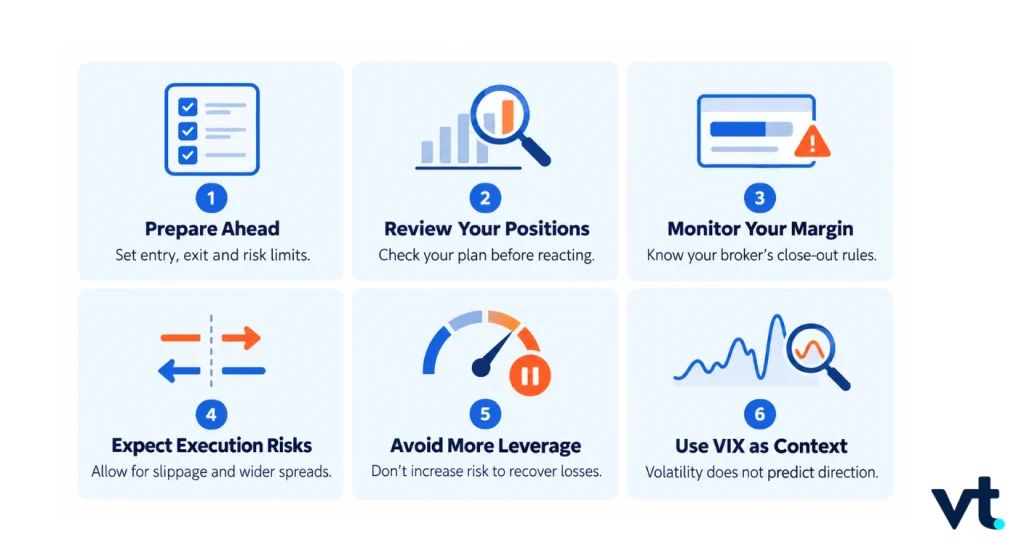
Managing fear during a market crash means understanding the risks, following a clear process and avoiding impulsive reactions when market conditions become uncertain.
1. Prepare Before Markets Become Volatile
Set clear entry and exit criteria, define acceptable risk limits and assess how much you could afford to lose before opening a position. Understanding how leverage amplifies both gains and losses can also help you avoid taking on more exposure than planned.
2. Reassess Positions Against Your Trading Plan
When prices fall sharply, pause to review whether new information has changed the original trading rationale and whether your position remains within predefined risk limits.
The Financial Industry Regulatory Authority (FINRA) identifies panic selling as a risk during stressed markets. Rather than reacting to price movements alone, distinguish between a change in market conditions and an emotional response to potential losses. However, do not delay action when urgent margin requirements need attention.
3. Understand Margin Requirements and Forced Liquidation
Check your available equity, margin levels and the broker’s close-out rules so you understand how much room your account has to withstand adverse price movements.
For leveraged positions, falling prices can reduce account equity and bring positions closer to forced closure. Knowing these thresholds in advance can help you monitor exposure and avoid being caught off guard, although it cannot eliminate the risk of losses.
4. Account for Execution Risks
During volatile markets, spreads may widen, liquidity may decline and orders may be filled at less favourable prices than expected. Understand how stop-loss orders work and recognise that execution at the specified price is not guaranteed. Factoring these risks into your trading plan can help you set more realistic expectations when markets move quickly.
5. Avoid Increasing Leverage to Recover Losses
The urge to recover losses quickly can lead to larger positions or greater leverage, increasing potential losses if the market moves against you again. Instead, reassess your trading rationale and risk limits before considering another position. Avoid treating a new trade as a way to win back previous losses.
6. Use the VIX as Context, Not Certainty
The CBOE Volatility Index (VIX) reflects options market expectations of near-term volatility in the S&P 500. Monitoring it alongside market news and price movements can help traders understand changing levels of uncertainty, but it cannot predict the market’s next direction.
During the 6 May 2010 market disruption, the US Securities and Exchange Commission noted that the VIX rose above 40. The episode illustrates how sharply expected volatility can increase during market stress. However, a high VIX reading alone does not indicate whether prices will recover or fall further, so traders should use it as one source of context rather than a standalone trading signal.
A Practical Checklist for Trading During Falling Markets
Before making a trading decision during a downturn, use this checklist to review your position, account exposure and reasons for acting.
| ✓ | Checklist item | What to review |
|---|---|---|
| ☐ | Review the trading rationale | Have market conditions or new developments changed the original reasons for entering the position? |
| ☐ | Check account exposure | Are position sizes, available funds and margin levels within planned limits? |
| ☐ | Recognise emotional triggers | Is fear, regret, FOMO, greed or the desire to recover losses influencing the decision? |
| ☐ | Assess execution conditions | Could wider spreads, slippage, price gaps or trading halts affect order execution? |
| ☐ | Revisit risk limits | Does the proposed action follow the trading plan, or involve taking greater risks to avoid accepting a loss? |
| ☐ | Document the decision | Can the action be explained by current market conditions, the trading rationale and predefined risk limits? |
The checklist supports a more structured assessment during volatile markets, but it cannot eliminate uncertainty or guarantee a better outcome. Urgent margin requirements and other time-sensitive account risks may require immediate attention.
Prepare for Your Next Market Move
Stay informed about market developments and explore trading tools to help you assess market conditions and manage risk.
Open an account with VT Markets and get started today.
Frequently Asked Questions
What Is Panic Selling in the Stock Market?
Panic selling occurs when traders rush to sell assets or close positions because they fear further price declines. These decisions are often driven by fear and uncertainty rather than a careful assessment of market conditions and risk.
Why Do Traders Panic Sell?
Traders may panic sell when prices fall sharply, negative news spreads or widespread selling increases market uncertainty. These factors can create pressure to exit positions quickly to avoid further losses.
How Can Traders Manage Fear During a Market Crash?
Traders can manage fear by following a written trading plan, setting clear risk limits and reviewing positions against current market conditions. Understanding leverage, margin requirements and execution risks can also help them prepare for volatile markets.
What Is FOMO in Trading?
FOMO, or fear of missing out, happens when traders worry that they are missing a profitable opportunity while others are making gains. For example, when prices rebound after a market decline, they may rush to buy because they fear prices will rise further, even without checking whether the trade fits their strategy.
How Does Loss Aversion Affect Trading Decisions?
Loss aversion can make traders reluctant to accept losses, causing them to hold losing positions longer than planned or delay closing them in the hope that prices will recover. This can expose them to further losses if the market continues to move against their positions.
Should Traders Sell When the Stock Market Falls?
There is no universal answer, as the decision depends on a trader’s strategy, risk tolerance and market conditions. Selling may reduce exposure to further losses, while holding a position leaves it exposed to additional price movements. Decisions should be based on a considered assessment of risk rather than fear or the assumption that prices will recover.



