





Key Takeaways
- A cent account denominates your balance in cents, reducing trade exposure by up to 100× — ideal for beginners and strategy testing.
- A standard account operates in full currency units, offering higher profit potential and access to tighter spreads.
- Upgrading too early — before consistent profitability over at least 2–3 months — is one of the most common mistakes retail traders make.
- The upgrade decision should be driven by performance metrics, not emotions or account balance alone.
- A gradual transition (running both account types in parallel) is the safest upgrade path for most traders.
- According to ESMA-mandated broker disclosures, between 74% and 89% of retail CFD accounts lose money — underscoring why structured skill-building on a cent account is essential before upgrading.
The Question Every Growing Trader Eventually Asks
You opened a cent account, practised your strategy, survived drawdowns, and started to see consistent results. Now the nagging question surfaces: Am I ready to switch to a standard account?
It’s one of the most pivotal moments in any trader’s journey — and, frankly, one of the most mishandled. Upgrade too soon, and you risk blowing through hard-earned capital. Wait too long, and you leave significant profit potential on the table.
This guide is your complete roadmap — designed to help you understand when the time is right, how to make the transition smoothly, and what pitfalls to watch out for along the way.
What Exactly Is a Cent Account?
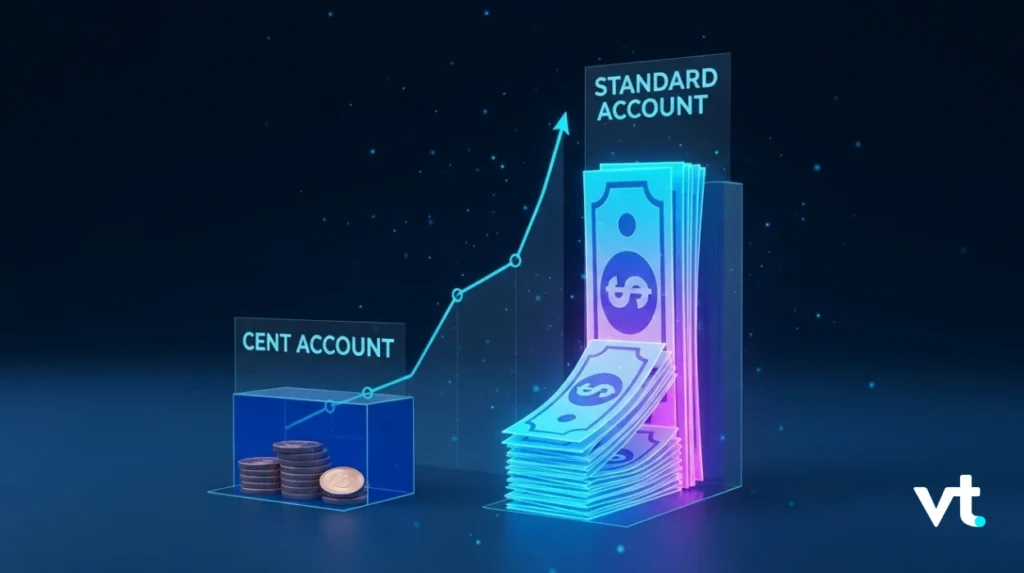
A cent account is a live trading account where your balance and trade sizes are denominated in cents rather than full currency units. If you deposit USD 50, your account displays a balance of 5,000 cents. Trade sizes are scaled accordingly — a 0.01 standard lot on a cent account is equivalent to just 0.0001 of a standard lot in real-market terms.
This structure makes real-money trading accessible with remarkably small capital outlay, and is one of the primary reasons cent accounts have surged in popularity over the past decade.
How Cent Accounts Differ from Demo Accounts
It’s worth clarifying this distinction early: a cent account is a live account, not a simulation. Trades are executed in real market conditions with real (albeit very small) money on the line. This matters enormously, because the psychological element of risking actual funds, even tiny amounts train discipline and emotional control in a way no demo account can replicate.
“The difference between a demo account and a cent account isn’t just financial — it’s psychological. Real money changes how you trade.”
What Is a Standard Account, and Why Does It Matter?
A standard account operates in full currency units (USD, EUR, GBP, etc.). A $1,000 deposit is displayed and traded as $1,000. Standard lot sizes (1 lot = 100,000 units of the base currency) apply directly, meaning pip values are significantly higher. A single pip movement on a 1-lot EUR/USD trade, for example, is worth approximately $10 — compared to roughly $0.10 on the equivalent cent account position.
This scaling cuts both ways: profits grow substantially, but so does the financial impact of losses. Standard accounts are where most professional and experienced retail traders operate.
Cent Account vs Standard Account: Side-by-Side Comparison
| Feature | Cent Account | Standard Account |
| Balance denomination | Cents (e.g., $10 → 1,000 cents) | Full currency units (e.g., $1,000 → $1,000) |
| Minimum capital required | Typically lower, starting from $10 | Typically higher, starting from $50 |
| Lot size exposure | 100× smaller than standard | Full standard lot exposure |
| Pip value (0.01 lot EUR/USD) | ~$0.001 | ~$0.10 |
| Risk level | Very low | Proportionate to capital |
| Profit potential | Limited (by design) | Significantly higher |
| Best for | Beginners, strategy testing, confidence-building | Experienced traders seeking capital growth |
The Real Purpose of a Cent Account: It’s a Training Ground, Not a Destination
Many traders — particularly beginners — make the mistake of treating their cent account as a long-term home. In reality, a well-used cent account serves a specific, time-bound purpose: to develop the skills, discipline, and system required to succeed at higher capital levels.
Micro and cent accounts have become the default entry point for most new retail forex traders in 2026, driven by their minimal capital required per trade (often as low as $1–$10) and dramatically reduced per-pip exposure. Industry observers across regulated markets consistently note this trend — and the logic is sound: practising on a cent account with real money on the line delivers psychological conditioning and discipline that no demo account can replicate.
What You Should Be Learning on Your Cent Account
- How to execute your strategy without deviation under live market conditions
- Emotional regulation — how you actually feel when a trade goes against you
- Position sizing and risk-per-trade discipline (e.g., never risking more than 1–2% per trade)
- How to handle drawdown periods without revenge trading
- Reading your trading journal and identifying recurring errors
If you’re not doing these things on your cent account, upgrading to a standard account will only scale your mistakes — not your profits.
5 Clear Signs You Are Ready to Upgrade to a Standard Account
Rather than upgrading based on gut feeling or impatience, here are objective indicators that signal readiness.
- You Have 2–3 Months of Consistent Profitability
One good month is luck. Two is coincidence. Three consecutive profitable months — with controlled drawdowns — is the beginning of a pattern worth trusting. This doesn’t mean you’re up every single day; it means your net P&L is positive and your losses are managed within your pre-set parameters.
- Your Win Rate and Risk-Reward Ratio Are Stable
A sound strategy doesn’t need a 70% win rate to be profitable. Even a 45% win rate paired with a 1:2 risk-reward ratio is mathematically positive in the long run. What matters is that these numbers are consistent, not volatile from week to week.
- Your Emotional Responses to Losses Are Measured
Examine your trading journal. Do you break your rules after a losing streak? Do you double your lot size to “make it back”? If yes, you’re not emotionally ready to trade a standard account regardless of your technical skill. Emotional discipline is a prerequisite, not an optional extra.
- You Understand Your Strategy’s Drawdown Profile
Every strategy has periods of drawdown — temporary declines in account equity. Knowing that your strategy has historically produced, say, a 12–15% maximum drawdown before recovering helps you avoid panic-closing during normal dips on a standard account.
- You Have Sufficient Capital to Trade Safely
Undercapitalisation is one of the leading causes of standard account failures. As a general rule, your standard account capital should allow you to trade at a position size where a 20-pip adverse move does not exceed 1–2% of your total balance. This typically requires a minimum of $500–$1,000 for conservative trading, though more capital provides considerably more buffer.
Readiness Checklist Before You Upgrade
| Readiness Criterion | Minimum Benchmark | Your Status |
| Consecutive profitable months | 2–3 months minimum | ✅ / ❌ |
| Maximum drawdown controlled | Below 15% of account | ✅ / ❌ |
| Trading journal maintained | Every trade logged | ✅ / ❌ |
| No revenge trading in last 30 days | Zero violations | ✅ / ❌ |
| Position sizing consistent | 1–2% risk per trade | ✅ / ❌ |
| Capital for standard account | $500+ recommended for sufficient margin | ✅ / ❌ |
| Strategy documented and rule-based | Written trading plan in place | ✅ / ❌ |
If you can honestly check all or most of these boxes, you’re in a strong position to upgrade. If three or more remain unchecked, it’s worth spending more time on your cent account to address the gaps.
Cautions to Take Note of Before Making the Switch
⚠️ Precaution — The Psychological Shift Is Real:
Even experienced cent account traders often report a significant emotional adjustment when transitioning to a standard account. The same strategy, the same setup — but suddenly the dollar figures attached to each trade feel heavier. Take note: this is normal, but it can cause otherwise disciplined traders to close profitable trades too early or hold losing trades too long. Give yourself 2–4 weeks on the standard account at minimum position sizes before gradually scaling up.
⚠️ Reminder — Spreads and Costs Scale Too:
Transaction costs on a standard account are 100× greater per unit than on a cent account. A 1-pip spread that costs 0.1 cents on a cent account costs $0.10 per micro lot on a standard account. For high-frequency traders, this difference can materially impact overall profitability. Ensure your strategy’s historical performance accounts for realistic transaction costs at standard account scale.
⚠️ Take Note — Leverage Is a Double-Edged Tool:
Standard accounts often provide access to identical or higher leverage compared to cent accounts. However, the absolute capital at risk is much higher. A precaution worth setting in advance: begin your standard account trading at reduced leverage — perhaps 1:100 — even if your account supports 1:500 or more, until you have verified that your cent account performance translates.
How to Transition: A Step-by-Step Upgrade Roadmap
Step 1 — Document Your Cent Account Performance
Before making any move, compile a performance summary: total trades taken, win rate, average risk-reward ratio, maximum drawdown, and net profit over your review period. This document becomes your benchmark — you’ll compare your early standard account performance against it.
Step 2 — Open Your Standard Account in Parallel
Rather than closing your cent account, keep it open and add a standard account alongside it. Platforms like VT Markets allow you to manage multiple account types under a single login. Run both simultaneously for 30 days, taking identical trades (scaled appropriately). This parallel-running approach shows whether your performance holds up on a real dollar scale before you commit your full capital.
Step 3 — Start with Minimum Position Sizes on the Standard Account
On your standard account, trade the smallest permissible lot sizes (typically 0.01 micro lots) during your first month. This keeps your financial exposure manageable while you adjust to the psychological differences of trading at larger nominal values.
Step 4 — Scale Position Sizes Gradually
Only increase your standard account position sizes after proving consistent results over a defined period — typically 20–30 trades. A methodical scale-up might look like: 0.01 lots for the first month → 0.02–0.03 lots for the second → 0.05 lots for the third, and so on, always tethered to your fixed risk percentage per trade.
Step 5 — Use Your Cent Account for New Strategies
Even after you’ve successfully transitioned to a standard account, your cent account remains a valuable tool. Whenever you want to test a new strategy, adapt your system to new market conditions, or experiment with different instruments, go back to the cent account. This protects your standard account capital from the inevitable costs of experimentation. VT Markets supports this dual-account workflow natively, making it easy to keep both environments active without extra cost.
Common Mistakes Traders Make When Upgrading
- Upgrading based on excitement, not data — A few great trades on the cent account do not equate to a proven edge. Always base your upgrade decision on statistical evidence across a meaningful sample size of trades.
- Transferring 100% of capital immediately — Moving all your savings into a standard account before verifying your strategy’s scalability is a high-risk approach. Consider starting with a portion (e.g., $300–$500) rather than your fully available capital.
- Ignoring the impact of broker conditions — Cent and standard accounts may have different spread structures, commission arrangements, or overnight swap rates. Review these carefully. What is profitable after costs on one account type may be less so on another.
- Not keeping a trading journal during the transition — The transition period is one of the most insight-rich phases of your trading career. Meticulous journaling during this time will pay dividends for years ahead.
- Abandoning your rules under pressure — The increased nominal value of losses on a standard account creates pressure. The traders who succeed are those who maintain their pre-defined rules regardless of the size of the dollar figures on screen.
The Statistics Behind Successful Transitions in 2026
Regulatory and industry data from 2025–2026 paints a clear, sobering picture of retail trading outcomes — and reinforces exactly why the preparation period on a cent account is not optional:
- According to ESMA (European Securities and Markets Authority), product-intervention disclosures — mandatory for all regulated CFD brokers in Europe — show that between 74% and 89% of retail CFD accounts lose money, a figure consistently cited across a broad sample of regulated brokers. (Source: ESMA mandated broker disclosures, 2025–2026)
- The Commodity Futures Trading Commission (CFTC) in the United States says that about 70–80% of retail forex traders lose money over time. (Source: CFTC / NFA reporting data)
- Independent synthesis of ESMA-driven loss disclosures places typical loss rates in the 70–85% range across firms of varying size and geography, suggesting outcomes are more systemic than platform-specific. (Source: AFBis.com analysis of regulated broker disclosures, 2025)
- Retail FX/CFD trading surged to over $30 trillion per month in Q2 2025, driven by increased mobile access and user-friendly platforms — highlighting the enormous and growing retail participation base entering the market. (Source: Coinlaw.io Foreign Exchange Industry Statistics, 2025)
- Cent and micro accounts with minimum capitals as low as $10 are now standard offerings across the majority of major retail brokers, making live market exposure accessible at virtually zero financial barriers. (Source: BestBrokers.com Forex Micro Accounts Review, 2026)
Who Should Consider Staying on a Cent Account Longer
Not every trader needs to be in a rush to upgrade. There are legitimate reasons to remain on a cent account for an extended period:
- You’re still refining your strategy — If you’ve changed your entry rules, indicators, or timeframes recently, give your revised approach a proper testing period before scaling up capital.
- You trade primarily for skill-building, not income — If your goal is to learn rather than generate primary income, the cent account provides everything you need at near-zero financial risk.
- Market conditions are particularly volatile — Periods of extreme volatility (geopolitical events, central bank surprises, major economic data releases) can distort results. It’s prudent to avoid upgrading accounts during these windows.
- Your capital is limited — There is no shame in operating a cent account until you’ve built sufficient savings to fund a standard account responsibly. Patience here is a form of risk management in itself.
VT Markets provides flexible account options precisely to accommodate traders at every stage of this journey from first-time live traders navigating the cent account to seasoned professionals managing diversified standard account portfolios.
A Practical Timeline: What a Healthy Upgrade Might Look Like
| Phase | Timeframe | Account Type | Primary Focus |
| Phase 1: Foundation | Month 1–2 | Cent account | Strategy execution, journaling, emotional baseline |
| Phase 2: Validation | Month 2–3 | Cent account | Proving consistency across different market conditions |
| Phase 3: Parallel Running | Month 3–4 | Cent + Standard (min lots) | Replicating trades on both accounts; psychological adjustment |
| Phase 4: Gradual Scale | Month 4–6 | Standard (primary) | Incremental position size increases; performance comparison |
| Phase 5: Full Transition | Month 6+ | Standard (primary) + Cent (testing) | Standard as main account; cent retained for strategy R&D |
Frequently Asked Questions
Q1: Can I run a cent account and a standard account at the same time?
Yes — and this is actually the recommended approach for transitioning traders. Most brokers, including VT Markets, allow you to operate multiple account types under a single client profile. Running them in parallel lets you test your strategy at standard account scale without immediately committing all your capital, making the transition far less risky and more informative.
Q2: Is a cent account only suitable for absolute beginners?
Not at all. While cent accounts are exceptionally well-suited for beginners entering live markets for the first time, experienced traders frequently use them to test new strategies, refine parameters, or trade unfamiliar instruments — all without putting real capital at meaningful risk. Think of the cent account as a permanent research-and-development tool rather than something you “graduate out of” entirely.
Q3: What is the biggest risk when upgrading to a standard account too early?
The most significant risk is psychological. When the nominal value of your trades increases by 100×, so does the emotional weight of every gain and loss. Traders who haven’t developed robust emotional discipline on their cent account often begin making rule-breaking decisions, widening stop-losses, closing winners too early, or over-leveraging to recover losses once they move to a standard account. This typically accelerates capital depletion rather than growth. As a precaution, ensuring your cent account trading includes intentional emotional-regulation practice, not just technical strategy testing.
Q4: How much money do I need to open a standard account and trade it responsibly?
The minimum deposit for a standard account varies by broker but is commonly in the range of $50–$500. However, to trade responsibly at a standard account level — maintaining a 1–2% risk per trade, while trading meaningful lot sizes — most traders benefit from a starting balance of at least $500 to $1,000. This provides enough margin buffer to withstand normal drawdown periods without risking a margin call. If your available capital is significantly below this range, continuing to develop and grow your balance on a cent account is a sound and disciplined strategy.
Upgrade With Intention, Not Impatience
The transition from a cent account to a standard account is not a graduation ceremony — it’s a calculated business decision. The traders who approach it methodically, using their cent account data as a decision-making tool, consistently outperform those who rush the process driven by FOMO or overconfidence.
Use your cent account for what it was designed for: real-market skill-building with minimal financial consequence. Keep a detailed journal. Set a clear performance benchmark — your own benchmark, not someone else’s and only move to a standard account once you’ve met it consistently. When you upgrade, do so incrementally, and never entirely retire your cent account. It remains, even for advanced traders, one of the most valuable tools in the arsenal.
Whether you’re just beginning your live trading journey or strategically planning your next move, the roadmap above gives you a framework grounded in discipline, not guesswork. The market rewards preparation and your account type choice is the first, foundational preparation decision you’ll make.
Begin your gold trading journey today with a VT Markets cent account.








