





Key Takeaways: Bull Market Economics in Plain Language
‘Bull market economics’ refers to the combination of favourable economic conditions—strong GDP growth, rising corporate profits, healthy employment, and supportive monetary policy—that underpins a sustained period of rising asset prices across financial markets.
- A bull market is typically defined as a 20%+ rise from a previous low in a broad market index, without an intervening 20% decline
- Bull markets reflect both economic fundamentals (output, earnings, wages) and investor sentiment (optimism and risk appetite)
- From 1949 to 2025, equity bull markets lasted approximately 5–6 years on average, with some extending beyond a decade
- These uptrends can apply to stocks, bonds, real estate, commodities, and currencies
- VT Markets provides multi-asset CFD access for traders seeking exposure to various market conditions—this article is educational, not personal investment advice
What is a bull market in economics?
A bull market occurs when asset prices experience a persistent rise driven by expanding economic activity, higher earnings expectations, and investor optimism. In macroeconomic terms, this means that strong fundamentals and good market sentiment are in sync.
The common rule of thumb: a bull market in stocks is often defined as a 20%+ increase in a major index—such as the S&P 500, FTSE 100, or TSX Composite—from its significant recent low without a subsequent 20% decline. This threshold distinguishes meaningful uptrends from short-term market volatility.
In the economic cycle, bull markets usually correspond to the expansion and early peak phases. During these periods, you’ll observe:
- Real GDP growth above trend (typically 2.5–4% in North America)
- Unemployment rates trending lower (Canada’s jobless rate staying under ~6%)
- Positive corporate earnings growth (often 10–15% year-over-year)
- Stable-to-easier financial conditions supporting credit availability
Bull markets aren’t solely about stock prices rising—they reflect a feedback loop where economic growth boosts profits, rising asset values create wealth effects, and investor confidence fuels further investment decisions.
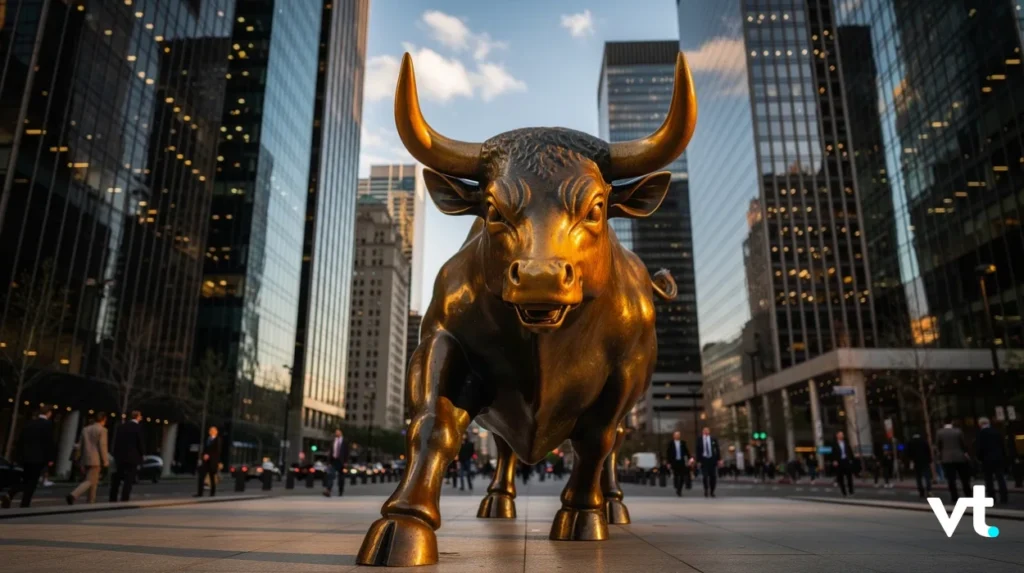
Bull vs Bear Market: Economic Differences at a Glance
Bull and bear markets represent two sides of the same economic cycle. Understanding both helps many investors to contextualise headlines and make more informed choices about asset allocation.
A bull market represents economic expansion with rising stock prices, while a bear market signals declining stock prices (20%+ drops) alongside economic contraction or slowdown. Here’s how the key indicators differ:
GDP Growth: Above trend during bull markets (2.5–4% in developed economies) versus flat or negative during bear markets
Unemployment: Falling or low in bull phases versus rising in bear markets, often reaching 8–10%
Inflation: Often moderate and stable in mid-bull phases versus volatile during late bull and early bear phases
Corporate Profits: Rising earnings with expanding margins versus shrinking profits and margin compression
Investor Sentiment: Optimistic with strong risk appetite versus cautious with investor pessimism dominating
These are tendencies rather than rigid rules. Stock market movements often lead the economy by 6–12 months—equity markets can begin a bull run while recession data still look weak, as savvy investors price in anticipated recoveries.
Since World War II, bull markets tend to outlast bear markets by roughly 3:1, contributing over 80% of long-term equity returns. Recognising the prevailing market environment helps you choose between growth-orientated and defensive strategies without attempting to perfect market timing.
Core Characteristics of a Bull Market in Economics
Economists and market analysts look for specific traits when classifying a sustained period as a bull market. These characteristics help distinguish genuine upward momentum from temporary rallies.
- Sustained upward trend: Major indices form higher highs and higher lows over months or years
- Above-trend GDP growth: North America at 2.5–4%, Europe and Asia-Pacific at 2–3.5%
- Broad sector participation: 80%+ of stocks advancing, not narrow leadership from a few names
- Improving labour markets: Employment growth of 1–2% annually with real wage increases of 3–5%
- Strong earnings growth: EPS growth of 12–20% with profit margins expanding 1–3 percentage points
- Higher risk appetite: Surging IPO volumes, small-cap outperformance, and corporate borrowing for expansion
- Accommodative monetary conditions: Interest rates below neutral levels with adequate credit availability
These characteristics interact dynamically. Strong earnings justify higher valuations, with price-to-earnings ratios expanding from 15–20x to 25–30x during robust bull runs. Positive wealth effects from rising investment prices boost consumer spending, which represents 70% of GDP in developed nations.
Even during bull markets, corrections of 5–15% occur every 6–12 months on average. These pullbacks purge short-term excesses without invalidating the longer-term uptrend.
Economic Forces That Create and Sustain Bull Markets
Understanding the drivers behind bull market economics reveals why some uptrends extend for years while others fade quickly.
Consumer Spending as the Backbone
Consumer spending—55–70% of GDP in G7 economies—typically powers bull markets. When wages grow 2–4% in real terms and household wealth increases from rising asset prices, consumers spend more freely. The IMF estimates that the $10 trillion increase in US household net worth post-2009 contributed an additional 2–3% to consumption growth.
Business Investment Multiplier
As demand strengthens, firms respond by investing in capacity, technology, and hiring. Capital expenditure growth of 5–10% mid-cycle enhances productivity by 1–2% annually, creating a virtuous cycle of expanding profits and rising corporate profits.
Global Trade Amplification
Expanding global trade volumes—up 4–6% mid-cycle—smooth supply chains and boost multinational earnings. For S&P 500 companies, 20–30% of revenue comes from overseas markets.
Innovation and Productivity Waves
Major technological shifts extend bull markets by opening new profit pools. The 1990s internet boom and 2020s AI revolution each lifted productivity 1–2% above baseline, propelling technology stocks to index leadership.
Policy Support
Fiscal stimuli (infrastructure spending adding 1–2% to GDP) and monetary easing build confidence. The feedback loop operates continuously: improving data exceeds expectations, sentiment indices rise, and capital inflows sustain valuations.
Monetary Policy, Interest Rates, and Bull Market Cycles
Central banks and interest rates are central to understanding why bull markets begin, extend, and eventually mature.
The typical pattern follows a predictable sequence. Early bull markets often start when central banks cut policy rates or maintain falling interest rates to support recovery. Low rates reduce borrowing costs, making equities more attractive than fixed-income securities and encouraging risk-taking.
As the economic expansion matures, central banks may gradually raise rates to control inflation. A measured pace—25–50 basis points quarterly—can manage overheating without derailing economic growth. However, aggressive hiking cycles (like the 1980s Volcker-era peaks or the 2022–2023 increases to 5.25–5.5%) signal late-stage precautions by tightening financial conditions.
The recent 2022–2026 context provides instructive examples:
- Post-pandemic hikes cooled inflation from 9% to 2–3%
- Markets adapted with soft landings (US unemployment steady at ~4.1% into 2026)
- Nasdaq gained over 150% from 2022 lows on AI momentum
Rising interest rates don’t automatically end bull runs, but they warrant monitoring. When rate cuts signal concern about slowing growth rather than a victory over inflation, that shift deserves attention.
Historical Bull Markets: Key Examples and Economic Backdrops
Concrete historical examples illustrate how bull market economics operates across different eras.
Post-World War II Expansion (1942–1966)
This 18-year secular bull delivered approximately 1,200% total return on the S&P 500. Industrial boom conditions drove GDP growth averaging 4–5% annually, unemployment stayed below 5%, and consumer demand for durables surged without major external shocks.
The 1982–2000 Secular Bull
The longest bull market of the 20th century saw the Dow gain 1,500%, while the Nasdaq increased 20-fold, thanks to technology leadership. Key drivers included Volcker’s inflation taming (bringing rates from 20% to 3%), deregulation, and the productivity boom from personal computers and the internet. Global trade expanded 6% annually.
2009–2020 Post-Financial Crisis Bull
The longest bull market in modern history stretched 11 years, with the S&P 500 gaining approximately 400%. Quantitative easing injected over $4 trillion in liquidity, rates stayed near zero, and unemployment fell from 10% to 3.5%.
2020–2021 Recovery and Beyond
The COVID-19 recovery bull saw the S&P 500 double from March 2020 lows to January 2022, powered by $5 trillion in fiscal stimulus and vaccines enabling a 5.9% GDP rebound. The subsequent 2023–2026 uptrend added 60% to the S&P, with AI driving Nasdaq gains of 120%.
Bull Market Economics in 2024–2026: Where Are We Now?
By 2024–2026, markets navigated the later stages of post-pandemic adjustments: moderating inflation, shifting interest rate expectations, and selective bull trends in sectors like technology and energy transition.
Current macro figures paint a picture of resilience amid uneven conditions:
| Indicator | 2024 Actual | 2026 Projection |
|---|---|---|
| Global GDP Growth | 3.2% | 3.1% |
| US GDP Growth | 2.8% | 2.7% |
| Canada’s GDP Growth | 1.5% | 1.8–2.0% |
| US Unemployment | 4.0% | 4.0–4.2% |
| Canada Unemployment | 6.2% | ~6.0% |
| Core Inflation | 2.5% | 2.0–2.5% |
Source: IMF World Economic Outlook, Bank of Canada
While some indices approached or exceeded market highs, bull market conditions proved uneven. The Magnificent 7 tech stocks comprise roughly 50% of Nasdaq weighting, while value sectors gained only 10% versus growth’s 50%+ advance. Regional disparities persist, with Asia’s emerging markets growing 4.5% while the Eurozone manages just 1.5%.
Traders using platforms like VT Markets can monitor live macro data, though conditions evolve rapidly.
How Bull Markets Influence Investor Behaviour and Sentiment
Bullish economic conditions fundamentally shift psychology. Investor optimism grows, fear of missing out (FOMO) intensifies, and perceptions of risk diminish—sometimes excessively.
Typical behavioural shifts during bull markets include the following:
- Rising participation as more investors open accounts during strong uptrends
- Greater appetite for higher-risk assets: growth stocks, smaller caps, emerging markets
- Valuation expansion as investors buy at higher prices for each dollar of earnings
- Herd behaviour amplifying momentum in popular sectors
Positive feedback loops operate powerfully. Rising prices validate optimistic narratives, attracting more capital and pushing prices further until fundamentals or policy constraints reassert themselves. Past speculative episodes in the housing market and technology stocks demonstrate how these dynamics can extend beyond reasonable valuations.
A Note of Caution: While investor confidence naturally rises in bull markets, remember that diversified portfolio construction, attention to valuations, and maintaining some exposure to dividend-paying stocks and fixed-income products help moderate risks when market sentiment eventually shifts.
Opportunities in Bull Markets: Where Economics and Strategy Meet
The economic traits of bull markets create tangible opportunities for both long-term investors and active traders.
- Long-term compounding: The S&P 500’s 10% historical CAGR means staying invested through bull cycles generates substantial real returns. Missing just the best 10 trading days can halve returns over a decade.
- Sector rotation: Early bull markets favour cyclicals (industrials, financials) with gains of 30–50%. Later stages often see leadership shift to quality growth or defensive sectors.
- Thematic investing: Structural trends like AI, renewable energy, and digital infrastructure benefit from both cyclical and secular tailwinds. AI-focused exchange-traded funds gained over 100% from 2023 to 2026.
- Active trading opportunities: Traders might gain exposure via index CFDs, sector positions, or major stocks through platforms like VT Markets while maintaining disciplined position sizing given leverage amplification effects.
Points to Keep in Mind: Market volatility persists even during uptrends. Asset classes respond differently to economic conditions, so diversification across mutual funds, individual equities, and fixed income securities helps manage unexpected events.
Risks and Cautions During Bull Markets
Even in bullish economic climates, awareness of potential setbacks prevents complacency.
Valuation Stretch: When CAPE ratios exceed 30x historical averages, markets become vulnerable to 20%+ corrections on disappointing data. Bear markets often begin when the expectation that prices will rise indefinitely becomes consensus.
Late-Cycle Signals: Monitor for slowing earnings growth, tightening credit standards, and yield curve inversions. Bear attacks on overextended positions can be swift.
Concentration Risk: Portfolios can unintentionally become tilted toward a few hot sectors. When the top 10 stocks comprise 35% of an index, diversification benefits diminish.
Leverage Considerations: Using borrowed money amplifies both gains and losses. Position sizing and margin management are crucial—view these practices as a precaution for active traders rather than a prohibition.
VT Markets offers tools including stop-loss orders and real-time margin monitoring to help manage these considerations. No bull run continues indefinitely, and planning for normal corrections reduces emotional stress when market ups and downs intensify.
Practical Strategies for Navigating Bull Market Economics
These evergreen approaches suit both long-term investors and active traders during different market cycles.
Stay Invested with a Long-Term Strategy
Market studies consistently show that timing exits perfectly is nearly impossible. Missing the best days devastates returns—research indicates missing just 10 optimal sessions can reduce decade-long returns by 50%.
Use Systematic Investing
Dollar-cost averaging into diversified assets smooths entry points across the bull cycle, reducing the anxiety of deciding when to invest.
Rebalance Periodically
Annual or semi-annual reviews lock in gains and realign with target risk levels. This discipline prevents portfolios from drifting too heavily into overheated sectors.
Tilt, Don’t Lurch
If late-cycle signals appear, make incremental shifts—modestly reduce risk or high-beta exposure rather than attempting to sell stocks entirely and exit the market. Reduce risk gradually rather than making dramatic moves.
Canadian Context: Consider adjusting exposure between domestic indices like the TSX and global indices based on sector composition and economic outlook differences.
Frequently Asked Questions on Bull Market Economics
How long does a typical bull market last?
Historical averages suggest 5–6 years, though variation is wide—some last 18 months, others extend beyond a decade. Duration depends on productivity trends, policy decisions, and external shocks. The post-2009 bull lasted 11 years.
Can the economy be weak while a bull market starts?
Yes. Markets are forward-looking and often begin new bull phases months before economic data clearly improves. Lower prices during downturns create opportunities as investors price in anticipated recoveries, even amid an economic slowdown.
Does inflation help or hurt bull markets?
Mild, stable inflation (2–3%) is compatible with strong bull markets. However, persistently high or volatile inflation pressures valuations and prompts central banks to raise rates aggressively, which can end uptrends.
Is it too late to invest once a bull market is recognised?
Timing perfectly is unrealistic. Long-term outcomes depend more on the amount of time spent in the market than on the timing of market entry and exit. Mid-bull entry has historically captured over 50% of cycle gains, making disciplined, diversified investing sensible even after upward movement is established.
Key Takeaways: Making Sense of Bull Market Economics
Bull market economics blends hard data—GDP growth, employment figures, and price appreciation in assets—with the softer elements of psychology and investor sentiment. When economic conditions align with confident expectations, sustained uptrends develop.
- Bull markets are periods of rising prices supported by economic expansion and optimistic expectations
- They tend to outlast bear markets’ investing timelines, contributing 80%+ of long-run returns
- Monetary policy, technological change, and global trade influence strength and duration
- Strong economy fundamentals—corporate profits, consumer spending, business investment—provide the foundation
- Investors benefit by staying diversified, managing risk thoughtfully, and avoiding emotional overreactions
- Platforms like VT Markets provide tools for accessing global markets and implementing disciplined strategies
Remember: conditions evolve, and this article provides education rather than personalised recommendations.
About VT Markets and This Educational Content
VT Markets is a multi-asset broker offering access to global markets via instruments including forex, indices, commodities, and share CFDs. The platform focuses on providing market analysis, educational resources, and trading tools to help clients understand environments across different market cycles.
Nothing in this article constitutes personalised advice or performance guarantees. Readers should consider seeking independent professional guidance. CFD trading involves leverage—traders should carefully assess whether they can accommodate potential losses.








