





Key Takeaways:
- Most crude oil trading mistakes come from sizing and leverage, not bad analysis.
- WTI and Brent are separate contracts with different drivers, spreads and expiry dates.
- EIA data and OPEC+ decisions move oil in dollars per barrel, not cents.
- A written, risk-first plan removes the most avoidable errors before they happen.
Crude oil is one of the world’s most heavily traded commodities. Most crude oil trading mistakes are not analytical errors. Traders often get the direction broadly right.
They lost money because the position was too large, the stop sat in the wrong place, or the trade was held through an inventory release with no plan.
This guide covers the six most common crude oil trading mistakes and what to do instead, with worked numbers you can apply to your own account.
What Crude Oil Trading Actually Involves
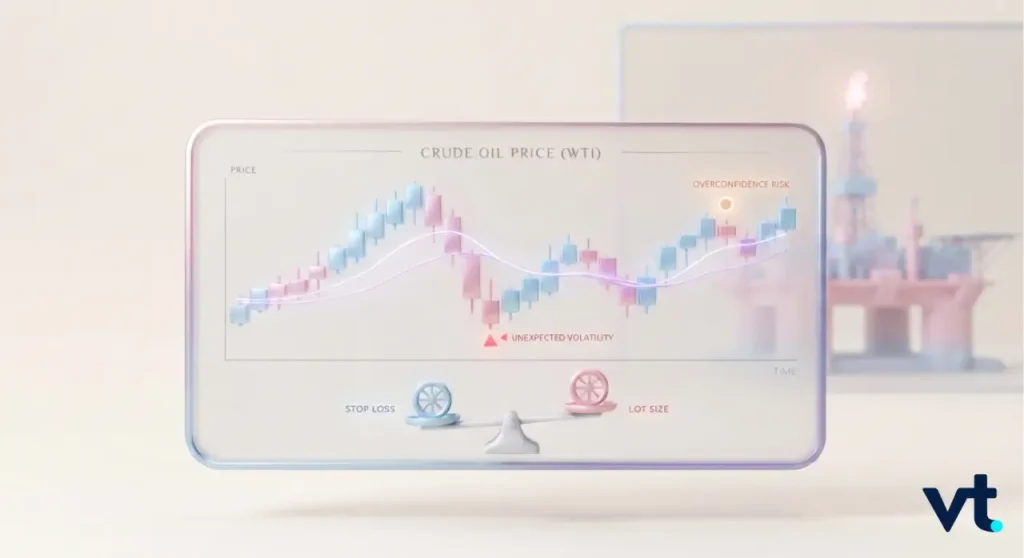
How Crude Oil Is Traded (Futures, CFDs, Spot And ETFs)
Crude oil is not a single market. There are four products wearing the same name.
- Futures: A NYMEX WTI contract covers 1,000 barrels, with a one-cent tick worth $10. Contracts expire monthly and can go to physical delivery.
- Crude oil CFDs: You trade price movement without delivery obligations. Sizing is flexible, typically from 10 barrels upward.
- Spot or cash oil: A continuous price with no expiry. You pay overnight financing for every night the position stays open.
- Oil ETFs: A fund wrapper holding futures for you. The rollover cost still exists, buried inside the fund’s performance.
Each route carries different costs. Mixing them up is where many crude oil trading mistakes begin.
What Counts As A Trading Mistake Versus Normal Market Risk
A losing trade is not automatically a mistake. If you risked 1% with a sensible stop and the market went the other way, that is normal market risk. A mistake is a breach of your own process.
- Market risk: Oil gaps against a correctly placed stop on a weekend headline.
- Trading mistake: You had no stop, so the gap took 30% of your balance.
- Market risk: A clean setup with defined 1% risk simply fails.
- Trading mistake: You doubled the size because you felt sure.
Log the two separately. It stops you rewriting a good process after a bad outcome.
Why Oil Punishes Mistakes More Than Other Markets
Oil price volatility sits in a different category to most currency pairs. On a quiet day EUR/USD might travel 0.5%. Crude travels four to six times, which is why crude oil trading mistakes cost more here than elsewhere.
| Market | Illustrative daily movement range | Move on $10,000 notional (Math conversions) |
| EUR/USD | 0.4% to 0.7% | $40 to $70 |
| Gold (XAU/USD) | 1.0% to 1.8% | $100 to $180 |
| WTI crude | 2.0% to 3.5% | $200 to $350 |
| WTI in an event of supply shock | 5% to 8% | $500 to $800 |
Source: European Central Bank (ECB), World Gold Council (WGC), CME Group and the US Energy Information Administration (EIA).
In the week ending 24 July 2026, Brent gained nearly 10% and WTI rose 8.27% amid escalating Middle East conflict and shipping disruptions. On 24 July, Brent fell 3.88% and WTI declined 3.12% after reports of efforts to restart US-Iran peace talks. A position sized for forex is sized wrong for oil.
The Most Common Crude Oil Trading Mistakes
What are some common mistakes traders make? The same six, in almost every account, in almost every cycle.
1. Overleveraging A Volatile Market
The largest single cause of blown accounts. High leverage is not the problem. Using it to justify an oversized position is. Work through a $2,000 account:
- One oil CFD lot covers 100 barrels. At $90, that is $9,000 of exposure.
- At 500:1 leverage, margin is roughly $18. It looks almost free.
- So the trader opens five lots, or 500 barrels, tying up about $90.
- Crude moves $2 against them, a routine day. The loss is 500 × $2 = $1,000, half the account.
Nothing unusual happened in the market. The sizing did all the damage.
Pro tip: Available leverage is a ceiling, not a target. Set position size from your risk in dollars first, then check the margin.
2. Trading Without A Stop Loss Or Defined Risk
Oil does not drift. It gaps. Trading without a stop loss means accepting unlimited risk on every position. Common versions of this error:
- Using a mental stop, then talking yourself out of it.
- Setting the stop at a round number rather than a level the chart respects.
- Moving the stop further away as the trade goes wrong.
- Placing it so tight that ordinary noise removes you.
A stop is not a prediction. It is where your idea is proven wrong.
3. Ignoring Position Sizing
Position sizing connects your stop to your account. Most traders skip it entirely.
Position size (barrels) = Risk amount ÷ Stop distance per barrel
| Account | Risk per trade | Stop distance | Correct position |
| $5,000 | 1% ($50) | $1.50 | 33 barrels (0.33 lots) |
| $5,000 | 1% ($50) | $3.00 | 16 barrels (0.16 lots) |
| $10,000 | 1% ($100) | $2.00 | 50 barrels (0.50 lots) |
| $10,000 | 2% ($200) | $2.00 | 100 barrels (1.00 lot) |
Note the first two rows. Same account, same risk, half the size. Wider stops demand smaller positions.
4. Chasing Momentum And FOMO Entries
Oil produces spectacular headlines, and headlines produce FOMO trading. By the time a $4 rally is on your screen, the risk-to-reward has already gone.
- Entering late pushes your stop further away, expanding risk per barrel.
- Late entries cluster exactly where profit-taking begins.
- Chasing means skipping your checklist, which is where your edge lives.
Pro tip: If you missed the entry, you missed the trade. Oil offers another setup within days, often within hours.
5. Trading Through Major News Without A Plan
Holding into a scheduled release without a decision made in advance is gambling with extra steps. Spreads widen and slippage becomes likely. Before any major event, know:
- Whether you will hold, reduce, or close entirely.
- Where your stop sits, allowing for slippage.
- What you do if price gaps straight through that level.
- Whether you will re-enter, and on what signal.
6. Overtrading And Revenge Trading After A Loss
Revenge trading is the most expensive of all crude oil trading mistakes. A loss stings, so the trader doubles the size to win it back. That trade fails too. The stats are cruel: a 20% drawdown needs a 25% gain to recover, and a 50% drawdown needs 100%.
Circuit breakers that work:
- A hard daily loss limit, for example 3% of the account.
- A maximum of two or three trades per session.
- A 30-minute pause after two consecutive losses.
- Closing the platform once the daily limit is hit.
Crude Oil Trading Mistakes That Generic Guides Miss
The errors above apply to every market. The next group is unique to oil, and these are the crude oil trading mistakes most beginner guides skip.
Confusing WTI And Brent (And Trading The Wrong One)
WTI vs Brent is not a cosmetic difference. They respond to different pressures and often move in different amounts on the same news.
| WTI crude | Brent crude | |
| Benchmark for | North America | Global |
| Delivery | Cushing, Oklahoma | Waterborne, North Sea |
| Exchange | NYMEX (CME) | ICE |
| Sensitive to | US inventories, shale output | Seaborne supply, OPEC+, shipping |
| Typical price | Usually cheaper | Usually at a premium |
On 24 July 2026, Brent futures settled at $96.78 per barrel, while WTI futures settled at $89.31. Any opening-price figures should identify the contract month, exchange, trading session, timezone and data provider.
That gap is the Brent-WTI spread, and it widens whenever seaborne supply is threatened. A trader positioned in WTI for a Strait of Hormuz story is trading the wrong benchmark.
Misunderstanding Contract Expiry And Rollover
Every futures contract expires. Forget the expiry date and your broker may close or roll the position for you, often at a poor moment.
- Front-month WTI expires monthly, with liquidity draining in the final days.
- Contract rollover means closing the expiring month and opening the next.
- Cash or spot symbols do not expire, but they charge financing instead.
- Check the contract specification for your symbol before holding overnight.
An example:
Front-month crude at $90.00, next month at $91.50. Rolling a 100-barrel long costs $1.50 per barrel, or $150, before the market moves a cent.
Overlooking Overnight Financing And Swap Costs On CFDs
Swing traders in crude oil CFD trading underestimate this. A swap looks trivial per night and compounds. Assume $1.50 per lot per night on 100 barrels:
- 5 nights: $7.50
- 20 nights: $30.00
- 60 nights: $90.00
On a $5,000 account, that 60-night figure is 1.8% of capital gone before the trade is judged. Hold for weeks and a swap-free account is worth investigating.
Not Tracking EIA And API Inventory Releases
Weekly inventory data is the most reliably market-moving scheduled release in oil. WTI can move $1 to $3 a barrel within seconds of a surprise print.
| Release | Day | Time (ET) | Notes |
| API Weekly Statistical Bulletin | Tuesday | 4:30 pm | Private survey, after the US close |
| EIA Weekly Petroleum Status Report | Wednesday | 10:30 am | Official data, the bigger mover |
Both shift a day in US holiday weeks. In mid-July 2026, US commercial crude inventories stood at 409.7 million barrels. Compare each print against the five-year range, not just last week.
Underestimating OPEC+ And Geopolitical Event Risk
OPEC+ production decisions now arrive monthly rather than twice a year, which means far more scheduled event risk than most traders realise.
On 5 July 2026, seven OPEC+ countries agreed to unwind 188,000 barrels per day of their additional voluntary production cuts in August 2026. This is effectively allowing production to increase by that amount, subject to compensation requirements and market conditions.
Geopolitical risk ignores the calendar entirely. Disruption around the Strait of Hormuz and the Red Sea drove crude up roughly 25% in a month during July 2026. Weekend headlines create Monday gaps, so weekend exposure needs deliberate sizing.
Why Oil Traders Lose Money
Is crude oil trading risky? Yes, and honestly so. Leverage, sharp gaps and event-driven repricing make it one of the more demanding markets open to retail traders. The risk is manageable, but only once you respect where the losses come from.
Emotional Decisions Under High Volatility
Large numbers on the profit and loss screen distort judgement. Traders close winners early for relief, then hold losers hoping for a recovery. That is the exact inverse of a profitable distribution.
- Winners cut at $200 while losers run to $800.
- Positions added to when already underwater.
- Stops cancelled at the worst possible moment.
No Trading Plan Or Edge
Without a written plan, every decision is made under pressure, which is when judgement is worst. An edge is not a feeling. It is a repeatable setup with documented results across a real sample.
Misreading The US Dollar And Macro Drivers
Oil is priced in dollars, so dollar strength typically works against crude and weakness supports it. Rate expectations, growth data and refinery margins all feed that relationship. Watch only the oil chart and you read half the story.
Ignoring Seasonality (Driving Season, Winter Demand)
Oil seasonality is a real, if imperfect, tendency in demand.
- Spring: Refinery maintenance cuts crude demand, then builds ahead of summer.
- Summer: US driving season lifts gasoline demand from late May to early September.
- Autumn: Refineries switch towards heating oil.
- Winter: Heating demand rises, and cold snaps create sudden spikes.
Treat seasonality as context. It sets a bias. It does not override supply shock. In addition, let’s discover the reasons why crude oil prices fluctuate erratically in 2026.
How To Avoid Crude Oil Trading Mistakes
Knowing the errors is not enough. Avoiding crude oil trading mistakes needs a system that makes the correct action the default one.
Building A Risk-First Trading Plan
Write the risk rules before the entry rules. Specify, in advance:
- Maximum risk per trade, usually 0.5% to 2% of the account.
- Maximum total open risk across all positions.
- Daily and weekly loss limits that end trading when hit.
- The setups you will trade, and the ones you will ignore.
- Your review process, including a journal entry for every trade.
Sizing Positions And Setting Stops Correctly
Work in this order every time. Reversing it is how oversized positions appear.
- Identify the invalidation level where your idea is proven wrong.
- Measure the stop distance in dollars per barrel from your entry.
- Calculate your risk amount as a percentage of your balance.
- Divide risk by stop distance for the position size in barrels.
- Check the margin last, purely to confirm the trade is executable.
To avoid making those mistakes, find out about how to trade ETF crude oil like a seasoned trader.
Using An Economic Calendar Around EIA And OPEC Events
Build your week around the known dates instead of being surprised by them. Mark API on Tuesday, EIA on Wednesday, the Baker Hughes rig count on Friday, and every OPEC+ meeting. VT Markets provides an economic calendar and market analysis, so these releases sit in front of you before you open a position, not after.
Managing Leverage Sensibly
Effective leverage is what you actually use, not what the broker offers. Scale it to your experience.
| Experience | Suggested maximum effective leverage | Rationale |
| First 3 months | 1:20 | Learning process and execution |
| 3 to 12 months | 1:50 | Building consistency |
| 12 months plus | 1:100 or higher | Demonstrated discipline |
Frequently Asked Questions (FAQs)
Q1. What are the most common crude oil trading mistakes?
The most common crude oil trading mistakes are overleveraging, trading without a stop loss, ignoring position sizing, chasing momentum, holding through major news without a plan, and revenge trading. Oil-specific errors include confusing WTI with Brent, missing contract expiry, and overlooking rollover and financing costs.
Q2. What is the difference between WTI and Brent crude?
WTI is the North American benchmark, delivered at Cushing, Oklahoma and traded on NYMEX. Brent is the global benchmark, waterborne from the North Sea and traded on ICE. Brent usually trades at a premium and reacts more to seaborne supply disruption, while WTI reacts more to US inventory data.
Q3. How much leverage should you use when trading crude oil?
Use the least leverage that lets you take the position your risk calculation allows. Many brokers offer up to 500:1, but effective leverage of 1:20 suits the first few months, rising to 1:50 as consistency develops. The real question is how many dollars you are risking.
Q4. What economic data moves crude oil prices?
The EIA Weekly Petroleum Status Report on Wednesday at 10:30 am ET is the biggest scheduled mover, followed by the API bulletin on Tuesday afternoon. OPEC+ meetings, US dollar strength, Federal Reserve decisions, the Baker Hughes rig count and geopolitical supply disruption also move prices.
Avoid Crude Oil Trading Mistakes With VT Markets
Almost every avoidable crude oil trade loss traces back to one root cause: a position too large for the stop it needed.
Decide your risk before your entry. Size from your stop, not your margin. Know which benchmark you are trading and what it costs to hold overnight. Mark the EIA and OPEC+ dates before the week begins.
VT Markets gives you the tools to trade crude oil CFDs on MetaTrader 4 and MetaTrader 5 with transparent spreads. Test your plan on a free demo account, then scale into live markets once your process is proven.
Open your account with VT Markets and put a plan behind every crude oil position you take.
This article is informational only and does not constitute personalised investment or financial advice. Always consult a qualified financial adviser before making investment decisions.








