





Key takeaways:
- The best CFD broker for you is determined by your instruments, trading frequency and jurisdiction, not by a ranking position.
- Compare all-in cost, meaning spread plus round-turn commission. A raw account at 0.0 pips with a USD 7 commission can cost more than a commission-free account at 0.6 pips.
- Regulation is entity-specific. Confirm which legal entity will hold your account before funding it, because leverage caps and compensation cover follow the entity, not the brand.
- All ten brokers here hold at least one licence from the FCA, ASIC, CySEC, BaFin, MAS or an equivalent authority, but licence scope varies. Some cover promotion only, or wholesale clients only, and give retail traders no protection.
- Retail leverage on major forex pairs is capped at 30:1 across the UK, EU and Australia. Higher figures generally apply to offshore entities.
- Every broker listed offers a free demo account. Testing execution during a scheduled data release tells you more than any comparison table.
The gap between the cheapest and most expensive way to open the same CFD position has never been wider. On a single EUR/USD standard lot, the all-in cost across mainstream regulated brokers ranges from roughly USD 6 on a raw-spread accounts to around USD 10 or more on the widest-spread commission-free accounts. Over a year of active trading, that is often the difference between a strategy that works and one that does not.
Cost is only half the question. The other half is who holds your money. CFD brokers operate through multiple legal entities, and the brand on the homepage is rarely the entity that accepts your account. A group can be authorised by the Financial Conduct Authority in London while onboarding clients elsewhere through a Mauritius or Seychelles subsidiary with different leverage limits and no compensation cover. Two traders using the same logo can hold entirely different levels of protection.
That is why choosing the best CFD broker in 2026 matters more than it did five years ago. Regulatory tightening across the FCA, ESMA and ASIC has raised the floor on conduct and disclosure. But it has also pushed the real differences between brokers into harder-to-see places: which entity you contract with, what raw pricing looks like once commission is added, and how much of the advertised instrument range is available in your country.
The best CFD broker choice depends on your goals, trading experience, location, and preferred instruments. A scalper running expert advisors on MetaTrader 5 has almost nothing in common with someone building a diversified multi-asset position, and no single broker serves both perfectly.
What Is A CFD Broker, And How do CFDs Differ From Other Products?
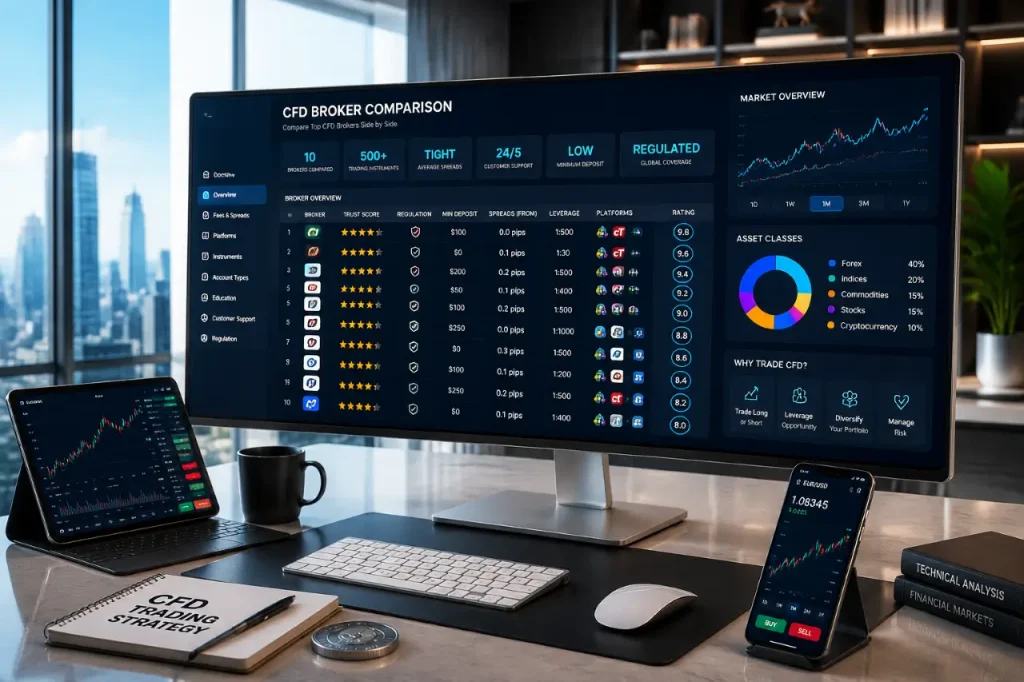
A CFD broker is a regulated firm that lets you take a leveraged position on an asset’s price without owning it. A contract for difference is an agreement to exchange the difference in price between the moment a position opens and the moment it closes.
That single mechanism is what allows one account to reach across forex, indices, commodities, shares, bonds, ETFs and cryptocurrencies. It is also why CFD trading is not investing.
CFDs versus other financial instrument products
| Product | What you own | Leverage | Can you go short? | Expiry |
| CFDs | Nothing. A contract with the broker | Yes, capped by regulator and entity | Yes, as easily as going long | None. Overnight financing applies |
| Futures | A standardised exchange contract | Yes, set by the exchange | Yes | Fixed expiry and rollover dates |
| ETFs | Units in a fund holding real assets | Only via margin lending | Only via specialist products | None |
| Physical commodities | The metal, grain or barrel itself | No | No | None, but storage costs apply |
| Shares | Ownership, dividends, voting rights | Only via margin lending | Only via stock borrowing | None |
Within the CFD wrapper, instrument groups behave differently:
- Forex CFDs carry the tightest spreads and highest permitted leverage. Liquidity is deepest during the London and New York overlap.
- Index CFDs track benchmarks such as the S&P 500 or DAX 40. Cash indices have no expiry; futures-based indices roll and can gap.
- Commodity CFDs split into hard commodities such as gold and crude oil, and softs such as coffee, sugar and wheat. Softs are thinner and wider.
- Share CFDs track individual equities, are subject to dividend adjustments, and usually carry a percentage commission rather than a marked-up spread.
- Bond CFDs track government debt such as US Treasuries and Bunds, and are used mainly for interest-rate positioning.
- ETF CFDs give leveraged, shortable exposure to a fund’s price without any ownership rights.
Availability, fees, spreads, leverage and regulatory protections vary by country. An instrument on a broker’s global site may not be offered to residents of your jurisdiction, and advertised leverage is frequently the most permissive figure available anywhere in that group.
10 Best CFD Brokers In 2026
Ratings are editorial assessments scored against the weighted methodology set out below. Costs are each broker’s published terms as of August 2026 and are subject to change.
| Rank | Broker / platform | Overall rating | Best for | Online trading | Fees / spreads | Regulation | Platform |
| 1 | VT Markets | ★★★★★ 4.8/5 | Choice of pricing structures | 1,000+ instruments, 7 asset classes | Standard STP from 1.2 pips, no commission; Raw ECN from 0.0 pips + USD 6 round turn | FSCA, FSC Mauritius, CMA Dubai (promotion only), ASIC (wholesale only) | MT4, MT5, WebTrader, TradingView,VT Markets App |
| 2 | IG | ★★★★★ 4.7/5 | Market breadth and regulation | 17,000+ markets | From 0.6 pips on major forex, no separate commission | FCA, ASIC, BaFin, MAS, FINMA | IG web and app, MT4, ProRealTime, L2 Dealer |
| 3 | Pepperstone | ★★★★★ 4.6/5 | Platform choice and raw pricing | 1,300+ instruments | Standard from 1.0 pip; Razor from 0.0 pips + circa USD 7 round turn | FCA, ASIC, CySEC, BaFin, DFSA, SCB | MT4, MT5, cTrader, TradingView |
| 4 | Saxo | ★★★★★ 4.5/5 | Professional multi-asset traders | 70,000+ products, 8,800+ CFDs | Tiered by account level; commission on share CFDs | Danish FSA, FCA, ASIC, MAS, FINMA | SaxoTraderGO, SaxoTraderPRO, API |
| 5 | CMC Markets | ★★★★☆ 4.4/5 | Forex and index CFD pricing | 12,000+ instruments | Standard from 0.5 pips; FX Active from 0.0 pips + USD 2.50 per USD 100,000 per side | FCA, ASIC, MAS, FMA, BMA | Next Generation, MT4, MT5, TradingView |
| 6 | XTB | ★★★★☆ 4.3/5 | A single strong proprietary platform | 6,000+ instruments | Commission-free, cost built into the spread | FCA (FRN 522157), KNF, CySEC, BaFin, DFSA | xStation 5 |
| 7 | IC Markets | ★★★★☆ 4.2/5 | Algorithmic trading and scalping | 2,250+ instruments | Raw Spread from 0.0 pips + USD 6 to 7 round turn | ASIC, CySEC, FSA Seychelles, CMA Kenya, SCB | MT4, MT5, cTrader, TradingView |
| 8 | Capital.com | ★★★★☆ 4.1/5 | Beginners and low entry cost | 4,500+ CFD instruments | Commission-free, spread-only | FCA, ASIC, CySEC, SCB, CMA UAE | Capital.com web and app, MT4, TradingView |
| 9 | eToro | ★★★★☆ 4.0/5 | Copy trading and social features | 7,000+ instruments | Spread-only, plus a USD 5 withdrawal fee on USD accounts | FCA, CySEC, ASIC | eToro web and app |
| 10 | AvaTrade | ★★★★☆ 3.9/5 | Risk tools and multi-regulation | 1,250+ instruments | Fixed and floating spreads from circa 0.9 pips | CBI Ireland, ASIC, CySEC, FSCA, JFSA | MT4, MT5, AvaTradeGO, AvaOptions |
Note: Figures reflect published broker terms and independent industry research as of August 2026. Spreads are variable unless stated and widen around data releases.
VT Markets (Rating: ★★★★★ 4.8/5)
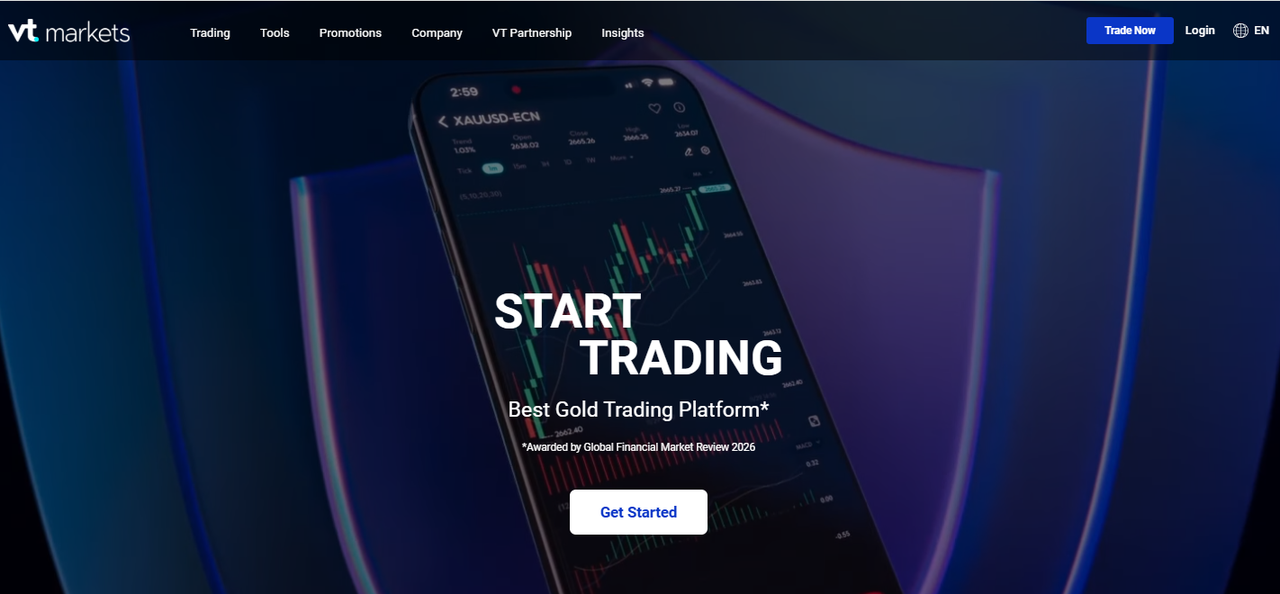
Source: VT Markets
| Criterion | Weight | Score |
| Regulation and trust | 25% | 4.5/5 |
| Trading costs | 20% | 5.0/5 |
| Instrument availability | 20% | 4.8/5 |
| Platform features | 15% | 5.0/5 |
| User experience | 10% | 4.8/5 |
| Education and research | 10% | 4.5/5 |
| Weighted overall | 100% | 4.8/5 |
Overview
VT Markets is a multi-asset CFD broker serving more than three million traders across over 160 countries, with roughly 1,000 instruments. It takes the top position for a specific reason: it is the only broker here that lets a trader choose between three cost structures on the same instrument set, without changing broker as volume grows.
Online trading platform features
The range spans forex, indices, energies, precious metals, soft commodities, share CFDs, bond CFDs, ETF CFDs and cryptocurrency CFDs. All products are CFDs rather than futures or physically settled contracts, so positions carry no expiry but do incur overnight financing.
Key features
- Platforms:MT4, MT5, WebTrader, TradingView and the VT Markets App
- Accounts: Standard STP, Raw ECN, Pro ECN, Cent and swap-free variants
- Research:Market Buzz sentiment analysis, economic calendar, trading glossary
- Education: Webinars, VT Academy, Help Centre knowledge base
- Automation: Expert Advisor support, VPS provision, and copy trading accounts
Trading costs
Standard STP is spread-only, with EUR/USD commonly observed from around 1.2 to 1.4 pips and no dealing commission. Raw ECN passes through raw pricing from 0.0 pips with a USD 6 round-turn commission instead, and Pro ECN sits above with a lower commission band as an upgrade tier. Minimum deposits are commonly USD 100, or USD 50 for Cent accounts.
Regulation and safety
The limitation that should weigh heaviest is regulatory. VT Markets operates through FSCA, FSC Mauritius, and a CMA-licensed Dubai branch rather than an FCA-authorised entity, which means UK FSCS compensation cover does not apply and leverage varies by entity.
For a UK trader who treats FSCS protection as non-negotiable, that is a decisive point in favour of Pepperstone, IG or Interactive Brokers, and it should be. Client funds are held in segregated accounts, and the group carries Lloyd’s-backed insurance cover and Financial Commission membership. Services are not offered to residents of the United States, Singapore, India, Russia or sanctioned jurisdictions.
Pros
- Three pricing structures on the same instrument set, so the cost model changes as volume grows
- Broad platform coverage including MT4, MT5, TradingView and a proprietary app
- Around 1,000 instruments across seven asset classes from one account
- Low entry point, with Cent accounts from a smaller deposit
- Copy trading and Expert Advisor support built in
Cons
- No tier-one retail authorisation. The ASIC licence is wholesale-only, the Dubai licence covers promotion only, and UK clients have no FOS or FSCS recourse
- Leverage and protections differ significantly between entities
- Pro ECN pricing is an upgrade tier rather than available by default
- Educational material is less extensive than IG’s or Saxo’s
Best for
Active and algorithmic traders wanting raw pricing without a large qualifying balance, and beginners wanting a commission-free start on the platform they will grow into. Less suitable for traders who require a domestic compensation scheme.
Final verdict
VT Markets is the strongest all-round choice here for traders prioritising cost flexibility and platform range over a national compensation scheme. Starting commission-free and moving to raw pricing without changing broker is uncommon at this price point.
IG (Rating: ★★★★★ 4.7/5)
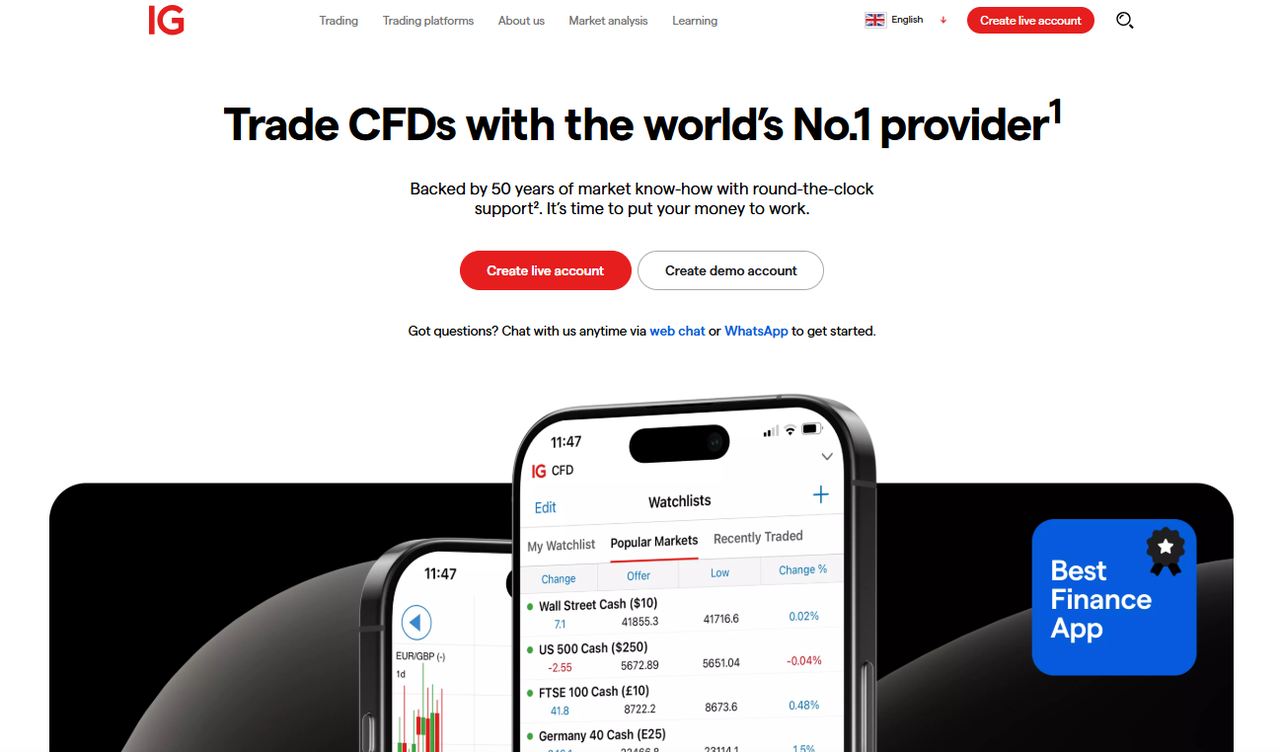
Source: IG
| Criterion | Weight | Score |
| Regulation and trust | 25% | 5.0/5 |
| Trading costs | 20% | 4.0/5 |
| Instrument availability | 20% | 5.0/5 |
| Platform features | 15% | 4.8/5 |
| User experience | 10% | 4.5/5 |
| Education and research | 10% | 5.0/5 |
| Weighted overall | 100% | 4.7/5 |
Overview
Founded in 1974 and listed on the London Stock Exchange, IG effectively created the retail CFD and spread betting industry. It is the benchmark for institutional solidity here, and the natural first choice for traders weighing safety and breadth above cost per trade.
Online trading platform features
More than 17,000 markets across forex, indices, shares, commodities, bonds, ETFs and options. IG is unusual in offering several product wrappers alongside CFDs, including spread betting for UK and Irish clients, barriers and vanilla options, and direct market access share dealing, so CFD positions and directly owned shares can sit under one relationship.
Key features
- Platforms: IG web and app, MT4, ProRealTime, L2 Dealer, TradingView, API
- Research: In-house analyst commentary, client sentiment data, integrated news
- Education: IG Academy, the most structured programme in the industry
- Risk tools: Guaranteed stop-loss orders and a Limited Risk account option
- Mobile: Full functionality rather than a cut-down version
Trading costs
Cost is built into the spread on forex, indices and commodities, with majors from around 0.6 pips and no dealing commission. Share CFDs carry a percentage commission with a minimum charge, and conversion fees apply on non-base-currency instruments. Minimum deposits are entity-dependent: the international CFD account at IG carries no minimum balance requirement, while a USD, GBP or EUR 250 minimum commonly applies on card and PayPal funding in several markets. An inactivity fee of GBP 12 or USD 18 a month applies after 24 consecutive months of no activity. IG does not compete on price and does not claim to.
Regulation and safety
UK entities are FCA-authorised, with CFDs from IG Markets Limited and spread betting from IG Index Limited, alongside ASIC, BaFin, MAS, FINMA, JFSA and DFSA authorisations. UK clients receive segregated money and FSCS cover up to GBP 85,000. European clients contract with the German entity under BaFin with different compensation arrangements.
Pros
- One of the deepest regulatory footprints available to retail CFD traders
- Over 17,000 markets, the widest range here after Saxo
- Professional execution tools including ProRealTime and L2 Dealer
- Tax-efficient spread betting for UK and Irish clients under current rules
- IG Academy is the strongest structured education programme on this list
Cons
- Forex costs sit well above the raw-spread brokers here
- Funding minimums apply in several markets that rivals do not impose
- Platform depth can overwhelm a first-time CFD trader
- Conversion and inactivity fees add up for low-frequency accounts
Best for
Long-term investors, professional traders, and anyone ranking regulatory protection and market breadth above cost per trade. The strongest fit for UK traders wanting spread betting and CFDs in one relationship.
Final verdict
IG is the safest and broadest option here, and the right answer for traders who would rather pay more per lot than compromise on counterparty strength. Cost-focused scalpers will find better economics elsewhere.
Pepperstone (Rating: ★★★★★ 4.6/5)
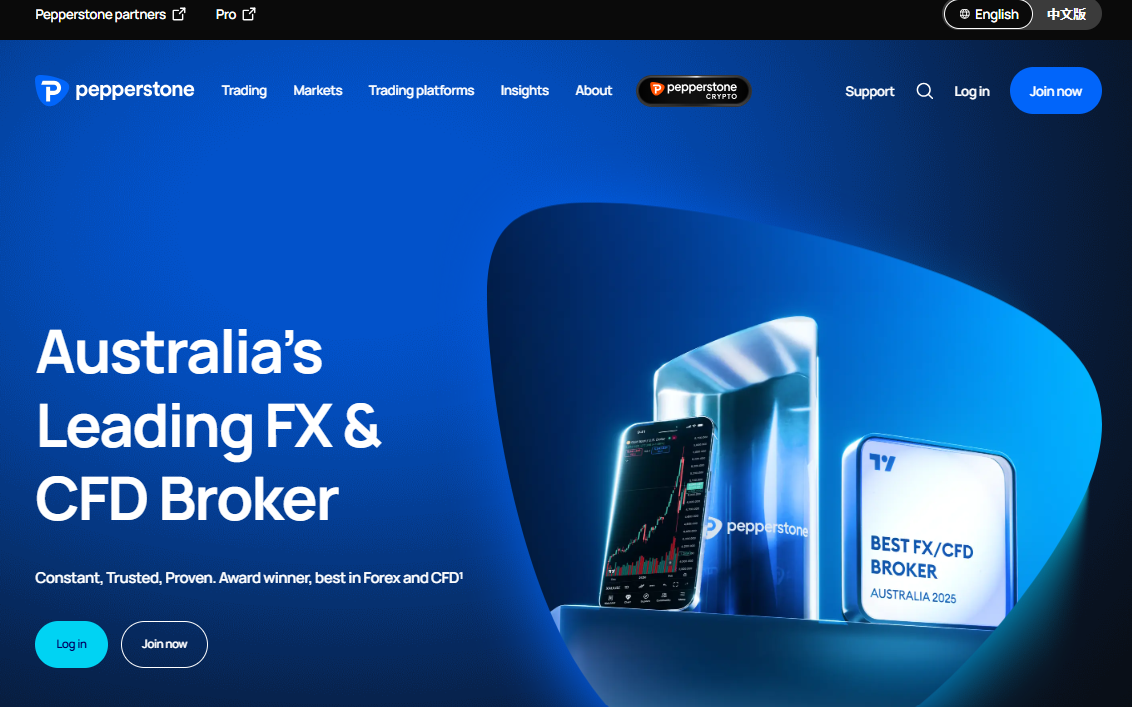
Source: Pepperstone
| Criterion | Weight | Score |
| Regulation and trust | 25% | 4.9/5 |
| Trading costs | 20% | 4.8/5 |
| Instrument availability | 20% | 4.2/5 |
| Platform features | 15% | 5.0/5 |
| User experience | 10% | 4.7/5 |
| Education and research | 10% | 4.0/5 |
| Weighted overall | 100% | 4.6/5 |
Overview
Pepperstone, founded in 2010, executes a narrow proposition unusually well: raw institutional pricing inside tier-one regulated entities, delivered across more platforms than any comparable broker.
Online trading platform features
Roughly 1,300 instruments across forex, indices, commodities, share CFDs, ETF CFDs, currency indices and cryptocurrency CFDs. That is narrower than IG, CMC or Saxo, and Pepperstone does not compete on breadth. It is one of two brokers here supporting MT4, MT5, cTrader and TradingView simultaneously, removing the migration problem for anyone with an existing expert advisor or cBot.
Key features
- Platforms: MT4, MT5, cTrader, TradingView and the Pepperstone platform
- Execution: Non-dealing-desk routing, published average speeds of 30 to 50 milliseconds
- Research: Autochartist, integrated market analysis, Smart Trader Tools
- Automation: Full Expert Advisor and cBot support, with VPS options
- Copy trading: Third-party integrations rather than a proprietary system
Trading costs
The Standard account is commission-free with EUR/USD around 1.0 pip. Razor passes through raw spreads from 0.0 pips with roughly USD 7 round turn on MetaTrader and around USD 6 on cTrader, a difference many users never notice. There is no strict minimum deposit and no inactivity fee.
Regulation and safety
Separate entities operate under the FCA, ASIC, CySEC, BaFin, DFSA, the Securities Commission of The Bahamas and the Capital Markets Authority of Kenya. UK clients receive FSCS cover up to GBP 85,000; EU clients receive Investor Compensation Fund cover to a lower limit. Client money is segregated with negative balance protection for retail clients in major jurisdictions.
Pros
- Raw pricing inside tier-one regulated entities, rarer than it sounds
- Among the widest platform selections here, covering MT4, MT5, cTrader and TradingView
- No minimum deposit and no inactivity fee
- Execution infrastructure suited to scalping and algorithmic strategies
- Transparent commission structure with cTrader rates published separately
Cons
- Instrument range materially narrower than IG, Saxo or CMC Markets
- Educational content thinner than at IG, XTB or Capital.com
- Commission differs by platform, easy to overlook when comparing accounts
- No proprietary copy trading system
Best for
Active traders, scalpers and algorithmic traders wanting the lowest realistic forex cost without leaving a tier-one regulatory perimeter, and anyone committed to cTrader or TradingView.
Final verdict
Pepperstone is the sharpest instrument here for a specific job. If you trade forex frequently, run automation, and care which platform you use, nothing else combines those three as well. Traders wanting thousands of share CFDs should look at IG or CMC.
Saxo (Rating: ★★★★★ 4.5/5)
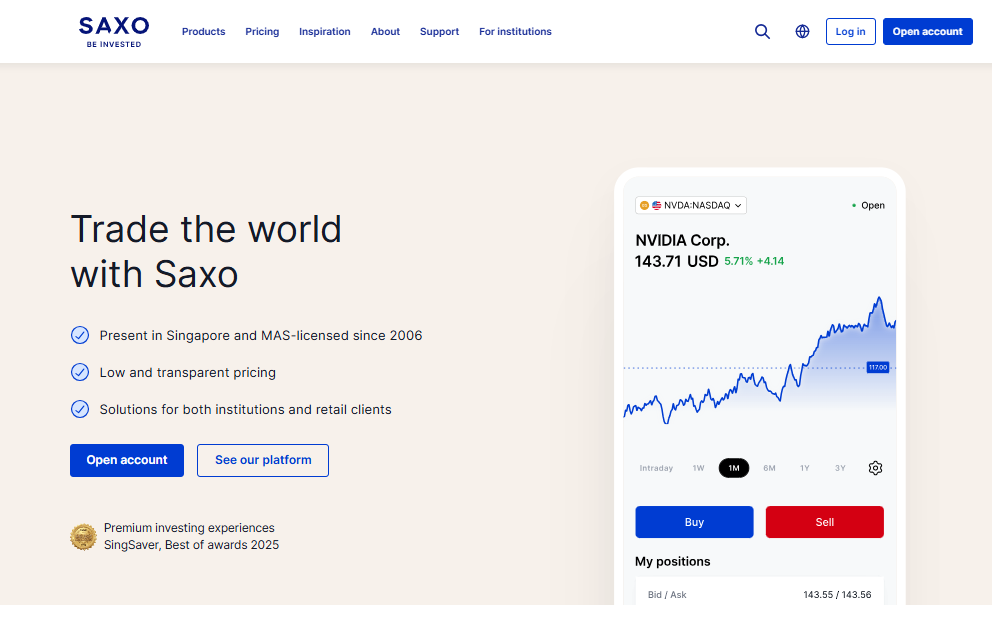
Source: SAXO
| Criterion | Weight | Score |
| Regulation and trust | 25% | 5.0/5 |
| Trading costs | 20% | 3.5/5 |
| Instrument availability | 20% | 5.0/5 |
| Platform features | 15% | 4.8/5 |
| User experience | 10% | 3.8/5 |
| Education and research | 10% | 4.8/5 |
| Weighted overall | 100% | 4.5/5 |
Overview
Saxo is a Danish investment bank founded in 1992, regulated across roughly 15 jurisdictions and operating on a different scale from most CFD brokers. Its offering exceeds 70,000 tradable products, of which around 8,800 are CFDs. The remainder is real securities.
Online trading platform features
CFD coverage spans forex, indices, single shares, commodities and bonds, with fractional index CFDs for precise sizing on expensive benchmarks. Alongside sit exchange-traded futures and listed options, which differ from CFDs in expiry, margining and settlement. SaxoTraderPRO supports algorithmic order types including VWAP and TWAP, direct market access and multiple APIs.
Key features
- Platforms: SaxoTraderGO, SaxoTraderPRO, plus REST and FIX APIs
- Products: CFDs, futures, listed options, bonds, ETFs, funds and shares in one account
- Research: In-house analysis across asset classes, among the best available to retail clients
- Advanced orders: Algorithmic order types, DMA and fractional index CFDs
- Tiers: Classic, Platinum and VIP, with pricing improving at each level
Trading costs
Saxo prices on a tiered basis, so headline pricing is not what most new accounts pay. Share CFDs carry a commission with a minimum charge per trade. Classic tier minimums are entity-dependent, with no formal minimum in many jurisdictions but GBP 500 at the UK entity, HKD 10,000 in Hong Kong and USD 5,000 across the MENA region. A typical retail-sized trade costs more than at the raw-spread brokers here, and custody or platform fees may apply to certain holdings.
Regulation and safety
Saxo Bank A/S is regulated by the Danish Financial Supervisory Authority and holds a banking licence, a meaningfully different status from a broker licence. Subsidiaries are authorised by the FCA, ASIC, MAS and FINMA. As a licensed bank, Saxo is subject to capital adequacy requirements pure brokers are not.
Pros
- Bank-level regulatory status with capital requirements beyond a broker licence
- Over 70,000 products, unmatched by any other provider here
- CFDs, futures, options and directly owned securities in a single account
- SaxoTraderPRO is institutional grade, with DMA and algorithmic orders
- Research quality is a real differentiator rather than a marketing line
Cons
- The best pricing tiers require substantial account balances
- Retail-sized CFD trades cost more than at the raw-spread brokers here
- More platform than a CFD-only trader needs, with a learning curve to match
- Customer support is frequently cited as the weakest part of the offering
Best for
Professional traders, long-term investors, and anyone running CFDs as one component of a diversified portfolio rather than the whole strategy. Not the right choice for a cost-focused day trader.
Final verdict
Saxo is where CFD trading meets genuine investment infrastructure. Traders wanting leveraged positions and a real portfolio in one place, with research to match, will find nothing comparable. Breadth and regulatory standing are what you pay for, not price.
CMC Markets (Rating: ★★★★☆ 4.4/5)
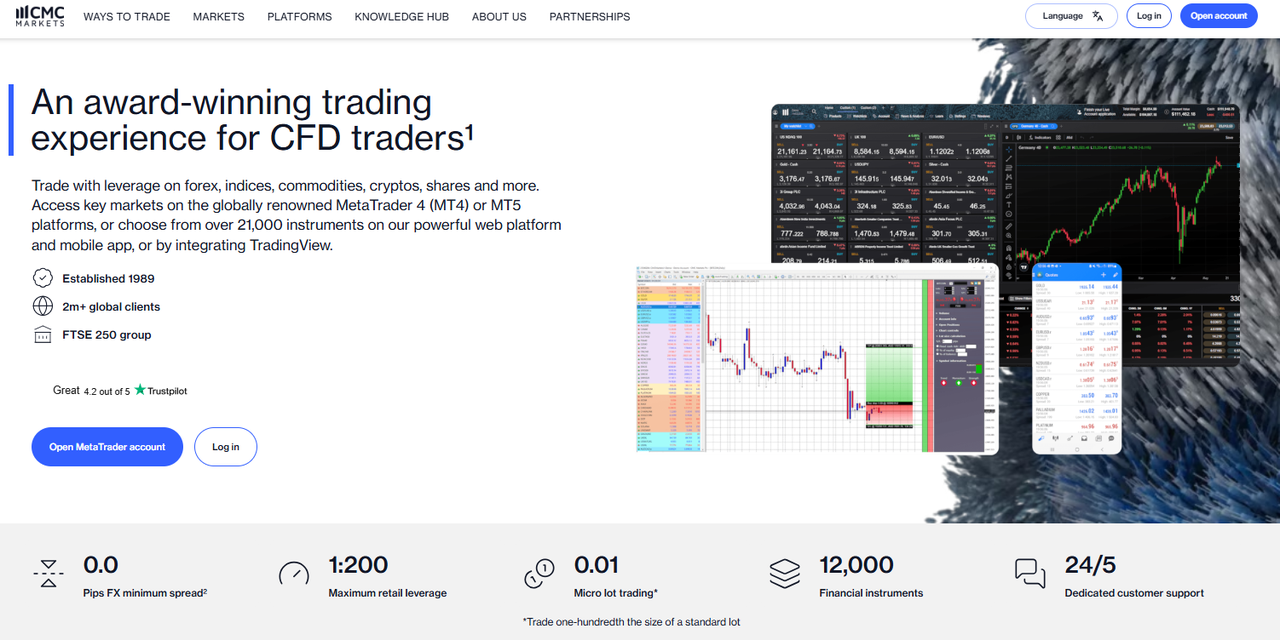
Source: CMC Markets
| Criterion | Weight | Score |
| Regulation and trust | 25% | 4.9/5 |
| Trading costs | 20% | 4.0/5 |
| Instrument availability | 20% | 4.6/5 |
| Platform features | 15% | 4.4/5 |
| User experience | 10% | 4.0/5 |
| Education and research | 10% | 4.0/5 |
| Weighted overall | 100% | 4.4/5 |
Overview
CMC Markets has offered leveraged trading since 1989 and listed on the London Stock Exchange in 2016. It occupies a useful middle position: FCA-regulated and long-established like IG, but with more aggressive forex pricing and no minimum deposit.
Online trading platform features
Over 12,000 instruments covering several hundred forex pairs, global indices, commodities, thousands of share and ETF CFDs, treasuries and selected cryptocurrency CFDs. Forex pair coverage is among the widest available anywhere, which matters for emerging-market and exotic crosses. UK and Irish clients can access spread betting alongside CFDs.
Key features
- Platforms: Next Generation, MT4, MT5 and TradingView integration
- Accounts: A standard commission-free CFD account and FX Active for higher-frequency forex traders
- Research: Morningstar research, Reuters news, client sentiment, automated pattern recognition
- Risk tools: Guaranteed stop-loss orders on the proprietary platform
- Order handling: A published no-partial-fill policy on trade size
Trading costs
The standard account is commission-free with EUR/USD from around 0.5 pips. FX Active offers minimum spreads of 0.0 pips on six major pairs with a commission of USD 2.50 per USD 100,000 of notional value per side, roughly USD 5.50 round turn on a standard lot, typically cheaper for anyone trading meaningful volume. FX Active is offered through the UK, Canadian and Bermudan entities rather than group-wide. Share CFD pricing varies by market: UK and most European share CFD commission has been reduced to zero, while US and Canadian share CFDs use a cents-per-share model with a USD 10 minimum. There is no minimum deposit, but an inactivity fee applies after 12 months.
Regulation and safety
CMC Markets UK plc and CMC Spreadbet plc are FCA-authorised under separate firm reference numbers, with additional ASIC, MAS, FMA, BaFin, CIRO and Bermuda Monetary Authority authorisations. UK clients receive segregated money and FSCS cover up to GBP 85,000. CMC does not run bonus promotions and states it earns primarily from spreads and share CFD commissions.
Pros
- No minimum deposit despite full FCA authorisation, an unusual combination
- Next Generation is one of the strongest proprietary platforms available to retail traders
- Exceptionally wide forex pair coverage, including exotic crosses
- FX Active offers raw-style pricing for higher-frequency forex traders
- Listed, long-established and transparent about how it earns revenue
Cons
- Some index and share CFD spreads run wide relative to the forex pricing
- Inactivity fee applies after 12 months, sooner than several rivals
- No proprietary copy trading or social features
- Limited electronic payment options compared with newer platforms here
Best for
Intermediate and active traders wanting FCA protection with competitive forex pricing, and anyone valuing a strong proprietary platform over MetaTrader. Also a reasonable beginner option given no minimum deposit.
Final verdict
CMC Markets is the best-value FCA-regulated option here for forex-focused traders. FX Active narrows the cost gap to the raw-spread brokers while keeping UK protections intact, a trade-off many traders will find worth making.
XTB (Rating: ★★★★☆ 4.3/5)

Source: XTB
| Criterion | Weight | Score |
| Regulation and trust | 25% | 4.7/5 |
| Trading costs | 20% | 3.9/5 |
| Instrument availability | 20% | 4.0/5 |
| Platform features | 15% | 4.7/5 |
| User experience | 10% | 4.4/5 |
| Education and research | 10% | 4.3/5 |
| Weighted overall | 100% | 4.3/5 |
Overview
XTB takes a deliberately different approach. Rather than layering a proprietary option on top of MetaTrader, it offers one platform, built in-house, and puts its development effort there. xStation 5 is consistently among the best-rated retail platforms in Europe. The company has been listed in Warsaw since May 2016 and served more than 2.16 million clients globally at the end of 2025, of which over 1.19 million were active.
Online trading platform features
Roughly 6,000 instruments across forex, indices, commodities, share CFDs, ETF CFDs and cryptocurrency CFDs, with real share and ETF investing available in some jurisdictions. xStation 5 includes integrated fundamental data, a sentiment tool, an economic calendar and analytics on your own trading patterns, built in rather than bolted on.
Key features
- Platform: xStation 5 on web, desktop and mobile
- Research: Integrated news, market sentiment, stock screener, performance analytics
- Education: A structured trading academy with courses by experience level
- Investing: Real shares and ETFs available in eligible jurisdictions
- Support: Frequently cited as among the best in the sector
Trading costs
CFD pricing is commission-free with cost built into the spread, keeping the arithmetic simple. Forex spreads sit around the market average rather than the tight end, so XTB is not the choice for a purely cost-driven trader. There is no minimum deposit for individual accounts. An inactivity fee applies after dormancy, and conversion charges apply outside your account currency.
Regulation and safety
XTB Limited, the UK entity, is FCA-authorised under firm reference number 522157. Other entities are regulated by the KNF in Poland, CySEC, BaFin, the CNMV in Spain and the DFSA. XTB agreed in February 2026 to sell its South African subsidiary, so its FSCA licence should not be treated as part of the current footprint, and in April 2026 it received Category 1 and Category 2 licences from the UAE Capital Market Authority. Client funds are segregated with negative balance protection for retail clients in regulated jurisdictions.
Pros
- xStation 5 is among the strongest proprietary platforms available to retail traders
- Commission-free pricing keeps the cost of a trade to a single figure
- No minimum deposit for individual accounts
- Broad regulatory footprint across the UK, EU, Middle East and Africa
- Real share and ETF investing alongside CFDs in eligible regions
Cons
- No MetaTrader support outside a limited MENA carve-out, so existing expert advisors cannot be migrated
- Spreads sit around the market average rather than the competitive end
- No raw-spread account to reward higher-volume traders
- A single-platform approach leaves no alternative if xStation does not suit you
Best for
Beginners and intermediate traders wanting one well-designed environment with strong education and support, and who have no existing MetaTrader dependency.
Final verdict
XTB is the best choice here for a trader who values platform quality and service above cost per lot. The absence of MetaTrader decides it: if you need it, XTB is ruled out; if you do not, xStation 5 is a better daily environment than most alternatives.
IC Markets (Rating: ★★★★☆ 4.2/5)

Source: IC Markets
| Criterion | Weight | Score |
| Regulation and trust | 25% | 3.8/5 |
| Trading costs | 20% | 5.0/5 |
| Instrument availability | 20% | 4.0/5 |
| Platform features | 15% | 4.8/5 |
| User experience | 10% | 4.2/5 |
| Education and research | 10% | 3.5/5 |
| Weighted overall | 100% | 4.2/5 |
Overview
Founded in 2007, IC Markets built its reputation on execution quality for high-frequency strategies. It aggregates pricing from a large liquidity panel and runs execution infrastructure co-located at Equinix NY4, with average execution under 40 milliseconds.
Online trading platform features
Roughly 2,250 instruments across forex, indices, commodities, share CFDs, bond CFDs and cryptocurrency CFDs. Breadth is adequate rather than impressive, and share CFD selection is narrower than at IG, CMC or Saxo. Platform support covers MT4, MT5, cTrader and TradingView, with cTrader offering Level II depth-of-market data MetaTrader does not provide natively.
Key features
- Platforms: MT4, MT5, cTrader and TradingView
- Execution: Aggregated pricing from a large liquidity panel, low-latency infrastructure
- Automation: Full Expert Advisor and cBot support, free VPS for qualifying accounts
- Trading styles: No restrictions on scalping, hedging or expert advisors
- Copy trading: Third-party services rather than an in-house system
Trading costs
Raw Spread offers spreads from 0.0 pips with around USD 7 round turn on MetaTrader and USD 6 on cTrader. The Standard account is commission-free with a markup placing EUR/USD around 0.6 to 0.8 pips. The minimum deposit is commonly USD 200. There are no deposit, withdrawal or inactivity fees on most methods, though international wires carry a charge.
Regulation and safety
IC Markets operates several entities, under ASIC (AFSL 335692), CySEC (362/18), the Seychelles FSA (SD018), the Capital Markets Authority of Kenya and the Securities Commission of The Bahamas. It does not hold FCA authorisation, and UK clients are typically onboarded through an offshore entity, bringing higher leverage but weaker protections and no FSCS cover. Its tier-one cover does not extend to UK retail clients, which is the main reason it does not rank higher despite its cost position.
Pros
- Among the lowest all-in forex costs of any broker here
- Execution infrastructure suited to scalping and high-frequency strategies
- Four platforms supported, including cTrader with Level II market depth
- No restrictions on scalping, hedging or automated strategies
- No deposit, withdrawal or inactivity fees on standard methods
Cons
- No FCA authorisation, and UK clients are onboarded offshore
- USD 200 minimum deposit is higher than most rivals here
- Educational material is thin relative to IG, XTB or Capital.com
- Instrument breadth is modest, particularly in share CFDs
Best for
Algorithmic traders, scalpers and experienced high-frequency traders who prioritise execution and cost above regulatory protection, and are comfortable with an offshore entity.
Final verdict
IC Markets is a specialist tool, and an excellent one for executing high volumes of short-term forex trades cheaply. Traders needing a domestic compensation scheme or broad instrument range should look elsewhere.
Capital.com (Rating: ★★★★☆ 4.1/5)
| Criterion | Weight | Score |
| Regulation and trust | 25% | 4.5/5 |
| Trading costs | 20% | 3.8/5 |
| Instrument availability | 20% | 4.0/5 |
| Platform features | 15% | 3.8/5 |
| User experience | 10% | 4.5/5 |
| Education and research | 10% | 4.4/5 |
| Weighted overall | 100% | 4.1/5 |
Overview
Capital.com is the most accessible entry point here. A very low minimum deposit, no dealing commission and a well-designed mobile app remove almost every barrier between opening an account and placing a first trade. It is also one of the few brokers that has invested in education as a product rather than as marketing.
Online trading platform features
Roughly 4,500 CFD instruments across forex, indices, commodities, shares and cryptocurrencies. Coverage is respectable for this price point, though it lacks the bond and ETF depth of IG, Saxo or CMC. Alongside its own web and mobile platform, Capital.com supports MT4 and TradingView, more platform choice than most beginner-oriented brokers offer.
Key features
- Platforms: Capital.com web and mobile, MT4 and TradingView
- Education: Investmate learning app plus AI-assisted analysis of trading patterns
- Risk tools: Guaranteed stop-loss orders on the proprietary platform
- Low entry: Minimum deposits from a very low threshold depending on payment method
- Spread betting: Available for UK clients under current tax rules
Trading costs
Pricing is built entirely into the spread with no dealing commission, making the cost of a trade one number rather than two. EUR/USD is commonly quoted around 0.6 pips, competitive for a commission-free model though not close to a raw-spread account once volume builds. Minimum deposits start around USD 10 to 20 by payment method, and there is no inactivity fee on the current schedule.
Regulation and safety
Entities are authorised by the FCA, ASIC, CySEC, the SCB and the UAE Capital Market Authority, which replaced the Securities and Commodities Authority on 1 January 2026. UK clients receive FSCS cover; EU clients receive Investor Compensation Fund cover. Client funds are
Pros
- One of the lowest entry points of any FCA-regulated CFD broker
- Simple all-in spread pricing with no separate dealing commission
- Genuinely strong educational tooling rather than a token article library
- MetaTrader 4 and TradingView supported alongside a polished proprietary app
- No inactivity fee on the current published schedule
Cons
- Costs become uncompetitive against raw-spread accounts once volume builds
- No raw-spread or commission-based account for growing traders
- Spread variance between instruments is wider than the headline suggests
- Fewer advanced execution tools than IG or Saxo
Best for
Beginners and lower-frequency traders wanting a well-regulated broker with a low entry point, clean pricing and strong learning material. Expect to outgrow the pricing if volume increases substantially.
Final verdict
Capital.com is the best starting point here for a new CFD trader. Tier-one regulation, a very low minimum deposit and one cost figure to track is hard to beat for a first year. Plan to reassess once trading regularly.
eToro (Rating: ★★★★☆ 4.0/5)
Source: eToro
| Criterion | Weight | Score |
| Regulation and trust | 25% | 4.4/5 |
| Trading costs | 20% | 3.4/5 |
| Instrument availability | 20% | 4.2/5 |
| Platform features | 15% | 3.8/5 |
| User experience | 10% | 4.6/5 |
| Education and research | 10% | 4.0/5 |
| Weighted overall | 100% | 4.0/5 |
Overview
eToro, founded in 2007, built its business on social and copy trading and remains the reference point for that model. CopyTrader allocates capital to another trader’s positions automatically, with the copied trader compensated through eToro’s Popular Investor programme rather than by the copier directly.
Online trading platform features
Around 7,000 instruments, the bulk being share CFDs, alongside ETFs, indices, commodities, forex and a substantial cryptocurrency offering. In several jurisdictions eToro also offers real share and crypto ownership. The platform is proprietary, web and mobile only, with no MetaTrader, cTrader or third-party charting, which rules it out for algorithmic traders.
Key features
- Platform: eToro web and mobile app only
- CopyTrader: Automatic replication of another trader’s positions with allocation controls
- Smart Portfolios: Thematic, professionally constructed baskets of assets
- Social feed: A discussion layer attached to every instrument
- Real ownership: Available for shares and crypto in eligible jurisdictions
Trading costs
eToro prices spread-only on CFDs, with spreads generally wider than the market average. On non-trading costs, eToro removed its inactivity fee in May 2026 and its published schedule now shows no inactivity charge. Withdrawals from local currency accounts in GBP, EUR or DKK are free with no minimum, while withdrawals from a USD investment account carry a fixed USD 5 fee with a USD 30 minimum. Conversion charges apply outside your account currency and vary by Club tier.
Regulation and safety
Entities are authorised by the FCA, CySEC, ASIC and additional regulators elsewhere. UK clients receive FSCS cover through the UK entity, and client funds are segregated with negative balance protection. Confirm which entity onboards you, since the product mix, including whether real asset ownership is available, differs between them.
Pros
- The most developed copy trading and social trading system available
- Real share and cryptocurrency ownership alongside CFDs in eligible jurisdictions
- An exceptionally approachable interface for people new to markets
- Tier-one regulation across the UK, EU and Australia
- Smart Portfolios offer diversified thematic exposure without manual construction
Cons
- Spreads are wider than most competitors on this list
- A USD 5 withdrawal fee and conversion charges still apply on USD accounts
- No MetaTrader, cTrader or TradingView support, so no automation
- Charting and analysis tools are basic relative to every other broker here
Best for
Beginners who want to learn by observing others, and passive traders who prefer allocating to a strategy over managing positions. Not suitable for algorithmic traders, scalpers or anyone cost-sensitive.
Final verdict
eToro answers a narrow question well: how do I get market exposure without making every call myself? Nothing else here comes close. For traders wanting tight pricing, automation or serious charting, it is the wrong tool.
AvaTrade (Rating: ★★★★☆ 3.9/5)
Source: AvaTrade
| Criterion | Weight | Score |
| Regulation and trust | 25% | 4.5/5 |
| Trading costs | 20% | 3.2/5 |
| Instrument availability | 20% | 3.5/5 |
| Platform features | 15% | 4.1/5 |
| User experience | 10% | 3.9/5 |
| Education and research | 10% | 4.1/5 |
| Weighted overall | 100% | 3.9/5 |
Overview
AvaTrade, founded in 2006 and headquartered in Dublin, is built on two things: an unusually wide regulatory footprint spanning six continents, and proprietary tools that address risk rather than cost. Chief among them is AvaProtect, which lets a trader pay a premium to insure a position against loss for a defined period.
Online trading platform features
Roughly 1,250 instruments across forex, indices, commodities, share CFDs, ETF CFDs, bonds and cryptocurrencies, the narrowest range in this comparison. Platform coverage is unusually broad for a broker of this size, including MT4, MT5, the AvaTradeGO app, WebTrader, and AvaOptions for currency options, a product type most CFD brokers do not offer at all.
Key features
- Platforms: MT4, MT5, AvaTradeGO, WebTrader and AvaOptions
- AvaProtect: Optional paid loss protection on a position for a defined window
- Copy trading: AvaSocial in-house, plus DupliTrade and ZuluTrade integrations
- Spread options: Both fixed and floating spread accounts available
- Education: A comprehensive academy with support in 14 or more languages
Trading costs
AvaTrade is spread-only with no dealing commission. EUR/USD is commonly quoted from around 0.9 pips, wider than most commission-free accounts here and considerably wider than raw-spread options. The minimum deposit is around USD 100. An inactivity fee applies after a short dormancy period, with an administration fee after longer inactivity, and withdrawal processing is slower than average.
Regulation and safety
Entities are regulated by the Central Bank of Ireland, ASIC, CySEC, the FSCA, the JFSA, the ADGM and the BVI FSC among others, one of the broadest footprints of any retail broker. Client funds are segregated with negative balance protection. Leverage varies dramatically between entities, from 30:1 under the Irish entity to considerably higher offshore.
Pros
- One of the widest regulatory footprints of any retail CFD broker
- AvaProtect is a distinctive risk tool not offered elsewhere on this list
- Both fixed and floating spread accounts, useful where spread widening matters
- AvaOptions provides currency options access most CFD brokers do not offer
- Strong multilingual education and support
Cons
- Spreads are among the widest in this comparison
- The narrowest instrument range on this list
- Inactivity fees apply sooner than at most competitors
- Withdrawal processing is slower than average
Best for
Traders wanting fixed spreads, built-in downside protection or currency options, and who value multilingual support and broad regulation over the lowest cost per trade.
Final verdict
AvaTrade earns its place through tools and regulatory reach rather than pricing. If AvaProtect, fixed spreads or AvaOptions solve a specific problem for your strategy, the premium is defensible. If not, the cost is hard to justify against the rest of this list.
How We Rated The Best CFD Brokers In 2026
Every score above is a weighted editorial assessment, not a measured performance figure. The weighting reflects what tends to determine outcomes for a typical retail CFD trader over a full year.
| Criterion | Weight | What it measures |
| Regulation and trust | 25% | Which entity holds client money, strength of the authorising regulator, compensation cover, fund segregation, negative balance protection |
| Trading costs | 20% | All-in cost including spread and round-turn commission, plus swaps, inactivity fees, withdrawal fees and conversion charges |
| CFD instrument availability | 20% | Breadth and depth across forex, indices, commodities, shares, bonds, ETFs and crypto, and how much is genuinely accessible by region |
| Platform features | 15% | Platforms supported, charting quality, order types, automation and API access, execution infrastructure |
| User experience | 10% | Onboarding, funding, mobile app quality, support responsiveness, clarity of pricing disclosure |
| Education and research | 10% | Structured learning material, in-house analysis and tools that support decisions rather than market them |
Each broker is scored out of five on every criterion, then multiplied by the weights and summed. VT Markets, for example, scores 4.5 on regulation, 5.0 on cost, 4.8 on instruments, 5.0 on platform, 4.8 on user experience and 4.5 on education, producing a weighted total of 4.8.
Regulation carries the largest weight deliberately. A broker with excellent pricing and weak counterparty standing is not a bargain. It is why IC Markets, which produces one of the strongest cost positions here, sits seventh rather than near the top.
These are editorial evaluations based on publicly available information, including published broker terms, regulator registers, corporate disclosures and independent industry research current as of August 2026. They are not audited data, not investment advice, and not a prediction of any individual outcome. Broker terms change frequently, so verify anything material directly before funding an account. This article is published by VT Markets, which appears in the ranking. No broker paid for placement, and the ranking reflects the weighted methodology above rather than any commercial relationship.
How To Choose The Best CFD Broker
Ranking positions are a starting point. The broker that suits you depends on eight checks only you can run.
- Confirm the entity and its regulator: Find out which legal entity will hold your account, then look it up on that regulator’s public register. Tier-one authorities, including the FCA, ASIC, BaFin and MAS impose the strictest segregation and compensation requirements. Offshore licences generally permit higher leverage and offer weaker recourse.
- Calculate the all-in trading cost: Compare spread plus round-turn commission, not the headline spread. A raw account quoting 0.0 pips with a USD 7 commission costs roughly 0.7 pips equivalent on a standard forex lot, more than a commission-free account at 0.6 pips. Then check swaps, inactivity fees, withdrawal charges and currency conversion.
- Check the instrument range you will actually use: A count of 17,000 markets is irrelevant if the twelve instruments you trade are priced poorly. Check spreads, swap rates and contract sizes on your specific instruments, and confirm they are available to residents of your country.
- Understand the leverage rules that apply to you: Retail leverage is capped at 30:1 on major forex pairs across the UK, EU and Australia, with tighter caps on indices, commodities and shares. Leverage magnifies losses exactly as much as gains, and a modest adverse move on a highly leveraged position can trigger a margin close-out within a single session.
- Test the platform on a demo account: Fund it with realistic virtual capital, trade your actual instruments, and specifically test execution during a scheduled data release. Advertised and real execution quality diverge most in fast markets, which is exactly when it matters.
- Assess mobile trading properly: Check whether the app is a full platform or a monitoring tool. Can you modify a stop, close a partial position, deposit funds and access the same charting you use on desktop?
- Test customer support before you need it: Contact support with a specific technical question before funding. Response time on a routine enquiry is a reasonable proxy for what happens during a funding problem or disputed file.
- Read the risk disclosures: Every regulated CFD broker publishes the percentage of retail accounts that lose money, ranging from around 51 to 89 per cent across providers. It should inform you how much capital you commit and how you size positions.
How To Trade CFD Financial Instrument Products Online In 2026
Step 1: Choose a regulated broker: Shortlist two or three whose regulation, cost structure and instrument range match your requirements, then verify each on the relevant regulator’s public register rather than relying on the website claim.
Step 2: Open an account: The online application takes ten to twenty minutes at most brokers. You select an account type at this stage. If unsure, a commission-free account is the simpler starting point since the cost of a trade is a single number.
Step 3: Complete verification: Prepare a government-issued photo ID and a recent utility bill or bank statement. You will also answer questions about experience and finances that determine retail or professional classification. Answer accurately, because retail classification carries stronger protections.
Step 4: Deposit funds: Fund in your account’s base currency where possible to avoid conversion charges, and deposit only capital you can afford to lose entirely. Card and e-wallet deposits usually clear within minutes, bank transfers within one to three business days.
Step 5: Research market conditions: Check the economic calendar for scheduled releases, review the technical picture, and compare the current spread against its typical level. Opening a position seconds before a central bank decision means paying several times the normal cost.
Step 6: Select your CFD instrument products: Choose instruments you understand. Forex majors and large-cap index CFDs are the most liquid with the tightest spreads. Exotic crosses, soft commodities and small-cap share CFDs are wider, thinner and gap more often. Confirm contract size first, because it determines what each price increment is worth.
Step 7: Manage risk before you enter: Decide your stop-loss level and position size before opening, not after. A common approach is to risk a small fixed percentage of equity per position, then work backwards to the size producing that risk at your stop. Consider a guaranteed stop for instruments prone to gapping.
Step 8: Monitor positions and costs: Track open positions, margin utilisation and accumulated swap charges. Overnight financing is irrelevant to a day trader and can dominate every other cost for someone holding a view for weeks. Review your record monthly against the assumptions you made when choosing the broker.
At A Glance
- Best overall CFD broker: VT Markets (★★★★★ 4.8/5), for three pricing structures across a 1,000-plus instrument range on MT4, MT5, TradingView and its own app.
- Best for beginners: Capital.com (★★★★☆ 4.1/5), for a very low minimum deposit, single-figure pricing and strong educational tooling under FCA regulation.
- Best low-cost option: IC Markets (★★★★☆ 4.2/5) on raw pricing, with VT Markets’ Raw ECN the strongest low-cost option alongside a broader instrument range.
- Best professional platform: Saxo (★★★★★ 4.5/5), for SaxoTraderPRO, direct market access, algorithmic order types and over 70,000 products.
- Best mobile trading platform: IG (★★★★★ 4.7/5), for a full-function app across 17,000-plus markets, with VT Markets and Capital.com close behind.
- Best for copy trading: eToro (★★★★☆ 4.0/5), for the most developed social and copy trading system available.
Frequently Asked Questions
What is the best CFD broker for CFD financial instrument products online in 2026?
There is no single answer, because the best CFD broker depends on your instruments, trading frequency and jurisdiction. On our weighted 2026 assessment, VT Markets ranks first overall for combining three pricing structures with roughly 1,000 instruments across MT4, MT5, TradingView and its own app. IG leads on regulation and breadth, Pepperstone on platform choice, and Capital.com on accessibility for newer traders.
Can beginners trade CFD financial instrument products online?
Yes, but with caution. CFDs are leveraged products, and regulated brokers publish figures showing most retail accounts lose money. Beginners should start on a demo account, use the lowest available leverage, trade liquid instruments such as forex majors or large index CFDs, and risk only a small fixed percentage of capital per position. Capital.com, XTB and VT Markets offer the most beginner-appropriate combinations of low entry cost and structured education.
Which CFD broker has the lowest CFD financial instrument products online trading fees?
On raw forex pricing, IC Markets and VT Markets’ Raw ECN account produce the lowest all-in costs here, both combining near-zero spreads with a modest round-turn commission. Pepperstone’s Razor account sits close behind inside a tier-one regulatory perimeter. The correct comparison is spread plus commission on your specific instruments, since a broker cheap on forex may be expensive on indices or shares.
Is trading financial instruments online through CFDs risky?
Yes, materially so. CFDs are leveraged, meaning a small adverse move can produce a loss much larger than the margin committed. Regulated brokers disclose that between roughly 51 and 89 per cent of retail accounts lose money, depending on the provider. Risks include leverage amplification, overnight financing costs, gapping past stop levels, and counterparty exposure to the broker itself. Negative balance protection limits but does not eliminate the downside.
Are CFD brokers regulated?
Reputable ones are, but regulation is entity-specific rather than brand-wide. A single group can hold an FCA licence in London while onboarding clients elsewhere through an offshore subsidiary with different leverage limits and no compensation cover. Always confirm which entity will hold your account and verify it on that regulator’s public register before funding. CFDs are prohibited for retail clients in some jurisdictions, including the United States.
Can I choose the best CFD broker the same way as other investment or trading brokers?
Only partly. The shared criteria are regulation, platform quality, costs and support. What differs is that CFD brokers are usually your direct counterparty rather than a route to an exchange, so their financial standing matters more. Leverage caps, overnight financing rates, margin close-out rules and negative balance protection are CFD-specific factors with no equivalent in ordinary share dealing.
What is the safest way to choose the best CFD broker?
Start with regulation rather than price. Identify the entity that will hold your account, verify it on the regulator’s public register, and confirm what compensation cover applies. Then check that client funds are segregated and negative balance protection is in place. Only after clearing those checks should you compare costs, platforms and instrument range, then test the broker on a demo account through a scheduled data release.
Final Verdict: Which CFD Broker Should You Choose?
Two questions decide it: what a position costs to open and hold, and who stands behind the account. Almost every broker here answers one well.
For flexibility across cost structures, VT Markets ranks first, offering commission-free, raw-spread and lower-commission tiers across the same 1,000-plus instrument range on MT4, MT5, TradingView and a proprietary app.
For regulatory depth and market breadth, IG remains the benchmark, with over 17,000 markets and tier-one authorisation across multiple continents, at a cost premium that buys institutional solidity.
For raw pricing with tier-one protection, Pepperstone offers the widest platform selection here alongside genuinely competitive commission-based forex costs.
For CFDs as part of a real portfolio, Saxo is the only provider where leveraged positions, futures, options and directly owned securities sit under one login with bank-level regulatory standing.
To start out, Capital.com combines FCA regulation, a very low minimum deposit and one cost figure to track.
The honest summary is that traders prioritising a domestic compensation scheme should choose from the FCA and equivalently authorised brokers here and accept the cost. Traders prioritising execution economics will find better numbers further down the regulatory ladder. That trade-off is real, and worth making deliberately rather than by default.
Start Trading Online With VT Markets
VT Markets provides access to more than 1,000 instruments across forex, indices, energies, precious metals, soft commodities, ETFs, share CFDs and bond CFDs, on MT4, MT5, WebTrader, TradingView and the VT Markets App.
Choose the pricing structure that fits how you trade: Standard STP for commission-free simplicity, Raw ECN for raw pricing with a transparent round-turn commission, or Pro ECN for reduced commission if you meet the activity criteria in an eligible country. New traders can practise risk-free on a demo account with no time limit, and the VT Markets Help Centre offers educational resources and platform guidance along the way.
Risk warning:
CFDs are complex instruments and come with a high risk of losing money rapidly due to leverage. Between roughly 51 and 89 per cent of retail investor accounts lose money, depending on the provider when trading CFDs with regulated providers. You should consider whether you understand how CFDs work and whether you can afford to take the high risk of losing your money. This article is for informational purposes only and does not constitute investment advice, a recommendation, or an offer to trade any instrument. Availability, fees, spreads, leverage and regulatory protections vary by country and by the entity that holds your account. Figures are correct as at August 2026 and are subject to change.








