





Your trading strategy is only as strong as the risk you can manage. A risk profile for CFD trading defines how much loss you can absorb, how much volatility you can tolerate, and the limits that guide your position size, leverage use, stop loss placement and choice of trading style. A trader’s risk profile is shaped by three key factors: risk capacity, risk tolerance and trading goals. This guide explains how to identify your CFD trading risk profile, match it with suitable trading styles such as scalping, day trading, swing trading or position trading, and build a risk framework that supports more consistent decision-making.
Key Takeaways:
- A risk profile for CFD trading sets how much loss you can absorb and how much volatility you can sit through.
- Risk capacity is arithmetic. Risk tolerance is psychology. Trouble starts when they do not match.
- Your profile should drive position sizing, leverage, stop loss placement and instrument choice.
- Scalping, day trading, swing trading and position trading each suit a different profile.
- At VT Markets, you can test a profile on a demo account using MetaTrader 4 or MetaTrader 5.
Most traders pick a strategy first and think about risk second. That order is backwards. Your risk profile for CFD trading decides how large you trade, how much leverage is sensible, and which styles you can hold when price moves against you. This guide covers how to measure yours and match it to a style.
What Is a Risk Profile for CFD Trading?
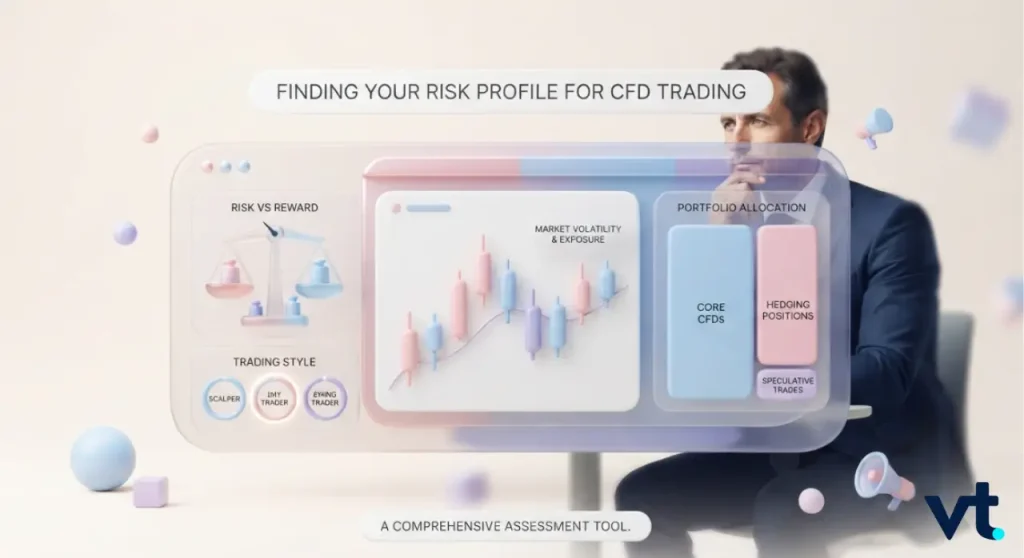
This section defines the term, separates it from two words often used in its place, and explains why contracts for difference raise the stakes.
What Does a Risk Profile for CFD Trading Actually Mean?
A risk profile for CFD trading is a rulebook, not a feeling. It records four elements. First, maximum risk per trade as a percentage of equity. Second, maximum total exposure across open positions. Third, maximum drawdown before you stop and review and fourth, the holding period and overnight exposure.
You need to write them down, or they get renegotiated at the worst moment.
How Is a Risk Profile Different from Risk Appetite and Risk Tolerance?
The terms overlap, which is why they get muddled.
- Risk appetite: how much risk you want to take
- Risk tolerance: how much loss you can emotionally handle
- Risk capacity: how much loss your finances can absorb
- Risk profile: all three, expressed as trading limits
Why CFD Trading Makes a Risk Profile More Important Than It Is for Investing
CFD trading explained simply: you trade price movement on margin without owning the asset.
Here is a CFD trading example:
You hold USD 5,000 and open one standard lot of EUR/USD, a notional USD 100,000.
- A 1% adverse move costs USD 1,000
- That is 20% of the account in one session
Same move, twenty times the damage.
What Components Make Up a Trading Risk Profile?
Five inputs shape almost every profile. First, the capital you can afford to lose. Second, income stability and how fast losses are replaced. Third, a trader’s experience with margin trading and CFD trading strategies. Fourth, your psychological tolerance for losing streaks and fifth, your specific trading goals like income, growth or skill.
The Three Broad Risk Profiles for CFD Trading
A risk profile for CFD trading usually falls into one of three bands. The table is illustrative, not prescriptive.
| Profile | Risk Per Trade | Effective Leverage | Open Positions | Drawdown Tolerated | Typical Instruments |
| Conservative | 0.25% to 0.5% | 2:1 to 5:1 | 1 to 2 | Up to 10% | Major FX, index CFDs |
| Moderate | 0.5% to 1% | 5:1 to 10:1 | 2 to 4 | 10% to 20% | Majors, gold, indices |
| Aggressive | 1% to 2% | Above 10:1 | 4 or more | 20% plus | Gold, oil, crypto CFDs |
What Does a Conservative Risk Profile Look Like?
Conservative traders prioritise preservation over speed:
- 0.5% or less risked per trade
- Effective leverage under 5:1
- Liquid major currency pairs with tighter spreads
What Does a Moderate Risk Profile Look Like?
The moderate profile accepts volatility for a faster equity curve:
- Around 1% risked per position
- Two to four positions across asset classes
- Comfortable holding swing trading positions overnight
What Does an Aggressive Risk Profile Look Like?
Aggressive traders accept large swings for outsized returns.
- 1% to 2% or more per trade
- Higher leverage, tighter margin buffers
- High-volatility instruments such as oil or crypto CFDs
Pro tip: If you cannot fund a 25% drawdown without changing how you live, this profile is not available to you.
Why Most Traders Are Placed Between Categories Rather Than Inside One
Few traders fit a label cleanly. Mixed profiles appear as:
- Conservative sizing, aggressive instrument choice
- Aggressive sizing, very short holding periods
Two traders sharing the same risk profile for CFD trading label can run entirely different exposure.
How to Determine Your Own Risk Profile for CFD Trading
Four assessments produce a usable profile. Work in order, because capacity caps everything after it.
1. Assessing Your Financial Capacity to Absorb Losses
Could you lose the balance tomorrow and still meet every obligation for a year? For instance:
- Three to six months of expenses saved separately
- No capital from credit or borrowed funds
- No dependants relying on trading income
Here is a risk profile for CFD trading example:
With USD 12,000 saved and USD 8,000 as an emergency fund, genuine risk capital is USD 4,000. At 1%, that is USD 40 per trade.
2. Assessing Your Psychological Tolerance for Drawdown
Capacity says what you can afford. Tolerance says what you can live with. Ask honestly:
- At what open loss do you check hourly?
- Have you widened a stop to avoid closure?
- Does a three-loss streak change your next size?
A 10% drawdown that ends your plan means tolerance sits below 10%.
3. Assessing Your Time Horizon and Availability
Screen time is a risk input, not a lifestyle detail.
| Availability | Realistic Style | Overnight Exposure |
| Full session | Scalping, day trading | None |
| Two to three hours | Day trading, short swing | Low |
| Morning and evening | Swing trading | Moderate |
| Weekly review only | Position trading | High |
4. Assessing Your Knowledge and Experience Level
Experience widens the profiles available, but does not move you up a band.
- Months 1 to 3: 0.25% risk, one instrument
- Months 4 to 12: 0.5% risk, two or three instruments
- Beyond 12 months: size set by documented performance, not confidence
Pro tip: Run any profile change for 30 trades before judging it.
In addition, identify and match your risk profile by learning how to manage risk in CFD trading.
Risk Capacity Versus Risk Tolerance
Every risk profile for CFD trading sits where these two overlap.
Why the Two Are Frequently Confused
Both use the same vocabulary, so the difference gets lost. Capacity is objective, calculated from savings and income. On the other hand, tolerance is subjective, and only shows under pressure. Nevertheless, tolerance can change within a session.
What Happens When Tolerance Exceeds Capacity
The dangerous mismatch. The trader feels calm about risk the finances cannot support. What happens is a trader will require the sizes needing a winning streak to survive. There will be margin calls triggered by ordinary noise. In addition, the trader also needs the capital drawn from money needed for living.
What Happens When Capacity Exceeds Tolerance
Less dramatic, equally limiting. The trader affords the risk but cannot sit through it. Winners closed early, losers left running. There will be size cuts after small setbacks and returns trailing tested results. The fix is smaller sizing, not more willpower.
How Brokers Assess Suitability During Account Opening
Regulated brokers must assess your risk profile for CFD trading before granting access to leveraged products. Expect questions on:
- Trading experience and instruments traded
- Income, net worth and source of funds
- Understanding of leverage and negative balance protection
Brokers such as VT Markets use these answers to confirm suitability, so answer accurately.
How a Risk Profile for CFD Trading Translates into Trading Decisions
A profile is only useful when it changes what you do.
How a Risk Profile for CFD Trading Determines Position Size
Position size = (Account equity × risk %) ÷ (stop distance in pips × pip value per lot)
Worked on EUR/USD:
- Equity USD 10,000, risk 1%, so USD 100
- Stop 25 pips, pip value USD 10 per standard lot
- USD 100 ÷ (25 × 10) = 0.4 lots
Widen the stop to 50 pips and size halves to 0.2 lots. Risk stays at USD 100. That consistency is what a risk profile for CFD trading example should show.
How a Risk Profile Determines Leverage Use
Available and used leverage differ. Only the second matters. Above, 0.4 lots is USD 40,000 notional against USD 10,000 equity, or 4:1 effective leverage.
- Conservative: under 5:1
- Moderate: 5:1 to 10:1
- Aggressive: above 10:1, with a stated maximum
How a Risk Profile Shapes Stop Loss Placement
Place the stop where it is technically valid, then size to fit:
- Stops beyond structure, not on round numbers
- Average true range (ATR) to match current volatility
- Never move a stop further away mid-trade
How a Risk Profile Influences Instrument Selection
Daily range, spread and gap risk vary by instrument.
- Conservative:major FX pairs and large index CFDs
- Moderate: gold and selected commodity CFDs
- Aggressive: oil, crypto CFDs and exotic pairs
Risk Profile and CFD Trading Style
Style is where the profile becomes practice.
| Trading Style | Holding Period | Trades Per Week | Overnight Risk | Best Suited To |
| Scalping | Seconds to minutes | 50 plus | None | Moderate to aggressive |
| Day trading | Minutes to hours | 5 to 20 | None | Moderate |
| Swing trading | Days to weeks | 2 to 5 | Moderate | Conservative to moderate |
| Position trading | Weeks to months | 1 to 4 monthly | High | Conservative |
1. Why Scalping and Day Trading Suit Different Profiles
Both close before the session ends, but demands differ.
Scalping needs frequency, tight spreads, fast decisions. Day trading allows more analysis per position. Neither pays swap fees.
2. Why Swing and Position Trading Carry Different Overnight Exposure
Holding through the close adds risks intraday traders avoid. Weekend gaps can open beyond your stop. Overnight financing accrues every night held. Size must be reduced for gap risk.
3. How Holding Period Changes the Risk Equation
Longer holds mean fewer, larger decisions.
- Short holds: higher cumulative spread and commission
- Long holds: higher financing and gap exposure
- Short holds: losses arrive fast but small
4. Matching Profile to Style Rather Than Forcing the Fit
Choose the style your risk profile for CFD trading supports, not the one that looks appealing online. Warning signs:
- Scalping around a full-time job
- Position trading on money needed within months
- Copying a style because someone posts profits
The Specific Risks CFDs Add to a Risk Profile
Price each risk below into your risk profile for CFD trading explicitly.
Leverage and Magnified Losses
Losses compound faster than gains recover. A 20% loss needs a 25% gain to break even. Losses can exceed deposits without protection. Negative balance protection is a safeguard, not a plan.
Market Gaps and Slippage
A stop is an instruction, not a guaranteed price. Weekend gaps can open well past the level. Slippage widens on news and thin liquidity. Guaranteed stop loss orders carry an extra cost.
Overnight Financing and Holding Costs
A short CFD trading example:
At USD 7 per night, 20 nights costs USD 140. On a USD 5,000 account, that is 2.8% of equity before the trade proves anything.
- Charges are usually tripled once weekly for the weekend
- Financing can outweigh profit on long-held positions
- Swap-free accounts exist for traders who need them
Margin Calls and Position Closure
Falling equity triggers automatic action at the worst moment. Margin level falls as unrealised losses build. A margin call warns that funds are required. Stop out closes positions at a set threshold.
Counterparty and Platform Risk
Your broker is the counterparty to every CFD trade. First, verify regulatory licences in your jurisdiction. Next, confirm client funds sit in segregated accounts. Then, confirm your required order types are supported.
Common Mistakes with a Risk Profile for CFD Trading
Most failures repeat the same four patterns.
1. Confusing Confidence with Capacity
Conviction does not change what you can afford to lose. Sizing up on certain trades is the common breach. Conviction decides whether to trade, never how large. Fixed percentage sizing removes the decision.
2. Setting a Profile Once and Never Reviewing It
A profile written at account opening rarely fits two years later:
- Income, savings and obligations shift
- Earned experience should show in the numbers
- Conditions change what a stop distance implies
3. Letting Recent Wins or Losses Redefine the Profile
Adjusting risk on the last few trades guarantees inconsistency. Sizing up after wins peaks exposure with overconfidence. Sizing down after losses slows recovery. Change size on 30-trade evidence, not three.
4. Copying Another Trader’s Risk Settings.
Their settings reflect capital, tolerance and time you cannot see. Their capital base may be far larger. Their risk may be funded by other income. Copy the process, never the position size.
How to Review and Adjust Your Risk Profile for CFD Trading
A risk profile for CFD trading is a living document, not a one-off form.
When Life Circumstances Should Trigger a Review
Anything that changes risk capacity triggers a review such as change of job, income or job security. Others include new dependants or recurring commitments or major planned expenses within a year.
When Performance Data Should Trigger a Review
Numbers, not feelings, drive changes to a risk profile for CFD trading. These include drawdown beyond your stated maximum. Another is your win rate or risk-reward ratio drifting from tested results. Take note of thirty or more trades confirming a pattern.
What to Record in a Trading Journal for Profile Review
A journal turns opinion into evidence. Record every trade the same way:
- Date, instrument, direction, holding period
- Size, stop distance, percentage risked
- Effective leverage on the position
- Whether the trade followed your rules
That last field matters most. A losing trade that followed the plan is still a success.
How Often to Reassess
Set a schedule and keep to it:
- Monthly: journal review and rule compliance
- Quarterly: drawdown, win rate, average risk-reward
- Annually: full reassessment of capacity, tolerance and goals
- Immediately: after any major life event or breach
Frequently Asked Questions (FAQs)
Q1: How much of my capital should I risk per CFD trade?
Most frameworks suggest 1% to 2% of equity per trade, with beginners at 0.25% to 0.5%. On a USD 5,000 account, 1% is USD 50 per position. The figure should reflect your capacity, not a general rule.
Q2: Can my risk profile change over time?
Yes, and it should. A risk profile for CFD trading is not fixed. Income, savings, dependants and experience all shift, changing what you can afford and tolerate. Review quarterly, reassess fully once a year.
Q3: Do CFD brokers assess my risk profile?
Regulated brokers must assess suitability before granting access to leveraged products. Account opening covers trading experience, financial position and understanding of leverage and margin. The assessment is a safeguard, so accurate answers serve you.
Q4: Is CFD trading suitable for a conservative risk profile?
It can be, provided sizing and leverage suit a conservative risk profile for CFD trading. That means 0.5% or less per trade, low effective leverage, liquid major pairs and limited overnight exposure. Sizing beyond capacity makes CFDs unsuitable, not the product.
Build Your Risk Profile for CFD Trading on a Platform That Supports It
Knowing your risk profile for CFD trading is only half the work. The other half is trading somewhere that lets you apply it precisely, with the order types, sizing flexibility and execution your plan depends on.
Write the profile down first. Define risk per trade, maximum drawdown, instruments and holding period. Test it for 30 trades before committing live capital, and keep the journal from day one.
With VT Markets, you get MetaTrader 4 and MetaTrader 5 access, flexible account types including cent and swap-free options, and the tools to size every position to your plan rather than your mood.
Create a live VT Markets account today to access our platform features, including market insights and educational content.








