





Key Takeaways:
- A fair value gap is a three-candle price imbalance where the market moves so quickly it skips a price zone.
- These gaps form when strong buying or selling pressure leaves unfilled orders behind.
- Price often returns to the zone to rebalance, which gives traders a potential entry zone.
- Fair value gaps appear across forex, indices and commodities, on any timeframe.
- No gap is guaranteed to fill, so risk management and confirmation always matter.
Price rarely moves in neat, even steps. Sometimes it jumps so fast that it leaves a gap behind on the chart. In CFD trading, these gaps are known as fair value gaps. They mark a zone where buyers or sellers are briefly in full control.
Many traders watch these zones closely, because price often returns to them later. Learning to read them can help you find precise entries and logical stop levels. This guide explains what an FVG is, what causes it, and how to trade it with discipline. You will also learn how these gaps compare with order blocks, and whether they really get filled.
What Is A Fair Value Gap
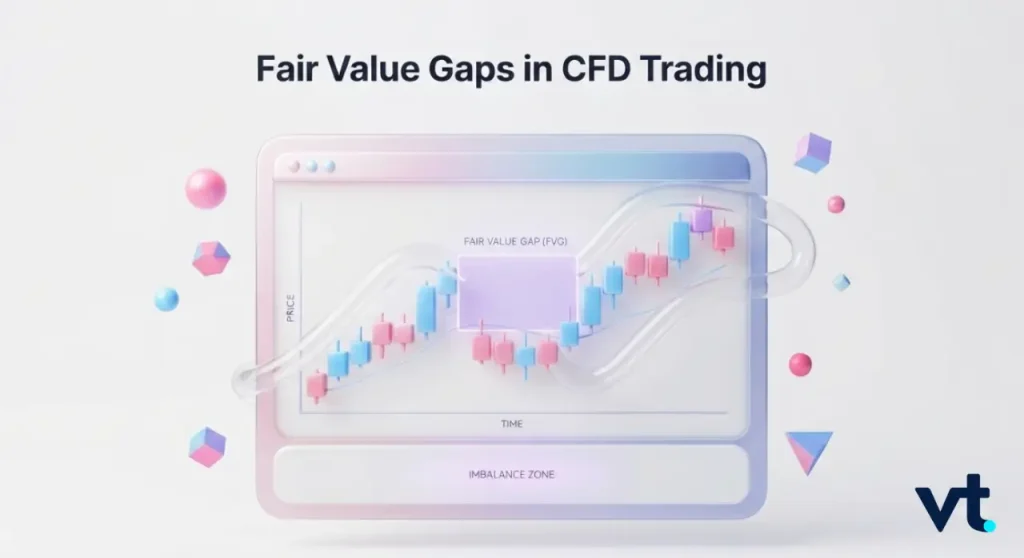
A fair value gap is a zone on a chart where price moved so sharply that it left an imbalance behind. Over three candles, the market races in one direction.
This leaves a space between the first and third candle that was never properly traded. Traders call this an FVG for short. It represents a moment when one side of the market, buyers or sellers, was clearly dominant.
Fair Value Gap Definition
In plain terms, an FVG is a price inefficiency. It is a small window where the market skipped past fair value. Buyers or sellers were so aggressive that trading became one-sided.
The result is a visible gap between candles. Many traders believe price will often revisit this zone later, to trade the levels it missed the first time.
The Three-Candle Structure That Creates An FVG
Every FVG is built from a three-candle pattern. The middle candle is large and strong. The gap is the space left between the wicks of the first and third candles.
- In a bullish move, the gap sits between the high of the first candle and the low of the third candle.
- In a bearish move, the gap sits between the low of the first candle and the high of the third candle.
- The middle candle shows the strong push that created the imbalance.
Where The Concept Comes From (Smart Money Concepts / ICT Context)
The idea comes from smart money concepts, often shortened to SMC. It was popularised by the ICT, or Inner Circle Trader, approach to price action.
The theory suggests that large institutions leave footprints when they move markets quickly. An FVG is one of those footprints. It is worth noting that this is a discretionary concept, not a guaranteed rule. It works best as one tool among several.
Key Terms: Imbalance, Inefficiency, Liquidity
A few core terms appear throughout any discussion of these gaps:
- Imbalance: a lopsided moment when one side of the market overwhelms the other.
- Inefficiency: a price zone that was skipped and not fully traded.
- Liquidity: the pool of orders that price is drawn towards.
- Fill: when price returns and trades back through the zone.
What Causes A Fair Value Gap
These gaps do not appear by accident. They form when the balance between buyers and sellers breaks down for a short time. Understanding the cause helps you judge which ones matter.
1. Imbalance Between Buying And Selling Pressure
At its core, an FVG is caused by an imbalance. One side simply overwhelms the other. When buyers flood in, price leaps upward before sellers can respond. When sellers dominate, price drops just as fast. This rapid, one-sided move is what leaves the gap behind.
2. Rapid Moves And Unfilled Orders (The Inefficiency)
Fast moves often leave unfilled orders in their wake. Not every buyer or seller gets to trade at every price. The market simply moves too quickly. This creates an inefficiency, a zone where fair trading never really happened. Common triggers include:
- Major economic news, such as interest rate decisions.
- Earnings releases that surprise the market.
- Sudden shifts in sentiment or breaking headlines.
- Thin liquidity that lets price jump between levels.
Why Fair Value Gaps Appear Across Forex, Indices, And Commodities
These gaps are not limited to one market. The same mechanic applies wherever price moves in candles. This is useful for CFD traders, who often trade several asset classes.
- In forex, gaps form around news, like central bank meetings.
- In indices, gaps appear after strong sessions or overnight moves.
- In commodities such as gold and oil, gaps follow supply and demand shocks.
How To Identify A Fair Value Gap
Spotting a clean gap is a skill worth practising. Once you can see them quickly, you can plan trades with more confidence. Here is how to find these zones on any chart.
1. The Three-Candle Rule, Step By Step
The three-candle rule is the simplest way to spot one. Follow these steps:
- Find a strong middle candle that moves sharply in one direction.
- Look at the candle before it and the candle after it.
- Check for a space between the first candle’s wick and the third candle’s wick.
- If that space exists and was not traded, you have found the imbalance.
2. Bullish Vs Bearish Fair Value Gaps
The direction of the gap tells you the likely bias. A bullish fair value gap forms during a strong move up. A bearish fair value gap forms during a strong move down. The table below shows how to read each one.
| Feature | Bullish FVG | Bearish FVG |
| Middle candle | Strong up (bullish) candle | Strong down (bearish) candle |
| Gap sits between | High of candle 1 and low of candle 3 | Low of candle 1 and high of candle 3 |
| Market bias | Look for longs on the return | Look for shorts on the return |
| Typical entry | Price dips back into the zone | Price rallies back into the zone |
3. Marking The Gap Zone On A Chart
Once you spot the zone, mark it clearly. Draw a rectangle across it, from its upper edge to its lower edge. This box becomes your area of interest. Here is a simple fair value gap example on EUR/USD:
- The first candle’s high is 1.1000.
- A strong middle candle pushes price up.
- The third candle’s low is 1.1030.
- The zone runs from 1.1000 to 1.1030, a 30-pip imbalance.
4. Timeframes And Avoiding Low-Quality Gaps
Gaps appear on every timeframe, but not all are worth trading. Higher timeframes usually produce more reliable signals. Scalping fair value gaps on the 1-minute or 5-minute chart is popular, yet it produces many weak setups. To filter for quality:
- Favour zones that align with the higher-timeframe trend.
- Ignore tiny gaps that offer little room for a trade.
- Prefer gaps left by a genuine, strong move, not slow drift.
How To Trade Fair Value Gaps
Once you can spot a gap, you can build a plan around it. A reliable fair value gaps strategy waits for price to return to the zone. Patience is the key. You are not chasing the move. You are waiting for price to come back to you.
1. Using The Gap As An Entry Zone (Waiting For The Fill Or Retracement)
The most common approach uses the gap as an entry zone. After the sharp move, you wait for a retracement back into it. When price re-enters the zone, you look for signs it will bounce and continue. This lets you enter at a better price than chasing the breakout.
Here is a worked example, continuing the EUR/USD bullish gap:
- The zone runs from 1.1000 to 1.1030.
- You wait for price to pull back into it.
- You enter long near the middle, at 1.1015.
- You place a stop below the zone, at 1.0995.
- You target a prior high at 1.1075.
That is 20 pips of risk against 60 pips of reward, a ratio of 1:3.
2. Combining Fair Value Gaps With Order Blocks And Market Structure
A gap is stronger when it lines up with other clues. Pairing a fair value gap and order block can sharpen your entries. An order block is the last candle before a strong move. When a gap sits inside or beside an order block, the zone carries more weight.
Always read the wider market structure too:
- Trade zones in the direction of the higher-timeframe trend.
- Look for a break of structure before trusting a reversal setup.
- Avoid gaps that fight a strong, clear trend.
3. Setting Stops And Targets Around The Gap
Clear stops and targets keep your trades objective. Place your stop just beyond the far edge of the gap. This gives price room to fill the zone without stopping you out early. For targets, use logical levels:
- A recent swing high or low.
- The next visible liquidity pool.
- A fixed risk-to-reward ratio, such as 1:2 or 1:3.
4. Risk Management And Position Sizing
Risk management protects your account when a setup fails. Never risk more than a small, fixed percentage per trade. Position sizing turns that rule into a precise lot size.
Here is a simple position-sizing example:
- Account balance: $5,000.
- Risk per trade: 1%, which is $50.
- Stop distance: 20 pips.
- Pip value per standard lot: about $10.
- Position size = $50 ÷ (20 pips × $10) = 0.25 lots.
On MetaTrader 4 and MetaTrader 5 from VT Markets, you can attach stop-loss and take-profit orders to lock in this discipline automatically.
Fair Value Gap Vs Order Block Vs Imbalance
These terms are often confused, because they overlap. All three describe traces left by strong moves. Still, each one means something specific. Knowing the difference sharpens your analysis.
| Concept | What It Is | How Traders Use It |
| Fair value gap | A three-candle price inefficiency | Entry zone on the return move |
| Order block | The last candle before a strong move | Origin of the move, pairs with a gap |
| General imbalance | Any one-sided, lopsided move | Broad context for momentum |
| Liquidity void | A large area with little trading | A zone price may travel through fast |
Fair Value Gap Vs Order Block
An FVG is the empty space left by a fast move. An order block is the candle that started that move. The gap is the inefficiency. The order block is the origin. Many traders use them together, since a gap near an order block marks a high-interest zone.
Versus A General Imbalance
Every FVG is a type of imbalance, but not every imbalance is a fair value gap. Imbalance is the broad idea of one-sided trading. An FVG is the specific three-candle version of that idea. In short, the gap is a precise, rule-based form of imbalance.
Versus A Liquidity Void
A liquidity void is a larger area with very little trading. It often spans several candles, not just three. An FVG is smaller and more defined. A void shows a broad vacuum. A gap shows a specific, measurable inefficiency you can trade around.
Do Fair Value Gaps Get Filled, And How Reliable Are They
This is the question every trader asks. The sincere answer needs balance. Gaps often fill, but not always. Treating a fill as certain is a common and costly mistake.
Why Price Often Returns To A Gap
Price frequently returns to a gap to rebalance the market. The unfilled orders in that zone act like a magnet. Buyers and sellers who missed out earlier want to trade there. This is why a retracement into the zone is so common. It is the market seeking the fair value it skipped before.
Do All Fair Value Gaps Get Filled
No. Not all fair value gaps get filled. Some fill quickly. Some fill much later. Some never fill at all. A strong trend can leave a gap behind and never look back. This is why you should never assume a fill is guaranteed. Use these zones as an area of interest, not a promise.
Common Mistakes And False Assumptions
Traders often misuse these zones. A few common errors stand out:
- Assuming every gap must fill, then holding a losing trade too long.
- Trading tiny gaps that carry no real significance.
- Ignoring the higher-timeframe trend and market structure.
- Entering without any confirmation that price is reacting.
Find out more about how to conduct gap trading, focusing on overnight price gaps in shares and indices trading.
Frequently Asked Questions (FAQs)
Q1: What is a fair value gap in simple terms?
A fair value gap is a zone where price moved so fast it skipped a level. It shows up as a gap across three candles. The middle candle is strong, leaving space between the first and third candles. Traders watch this zone because price often returns to it later.
Q2: Do all fair value gaps get filled?
No. Many gaps do get filled, as price returns to rebalance. However, some fill slowly, and others never fill at all. A strong trend can leave a gap behind for good. Due to this, the zone is best used as an area of interest, not a guaranteed target.
Q3: What is the difference between a fair value gap and an order block?
An FVG is the empty space left by a fast move. An order block is the last candle before that move began. The gap is the inefficiency, and the order block is its origin. Many traders combine the two, since a gap near an order block marks a stronger zone.
Q4: What timeframe is best for trading fair value gaps?
There is no single best timeframe. Higher timeframes, such as the 1-hour or 4-hour chart, tend to produce more reliable gaps. Lower timeframes offer more signals but more noise. Many traders find a zone on a higher timeframe, then refine the entry on a lower one.
Q5: Are fair value gaps reliable?
They can be useful, but they are not certain. An FVG is a discretionary tool, not a guaranteed signal. It works best with confirmation, sound market structure, and strict risk management. Used carefully on MT4 or MT5, it can support clearer entries and exits.
Start Trading Fair Value Gaps With Confidence
Fair value gaps are a powerful way to read what the market is really doing. They reveal moments when one side took control and left an opportunity behind. Once you can spot the three-candle pattern, mark the zone, and wait for price to return, you gain a repeatable edge.
The key is discipline. Treat every zone as an area of interest, confirm before you enter, and always manage your risk. With VT Markets, you can put these ideas into practice across forex, indices, commodities and more. Using MetaTrader 4 and MetaTrader 5, you get the charting tools and order types needed to trade these setups with precision.
Open a VT Markets account today, and start turning market inefficiencies into well-planned trading opportunities.








