





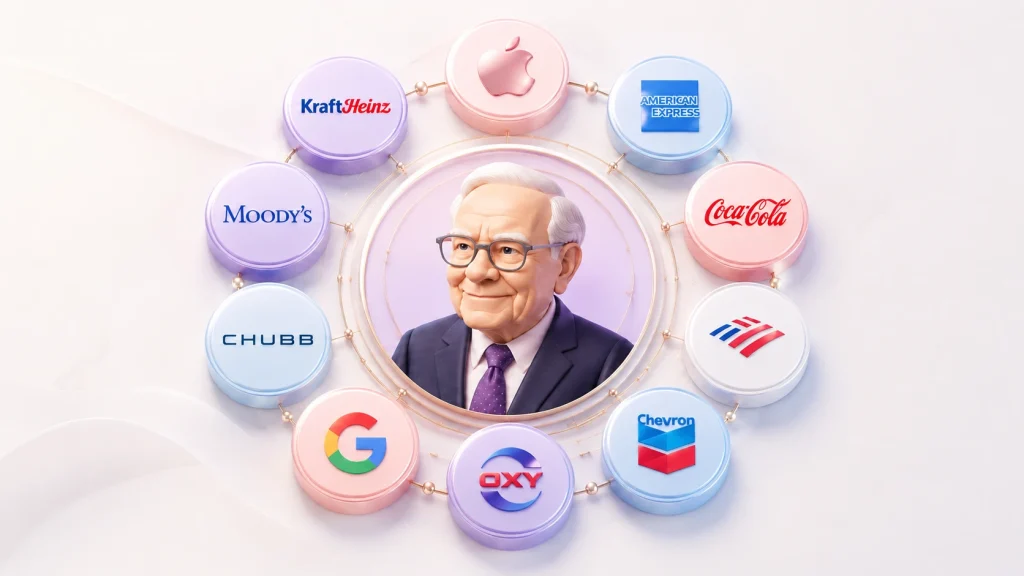
Berkshire Hathaway is a US conglomerate holding company listed on the NYSE under BRK.A and BRK.B, with a market capitalisation of about $1.06 trillion as of July 2026. It owns businesses outright, including GEICO, BNSF Railway and Berkshire Hathaway Energy, and separately manages a $263.1 billion public stock portfolio. Warren Buffett is Chairman; Greg Abel became CEO in January 2026.
Most companies are one thing. Berkshire Hathaway is closer to a small economy with a stock ticker attached. On one side sits a collection of roughly 190 wholly owned businesses that sell car insurance, haul freight, generate electricity, make bricks, sell candy, and run truck stops. On the other hand, sits a concentrated basket of listed shares that Warren Buffett and his lieutenants have assembled over four decades. Buying Berkshire Hathaway stock is not a bet on a product or a sector. It is a bet on a capital allocation machine, and on the judgement of the people running it.
That second side, the listed stock portfolio, is the part the market watches most closely, because Berkshire is legally obliged to publish it every quarter in a filing called Form 13F. This guide walks through what Berkshire Hathaway is, who actually owns the company, what its top stock holdings are as of the latest filing, what percentage of the portfolio each position represents, how much is invested in each, and the investment logic behind them. It closes with how to buy Berkshire Hathaway stock, the risks to weigh, and how to trade it as a CFD with VT Markets.
Key Takeaways
- Berkshire Hathaway (NYSE: BRK.A, BRK.B) is a conglomerate holding company with a market cap of roughly $1.06 trillion. BRK.A closed at $733,526 on 21 July 2026. BRK.B closed at $489.39 on 22 July 2026.
- Its reported 13F stock portfolio was worth $263.1 billion as of 31 March 2026, spread across just 26 companies.
- The top five holdings account for 67.1% of the portfolio: Apple (21.99%), American Express (17.43%), Coca-Cola (11.56%), Bank of America (9.52%), and Chevron (6.64%).
- Warren Buffett remains chairman and the largest single shareholder, with roughly 188,000 Class A shares worth about $138 billion, controlling around 30% of voting power. Greg Abel took over as CEO on 1 January 2026.
- Berkshire’s cash and Treasury pile hit a record $397.4 billion in Q1 2026, meaning it holds about 1.5 times more in cash than in listed stocks.
- Q1 2026 was one of the most aggressive portfolio clean-ups in years: 15 companies exited entirely, including Visa, Mastercard, Amazon, and UnitedHealth, while the Alphabet stake more than tripled.
- Retail investors can access Berkshire Hathaway stock by buying BRK.B shares directly or by trading it as a share CFD, which allows long and short positions with leverage.
What Is Berkshire Hathaway? A Failed Textile Mill That Became a $1 Trillion Conglomerate
Berkshire Hathaway is a diversified holding company headquartered in Omaha, Nebraska. It does not make a single flagship product. Instead, it owns controlling stakes in dozens of operating businesses and minority stakes in dozens of listed ones, funded largely by the cash generated inside its insurance operations.
The origin story is famously unglamorous. Berkshire Hathaway was a struggling New England textile manufacturer when Warren Buffett began buying its shares in the early 1960s. He took control in 1965, wound the textile business down over the following two decades, and used the corporate shell as a vehicle to buy other companies. The first insurance acquisition, National Indemnity in 1967, established the template that still defines the company today.
For the 2025 financial year, Berkshire reported total revenues of $371.4 billion and net earnings attributable to shareholders of $66.97 billion, down from $89 billion the prior year, largely because of swings in the mark-to-market value of its equity holdings.
The Two Engines Inside Berkshire Hathaway
Understanding Berkshire Hathaway stock means separating the two things you are buying.
Engine one: the wholly owned operating businesses. These are consolidated into Berkshire’s income statement and do not appear in the 13F at all. They include:
| Business | What it does | Scale |
| GEICO | Private passenger auto insurance, acquired outright in 1996 | Second-largest US auto insurer |
| BNSF Railway | Freight rail, acquired 2010 | Generated $8.1bn operating cash flow in 2025, paid $4.4bn up to Berkshire |
| Berkshire Hathaway Energy | Regulated utilities and pipelines | $26.2bn revenue in 2025, ~5.4m retail customers, ~23,900 employees |
| Berkshire Hathaway Reinsurance | Large-scale reinsurance and catastrophe cover | Primary source of investment “float” |
| Precision Castparts | Aerospace components, acquired 2016 | ~$37 billion purchase price |
| Pilot Travel Centers | Truck stops and fuel retail: full control 2024 | Largest US travel centre network |
| Others | See’s Candies, Dairy Queen, Duracell, Clayton Homes, NetJets, Marmon, McLane, Fruit of the Loom, Benjamin Moore, Shaw Industries, Lubrizol, Forest River, Brooks | ~190 subsidiaries in total |
In October 2025, Berkshire agreed to acquire OxyChem, Occidental Petroleum’s chemicals division, for $9.7 billion, its largest deal in three years.
Engine two: the listed stock portfolio. This is the $263.1 billion basket of marketable equities disclosed quarterly in the 13F, and it is what most people mean when they talk about “Warren Buffett’s portfolio.”
The connection between the two is insurance float. Policyholders pay premiums today for claims that may be paid years later. That gap leaves Berkshire holding tens of billions of dollars it does not own but can invest. Float is, in effect, a very cheap and very long-dated source of leverage, and it is the structural advantage most retail investors cannot replicate.
Berkshire Hathaway Stock by the Numbers (July 2026)
| Metric | Value |
| Market capitalisation | ~$1.058 trillion (14th largest company globally) |
| BRK.A price | $733,526 (21 July 2026) |
| BRK.B price | $489.39 (22 July 2026) |
| 2025 revenue | $371.4 billion |
| 2025 net earnings | $66.97 billion |
| Q1 2026 operating earnings | $11.35 billion (+18% year on year) |
| Q1 2026 net income | $10.1 billion |
| Cash and short-term Treasuries (31 Mar 2026) | $397.4 billion (record) |
| Reported 13F equity portfolio (31 Mar 2026) | $263.1 billion across 26 companies |
| Dividend | None paid since 1967 |
| 2025 share performance | BRK.A +10% vs S&P 500 +16.4% |
BRK.A vs BRK.B: Why One Berkshire Hathaway Stock Costs $733,000 and the Other $489
Berkshire has never split its Class A shares. Buffett’s stated reasoning is that a high price discourages short-term speculators and attracts long-horizon owners. That left the stock inaccessible to ordinary investors, so in 1996 Berkshire created Class B shares.
| Feature | BRK.A | BRK.B |
| Approximate price (July 2026) | $733,526 | $489.39 |
| Economic rights | 1 unit | 1/1,500th Class A share |
| Voting rights | 1 vote | 1/10,000th Class A vote |
| Convertible | Yes, into 1,500 Class B shares | No, can’t convert back to Class A |
| Typical holder | Long-term founders, estates, institutions | Retail investors, index funds, ETFs |
The one-way conversion matters. It is the mechanism Buffett uses to fund his charitable giving: he converts Class A shares into Class B, then donates Class B. It also means Class A voting power gradually drains out of the register over time.
For almost every retail investor and every CFD trader, BRK.B is the relevant instrument. It tracks BRK.A almost exactly, at roughly 1/1,500th of the price.
Who Owns Berkshire Hathaway?
Berkshire Hathaway is owned by a mix of one very large individual holder, three enormous index managers, and a long tail of retail shareholders. The dual-class structure means economic ownership and voting control look quite different.
Warren Buffett: Still the Largest Shareholder, and Actively Giving It Away
Warren Buffett remains Berkshire’s single largest shareholder and its chairman. Following his July 2026 donation, he holds roughly 188,000 Class A shares worth approximately $138 billion, which translates to around 30% of the company’s total voting power.
That stake is shrinking by design. On 14 July 2026, Buffett converted 8,000 Class A shares into 12 million Class B shares and donated all 12 million, worth about $6 billion, to four family foundations:
| Recipient foundation | Class B shares | Approximate value |
| Susan Thompson Buffett Foundation | 9,000,000 | ~$4.4 billion |
| Sherwood Foundation | 1,000,000 | ~$500 million |
| Howard G. Buffett Foundation | 1,000,000 | ~$500 million |
| NoVo Foundation | 1,000,000 | ~$500 million |
Notably, the Bill & Melinda Gates Foundation, which had received Buffett’s annual donations for nearly two decades, was excluded. Buffett has stated his goal is to dispose of his entire remaining stake by the end of 2034, roughly eight years.
For anyone buying Berkshire Hathaway stock today, this is a genuine structural consideration. A predictable, multi-billion-dollar annual supply of Class B shares is entering the market for the next several years, and Buffett’s voting bloc, historically the company’s defence against activist pressure and break-up demands, is dissolving.
Greg Abel and the Post-Buffett Management Structure
Greg Abel became chief executive officer of Berkshire Hathaway on 1 January 2026, having been named successor in May 2025. Buffett retained the chairman role. Abel previously ran Berkshire Hathaway Energy and oversaw all non-insurance operations.
Abel owns less than 1% of Berkshire Hathaway stock, which is the crux of the governance change. The company’s capital allocation is now run by an executive without a controlling ownership position, backed by a chairman whose stake is being given away.
At the May 2026 annual meeting, Abel explicitly ruled out breaking Berkshire up, stressing continuity with Buffett’s approach. He is described by insiders as a more hands-on operator than Buffett, pressing subsidiary managers harder and pushing for collaboration between units. Buffett has separately indicated that his son Howard Buffett is intended to become non-executive chairman after his death as a cultural guardian rather than an operator.
The Index Giants
Because Berkshire is one of the largest components of the S&P 500, passive funds hold enormous positions in it. Based on the most recent disclosures:
| Shareholder | Approximate Class B shares | Approximate share of Class B outstanding |
| Warren Buffett (Class A equivalent) | ~188,000 Class A shares | ~30% of total voting power |
| The Vanguard Group | ~148 million | ~11% |
| BlackRock | ~111.6 million | ~8.3% |
| State Street Corporation | ~71.7 million | ~5.35% |
| Buffett family foundations and Gates Foundation | Substantial, declining as shares are sold to fund grants | Varies |
| Retail and other institutional investors | Remainder | Majority of Class B float |
Vanguard and BlackRock together control more than 12% of outstanding shares, almost entirely through index-tracking products. These are not discretionary bets on Buffett; they are mechanical positions driven by Berkshire’s index weight.
Berkshire Hathaway Top Stock Holdings: Where $263 Billion Sits
Berkshire’s Q1 2026 Form 13F, filed with the SEC on 15 May 2026 and covering positions as of 31 March 2026, discloses a $263.1 billion portfolio across 26 companies. That is down from $274.2 billion and 39 companies at the end of December 2025.
The headline characteristic is extreme concentration. The top three positions alone are 51% of the portfolio, the top five are 67.1%, and the top ten are 91.1%. The remaining 16 companies share less than 9% of the portfolio.
Full Portfolio Table: Berkshire Hathaway Top Stock Holdings (31 March 2026)
| # | Company | Ticker | Shares held | Value (USD) | % of portfolio |
| 1 | Apple | AAPL | 227,917,808 | $57.84bn | 21.99% |
| 2 | American Express | AXP | 151,610,700 | $45.86bn | 17.43% |
| 3 | Coca-Cola | KO | 400,000,000 | $30.42bn | 11.56% |
| 4 | Bank of America | BAC | 513,624,165 | $25.04bn | 9.52% |
| 5 | Chevron | CVX | 84,375,856 | $17.46bn | 6.64% |
| 6 | Occidental Petroleum | OXY | 264,941,431 | $17.22bn | 6.55% |
| 7 | Alphabet | GOOGL / GOOG | 57,835,013 | $16.63bn | 6.32% |
| 8 | Chubb | CB | 34,249,183 | $11.16bn | 4.24% |
| 9 | Moody’s | MCO | 24,669,778 | $10.76bn | 4.09% |
| 10 | Kraft Heinz | KHC | 325,634,818 | $7.32bn | 2.78% |
| 11 | DaVita | DVA | 30,100,585 | $4.63bn | 1.76% |
| 12 | Kroger | KR | 50,000,000 | $3.62bn | 1.38% |
| 13 | SiriusXM Holdings | SIRI | 124,807,117 | $2.88bn | 1.09% |
| 14 | Delta Air Lines | DAL | 39,809,456 | $2.65bn | 1.01% |
| 15 | VeriSign | VRSN | 8,989,880 | $2.23bn | 0.85% |
| 16 | Liberty Live Holdings | LLYVA / LLYVK | 15,573,731 | $1.45bn | 0.55% |
| 17 | Capital One Financial | COF | 7,150,000 | $1.30bn | 0.50% |
| 18 | The New York Times | NYT | 15,146,535 | $1.27bn | 0.48% |
| 19 | Ally Financial | ALLY | 29,000,000 | $1.14bn | 0.43% |
| 20 | Lennar | LEN | 10,337,345 | $0.90bn | 0.34% |
| 21 | Nucor | NUE | 3,907,075 | $0.66bn | 0.25% |
| 22 | Louisiana-Pacific | LPX | 5,664,793 | $0.41bn | 0.16% |
| 23 | Constellation Brands | STZ | 632,890 | $0.09bn | 0.04% |
| 24 | NVR | NVR | 11,112 | $0.07bn | 0.03% |
| 25 | Macy’s | M | 3,038,355 | $0.05bn | 0.02% |
| 26 | Jefferies Financial Group | JEF | 433,558 | $0.02bn | 0.01% |
| Total | $263.10bn | 100% |
Source: Berkshire Hathaway Inc. Form 13F-HR, filed 15 May 2026, positions as of 31 March 2026. Figures aggregate multiple share classes and separate manager accounts.
Sector Concentration
Grouping the same portfolio by sector reveals what Berkshire actually believes in:
| Sector | Holdings | % of portfolio |
| Financials and insurance | American Express, Bank of America, Chubb, Moody’s, Capital One, Ally, Jefferies | 36.2% |
| Technology and communications | Apple, Alphabet, VeriSign, SiriusXM, Liberty Live, NYT | 31.2% |
| Consumer staples | Coca-Cola, Kraft Heinz, Kroger, Constellation Brands | 15.8% |
| Energy | Chevron, Occidental Petroleum | 13.2% |
| Healthcare | DaVita | 1.8% |
| Industrials, housing and transport | Delta, Lennar, Nucor, Louisiana-Pacific, NVR | 1.8% |
| Retail | Macy’s | 0.02% |
Roughly two-thirds of the portfolio sits in just two buckets: financial services and consumer-facing technology. That is not accidental. It reflects Buffett’s lifelong preference for toll-booth businesses, ones that collect a small fee on an enormous volume of transactions they do not have to fight for each time.
The Top 10 Berkshire Hathaway Holdings Explained
A table shows you what Berkshire owns. It does not show you why. Each of the ten positions below was bought for a specific reason, at a specific moment, and several have been held for longer than most funds have existed. Taken in order of size, they read almost like a timeline of how Buffett’s thinking has changed, and where it has not changed at all.
1. Apple (AAPL): 21.99% of the portfolio, $57.84 billion
Position: 227,917,808 shares, roughly 1.6% of Apple.
Apple has been Berkshire’s largest holding since 2018 and remains so despite years of selling. Berkshire first bought it in 2016, a decision that surprised a market accustomed to Buffett avoiding technology. His framing was that Apple is not a technology company in the risky sense, but a consumer products company with a moat built from switching costs. Customers do not compare-shop their iPhones the way they shop for a laptop; the ecosystem, the photos, the messages, and the apps hold them in place.
The position peaked at more than 900 million split-adjusted shares. Berkshire has cut it by roughly 75% since, most aggressively through 2024, banking enormous gains and generating a substantial tax bill. Buffett publicly attributed at least part of the selling to expectations of higher future US capital gains tax rates rather than a change in view of Apple itself.
The insight: even after the largest sell-down in Berkshire’s history, Apple is still more than a fifth of the portfolio. That tells you the trimming was about position sizing and tax, not a lost thesis. Apple’s dividend now contributes roughly $250 million a year to Berkshire at the current share count.
2. American Express (AXP): 17.43% of the portfolio, $45.86 billion
Position: 151,610,700 shares, approximately 22% of American Express.
This is the position that best explains what Buffett thinks about time. Berkshire accumulated its Amex stake between 1991 and 1995 for roughly $1.29 billion. It is now worth $45.86 billion, a gain of more than 35 times, and Berkshire has not bought or sold a single share in years.
The share count has stayed flat while Amex has bought back its own stock, which means Berkshire’s ownership percentage keeps rising without spending a cent. Buffett has described this as the ideal outcome: a partner that shrinks the pie into fewer slices while you hold still.
Amex paid Berkshire roughly $479 million in dividends during 2025, a yield of well over a third of the original purchase price, annually.
The insight: Amex is a closed-loop network that both issues cards and processes transactions, and it targets affluent spenders who default less and spend more. It is a spread business wrapped in a brand, exactly the kind of pricing power Buffett pays for.
3. Coca-Cola (KO): 11.56% of the portfolio, $30.42 billion
Position: 400,000,000 shares, unchanged since 1994.
Coca-Cola is the purest demonstration of Buffett’s holding period. Berkshire bought in after the 1987 crash and finished accumulating in 1994 at a total cost of about $1.3 billion. The stake has not moved in over 30 years. It is now worth $30.42 billion.
More importantly, Coca-Cola paid Berkshire $816 million in dividends in 2025 alone. Against the original cost, that is a yield on cost of roughly 63%. Berkshire now recovers over half its entire original investment every year, in cash, without selling anything.
The insight: Buffett has never argued Coca-Cola is a growth business. The argument is that the brand and distribution network make its cash flows extraordinarily durable, and that a dividend grows steadily against a fixed cost basis compounds into an income stream that eventually dwarfs the purchase price. This is the position that makes the case for patience better than any Buffett quote.
4. Bank of America (BAC): 9.52% of the portfolio, $25.04 billion
Position: 513,624,165 shares, roughly 7% of Bank of America.
The Bank of America position began in 2011, when Buffett offered $5 billion of capital during the post-crisis crisis of confidence in exchange for preferred stock and warrants. He exercised those warrants in 2017 at a substantially lower price than the market, converting a rescue package into one of Berkshire’s largest equity holdings at a cost of roughly $14.6 billion.
Berkshire has been trimming steadily since mid-2024. The Q1 2026 reduction was modest at about 0.7%, suggesting the aggressive selling phase has largely ended.
The insight: BAC is a leveraged bet on the US consumer and on interest rates. Its huge low-cost deposit base earns more as rates rise. Buffett’s willingness to hold a bank of this size, while exiting almost every other large financial position, says he views scale deposit franchises as structurally different from the rest of the banking sector.
5. Chevron (CVX): 6.64% of the portfolio, $17.46 billion
Position: 84,375,856 shares, cut by 35.2% during Q1 2026.
Chevron was Berkshire’s clearest post-pandemic energy bet, built rapidly from 2020 to 2022 on the view that global energy demand would outrun capital investment in supply. Chevron is an integrated major with low-cost Permian Basin assets, a strong balance sheet and a long dividend growth record.
Q1 2026 saw the sharpest single-quarter cut in the position’s history, over 45 million shares sold. Combined with the flat Occidental holding, Berkshire’s energy weighting fell from 11.2% to 13.2% only because Occidental’s share price rose sharply; in share terms, Berkshire reduced its oil exposure meaningfully.
6. Occidental Petroleum (OXY): 6.55% of the portfolio, $17.22 billion
Position: 264,941,431 shares, approximately 26.6% of Occidental, plus $8.5 billion of preferred stock and warrants.
Occidental is the position where Berkshire behaves less like an investor and more like a partner. The relationship began in 2019, when Berkshire funded Occidental’s acquisition of Anadarko with $10 billion in exchange for preferred shares paying an 8% coupon, plus warrants. Berkshire has since built the common stock position to more than a quarter of the company, and holds regulatory approval to go as high as 50%.
The preferred stock alone generates around $680 million a year in dividends before any common stock returns. Occidental plans to begin redeeming it from 2029. Separately, Berkshire agreed in October 2025 to buy Occidental’s OxyChem chemicals unit for $9.7 billion, giving Occidental cash to reduce debt while adding a wholly owned business to Berkshire.
The insight: this is a structurally different holding from Chevron. Chevron is a liquid, index-weight energy position that can be trimmed at will. Occidental is a strategic relationship spanning preferred stock, warrants, common equity, and an M&A transaction. That Berkshire cut Chevron by 35% and left Occidental untouched is the clearest signal in the entire Q1 2026 filing.
7. Alphabet (GOOGL): 6.32% of the portfolio, $16.63 billion
Position: 57,835,013 shares across Class A and Class C, up from 17,846,142 shares, an increase of 224%.
Alphabet is the most consequential new-era position in the portfolio. Berkshire opened the stake in Q3 2025 and then more than tripled it in Q1 2026, buying roughly 40 million additional shares. That single move lifted Alphabet from a mid-sized holding to the fifth-largest position in the portfolio.
The purchase carries symbolic weight. Buffett has said publicly, more than once, that passing on Google was one of his biggest mistakes, having watched GEICO pay Google enormous sums for search advertising and failing to draw the obvious conclusion. Berkshire buying it aggressively in 2026, at a moment when the market was actively debating whether AI chatbots would erode search economics, is a bet that the search and advertising moat is more durable than the bears think, and that Alphabet’s own AI assets are underpriced inside the conglomerate.
The insight: it is also the clearest evidence of the investment team’s influence. Berkshire’s non-Buffett managers, Todd Combs and Ted Weschler, have historically driven the technology positions, and this is the shape of the portfolio Greg Abel will inherit.
8. Chubb (CB): 4.24% of the portfolio, $11.16 billion
Position: 34,249,183 shares, approximately 9% of Chubb.
Berkshire built this position in secret through 2023 and 2024, using a rare SEC confidential treatment exemption that allowed it to withhold the holding from public 13F filings while accumulating. The stake was only revealed in May 2024.
Chubb is the world’s largest publicly traded property and casualty insurer, with a strong underwriting discipline and international commercial reach. Buying it is entirely on-brand: Berkshire is itself an insurance company, understands the economics intimately, and Chubb offers exposure to a hardening commercial insurance market with a management team known for walking away from underpriced risk.
9. Moody’s (MCO): 4.09% of the portfolio, $10.76 billion
Position: 24,669,778 shares, approximately 14% of Moody’s.
Berkshire never actively bought most of this stake. It arrived in 2000 when Dun & Bradstreet spun off Moody’s, and Berkshire simply kept the shares. It has been essentially untouched ever since, and has compounded into a $10.76 billion position.
Moody’s is close to a textbook Buffett business: the credit ratings industry is effectively a duopoly with S&P Global, regulation and market conventions make ratings near-mandatory for debt issuance, the business requires almost no capital, and margins are exceptional. It charges a toll on the flow of global debt issuance.
10. Kraft Heinz (KHC): 2.78% of the portfolio, $7.32 billion
Position: 325,634,818 shares, approximately 27% of Kraft Heinz.
Kraft Heinz is the position Buffett has been most publicly candid about getting wrong. Berkshire partnered with 3G Capital to merge Kraft and Heinz in 2015 and ended up with a controlling-scale stake. Buffett later admitted Berkshire overpaid for Kraft, and the position has produced multi-billion-dollar writedowns as private-label competition and shifting consumer preferences eroded the value of legacy packaged food brands.
The insight: its continued presence in the portfolio is instructive. The position is too large to exit without moving the market, and Berkshire’s 27% stake makes it an insider rather than a passive holder. It stands as a live reminder that even the most disciplined process produces mistakes, and that concentration cuts both ways.
The Rest of the Portfolio: Positions 11 to 26
The tail of the portfolio is where the non-Buffett managers and structural quirks show up:
- DaVita (1.76%): Berkshire owns more than 40% of this dialysis provider, its highest ownership percentage of any listed holding. Berkshire has a standstill agreement capping the stake, and its share count falls passively each quarter as DaVita buys back stock and Berkshire sells just enough to stay under the cap.
- Kroger (1.38%) and Delta Air Lines (1.01%): defensive consumer and a surprising airline re-entry. Delta is the largest new position in Q1 2026 at $2.65 billion, notable because Buffett famously dumped all four US airlines in 2020 and called the sector a mistake.
- SiriusXM (1.09%): Berkshire holds roughly a third of the company, inherited largely through Liberty Media tracking stock consolidation rather than an outright purchase.
- VeriSign (0.85%): the sole registry operator for .com and .net domains under a US government contract, with contractual price increases built in. A near-perfect monopoly.
- Homebuilders and materials: Lennar, NVR, Louisiana-Pacific and Nucor form a small basket of US housing and construction exposure. Lennar increased to 42.9% in Q1 2026, while Nucor was cut to 39%.
- Macy’s (0.02%): a tiny new position, most likely a valuation or real estate play by one of the deputy managers rather than a Buffett decision.
What Changed in Q1 2026: Greg Abel’s First 13F
The Q1 2026 filing was the first covering a full quarter with Greg Abel as CEO, and it was the most active Berkshire filing in years.
The 15 Companies Berkshire Exited Entirely
| Exited holding | Value at 31 Dec 2025 |
| Visa | $2.91bn |
| Mastercard | $2.28bn |
| UnitedHealth Group | $1.66bn |
| Domino’s Pizza | $1.40bn |
| Aon | $1.27bn |
| Pool Corp | $0.70bn |
| Amazon | $0.53bn |
| HEICO | $0.33bn |
| Liberty Media | $0.30bn |
| Charter Communications | $0.22bn |
| Lamar Advertising | $0.15bn |
| Allegion | $0.12bn |
| Liberty Latin America | $0.03bn |
| Jefferies (retained, reduced elsewhere) | held |
| Diageo | $0.02bn |
| Atlanta Braves Holdings | <$0.01bn |
The Visa and Mastercard exits are the most striking. Both are quintessential Buffett businesses, toll booths on global payments with enormous margins, and Berkshire had held them for over a decade. Exiting both in the same quarter, while retaining American Express as the second-largest position, suggests either a valuation call on the payment networks or a deliberate simplification of the closed-loop versus open-loop payments exposure.
What Berkshire Bought and Added
| Action | Stock | Change |
| New position | Delta Air Lines | 39,809,456 shares, $2.65bn |
| New position | Macy’s | 3,038,355 shares, $0.05bn |
| Increased | Alphabet | +224% (up ~40m shares) |
| Increased | The New York Times | +199% |
| Increased | Lennar | +42.9% |
| Reduced | Constellation Brands | -95.1% |
| Reduced | Nucor | -39.0% |
| Reduced | Chevron | -35.2% |
| Reduced | DaVita | -5.2% |
| Reduced | Bank of America | -0.7% |
| Unchanged | Apple, American Express, Coca-Cola, Occidental, Chubb, Moody’s, Kraft Heinz, Kroger, SiriusXM, VeriSign, Capital One, Ally, Louisiana-Pacific, NVR, Jefferies | 0% |
What It Signals
Three readings are defensible:
- Simplification. Cutting from 39 companies to 26 removes the long tail of sub-1% positions that could never move the needle on a $263 billion portfolio. This looks like housekeeping by a new CEO.
- Conviction rotation, not liquidation. The proceeds did not go into a broad basket. They went overwhelmingly into Alphabet. That is a deliberate, high-conviction reallocation rather than a defensive retreat.
- Continuity where it counts. Every single one of the pre-existing top three positions was left completely untouched. Abel did not reshape the core. He cleaned the edges.
The $397 Billion Elephant: Cash Is Berkshire’s Largest Position
Any analysis of Berkshire Hathaway’s top stock holdings that stops at the 13F misses the single biggest allocation decision the company has made.
At 31 March 2026, Berkshire held $397.4 billion in cash and short-term US Treasuries, up from $373 billion at the end of 2025 and a record for the company. That is roughly 1.5 times the entire value of the listed stock portfolio.
Put differently: for every $1 Berkshire has invested in listed shares, it is holding about $1.51 in cash. If cash were a line item on the 13F, it would be a 60% position, three times the size of Apple.
There are three interpretations, and they are not mutually exclusive:
- Valuation discipline. Berkshire cannot find businesses at prices that meet its return threshold. This is the explanation Buffett has offered consistently.
- Succession buffer. A new CEO with less than 1% ownership and no Buffett track record benefits enormously from an unassailable balance sheet.
- Optionality. Short-term Treasuries at prevailing yields generate meaningful income while preserving the ability to deploy tens of billions at short notice if markets dislocate. Berkshire’s 2008 and 2011 interventions only worked because it had cash when nobody else did.
For anyone considering Berkshire Hathaway stock, this is central tension. You are buying a company that is deliberately underinvested in equities, earning a Treasury yield on the majority of its investable assets, and waiting.
What the Portfolio Tells You About How Buffett Actually Invests
Looking at the holdings in aggregate, several principles are visible in numbers rather than the quotes.
Concentration Over Diversification
Ten companies make up 91.1% of a $263 billion portfolio. This is the opposite of standard institutional practice. Buffett’s stated position is that diversification is protection against ignorance and that if you genuinely understand a business, spreading capital thinly across dozens of others reduces your average quality.
Moats, Not Momentum
Almost every large position is protected by something structural rather than by execution speed: Apple by switching costs, Amex by a closed-loop network and brand, Coca-Cola by distribution, Moody’s by regulation, VeriSign by an exclusive government contract, Alphabet by search share and data. None of these are cheap stocks in a conventional screening sense. They are businesses that are difficult to attack.
Time Arbitrage
The Coca-Cola position is 32 years old. The Amex position is 31 years old. Moody’s arrived in 2000 and has never been sold. Berkshire’s genuine edge is not stock picking so much as the ability to hold through periods when a position looks wrong, funded by permanent capital and insurance float that never faces redemption pressure.
Yield on Cost Compounds Silently
Coca-Cola returns roughly 63% of its original cost in cash dividends every year. Amex returns well over a third. These numbers do not appear on any stock screener because they only exist relative to a cost basis fixed decades ago. It is arithmetic that makes long holding periods economically, not just philosophically, rational.
The Limits of Copying the Portfolio
If you plan to use Berkshire’s holdings as an idea list, understand what the 13F does not tell you:
- It is 45 days stale. The Q1 2026 filing was published on 15 May, covering positions as of 31 March. Berkshire may have already changed course.
- It excludes non-US listings, bonds, cash, preferred stock and derivatives. The Occidental preferred and the entire $397 billion cash position are invisible.
- It excludes the operating businesses, which produce the majority of Berkshire’s actual earnings.
- It does not show cost basis or intent. A position that looks new may be a partially built stake; one that looks trimmed may be a tax decision.
- You do not have Berkshire’s cost of capital. Insurance float is a form of leverage retail investors simply cannot access.
How to Buy Berkshire Hathaway Stock
Getting exposure to Berkshire Hathaway is straightforward once you have decided what kind of exposure you actually want. Below is a step-by-step guide on how to buy Berkshire Hathaway stock.
Step 1: Understand What You Are Buying
Berkshire is not a business. You are buying an insurance group, a railroad, a utility, around 190 subsidiaries, a $263.1 billion stock portfolio, and $397.4 billion in Treasuries, all in one ticker. It has paid no dividend since 1967, so your entire return depends on the share price.
Step 2: Decide How You Want the Exposure
Buying the share makes you an owner: you pay the full amount, hold as long as you like, and only profit if the price rises. Trading it as a Contract for Difference (CFD) instead means you never own the share, you post margin rather than the full value, you can go short as easily as long, and you pay an overnight financing charge for every night the position stays open. The first suits a view measured in years, the second a view measured in days or weeks. Brokers such as VT Markets list BRK.B as a share CFD.
Step 3: Choose Your Ticker
BRK.B is the right choice for almost everyone. At around $489, it is accessible; it is far more liquid than BRK.A, and it tracks the same company at roughly 1/1,500th the price. BRK.A, at around $733,526 per share, trades at very low volume and exists mainly for legacy holders and institutions.
Step 4: Open and Fund Your Account
Pick a platform with access to NYSE-listed instruments, complete verification, then deposit. Check two costs before you do: the FX conversion into USD and the cost of holding the position, whether that is commission and custody on shares or spread and overnight financing on a CFD.
Step 5: Decide Your Direction
Write your view down before you place anything. Go long if you think Berkshire’s earnings power and cash pile are underpriced, or short if you think the succession discount is real and $397 billion of idle cash will keep dragging on returns. Shorting is only possible if you are trading the price movement, not if you own the shares.
Step 6: Size the Position and Set Your Risk Levels
Set your stop loss and take profit before you open, not after. Watch for overlap: if you already hold Apple, Alphabet, American Express, or Bank of America, Berkshire quietly doubles your exposure to those four, which are more than 55% of its portfolio. Leverage scales losses at exactly the rate it scales gains.
Step 7: Open Your Position and Track the Catalysts
Place the order, then diarise what moves the price: 13F filings in mid-February, mid-May, mid-August, and mid-November; quarterly earnings; the shareholder letter in late February; the Omaha annual meeting in early May; and Buffett’s mid-year share donations. Review the position after each, and close it when the reason you opened it no longer holds.
Risks and Limitations of Berkshire Hathaway Stock
A balanced picture has to include what could go wrong.
- Key person and succession risk. Greg Abel is a proven operator but unproven as a capital allocator at this scale. Buffett’s presence as Chairman is finite, and the market has never priced Berkshire without him.
- Ownership structure changed. Buffett’s voting bloc, historically a defence against breakup pressure, is being given away over roughly eight years, with a steady stream of Class B shares entering the market.
- Size is a genuine drag. At $1.06 trillion, Berkshire cannot buy a $2 billion company and move the needle. The universe of deals large enough to matter is small, which is precisely why $397 billion is sitting in cash.
- Cash drag. Holding 60% of investable assets in Treasuries limits upside in a rising equity market. Berkshire’s Class A shares returned 10% in 2025 against the S&P 500’s 16.4%.
- Concentration risk. Apple and American Express alone are 39.4% of the equity portfolio. A severe derating in either would be material.
- No dividend. Investors requiring income get nothing from Berkshire.
- Earnings volatility. Accounting rules require unrealised equity gains and losses to flow through net income, making reported earnings extremely noisy quarter to quarter. Operating earnings are the more meaningful figure.
Conclusion
Berkshire Hathaway has three things at once: an operating conglomerate turning over $371 billion a year, a $263.1 billion stock portfolio, and a $397.4 billion pile of Treasuries waiting for something worth buying.
The Q1 2026 filing shows that the portfolio is in transition but not upheaval. Fifteen companies went, the count fell from 39 to 26, and almost all the proceeds went into Alphabet. Yet Apple, American Express, and Coca-Cola, more than half the portfolio between them, were left completely untouched. Greg Abel tidied the edges rather than rewriting philosophy.
The useful lesson sits in the structure rather than the names: ten companies holding 91% of the capital, positions measured in decades, and a willingness to sit in cash rather than lower the bar. Copying the holdings is easy. Copying the permanent capital and insurance float that make them work is not.
Start Trading Berkshire Hathaway Today with VT Markets
Ready to move from reading about Berkshire Hathaway to trading it? VT Markets is a regulated multi-asset broker offering access to over 1,000 instruments across forex, indices, precious metals, share CFDs, ETFs, and bond CFDs. You can trade Berkshire Hathaway (BRK.B) as a share CFD, taking a position in one of the world’s largest companies without needing to buy the underlying shares outright, with competitive spreads and fast execution on industry-standard platforms, including MetaTrader 4 (MT4), MetaTrader 5 (MT5), and the VT Markets App.
Why trade Berkshire Hathaway with VT Markets:
- Go long or short around real catalysts, positioning for upside or hedging existing exposure ahead of 13F releases, quarterly earnings, or the annual meeting.
- Trade on margin for meaningful exposure with a fraction of the capital needed to buy shares outright, remembering that leverage increases both potential profit and potential loss.
- Test your strategy risk-free on a demo account before taking a position in live markets.
- Get support at every step from a dedicated VT Markets Help Centre.
Open your VT Markets account today and start trading Berkshire Hathaway stock.
Frequently Asked Questions
1. What is Berkshire Hathaway in simple terms?
Berkshire Hathaway is a US holding company that owns around 190 businesses outright, including GEICO insurance, BNSF Railway, and Berkshire Hathaway Energy, and also holds a $263.1 billion portfolio of shares in other public companies. It is run from Omaha, Nebraska, and has a market capitalisation of about $1.06 trillion as of July 2026.
2. Who owns Berkshire Hathaway?
Warren Buffett is the largest single shareholder with roughly 188,000 Class A shares worth about $138 billion, giving him around 30% of the voting power. The largest institutional holders are Vanguard (~11% of Class B shares), BlackRock (~8.3%), and State Street (~5.35%), mostly through index funds. The rest is held by other institutions and retail investors.
3. Who is the CEO of Berkshire Hathaway now?
Greg Abel became chief executive officer on 1 January 2026. Warren Buffett stepped back from the CEO role but remains chairman of the board.
4. What are Berkshire Hathaway’s top stock holdings?
As of 31 March 2026, the top ten are Apple (21.99%), American Express (17.43%), Coca-Cola (11.56%), Bank of America (9.52%), Chevron (6.64%), Occidental Petroleum (6.55%), Alphabet (6.32%), Chubb (4.24%), Moody’s (4.09%) and Kraft Heinz (2.78%). Together, they account for 91.1% of the $263.1 billion portfolio.
5. What is Berkshire Hathaway’s largest holding?
Apple, at 227,917,808 shares, is worth $57.84 billion, or 21.99% of the portfolio. Berkshire has cut the position by roughly 75% from its peak, but it remains the single largest holding.
6. How to buy Berkshire Hathaway stock?
Open a brokerage account with access to the NYSE, fund it, then buy BRK.B, which trades at roughly 1/1,500th the price of BRK.A. Alternatively, trade Berkshire Hathaway stock as a share CFD with a broker such as VT Markets, which allows both long and short positions using margin without owning the underlying shares.
7. What is the difference between BRK.A and BRK.B?
BRK.A is the original share class, priced around $733,526, carrying full voting rights and convertible into 1,500 Class B shares. BRK.B is priced around $489.39, carries 1/10,000th of a Class A vote, and cannot be converted back into Class A. Both track the same underlying company.
8. Does Berkshire Hathaway pay a dividend?
No. Berkshire has paid only one dividend in its history, in 1967. Buffett’s position has always been that retained capital reinvested by Berkshire produces better returns for shareholders than cash paid out.
9. How often does Berkshire Hathaway disclose its holdings?
Every quarter, via SEC Form 13F, filed within 45 days of quarter end. That means mid-February, mid-May, mid-August, and mid-November. The filing is always at least 45 days out of date and excludes cash, bonds, preferred stock, and non-US listings.
10. Is Berkshire Hathaway stock a good investment?
That depends entirely on your objectives, horizon and risk tolerance. The bull case is a fortress balance sheet, durable businesses, and disciplined capital allocation. The bear case is size-driven slowing growth, key-person risk around the CEO transition, no dividend, and a 60% allocation to cash that drags on returns in rising markets. Berkshire’s Class A shares returned 10% in 2025 against the S&P 500’s 16.4%. Do your own research and consider seeking independent financial advice.








