





Key Takeaways
- Artificial Intelligence (AI) enables machines to carry out tasks that would typically require human intelligence, such as understanding language, recognising images, making decisions, and creating content.
- AI has seamlessly integrated into digital experiences, including chatbots, search engines, image generators, and smart assistants, enhancing personal and business productivity.
- Individuals use AI for personal tasks and productivity, while businesses apply it to automation, customer service, data analysis, and driving innovation.
- The ideal AI app depends on the user’s needs, whether for writing, coding, research, or creative endeavors.
Artificial intelligence has transitioned from a futuristic concept to an essential technology that plays a key role in modern life. Whether it’s through personal assistants, smart home devices, or business tools, AI is now integrated into nearly every aspect of society.
At its core, AI enables machines to perform tasks that would typically require human intelligence. These tasks include understanding language, recognising images, solving problems, and creating content. As AI technology advances, it is reshaping how we work, communicate, and make decisions.
In this guide, we’ll dive into the basics of AI, explore how it works, and highlight its wide-ranging applications in daily life and business.
What Is Artificial Intelligence (AI)?
Artificial intelligence (AI) refers to technology that enables machines to perform tasks that typically require human intelligence. These tasks can include understanding language, recognising images, making predictions, solving problems, and creating content.
It allows machines to learn from data and improve over time, enabling them to handle increasingly complex tasks without direct human input.
Why Is Artificial Intelligence Important?
AI is critical because it allows individuals and businesses to work more efficiently, make informed decisions, and process large volumes of data quickly. Instead of manually sorting through documents or customer inquiries, AI swiftly analyzes patterns and provides valuable insights.
The growth of AI is fueled by significant investments and widespread adoption. According to Stanford’s 2025 AI Index, 78% of organisations reported using AI in 2024, a significant increase from 55% the previous year. The same report also revealed that global private investment in generative AI reached USD 33.9 billion, marking an 18.7% increase from 2023.
This underscores the fact that AI is no longer confined to technology companies. It is now being applied across a wide range of sectors, including healthcare, education, finance, retail, manufacturing, logistics, marketing, entertainment, and public services.
How Does Artificial Intelligence Work?
At its core, AI works by leveraging data, algorithms, and computing power to identify patterns and produce results. The process can be broken down into three basic steps:
- Data Input: AI systems require information to process. This data can come in various forms—text, images, audio, video, and more.
- Pattern Analysis: Once the data is received, AI systems analyse it to identify patterns or correlations that humans may not readily spot.
- Output Generation: Based on this analysis, AI generates responses, predictions, recommendations, or actions.
Machine learning plays a critical role in this process by enabling AI to “learn” from the data it processes and adapt over time. As more data is fed into the system, the AI becomes better at making decisions and improving its accuracy.
For instance, when you ask an AI chatbot to summarise a report, the system processes the text, picks out the key points, and creates a concise summary. Similarly, AI used by streaming platforms like Netflix analyses your viewing history to recommend new shows or movies that match your preferences.
Types of Artificial Intelligence
AI encompasses several key technologies, each serving different functions and applications:
| Type of AI | What It Does | Common Examples |
| Generative AI | Creates new content | Text, images, videos, music, code |
| Machine learning | Learns from data patterns | Recommendations, fraud detection, predictions |
| Natural language processing | Understands and generates human language | Chatbots, translation tools, voice assistants |
| Computer vision | Interprets images and videos | Facial recognition, medical imaging, quality inspection |
| Predictive AI | Forecasts possible outcomes | Demand forecasts, risk analysis, customer behaviour |
| Robotics AI | Helps machines perform physical tasks | Surgical robots, warehouse robots, self-driving systems |
Natural language processing (NLP) is particularly important because it enables computers to interact with human language in a meaningful way, facilitating applications like chatbots and voice assistants. NLP uses machine learning to help computers understand, generate, and respond to text or speech.
How to Use Artificial Intelligence
Artificial intelligence can be used by students, professionals, business owners, creators, developers, and everyday users. The best way to get started is by applying AI to simple tasks that can save time or boost productivity.
Here are some common ways to use artificial intelligence:
| Use Case | How AI Can Help |
| Writing | Draft emails, articles, reports, captions, and product descriptions |
| Research | Summarise topics, compare ideas, and explain complex subjects |
| Studying | Create notes, quizzes, flashcards, and learning plans |
| Business | Analyse customer data, automate workflows, and generate reports |
| Design | Create images, mood boards, ad concepts, and creative ideas |
| Coding | Explain code, debug errors, and generate basic scripts |
| Customer service | Answer common questions and support chatbot workflows |
| Data analysis | Identify trends, clean data, and summarise spreadsheets |
| Personal productivity | Plan schedules, organise tasks, and create checklists |
How to Write Better AI Prompts
To use artificial intelligence effectively, the most important skill is writing clear prompts. A prompt is the instruction you give to an AI tool. The clearer the prompt, the better the AI output will usually be.
Here’s a simple structure to help you write effective prompts:
| Prompt Element | Example |
| Task | “Write an article introduction” |
| Context | “For beginners learning about artificial intelligence” |
| Format | “Use short paragraphs and a professional tone” |
| Details | “Mention daily life examples such as chatbots and translation tools” |
| Limitations | “Avoid technical jargon” |
Instead of writing:
Explain AI
A better prompt would be:
Explain artificial intelligence in simple terms for beginners. Include examples from daily life, such as chatbots, search engines, recommendation systems, and image generation tools. Keep the tone professional and easy to understand.
By providing clear instructions, you help the AI understand your expectations and produce more accurate and relevant results.
Artificial Intelligence in Daily Life
Many people use artificial intelligence every day without realising it. AI is already embedded in many digital tools and services.
Examples of AI in daily life include:
| Daily Activity | How AI Is Used |
| Searching online | Improves search results and answer summaries |
| Watching videos | Recommends content based on viewing habits |
| Shopping online | Suggests products based on browsing behaviour |
| Taking photos | Enhances image quality and detects faces |
| Using maps | Predicts traffic and recommends routes |
| Translating text | Converts one language into another |
| Using email | Filters spam and suggests replies |
| Listening to music | Recommends songs and playlists |
| Customer support | Uses chatbots to answer common questions |
This widespread integration of AI reflects its growing presence in our digital interactions. It’s no longer exclusive to engineers or technology companies but has become a part of everyday life, benefiting consumers, creators, and businesses alike.
Artificial Intelligence in Business
Businesses leverage artificial intelligence to improve efficiency, reduce manual tasks, and make better use of data. AI helps organisations understand customers, streamline operations, assess risks, and deliver more personalised services.
Common business uses include:
| Business Area | AI Application |
| Customer service | Chatbots and automated support |
| Marketing | Personalised campaigns and customer segmentation |
| Sales | Lead scoring and sales forecasting |
| Finance | Fraud detection and risk analysis |
| Human resources | Resume screening and employee analytics |
| Operations | Demand forecasting and process automation |
| Cybersecurity | Threat detection and abnormal activity alerts |
| Product development | Research, testing, and user feedback analysis |
However, many businesses are still figuring out how to fully implement AI. According to McKinsey’s 2025 State of AI report, AI adoption continues to rise, with many businesses transitioning from pilot projects to large-scale implementation. Success in AI integration depends on factors such as strategy, talent, and technology.
Artificial Intelligence in Trading
AI is transforming trading by providing traders with tools that make decision-making faster and more precise.
Here are some of the key applications of AI in trading:
| AI Application | How It Enhances Trading |
| AI-Powered Market Analysis | Analyses vast amounts of market data to identify patterns and trends for better decision-making. |
| Real-Time Trade Signals | Generates real-time alerts about market movements, enabling traders to act quickly on opportunities. |
| Automated Trading Strategies | Uses algorithms to autonomously execute trades based on pre-set criteria, reducing the need for manual intervention. |
| Sentiment Analysis | Analyses social media, news, and other sources to gauge market sentiment and predict price movements. |
| Risk Management | AI models assess market conditions and adjust trading strategies to minimise risk and maximise returns. |
| Portfolio Optimisation | AI helps traders and investors optimise portfolios by analysing risk, return, and diversification levels. |
| Market Forecasting | AI uses historical data to predict future market trends and potential price movements. |
| Algorithmic Trading | Develops complex algorithms for high-frequency trading, executing thousands of trades in fractions of a second. |
VT Markets offers AI-driven tools like Expert Advisors (EAs) on MetaTrader 4 (MT4) and MetaTrader 5 (MT5), enabling traders to automate strategies and execute trades based on pre-set rules.
What Is the Best Artificial Intelligence App?
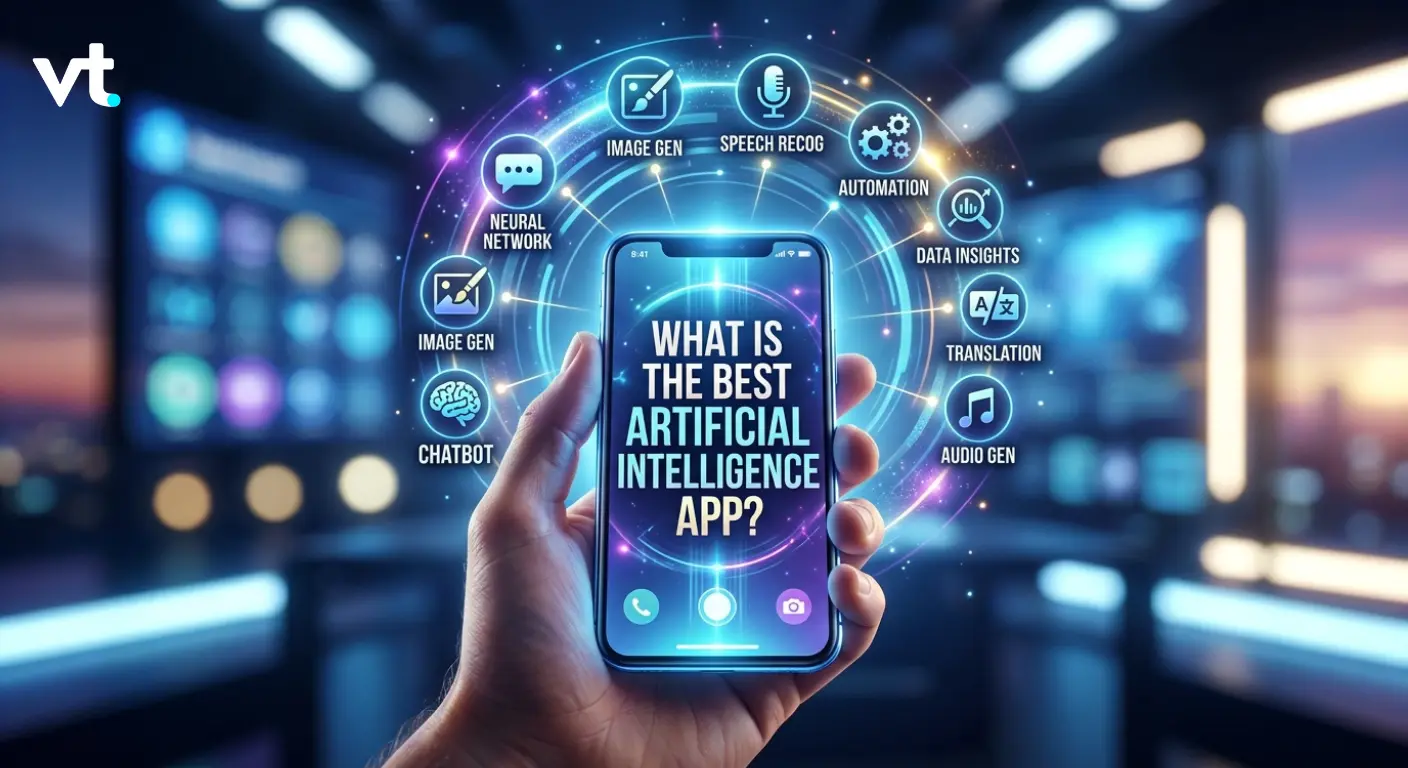
There is no single best artificial intelligence app for everyone. The ideal AI app depends on the user’s specific needs and goals.
Popular artificial intelligence apps include tools such as ChatGPT, Claude, Gemini, Microsoft Copilot, Perplexity, Adobe Firefly, Midjourney, Notion AI, Grammarly, and Zapier AI. Each app has unique strengths, so users should choose based on their specific needs, budget, and workflow.
For instance, a student might prefer an AI tool that explains concepts clearly, while a marketer might need an AI tool for content creation. A developer may require an AI coding assistant, and a business owner might want an AI-powered automation tool to streamline operations.
The best approach is to test a few AI apps, compare their output quality, and select the one that best fits your daily tasks.
Benefits of Artificial Intelligence
Artificial intelligence can support individuals, businesses, and organisations in many practical ways. When used effectively, it can enhance productivity, reduce manual labor, and help make more informed decisions.
1. Saves Time
AI can automate repetitive tasks, such as summarising documents, drafting emails, sorting information, and answering common queries. This enables users to focus on more complex or creative work, increasing efficiency.
2. Improves Decision-Making
AI processes large amounts of data quickly, uncovering patterns and insights that may be difficult for humans to identify. This is especially valuable for businesses, which can use AI to analyse customer behavior, forecast demand, and evaluate multiple options before making a decision.
3. Increases Productivity
By automating routine processes, AI allows users to accomplish more tasks in less time. Writers, analysts, marketers, and teams across various industries can use AI to streamline workflows, generate ideas, and speed up everyday tasks.
4. Supports Creativity
AI can help generate initial drafts, design concepts, and creative ideas, which users can then refine and develop further. It doesn’t replace human creativity, but serves as a powerful tool to enhance it and accelerate the creative process.
5. Personalises User Experiences
AI can analyse user behavior to offer personalised recommendations, such as products, music, videos, and learning materials. This makes digital platforms more engaging and relevant to individual users, improving their overall experience.
Risks and Limitations of Artificial Intelligence
Despite its benefits, AI has certain risks and limitations that need careful consideration. Here are some of the key challenges:
1. AI Can Produce Inaccurate Information
AI-generated content may sometimes be incorrect, outdated, or misleading. It’s essential for users to fact-check AI outputs, particularly when making important decisions in areas like health, finance, and law.
2. AI May Reflect Bias
AI systems learn from the data they’re trained on. If the data contains biases, AI outputs may reflect those same biases. This can lead to unfair or discriminatory outcomes, particularly in sensitive areas like hiring, lending, and content moderation.
3. Privacy Concerns
When entering personal, financial, or sensitive data into AI tools, privacy and security become critical concerns. Users must be cautious, particularly when using platforms that store or process sensitive information.
4. Overreliance Can Reduce Human Judgment
While AI supports decision-making, it shouldn’t replace critical thinking. Relying too heavily on AI can lead to missed context or poor-quality outputs, so it’s essential to maintain human oversight in important decisions.
5. AI Can Be Misused
AI technologies can be exploited for malicious purposes, such as creating deepfakes, generating misinformation, or automating cyberattacks. Responsible AI usage, clear policies, and increased digital awareness are vital to prevent misuse.
How to Use Artificial Intelligence Responsibly
Using AI responsibly is crucial, especially since it can influence decisions and impact privacy. Here are some best practices for responsible AI usage:
1. Always Review AI Output
AI can be a valuable tool, but it’s not infallible. Always review the results, particularly when dealing with professional, legal, or sensitive content, to ensure accuracy.
2. Avoid Entering Sensitive Information
Unless a platform is specifically designed to handle confidential data, avoid entering private or sensitive information into AI tools. This helps mitigate privacy risks and potential security breaches.
3. Fact-Check Important Claims
AI might sound confident even when the information is wrong. Always verify important details with reliable sources, especially when making significant decisions based on AI-generated content.
4. Use AI as a Support Tool
AI should enhance human judgment, not replace it. Use AI to support decision-making by applying your experience and expertise, especially when the situation requires ethical or contextual insight.
5. Be Transparent About AI Usage
Whenever AI is used in decision-making or content creation, it’s important to disclose this, particularly in fields like education, business, journalism, or customer service. Transparency helps maintain trust.
6. Understand the Limits of Each AI Tool
Different AI tools have varying capabilities. Some are better suited for writing, others for coding, and some excel at creative tasks or data analysis. Understanding the strengths and limitations of each tool ensures the right application for each task.
Embrace AI’s Potential Responsibly
Artificial intelligence has evolved from science fiction to a cornerstone of modern life, powering everything from personal productivity tools to sophisticated trading strategies. As we’ve explored, AI boosts efficiency, sparks creativity, and drives innovation across industries, but its true power lies in how you use it. Looking ahead, AI’s role in specialised fields like trading will only grow, with advanced tools enabling smarter, automated decisions. Stay informed, use it ethically, and watch how it reshapes your world.
Ready to dive deeper? Explore AI responsibly and Open a live account with VT Markets today and experience the full potential of AI-driven trading.
Frequently Asked Questions
1. What is artificial intelligence (AI)?
AI refers to technology that enables machines to perform tasks that typically require human intelligence, such as understanding language, recognising images, solving problems, and creating content. AI systems learn from data and adapt over time, making them capable of handling increasingly complex tasks.
2. How does AI improve productivity?
AI can automate routine tasks, analyse large datasets quickly, and provide actionable insights, helping individuals and businesses make faster, more informed decisions. This reduces manual effort and frees up time for higher-value work.
3. What is machine learning and how does it relate to AI?
Machine learning is a subset of AI that allows systems to learn from data and improve over time. Unlike traditional programming, machine learning enables AI systems to automatically learn patterns, making predictions, and refining processes based on new data.
4. How does AI improve decision-making?
AI analyses vast amounts of data to uncover patterns and insights that may be difficult for humans to spot. This helps businesses and individuals make more informed, data-driven decisions, whether it’s in marketing, healthcare, or finance.
5. What is AI in trading?
AI in trading involves using advanced algorithms to analyse market data, make predictions, and automate trade executions. It helps traders make faster, more accurate decisions and allows for the automation of strategies based on predefined rules.
6. How can I start trading with AI at VT Markets?
VT Markets offers AI-powered tools like Expert Advisors (EAs) on MetaTrader 4 (MT4) and MetaTrader 5 (MT5). To get started, simply open a live account with VT Markets and begin using these AI tools to automate your trading strategies and improve your decision-making.
7. What is natural language processing (NLP)?
NLP is a branch of AI that enables machines to understand, interpret, and generate human language. It is used in applications like chatbots, voice assistants, and translation tools, allowing machines to communicate with humans in a natural way.
8. How does AI help with data analysis?
AI can analyse large volumes of data at high speed, identifying patterns, correlations, and trends that might not be immediately obvious. This allows businesses to make data-driven decisions, forecast trends, and optimise strategies more effectively.










