





Key Takeaways
- Canadian gas prices are displayed in CAD per litre, while US prices are shown in USD per gallon — two completely different units and currencies.
- To convert Canadian gas prices to a US-comparable figure, multiply the CAD per litre price by 3.7854 (litres per gallon), then multiply by the current CAD/USD exchange rate (~0.73 as of May 2026).
- As of early May 2026, Canada’s national average sits at CAD $1.87 per litre, which converts to approximately USD $5.17 per gallon — higher than the US national average of USD $4.50 per gallon.
- The primary reason Canadian gas costs more than American gas, once converted, is higher gasoline taxes at both the federal and provincial levels.
- Gas prices vary significantly by province in Canada and by state in the USA — always check local prices before making cross-border fuel decisions.
- Commodity markets, the CAD/USD exchange rate, geopolitical events, and regional taxes all influence what you ultimately pay at the pump.
Canada to US Gas Price Conversion: Everything You Need to Know in 2026
If you’ve ever pulled into a gas station in Canada after crossing the border from the USA, you’ve probably felt a moment of confusion — or perhaps relief — staring at the price board. Numbers like “$1.87” seem reasonable until you realise that’s per litre, not per gallon, and it’s in Canadian dollars, not US dollars.
This evergreen guide breaks down exactly how to convert canadian gas prices into their US equivalent, explains why prices differ between the two countries, and gives you the tools you need to make informed decisions — whether you’re a cross-border commeller, a road-tripper, or simply a curious consumer trying to understand the fuel market.

Why Are Canadian and US Gas Prices Shown Differently?
The first source of confusion is a simple but significant measurement difference. In Canada, fuel is sold by the litre, priced in Canadian dollars (CAD). In the United States, fuel is sold by the gallon, priced in US dollars (USD). These two systems are not interchangeable without conversion.
There are approximately 3.7854 litres in one US gallon. On top of that, the exchange rate between the Canadian dollar and the US dollar fluctuates daily. As of early May 2026, 1 CAD = approximately 0.73 USD (or conversely, 1 USD ≈ 1.37 CAD).
So when you see a gas station in Canada displaying $1.87 CAD per litre, a quick mental estimate won’t tell you whether that’s cheap or expensive relative to US prices — you need to do the full conversion.
The Step-by-Step Canada Gas Price Conversion to US Formula
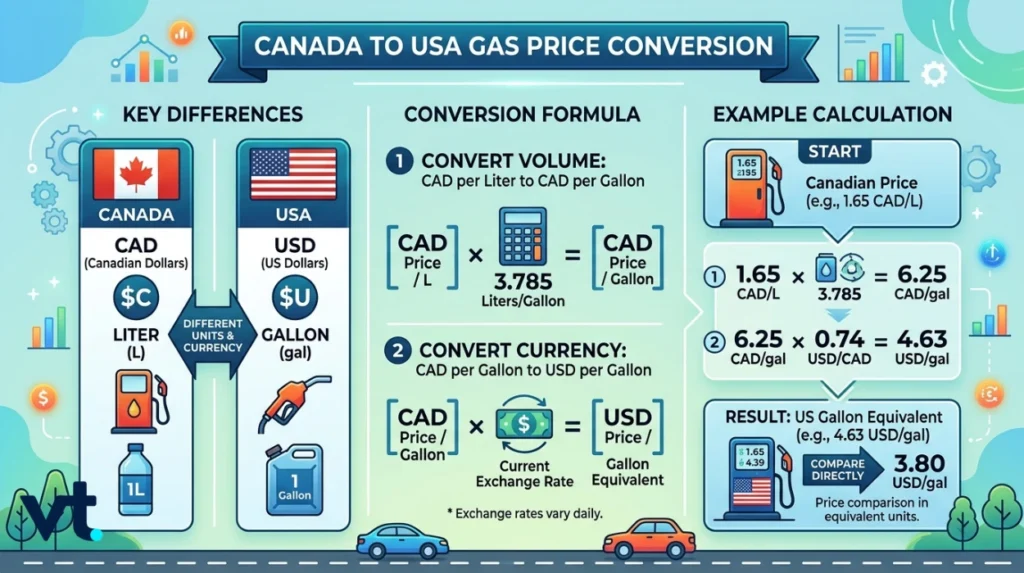
Converting canadian gas prices to a US-comparable equivalent is a two-step process:
Step 1: Convert litres to gallons
Multiply the price per litre by 3.7854 to get the price per gallon in CAD.
Step 2: Convert CAD to USD
Multiply the CAD per gallon figure by the current CAD/USD exchange rate.
The Full Conversion Equation
USD per gallon = (CAD per litre × 3.7854) × CAD/USD exchange rate
Or, expressed differently:
USD per gallon = CAD L price × 3.7854 × 0.73 (using May 2026 rate)
Worked Example Using May 2026 Data
Using Canada’s national average of $1.87 CAD per litre as of 5 May 2026:
- $1.87 × 3.7854 = $7.079 CAD per gallon
- $7.079 × 0.73 = approximately $5.17 USD per gallon
Compare that to the US national average of $4.50 USD per gallon (as of 12 May 2026, per AAA/EIA data), and you’ll see that — on a converted basis — Canadian gas is currently more expensive for most cross-border travellers paying with US dollars.
2026 Gas Price Snapshot: Canada vs. United States
Below is a current comparison of pump prices in both countries, with the converted price for Canadian fuel shown in USD per gallon for easy comparison.
| Metric | Canada | United States |
|---|---|---|
| Price format | CAD per litre | USD per gallon |
| National average (May 2026) | CAD $1.87/L | USD $4.50/gal |
| Converted equivalent | ~USD $5.17/gal | USD $4.50/gal |
| Most expensive region | British Columbia (~$2.01/L) | California (~$6.10/gal) |
| Least expensive region | Alberta (~$1.78/L) | Oklahoma (~$3.93/gal) |
| Annual average (2026 YTD) | CAD $1.53/L | USD $3.44/gal |
| CAD/USD exchange rate | ~0.73 (May 2026) | N/A |
Sources: Finder.com Canada (Kalibrate data), AAA, EIA, Wise.com. Prices are subject to daily fluctuation.
Canadian Gas Prices by Province: How Much Do They Vary?
Gas prices in Canada are not uniform across the country. Provincial taxes, carbon pricing, and local market conditions create notable differences in what drivers pay at the pump from one province to the next.
Provincial Price Breakdown (May 2026)
| Province | Approx. CAD per litre | USD per gallon equivalent* |
|---|---|---|
| Alberta | $1.78 | $4.92 |
| Manitoba | $1.81 | $5.00 |
| Saskatchewan | ~$1.83 | $5.06 |
| Ontario | ~$1.88 | $5.19 |
| Quebec | ~$1.91 | $5.28 |
| Nova Scotia | ~$1.92 | $5.30 |
| Prince Edward Island | ~$1.94 | $5.36 |
| New Brunswick | ~$1.96 | $5.41 |
| British Columbia | $2.01 | $5.55 |
| Newfoundland & Labrador | $2.04 | $5.63 |
Converted at approximately 0.73 CAD/USD exchange rate.
Key observations:
- Alberta consistently has the cheapest gas in Canada due to lower provincial fuel taxes and no carbon tax surcharge at the same level as other provinces.
- British Columbia and Newfoundland and Labrador routinely top the charts as the most expensive province for fuel — driven by higher gasoline taxes and, in BC’s case, transit levies and carbon pricing.
- Some provinces such as Prince Edward Island, New Brunswick, Nova Scotia, Quebec, and Newfoundland and Labrador operate regulated markets, where the price is partially controlled to prevent below-cost selling and protect dealer margins.
Why Is Gas More Expensive in Canada Than in the US (After Conversion)?
Once you apply the canada to us gas price conversion, Canadian fuel typically comes out more expensive. The primary culprit? Taxes.
The Role of Gasoline Taxes
Gasoline taxes vary considerably between Canada and the United States — and this is the biggest driver of the price gap between the two countries. Outside of taxes, the underlying cost of refined gasoline in both countries is broadly similar, since both markets are tied to the same global crude oil benchmarks.
In Canada, gasoline taxes include:
- Federal excise tax (approximately 10 cents per litre)
- Federal carbon pricing levy (varies by province and year)
- Provincial fuel tax (varies widely by province)
- GST/HST applied on top of the pre-tax pump price
- Municipal taxes in some cities (e.g., the Montreal Metropolitan region)
In the United States, taxes on gasoline are notably lower:
- Federal excise tax: 18.4 cents per gallon (~4.9 cents per litre)
- State taxes: vary widely, from roughly 8 cents per gallon (Alaska) to over 60 cents per gallon (California and Pennsylvania)
The net result: Canadians pay substantially more per litre in taxes than their American counterparts pay per gallon, even accounting for volume differences.
What Else Affects Gas Prices on Both Sides of the Border?
Taxes explain part of the story, but several other fuel market dynamics shape the final price you pay at the pump.
Crude Oil Prices
Both Canada and the USA are deeply integrated into global gasoline markets. Crude oil — the primary input in refined gasoline — trades on international markets and is priced in US dollars. When crude prices rise, pump prices in both countries follow. As of early May 2026, Brent crude was trading at approximately $108.83 per barrel, elevated significantly due to ongoing geopolitical tensions in the Middle East and disruption to shipping through the Strait of Hormuz.
The CAD/USD Exchange Rate
The exchange rate between the Canadian dollar and the US dollar plays a critical role in cross-border fuel price comparisons. When the Canadian dollar weakens against the USD (as it has in recent years), the converted price of Canadian fuel in US dollar terms looks even higher than the raw CAD per litre figure suggests.
As of early May 2026, the CAD was trading at roughly 0.730–0.736 USD, meaning that Canadian dollars go considerably less far when converted to US dollars.
Refining Costs and Regional Supply
The cost of refining crude oil into usable fuel varies by region depending on local refinery capacity, the type of crude being processed, and transportation infrastructure. Some provinces and states must import refined fuel from distant locations, adding distribution costs to the final price.
Seasonal Demand
Gasoline demand spikes during summer driving season in both countries, typically pushing prices higher between May and August. Similarly, winter can bring higher diesel demand for heating and transportation in colder regions.
Quick Reference: CAD Per Litre to USD Per Gallon Conversion Table
Use the table below to quickly look up equivalent price figures. Conversions are based on a CAD/USD exchange rate of 0.73 (approximate May 2026 rate). For an exact figure, always use the current exchange rate.
| CAD per litre | CAD per gallon | USD per gallon (at 0.73) |
|---|---|---|
| $1.20 | $4.54 | $3.32 |
| $1.30 | $4.92 | $3.59 |
| $1.40 | $5.30 | $3.87 |
| $1.50 | $5.68 | $4.15 |
| $1.60 | $6.06 | $4.42 |
| $1.70 | $6.43 | $4.70 |
| $1.78 | $6.73 | $4.92 |
| $1.87 | $7.08 | $5.17 |
| $2.00 | $7.57 | $5.53 |
| $2.10 | $7.95 | $5.80 |
Formula: CAD/L × 3.7854 × 0.73 = USD/gal
Take note: Exchange rates fluctuate daily and sometimes dramatically. The figures above are based on the approximate rate as of May 2026. Always check the current CAD/USD rate before making cross-border fuel or financial decisions.
Cross-Border Driving and the Fuel Decision
If you live near the Canada-US border — in cities like Windsor/Detroit, Vancouver/Seattle, or Niagara Falls — you may occasionally wonder whether it’s worth crossing the border just to fill up your vehicle.
When It Might Make Sense to Drive Across the Border for Gas
Based on current 2026 data:
- If you’re in Alberta (at ~$1.78 CAD/L ≈ USD $4.92/gal), and a nearby US state offers gas at USD $3.99/gal or less, crossing the border could save a meaningful amount depending on your tank size.
- If you’re in British Columbia (at ~$2.01 CAD/L ≈ USD $5.55/gal), and you’re near Washington State (currently above USD $5.00/gal), the saving is less clear-cut and may not justify the trip.
- The cost of the border crossing itself — time, tolls, and any import duties on fuel for commercial vehicle operators — should always factor into the equation.
Important Reminder for Border Crossers
Reminder: Carrying excessive amounts of fuel across the Canada-US border in portable containers may be subject to customs regulations and restrictions. Always check current rules with the Canada Border Services Agency (CBSA) or US Customs and Border Protection (CBP) before your trip.
How Gas Prices Connect to Broader Commodity Markets
For those interested in the financial side of energy — not just the pump price — it’s worth understanding that gasoline prices don’t exist in isolation. They are downstream of a complex chain of commodity markets, exchange rate movements, and geopolitical events.
- Crude oil is the dominant price driver, typically accounting for roughly 50% of the pump price in both Canada and the USA.
- Refined product markets (wholesale gasoline and diesel) add another layer of price discovery.
- Currency markets determine how much a Canadian dollar buys in terms of global oil, which is priced in USD.
- Futures contracts traded on exchanges like NYMEX allow producers, refiners, and traders to hedge against price volatility.
For traders and investors who want exposure to energy commodity markets — including crude oil, refined products, and related instruments — VT Markets provides a platform with access to a wide range of commodity CFDs, allowing participants to go long or short on energy markets with competitive spreads.
Gas Prices in 2026: A Market Snapshot
2026 has been a particularly volatile year for fuel prices in both Canada and the United States, shaped by a convergence of global factors.
Key developments driving gas prices higher in 2026:
- Middle East geopolitical tensions and disruption to the Strait of Hormuz since March 2026 have constrained global oil supplies.
- Brent crude climbed to above $108/barrel by May 2026, significantly elevated versus late 2025 levels.
- US gasoline prices rose roughly 53% between late February and early May 2026, from ~$2.96/gal to a peak of ~$4.52/gal (source: Finder.com).
- Canadian pump prices have also surged, with the national average hitting $1.87/L by 5 May 2026 — up from $1.27/L in early January 2026.
- The annual average in Canada for 2026 YTD is $1.53/L, while in the US it is $3.44/gal — representing a 20-year-high trajectory for the year so far.
Despite these elevated levels, energy market analysts continue to note that global supply and demand fundamentals could push prices either direction in the second half of 2026, depending on geopolitical resolution and OPEC+ production decisions.
Diesel Prices: The Other Side of the Fuel Equation
While most consumers focus on gasoline, diesel is equally important — particularly for truckers, farmers, and commercial operators across both Canada and the USA.
As of May 2026:
- Canadian diesel benchmark: approximately CAD $1.69 per litre (~USD $4.67 per gallon converted)
- US diesel national average: approximately USD $4.60–$4.80 per gallon
Diesel prices in both countries are similarly elevated in 2026, reflecting refinery prioritisation of distillate production over gasoline in response to global supply pressures.
Frequently Asked Questions (FAQs)
FAQ 1: How do I convert Canadian gas prices to US dollars per gallon?
The simple formula is:
USD per gallon = CAD per litre × 3.7854 × CAD/USD exchange rate
For example, using $1.87 CAD/L at an exchange rate of 0.73: $1.87 × 3.7854 × 0.73 = approximately $5.17 USD per gallon.
Always use the current exchange rate for accuracy, as the CAD/USD rate can shift meaningfully within weeks.
FAQ 2: Is gas cheaper in Canada or the US?
It depends on how and where you measure. In raw local currency terms, Canadian gas displayed as $1.87 CAD/L looks very different from the US price of $4.50 USD/gal. However, once you perform the full canada gas price conversion to us (adjusting for both volume and exchange rate), Canadian gas currently comes out slightly more expensive on average in 2026. The key driver is that gasoline taxes in Canada are significantly higher than in the US. That said, prices vary significantly by province and state, so the comparison can flip depending on exactly where you’re filling up.
FAQ 3: Why do gas prices vary so much between Canadian provinces?
Canadian gas prices vary by province primarily because of differences in provincial fuel taxes, carbon pricing regimes, distance from refineries, and local market competition. Alberta typically has the lowest prices due to its proximity to western Canadian oil production and its relatively lower provincial fuel taxes. British Columbia and Atlantic Canadian provinces tend to have the highest prices, reflecting higher taxes, greater transportation distances, and in BC’s case, a higher carbon levy. Some provinces also operate regulated pricing markets that set floors and ceilings on the price at the pump.
FAQ 4: Can I use a simple calculation to quickly compare prices at the border?
Yes! A practical rule of thumb: multiply the CAD per litre price by 2.8 to get a rough USD per gallon equivalent (based on recent exchange rates around 0.73–0.74 CAD/USD). This is a simplified equation — the exact multiplier will shift as the exchange rate changes — but it gives a simple, quick comparison tool for use at the gas station border crossing. For precise calculations, use the full formula or an online conversion tool.
Take note: Online conversion calculators may use slightly different exchange rate data. For financial decisions of any significant size, always verify the current rate from a reliable source such as the Bank of Canada or a major financial institution.
Summary: Key Points for the Canada-to-US Gas Price Comparison
- Unit difference: Canada uses CAD per litre; USA uses USD per gallon. These are not directly comparable without conversion.
- The formula: USD/gal = CAD/L × 3.7854 × exchange rate.
- Exchange rate matters: At approximately 0.73 CAD/USD in May 2026, the multiplier to convert CAD/L to USD/gal is roughly 2.76.
- Higher taxes: Canadian fuel is taxed more heavily at both federal and provincial levels, which is the primary reason converted Canadian prices are often higher than US prices.
- Market volatility: In 2026, both countries have seen substantial pump price increases driven by global crude supply disruption.
- Regional variation: Prices differ significantly by province and state — never assume the national average reflects your local reality.
- Diesel follows a similar pattern to gasoline, with comparable converted price gaps between the two countries.
Start Trading Energy and Commodity Markets with VT Markets
Understanding gas prices is about more than budgeting at the pump — it’s a window into global commodity markets, currency dynamics, and geopolitical risk. For traders and investors who want to engage with these markets directly, energy commodities represent one of the most liquid and widely-followed sectors in the world.
Ready to explore what commodity and currency trading looks like in practice? VT Markets offers a secure and user-friendly platform with access to MetaTrader 4 (MT4) and MetaTrader 5 (MT5). Enjoy fast execution, competitive spreads, and a seamless trading experience whether you choose to go long or short on energy, currencies, or a wide range of global markets.
New to trading? Try a VT Markets demo account to explore real market conditions in a risk-free environment before moving to a live account. For platform guides, tutorials, and support, visit the VT Markets Help Centre.
Start trading with VT Markets today and trade with confidence.
Precaution: Trading commodity CFDs and currency instruments involves significant risk and is not suitable for all investors. Ensure you fully understand the risks involved and consider your financial situation carefully before trading. Past performance is not indicative of future results.








