





Key Takeaways
- Silver trading means speculating on silver’s price through financial instruments — CFDs, futures, ETFs, or spot contracts — without necessarily owning physical metal.
- Silver surged 148% in 2025, breaking out of a four-decade consolidation pattern, driven by a structural supply deficit of 160–200 million ounces annually and booming green-energy demand.
- Industrial demand accounts for over 60% of annual silver consumption, with solar panels, electric vehicles, and AI infrastructure emerging as the fastest-growing drivers in 2026.
- Multiple instruments are available to trade silver, including CFDs (most popular for active traders), spot contracts, futures, options, and ETFs—each with different risk profiles and capital requirements.
- Key price drivers include US dollar strength, inflation expectations, Federal Reserve policy, industrial output data, and global ETF flows, which reached 95 million ounces by mid-2025.
- Effective silver trading combines technical analysis (RSI, MACD, support and resistance levels) with fundamental awareness of macro and supply-demand dynamics.
- Risk management is non-negotiable —silver’s volatility can work in your favour and against you. Always use stop-loss orders and limit individual trade risk to 1–2% of your account capital.
Silver gained 148% in 2025—more than doubling in a single year and shattering forecasts. Whether you are entirely new to commodities or looking to sharpen your silver trading strategy, this comprehensive guide covers what silver trading is, how to trade it effectively, the key price drivers in 2026, and the strategies that seasoned traders rely on.
What Is Silver Trading?
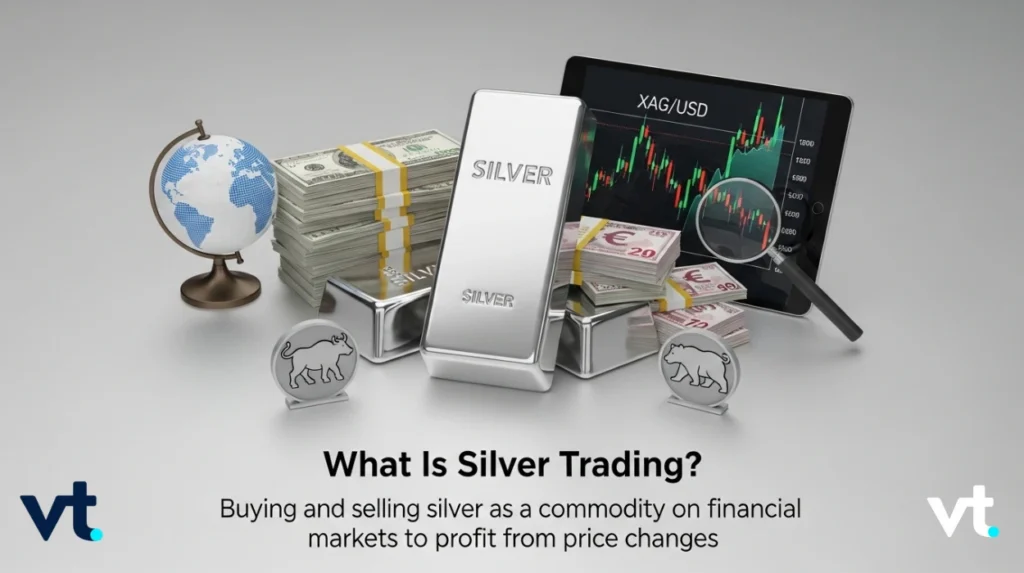
Silver trading is the act of speculating on—or actively buying and selling— silver in financial markets with the aim of profiting from price movements. Unlike purchasing physical silver bars or coins, trading silver typically involves financial instruments that track the metal’s price, allowing participants to take positions without the logistical burden of storing physical metal.
As both a precious metal and a critical industrial material, silver occupies a unique position in global commodities markets. It is priced in US dollars per troy ounce and trades around the clock across major financial centers, making it one of the most liquid and accessible commodities available to retail and institutional traders alike.
Why Is Silver Such a Compelling Market in 2026?
The silver market has undergone a remarkable structural shift. After years of trading in the shadows of gold, silver broke out of a four-decade-long consolidation pattern in 2025, smashing through the psychologically significant $50 per ounce resistance level. The metal closed 2025 at approximately $2,416 per kilogram (roughly $75 per troy ounce), representing a staggering 148% annual gain — far beyond what even the most bullish forecasters had projected at the start of that year.
In 2026, the market has continued to generate significant activity. J.P. Morgan Global Research sees silver prices averaging $81 per ounce in 2026—more than double its average in 2025—though this hinges on several macroeconomic variables, including global industrial demand and Federal Reserve monetary policy.
This is not merely a speculative frenzy. The silver market remains in a multiyear structural deficit, with demand exceeding mine supply by roughly 160–200 million ounces in 2025, and limited new mining projects and tightening global inventories mean the deficit is likely to continue into 2026.
The Five Forces Driving Silver Prices Right Now
1. Surging Industrial Demand
Unlike gold, where industrial demand accounts for only around 5% of annual consumption, silver sees upwards of 60% of annual demand going into industrial applications— primarily because of its exceptional electrical conductivity. This demand is structural, not cyclical.
Key growth areas include:
- Solar photovoltaic (PV) panels—PV manufacturers consumed over 25% of the annual global silver supply in 2024, and demand rose again in 2025. Solar alone is expected to nearly double silver demand between 2020 and 2030.
- Electric vehicles (EVs) — EV-related silver demand jumped an estimated 20% in 2025, driven by the growing use of sensors and high-voltage wiring.
- Artificial intelligence infrastructure—Advanced electronics and AI data centers are emerging as an entirely new demand driver in 2026.
2. The US Dollar’s Trajectory
Silver is denominated in US dollars, so the two share an inverse relationship. When the dollar weakens, silver becomes cheaper for foreign buyers, boosting demand and lifting prices. The US dollar index fell over 8% in 2025, and combined with a gradual move towards lower interest rates from the Federal Reserve and ongoing de-dollarisation globally, the US dollar has weakened — this is expected to continue in 2026 and should continue to support the silver price.
3. Inflation and Interest Rate Expectations
Silver has historically served as a store of value during inflationary periods. High or rising inflation generally means rising silver prices as costs increase, and inflationary pressures are likely to keep rising, making it harder for people to plan for retirement. When central banks cut interest rates, the opportunity cost of holding non-yielding assets like silver diminishes, making the metal more attractive relative to bonds or cash deposits.
4. Supply Constraints
Environmental scrutiny of mining operations has tightened in several regions, while geopolitical instability has affected key producers in Latin America. With limited new primary silver projects coming online, the market remains sensitive to supply disruptions — a dynamic that can amplify price swings but also create opportunities.
5. Investment Demand and ETF Flows
Global silver ETF inflows reached 95 million ounces by mid-2025, surpassing total inflows for all of 2024. Total ETF holdings reached approximately 1.13 billion ounces valued at over $40 billion. This institutional participation provides a significant underpinning to silver prices that did not exist in previous cycles.
Silver Price Snapshot: 2026 at a Glance
| Institution / Source | 2026 Silver Price Forecast (USD/oz) | Key Rationale |
|---|---|---|
| J.P. Morgan Global Research | ~$81 average | Industrial demand, dollar weakness |
| Bank of America | ~$56–$65 | Moderate demand growth, Fed easing |
| GoldSilver (Alan Hibbard) | $175+ | Structural supply deficit, green energy |
| FX Empire Technical Analysis | $100 test likely | Cup-and-handle breakout above $50 |
| CBS News Expert Consensus | Broadly bullish | Inflation, rate cuts, supply shortfall |
Note: Forecasts represent analyst projections and are not guarantees of future performance. Silver markets are highly volatile.
Different Ways to Trade Silver
There is no single “right” way to trade silver — the best method depends on your objectives, capital, and risk appetite. Here is a concise overview of the primary instruments:
| Instrument | How It Works | Best For | Leverage? |
|---|---|---|---|
| Silver CFDs | Speculate on price movement without owning silver | Active short-term traders | Yes |
| Spot Silver | Buy/sell at live market price for immediate settlement | Swing traders | Yes (with broker) |
| Silver Futures | Contract to buy/sell silver at a set price on a future date | Hedgers & institutional traders | Yes |
| Silver ETFs | Fund tracking silver price traded on an exchange | Long-term investors | Typically no |
| Silver Options | Right (not obligation) to buy/sell at a set price | Advanced traders, hedgers | Built-in |
| Physical Silver | Purchase bars, coins, or bullion outright | Long-term wealth preservation | No |
Among these, Silver CFDs are the most popular instrument for active retail traders because they offer flexibility to go long (buy) or short (sell), require less upfront capital, and can be traded on professional platforms with competitive spreads. VT Markets offers silver CFD trading, providing access to live silver prices with tight spreads and institutional-grade execution.
How to Trade Silver: A Step-by-Step Guide
1. Understand the Fundamentals
Before placing any trade, develop a clear understanding of what moves silver prices. Study the relationship between silver and the US dollar, monitor industrial demand reports (particularly from the Silver Institute), and keep an eye on Federal Reserve policy announcements. A well-grounded understanding of the macro environment is the foundation of every sound silver trading strategy.
2. Choose Your Trading Instrument
Decide whether CFDs, spot contracts, futures, or ETFs suit your goals. If you are looking for short-term trading opportunities with the ability to go both long and short, silver CFDs are typically the most efficient choice for retail participants. If you are seeking long-term exposure with lower day-to-day management, silver ETFs may be more appropriate.
3. Select a Regulated Broker
Your choice of broker is critical. Look for tight spreads on silver instruments, transparent fee structures, and robust regulatory oversight. A demo account is invaluable for testing your strategy before committing real capital. VT Markets provides access to silver markets through both MetaTrader 4 and MetaTrader 5, along with TradingView — giving traders a suite of professional-grade charting and analysis tools.
4. Open and Fund Your Account
Complete the account registration and identity verification process, then fund your account with an amount that aligns with your trading plan. Never deposit money you cannot afford to lose, and always start with a modest position size while you are building experience.
5. Develop and Test Your Strategy
Effective silver trading relies on a blend of technical analysis and fundamental analysis. Technical traders use tools like the Relative Strength Index (RSI), Moving Average Convergence Divergence (MACD), Bollinger Bands, and key support and resistance levels to time entries and exits. Fundamental traders, meanwhile, track industrial output data, currency movements, and central bank communications.
6. Execute Your Trade with Proper Risk Management
Set your stop-loss and take-profit levels before entering a trade. Determine your position size based on a fixed percentage of your account — most experienced traders risk no more than 1%–2% of total capital per individual trade. This disciplined approach ensures that a string of losing trades will not wipe out your account.
7. Monitor, Review, and Adapt
Silver markets can move rapidly, particularly during major economic data releases. Monitor your open positions, record your trades in a journal, and regularly review your performance. The traders who improve fastest are those who honestly analyse both their wins and losses.
Popular Silver Trading Strategies
Trend Following
When silver is in a clear uptrend or downtrend, trend-following strategies align positions in the direction of the prevailing momentum. Moving averages — particularly the 50-day and 200-day — are widely used to identify the trend’s direction and potential reversal points.
Breakout Trading
Silver’s 2025 breakout above $50 is a textbook example of how powerful breakout trades can be. Traders watch for price consolidation near major historical resistance or support levels, then enter when volume confirms a decisive move beyond that level. In 2026, the $100 per ounce level is being closely watched as the next major psychological barrier.
Range Trading
During periods of consolidation, silver often trades within a defined price band. Range traders buy near the lower boundary (support) and sell near the upper boundary (resistance), profiting from the oscillation rather than a sustained directional move.
The Gold-to-Silver Ratio Strategy
The gold-to-silver ratio measures how many ounces of silver it takes to purchase one ounce of gold. When this ratio is historically high (meaning silver is cheap relative to gold), some traders rotate into silver in anticipation of the ratio compressing. In 2025, this ratio narrowed sharply as silver outperformed gold, and monitoring it remains a valuable strategic tool in 2026.
Advantages of Silver Trading
- High liquidity: Silver markets operate virtually around the clock, with deep liquidity ensuring traders can enter and exit positions efficiently.
- Portfolio diversification: Silver’s pricing behaviour does not always correlate with equities or bonds, making it an effective portfolio buffer.
- Dual demand drivers: Both industrial utility and investment safe-haven demand support silver prices, creating a broader base than most commodities.
- Affordability relative to gold: Traders can build meaningful silver positions with smaller capital outlays than gold requires.
- Leverage access: CFD instruments allow traders to amplify their market exposure— useful in trending markets when managed carefully.
Precautions Every Silver Trader Should Know
⚠ Take Note The following points are not meant to discourage participation in silver markets — they are important reminders that responsible traders factor into every decision.
- Volatility is a double-edged sword: silver is considerably more volatile than gold. Silver remains roughly 30% below its late January 2026 peak following a selloff that briefly erased nearly half its value. Price swings of 10%–20% within days are not uncommon. This same volatility that creates profit opportunities can result in rapid, substantial losses if positions are not carefully sized and protected by stop-loss orders.
- Leverage amplifies both gains and losses: trading silver with leverage means a relatively small adverse price move can produce losses that exceed your initial margin deposit. As a precaution, always understand your full leverage exposure before entering a position.
- Spread and overnight fees: When trading CFDs, be mindful of the bid-ask spread and any overnight swap charges that accrue on positions held open beyond a single trading session. These costs can erode profitability on small or slow-moving trades.
- Market unpredictability: Even the most sophisticated institutional forecasts can be significantly wrong. If industrial demand slows and real yields rise again, silver could either stabilise or retreat from current price levels. A reminder to always trade with a plan and never rely on a single forecast.
- Regulatory environment varies: Silver trading regulations differ by jurisdiction. Always confirm your broker is properly licensed and regulated in your region before committing funds.
Silver vs. Gold: Which Should You Trade?
| Feature | Silver | Gold |
|---|---|---|
| Price per ounce (March 2026) | ~$69.39 ▼ from ~$85 | ~$4,574 ▲ from ~$3,200 |
| Volatility | Extreme −30% in Jan 2026 | Very high −9.6% in one week |
| Industrial demand share | ~60%+ of total demand | ~5% of total demand |
| Safe-haven appeal | Strong | Very strong (but selling off) |
| Liquidity | High | Very high |
| Entry cost | Lower | Higher |
| 2025 performance | +135% Record high | +66% Record high |
| 2026 YTD performance | −1% Down from peak | +5% Still positive |
| Profit potential (short-term) | Higher due to extreme volatility | Moderate (but volatile in 2026) |
The choice between silver and gold depends on your trading style. Both metals saw record rallies in 2025, followed by historic sell-offs in 2026 driven by the US–Iran conflict and macro uncertainty. Silver remains the higher-risk, higher-reward option; gold, while sharply down from its 2026 peak, retains its safe-haven lead. Experienced traders may hold positions in both, using each metal’s distinct characteristics to complement the other.
Getting Started: What to Look for in a Silver Trading Platform
The right platform can make a meaningful difference to your trading experience. When evaluating where to trade silver, consider the following:
- Tight spreads on XAG/USD—the silver CFD instrument—to minimise transaction costs on every trade.
- Access to professional charting tools, including multiple timeframes, technical indicators, and drawing tools.
- Fast, reliable order execution without excessive slippage, particularly important during high-volatility news events.
- Regulatory transparency — your broker should be authorised by a recognised financial regulator and publish this information clearly.
- Educational resources and market analysis to help you stay informed about the factors moving silver prices day to day.
- A demo account to practise strategies with virtual funds before transitioning to a live account.
VT Markets offers silver CFD trading across MT4, MT5, and TradingView, with access to real-time market analysis, economic calendars, and a full range of account types — from beginner-friendly Standard STP accounts to professional Raw ECN accounts with institutional pricing.
Frequently Asked Questions (FAQs)
1. What is silver trading, and how is it different from buying physical silver?
Silver trading involves speculating on the price of silver through financial instruments such as CFDs, futures contracts, or ETFs — without the need to physically own or store the metal. Buying physical silver (coins or bars) means you own the actual asset, which involves storage costs and logistical complexity. Trading silver through financial instruments offers greater flexibility, the ability to profit from both rising and falling prices, and the option to use leverage – though the latter also increases risk exposure.
2. How much money do I need to start trading silver?
The minimum capital required depends on the instrument and broker you choose. With silver CFDs, many brokers—including those with competitive retail account offerings—allow traders to begin with relatively modest deposits due to the availability of leverage. That said, it is important to remember that leverage magnifies both gains and losses. As a general precaution, only commit funds you are fully prepared to lose, and consider starting on a demo account to build your skills before risking real capital.
3. What are the main risks of trading silver, and how can I manage them?
The principal risks in silver trading include price volatility, leverage-related losses, overnight financing costs on CFD positions, and macroeconomic uncertainty. Risk management best practices include always using stop-loss orders, limiting individual trade risk to 1%–2% of your total account balance, diversifying your position across different assets, and never trading with more leverage than you fully understand. Keeping an eye on economic calendars and central bank communications also helps you anticipate volatile market events before they occur.
4. Is 2026 a good time to trade silver?
Silver’s current market environment — characterised by a structural supply deficit, surging industrial demand from solar energy and electric vehicles, a weakening US dollar, and an accommodative Federal Reserve — has created conditions that many analysts consider historically significant for the metal. However, it is important to note that past performance and analyst forecasts do not guarantee future results. Silver’s elevated price levels also mean that corrections can be sharp and swift, as seen in early 2026. Whether now is the “right” time to trade depends entirely on your individual financial situation, risk tolerance, and trading strategy — not on any single market narrative.
Silver’s Time in the Spotlight
Silver trading has evolved from a niche commodity strategy into one of the most actively discussed markets of 2026. Driven by a powerful combination of industrial necessity, monetary policy tailwinds, and a structural supply shortfall, silver is no longer simply riding on gold’s coattails—it is generating its own compelling story.
Whether you are drawn to silver’s explosive short-term price potential, its role as an inflation hedge, or its critical position in the global green energy transition, building a thorough understanding of what moves this market is the essential first step. From there, selecting the right instrument, developing a disciplined strategy, and working with a reliable, regulated broker will determine the quality of your trading journey.
The opportunities in silver are real — and so are the responsibilities that come with navigating a volatile, fast-moving market. Approach it with knowledge, patience, and sound risk management, and silver trading can be a meaningful component of a well-rounded financial strategy.








