





Key Takeaways:
- The bullish flag pattern is one of the most reliable continuation patterns in technical analysis, with a success rate exceeding 68% according to 2026 trading data
- This chart pattern consists of a strong upward price movement (flagpole) followed by a brief consolidation phase forming parallel lines
- Volume confirmation is critical—high trading volume during the flagpole and declining volume during the consolidation period signal pattern validity
- Proper risk management requires setting stop-losses below the flag’s lower boundary and targeting profit levels 1-2 times the flagpole height
- The pattern typically completes within 1-3 weeks on daily charts, making it ideal for swing traders seeking effective trading strategies
What is a Bullish Flag Pattern?
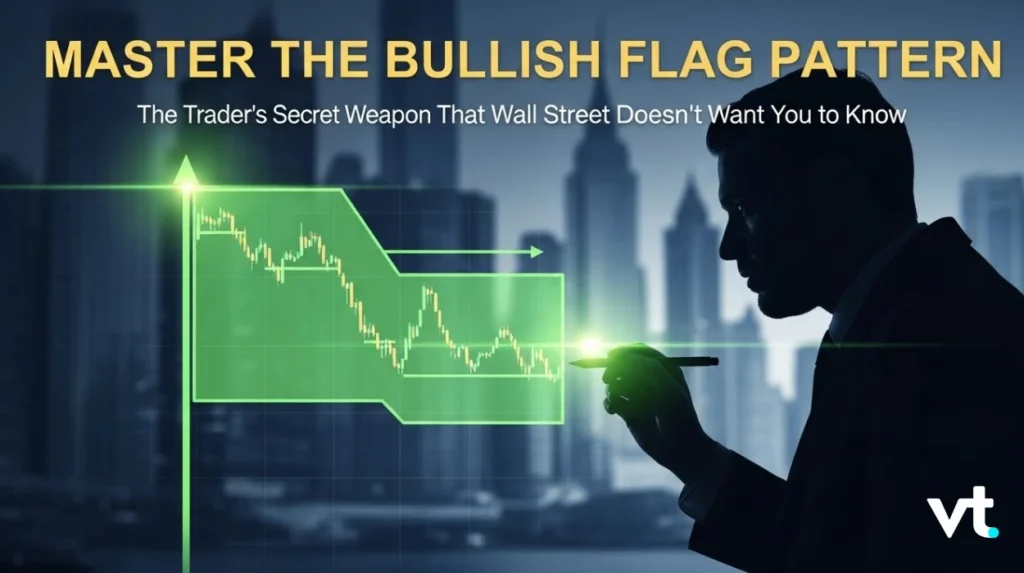
The bullish flag pattern stands as one of the most reliable continuation patterns in the arsenal of technical analysis tools available to modern traders. This distinctive chart pattern emerges when a financial instrument experiences strong upward price movement, followed by a temporary pause in bullish momentum that creates a rectangular or slightly downward-sloping consolidation phase.
Unlike reversal patterns that signal trend changes, the bull flag pattern indicates that the existing trend will likely resume in the same direction after the brief pause. This underlying market psychology reflects a healthy market dynamic where early buyers take profits while new buyers accumulate positions before the next upward leg.
The Anatomy of a Bull Flag Chart Pattern
The Flagpole: Where Momentum Begins
The flagpole represents the initial move—a sharp, near-vertical price surge driven by high trading volume and strong market sentiment. This strong upward price movement typically occurs following a significant catalyst such as earnings announcements, economic data releases, or breakthrough technical resistance levels. The flagpole’s length determines the pattern’s profit target, making it a critical component for calculating the risk-reward ratio.
The Flag Formation: Consolidation at Work
After the explosive initial trend, price action enters the consolidation period, forming the flag portion of the pattern. This phase exhibits several distinguishing characteristics:
- Two parallel lines or channels that slope slightly downward or remain horizontal
- Declining trading volume as market participants pause
- Duration typically lasting 1-3 weeks on daily charts
- A slight downward slope of approximately 10-30 degrees (though horizontal flags also occur)
The tight flag formation reflects a healthy correction where price consolidates rather than reverses, setting the stage for the next advance.
Bull Flag vs Bear Flag Pattern: Key Differences
Understanding bull and bear flags helps traders identify trend direction and make informed decisions. Here’s a comparative breakdown:
| Characteristic | Bull Flag Pattern | Bear Flag Pattern |
|---|---|---|
| Preceding Trend | Upward trend | Downward trend |
| Flagpole Direction | Sharp upward move | Sharp downward move |
| Flag Slope | Slight downward slope or horizontal | Slight upward slope or horizontal |
| Breakout Direction | Upward (continuation) | Downward (continuation) |
| Volume Pattern | High on pole, low in flag, high on breakout | High on pole, low in flag, high on breakdown |
| Market Psychology | Profit-taking in uptrend | Short-covering in downtrend |
Bull and bear flag patterns mirror each other, indicating the continuation of the underlying trend instead of its reversal. The bearish flag operates as a bearish continuation pattern, signalling that downward momentum will likely resume.
How to Trade Bullish Flag Pattern: A Step-by-Step Guide
Step 1: Pattern Recognition and Confirmation
Successful trading begins with accurate identification. VT Markets traders should look for these confirmation signals:
- Clear flagpole: A near-vertical price surge of at least 20-30% (stocks) or equivalent in forex/commodities
- Defined consolidation phase: Price consolidates between parallel lines for 1-3 weeks
- Volume confirmation: High volume during the pole, decreasing during the flag
- Context verification: Pattern appears within strong trending markets
Step 2: Identifying the Breakout Point
The breakout point marks where the price breaks above the upper boundary of the flag formation with conviction. Key indicators include:
- Price breaks decisively above the upper trendline
- Volume surge exceeding the 10-day average by 50% or more
- Sustained momentum with price closing above the breakout level
- Minimal wicking suggesting genuine buying pressure rather than false breakouts
Step 3: Entry Strategy and Timing
Conservative traders wait for confirmed breakouts, while aggressive traders may enter within the tight flag, anticipating the move. Consider these approaches:
Conservative Entry:
- Wait for price to close above the flag’s upper boundary
- Enter on the first pullback to the breakout level
- Confirm with volume expansion
Aggressive Entry:
- Enter near the flag’s lower support
- Use tighter stop-losses
- Accept higher risk for potentially better entry prices
Setting Your Profit Target and Managing Risk
Calculating Target Price Levels
The flagpole height provides a mathematical framework for projecting price targets. VT Markets recommends this calculation method:
Target Price = Breakout Point + Flagpole Height
For example, if the flagpole measures $10 (from $50 to $60) and the breakout point occurs at $58, your target price would be $68 ($58 + $10).
Advanced traders often set multiple targets:
| Target Level | Calculation | Exit Strategy |
|---|---|---|
| First Profit Target | Breakout + 50% of pole | Exit 30-40% of position |
| Second Target | Breakout + 75% of pole | Exit additional 30-40% |
| Final Target | Breakout + 100% of pole | Exit remaining position |
Essential Risk Management Techniques
Protecting capital remains paramount when trading flags. Implement these risk management protocols:
- Stop-loss placement: Position stops 2-5% below the flag’s lower boundary
- Position sizing: Risk no more than 1-2% of trading capital per trade
- Risk-reward ratio: Target minimum 2:1 ratio (potential reward vs potential loss)
- Time stops: Exit if pattern fails to break out within expected timeframe
- Significant risk awareness: Acknowledge that no pattern succeeds 100% of the time
Volume Pattern: The Critical Confirmation Signal
Volume serves as the lifeblood of reliable continuation patterns, offering insight into market momentum and conviction. The ideal volume pattern for bullish flag formations follows this sequence:
- Flagpole Phase: Volume spikes to 150-300% above average as price surges
- Consolidation Phase: Volume declines to 50–70% of average during the flag
- Breakout Phase: Volume explodes to 200-400% of average, confirming genuine demand
According to 2026 data from quantitative trading firms, patterns with proper volume confirmation demonstrate success rates 15-20 percentage points higher than those without volume validation. This volume pattern reflects the underlying market psychology—exhaustion during consolidation followed by renewed buying interest.
Advanced Techniques: Combining Flag Patterns with Technical Indicators
Moving Averages and Trend Confirmation
Integrating moving averages enhances pattern reliability. Effective trading strategies combine flag patterns with:
- 20-day and 50-day EMAs: Flag should form above both during upward trend
- 200-day SMA: Confirms long-term bullish context
- Moving average convergence: Signals strengthening momentum
RSI and Momentum Indicators
The Relative Strength Index and similar technical indicators provide additional confluence:
- RSI levels 40-60 during consolidation suggest healthy correction
- Positive divergence during the flag strengthens bullish case
- A momentum surge above 70 on breakout confirms strong buying pressure
Fibonacci Retracements and Flag Slope
Price action within the flag often respects Fibonacci levels:
- Flags typically retrace 23.6% to 50% of the flagpole
- Deeper retracements approaching 61.8% may signal pattern failure
- The flag slope combined with Fibonacci provides precise entry zones
Common Pitfalls: Avoiding False Signals and Pattern Fails
When the Pattern Fails: Warning Signs
Not every formation succeeds. Recognition of failure signals prevents losses:
- Excessive duration: Flags lasting beyond 4-5 weeks often fail
- Steep flag slope: Downward slopes exceeding 45 degrees suggest weakness
- Weak volume: Insufficient volume on breakout indicates false breakouts
- Pattern fails when price breaks below the flag’s lower support
False Breakouts: Identification and Response
False breakouts occur when price briefly exceeds the upper boundary before reversing. Protect yourself by:
- Waiting for closing price confirmation above resistance
- Requiring volume validation accompanying the breakout
- Watching for sustained momentum over 2-3 sessions
- Using stop-loss orders to limit downside exposure
Bull Flag Pattern Across Different Markets and Timeframes
Equity Markets
Bull flag chart patterns appear frequently in stock markets during earnings seasons and sector rotations. The pattern works particularly well with:
- Growth stocks in strong trending markets
- Technology sector leaders during innovation cycles
- Small-cap stocks experiencing breakout momentum
Forex and Cryptocurrency
Currency pairs and digital assets exhibit bullish flag patterns during trending phases. These markets show:
- Higher volatility requiring wider stop-losses
- 24-hour trading enabling gaps that may invalidate patterns
- News sensitivity creating rapid pattern formation and resolution
Daily Charts vs Intraday Trading
The pattern’s reliability varies by timeframe:
| Timeframe | Success Rate | Ideal For | Considerations |
|---|---|---|---|
| 1-5 minute | 55-60% | Day traders | More false signals, requires quick decisions |
| 15-60 minute | 62-67% | Active traders | Balanced reliability and opportunity |
| Daily charts | 68-73% | Swing traders | Most reliable, fewer false breakouts |
| Weekly | 70-75% | Position traders | Highest reliability, fewer opportunities |
Comparing Flag Pattern with Other Chart Patterns
Pennant Pattern: The Close Cousin
The pennant pattern closely resembles the flag but with converging trendlines rather than parallel lines. Key differences include:
- Formation time: Pennants form faster (1-2 weeks vs 2-4 weeks)
- Shape: Symmetrical triangle vs rectangular channel
- Reliability: Both rank amongst most reliable continuation patterns (68-72% success)
- Volume pattern: Similar decline during formation, surge on breakout
Wedge Pattern: Rising vs Falling
The wedge pattern shares the consolidation characteristic but signals potential reversal:
- Slope direction: Wedges slope against the trend
- Converging lines: Wedge trendlines converge; flags remain parallel
- Implication: Wedges often reverse; flags continue
Triangle Patterns
Triangles represent another continuation pattern family with distinct traits:
- Formation structure: Three or more touch points vs two parallel lines
- Duration: Triangles often take longer to develop
- Breakout clarity: Flags typically offer clearer breakout signals
Real-World Examples: Bullish Flag Patterns in 2026 Markets
Case Study: Technology Sector Rally
In March 2026, leading AI semiconductor stocks demonstrated textbook bull flag formations following breakthrough product announcements. The patterns exhibited:
- Flagpole: 35% surge over 5 trading days on 3x average volume
- Consolidation phase: 12-day flag with slight downward slope of 15 degrees
- Breakout: Volume-confirmed break leading to additional 32% gain
- Time to target: Pattern reached projected profit target within 18 days
Forex Market Example
The EUR/USD pair formed a bullish flag in January 2026 amid European economic optimism:
- Initial move: 280-pip advance following ECB policy shift
- Flag portion: 8-day consolidation retracing 38% of the move
- Resolution: Clean breakout adding 260 pips to the upward trend
Psychology Behind the Bullish Continuation Pattern
Understanding the underlying market psychology enhances trading strategy effectiveness. The bullish flag reflects this market dynamic:
- Initial euphoria: Strong catalyst drives aggressive buying (flagpole)
- Profit-taking: Early buyers secure gains, creating brief pause
- Accumulation: Smart money enters during consolidation period
- Renewed conviction: Breakout confirms trend resumption in same direction
- FOMO buying: Late participants chase momentum, driving price to target price
This psychological cycle repeats across all timeframes and asset classes, making pattern recognition a valuable skill for traders employing technical analysis.
Trading Flags in Modern Markets: 2026 Considerations
Contemporary markets present unique challenges and opportunities for flag pattern traders:
Algorithmic Trading Impact
High-frequency trading and algorithms affect price action:
- Faster pattern formation: Patterns complete more quickly than historical averages
- Increased false breakouts: Algorithmic probing creates more fake-outs
- Volume spikes: Flash orders temporarily distort volume pattern readings
Social Media and Market Sentiment
Retail trader coordination via social platforms influences pattern behaviour:
- Accelerated breakouts: Coordinated buying can trigger premature moves
- Extended flags: Social discussion may prolong consolidation phase
- Higher volatility: Sentiment swings create wider price swings within the flag
Building Your Complete Trading Strategy with Flag Formations
Pre-Trade Checklist
Before executing any long position based on a bullish flag, verify:
- [ ] Clear preceding trend with minimum 20% advance
- [ ] Well-defined parallel lines forming the flag
- [ ] Proper volume pattern (high-low-high sequence)
- [ ] Duration appropriate for timeframe (1-3 weeks on daily charts)
- [ ] Breakout point clearly identified
- [ ] Stop-loss level determined (below flag’s lower boundary)
- [ ] Target price calculated (breakout + flagpole height)
- [ ] Position size aligned with risk management rules
- [ ] Market sentiment supports continuation
- [ ] No conflicting signals from technical indicators
Post-Trade Management
Once in the trade, active management maximises returns while controlling significant risk:
- Monitor volume: Sustained high trading volume confirms pattern validity
- Trail stops: Raise stop-loss as price advances toward profit target
- Scale out: Exit portions at first profit target, second target, final target
- Time management: If pattern fails to perform within 5-10 days, reassess
- Document trades: Record pattern characteristics, entry, exit, and outcome
Integration with Broader Market Analysis
The bullish flag pattern shouldn’t exist in isolation. VT Markets emphasises integrating pattern recognition with:
Fundamental Analysis
- Earnings quality: Strong fundamentals support pattern follow-through
- Sector trends: Industry tailwinds increase success probability
- Economic context: Bullish momentum aligns with favourable macro environment
Sentiment Indicators
- Put/call ratios: Extreme readings may contradict pattern signals
- VIX levels: Low volatility environments favour continuation patterns
- Market breadth: Advancing stocks support individual flag patterns
Intermarket Analysis
- Currency correlations: FX movements impact international equities
- Commodity trends: Resource prices affect related sectors
- Bond yields: Interest rate context influences risk appetite
Frequently Asked Questions (FAQs)
1. What is the success rate of bullish flag patterns in 2026?
According to recent quantitative studies, the bullish flag pattern demonstrates a success rate of approximately 68-73% across major asset classes when properly identified with volume confirmation. This ranks it amongst the most reliable continuation patterns available to technical traders. However, success rates vary by market conditions, with strong trending markets showing higher reliability than choppy or ranging environments. Traders at platforms like VT Markets report that combining flag patterns with additional technical indicators can improve success rates by an additional 8-12 percentage points.
2. How long should a bull flag pattern take to form?
On daily charts, a typical bull flag pattern completes its consolidation phase within 1-3 weeks (5-15 trading days). Patterns forming faster than one week may lack the proper consolidation period, while those extending beyond 4-5 weeks often signal weakening momentum and increased risk of pattern failure. The flagpole itself usually forms over 3-10 days, depending on the catalyst’s strength. Intraday traders working with hourly or 15-minute price charts see proportionally shorter formations, typically completing within hours rather than weeks.
3. Can bullish flag patterns fail, and how do I protect myself?
Yes, approximately 28-32% of identified bullish flag patterns fail to achieve their profit target or break down instead of breaking out. Protection strategies include positioning stop-loss orders 2-5% below the flag’s lower boundary, waiting for volume-confirmed breakouts rather than anticipating moves, limiting position size to 1-2% of trading capital, and setting time stops to exit if the pattern fails to resolve within the expected timeframe. The pattern fails when the price breaks decisively below the consolidation channel, particularly on high volume, signalling that the brief pause has become a genuine reversal.
4. What’s the difference between a bull flag and a pennant pattern?
While both are reliable continuation patterns signalling trend resumption, they differ structurally. The bull flag features two parallel lines (or a slight downward slope) forming a rectangular consolidation channel, whereas the pennant pattern shows converging trendlines creating a symmetrical triangle shape. Pennants typically form faster (1-2 weeks vs 2-4 weeks) and exhibit tighter price action. However, both patterns share similar volume characteristics, require breakouts for confirmation, and project targets using the preceding trend’s (flagpole) height. Success rates are comparable at 68-72%, making both valuable tools in pattern recognition.
Mastering the Bullish Flag for Trading Success
The bullish flag pattern represents one of technical analysis’s most powerful and reliable continuation patterns, offering traders clear entry signals, defined risk parameters, and measurable profit targets. Understanding the flag formation, recognising proper volume confirmation, and implementing disciplined risk management separates successful traders from those who struggle.
As markets evolve in 2026, the fundamental psychology driving bull and bear flags remains constant—temporary pauses within strong trends create opportunities for prepared traders. Whether you’re analysing daily charts for swing trades or monitoring intraday price action, the principles outlined here provide a comprehensive framework for trading flags effectively.
Remember that no pattern succeeds every time. False signals and pattern failures occur regularly, making risk-reward ratio calculations and position sizing critical components of any trading strategy. By combining bullish flag recognition with broad market analysis, volume pattern confirmation, and prudent risk management, traders position themselves to capitalise on these recurring opportunities across all financial markets.








