





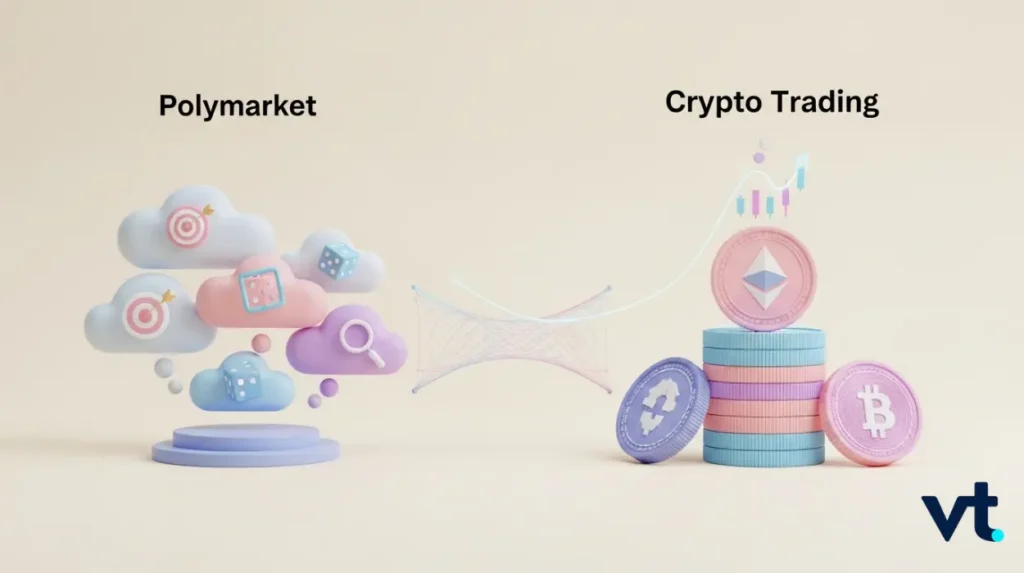
Key Takeaways
- Polymarket is a prediction market where traders speculate on real-world event outcomes.
- Crypto trading with brokers involves trading cryptocurrency price movements via CFDs.
- Crypto CFDs allow leverage, short selling, and structured risk management.
- Polymarket has binary outcomes, while crypto trades scale with price movement.
- Broker-based crypto trading offers greater flexibility and strategy development.
What is Polymarket Trading?
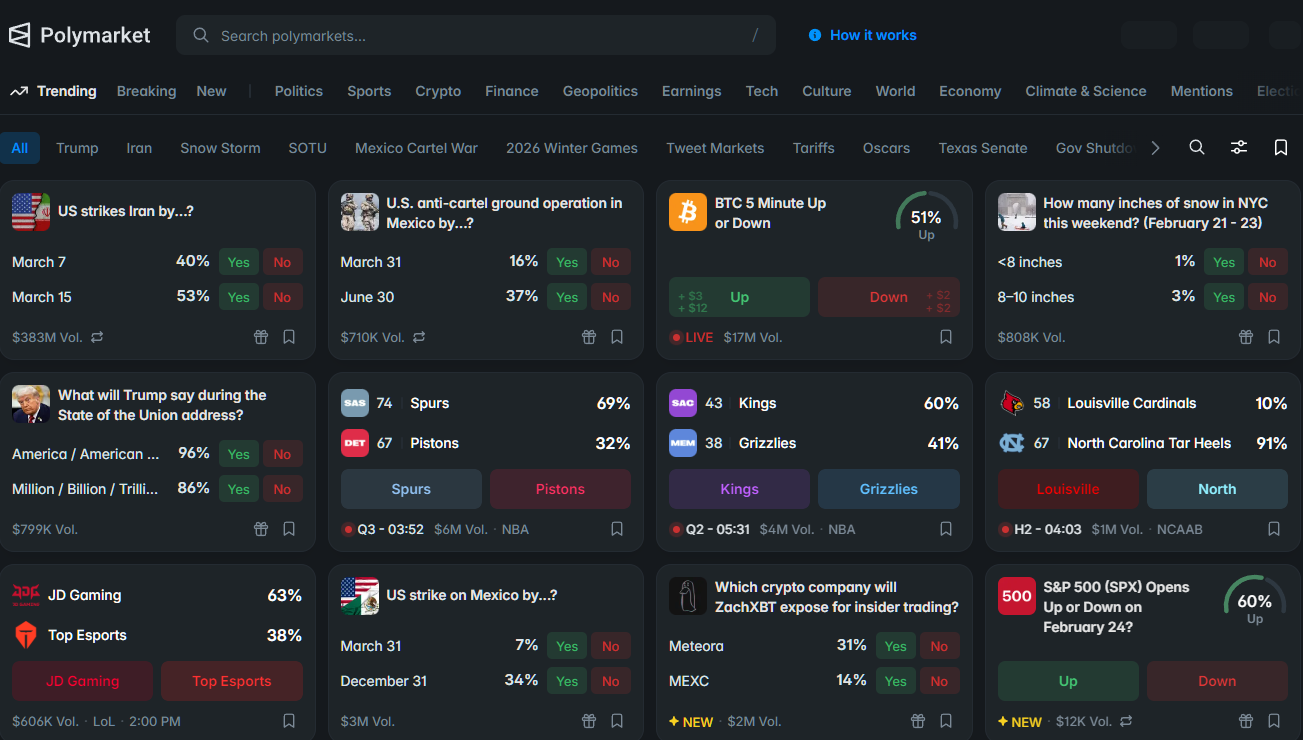
Polymarket trading involves speculating on the probability of real-world events rather than trading financial asset prices. On platforms like Polymarket, each market represents a yes-or-no question, such as whether Bitcoin will reach a certain price or whether a policy decision will occur.
Contracts are priced between $0 and $1, reflecting the market’s implied probability. If the event happens, the contract settles at $1; if it does not, it settles at $0.
This creates a binary payoff structure where profit depends solely on whether the prediction is correct, rather than how far a market price moves — making Polymarket fundamentally different from crypto CFD trading.
What is Crypto Trading?
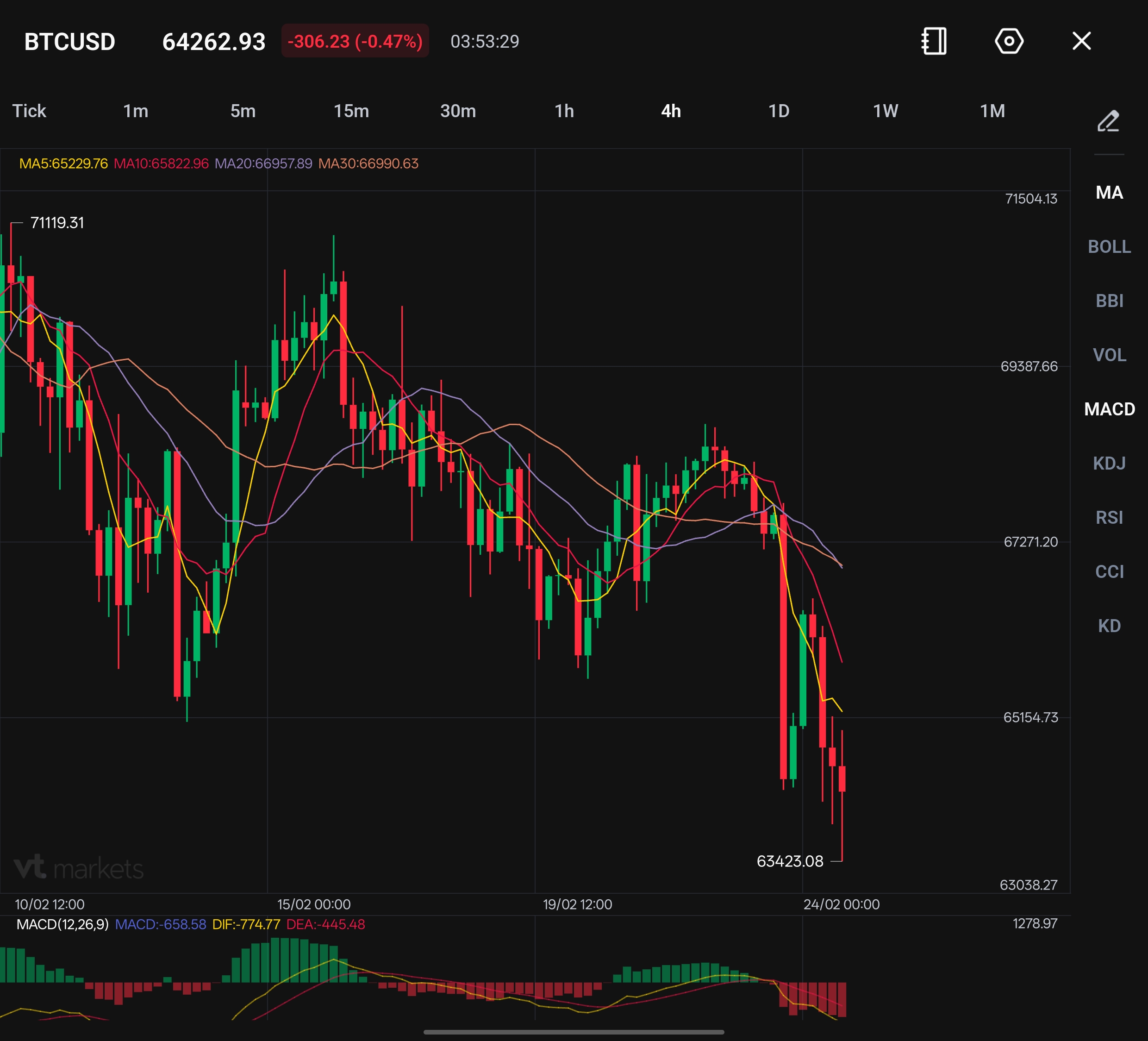
Crypto trading involves speculating on the price movements of cryptocurrencies such as Bitcoin and Ethereum. With brokers like VT Markets, this is typically done via CFDs (Contracts for Difference), meaning traders do not own the underlying coins but trade their price changes.
Crypto CFDs allow traders to go long if they expect prices to rise or short if they expect prices to fall, with profit or loss depending on how far the market moves. Positions can also be managed using tools such as stop-loss and take-profit orders.
How does Polymarket differ from Crypto CFD trading?
Prediction markets and cryptocurrency trading both attract traders seeking exposure to global developments and volatility. However, they operate on entirely different trading frameworks.
Platforms like Polymarket allow users to speculate on the probability of real-world events — from elections to regulatory decisions affecting crypto markets.
Caption: An example of Polymarket’s predictive trading in real-life applications
Crypto trading with brokers such as VT Markets, by contrast, involves speculating on the price movements of digital assets like Bitcoin or Ethereum via CFDs, without owning the underlying coins.
This distinction is crucial.
In simple terms:
- Crypto CFD traders speculate on how much price will move
- Polymarket traders speculate on whether an event will occur
What are the primary risks of trading on Polymarket in 2026?
The primary risks on Polymarket include Binary Outcome Risk (100% loss on incorrect predictions), Oracle Manipulation, and Liquidity Gaps. In 2026, traders also face Agentic Alpha risk, where AI trading bots arbitrage away price inefficiencies, and regulatory shifts under the 2026 CLARITY Act, which impact market resolution and access. While Polymarket offers fixed maximum loss per position, this does not eliminate trading risk. The primary risk arises from incorrect probability assessment.
Because contracts settle at either $0 or $1, a wrong prediction results in a total loss of the stake, regardless of how close the outcome was.
Another key risk is pricing inefficiency. Prediction market prices reflect crowd sentiment rather than underlying asset valuation. This means probabilities can remain misaligned with real-world likelihood for extended periods, exposing traders to losses even when their thesis is fundamentally sound.
Liquidity risk is also significant. In thinner markets, entering or exiting positions near fair value can be difficult, increasing slippage and reducing expected returns. Additionally, because there are no stop-loss or adjustment tools, traders cannot actively manage risk once a position is opened.
Finally, Polymarket trading is event-dependent. Unexpected news, regulatory changes, or interpretation disputes around event resolution can rapidly shift probabilities or outcomes, creating abrupt losses without the ability to hedge or adjust exposure.
Risk and Reward Profile: A Practical Comparison
The primary difference between Polymarket and crypto CFD trading lies in payoff behaviour.
Polymarket
- Maximum loss = 100% stake
- Maximum gain = payout difference
- No scaling with market move
Example:
Buy at $0.35 → maximum gain $0.65
Even if Bitcoin rallies far beyond expectations, profit remains capped.
Crypto CFDs
- Loss depends on stop-loss placement
- Profit scales with price movement
- Risk-reward adjustable
Example:
Bitcoin rises 20% → leveraged CFD position scales accordingly.
This scalability enables repeatable trading strategies and portfolio growth.
Limitations of Polymarket Compared with Crypto CFDs
While prediction markets are innovative, they lack several capabilities essential for active trading.
Binary Payoff Caps Profit
Polymarket contracts settle at either $0 or $1, meaning profits are fixed regardless of how strongly the underlying theme or narrative develops. Even if a crypto trend extends significantly, gains cannot scale beyond the contract payout. Crypto CFDs, by contrast, allow profits to expand as price trends continue.
Limited Liquidity
Prediction markets typically have narrower participation than global cryptocurrency markets. This can lead to wider spreads and less efficient pricing, making it harder to enter or exit positions at favourable levels. Crypto CFD markets benefit from deeper liquidity linked to underlying crypto exchanges.
No Leverage or Position Scaling
Polymarket does not provide leverage or the ability to scale exposure. Traders must commit full capital upfront and cannot amplify or adjust positions as conviction changes. Crypto CFDs allow flexible position sizing and leverage, enabling traders to express varying levels of market conviction.
No Dynamic Risk Management Tools
There are no stop-loss, take-profit, or partial closure functions in prediction markets. Risk is fixed at entry and cannot be actively managed as market conditions evolve. In crypto CFD trading, positions can be protected or adjusted throughout the trade lifecycle.
Event Dependency Limits Opportunities
Polymarket markets exist only around specific events and close once resolved. This creates gaps between opportunities and prevents continuous strategy application. Crypto markets, by contrast, trade continuously with frequent volatility-driven setups, supporting repeatable trading approaches across time.
Can Polymarket Replace Crypto Trading?
Polymarket and crypto CFD trading serve different roles.
Prediction markets enable event speculation.
Crypto CFDs enable price trading.
They overlap conceptually — both involve forecasting — but differ operationally.
In practice:
- Polymarket = event-based crypto speculation
- Crypto CFDs = price-based crypto trading
Most active traders view prediction markets as complementary rather than substitutes.
The Future of Prediction Markets vs Crypto Trading
Prediction markets are expanding alongside decentralised finance infrastructure.
Platforms like Polymarket illustrate a growing interest in event-driven speculation.
However, crypto CFD trading continues to grow due to:
- Institutional Participation
- Institutional investors, funds, and professional trading firms are increasingly active in cryptocurrency markets. Their involvement improves liquidity, price discovery, and market maturity. This institutional flow supports sustained trading volume in crypto price markets, whereas prediction markets remain largely retail-driven.
- High Crypto Volatility
- Cryptocurrencies are among the most volatile major asset classes, with frequent multi-percentage daily moves. This volatility creates continuous trading opportunities for both long and short strategies. Prediction markets, by contrast, typically experience gradual probability shifts rather than sustained directional price trends.
- 24/7 Price Movement
- Crypto markets trade continuously without closing hours, enabling traders to respond to global developments at any time. This constant activity supports active strategies such as scalping, day trading, and swing trading. Prediction markets are active only around specific events and become inactive once outcomes resolve.
- Leverage Access
- Crypto CFDs allow traders to apply leverage to price movements, increasing capital efficiency and enabling scalable strategies. This flexibility supports portfolio allocation and risk-adjusted positioning across market conditions. Prediction markets do not offer leverage, limiting position scaling and return potential.
- Integration with Multi-Asset Brokers
- Crypto CFDs are offered alongside forex, indices, commodities, and shares within multi-asset broker platforms. This integration allows traders to diversify and manage exposure across correlated markets within a single account. Prediction markets operate in isolated ecosystems without broader portfolio integration.
Prediction markets may expand in niche areas of event speculation, but price-based crypto trading continues to dominate due to its liquidity, continuity, and structural compatibility with professional trading frameworks.
Why Many Traders Choose Crypto Trading with VT Markets
For traders seeking structured exposure to cryptocurrency volatility, broker-based trading provides a more flexible environment than binary prediction markets.
With VT Markets, traders gain access to:
- Major cryptocurrencies via CFDs
- Long and short trading
- Flexible leverage
- MT4/MT5 trading platforms
- Stop-loss and risk tools
- Multi-asset portfolio integration
This enables traders to move beyond event speculation and participate directly in crypto price movements.
Frequently Asked Questions (FAQs)
Q1: Is Polymarket safer than crypto trading? Polymarket has fixed losses per position, while crypto CFDs allow controlled risk via stop-losses. Both involve risk.
Q2: Can you make more money trading crypto CFDs than Polymarket? Crypto CFD profits scale with price movement and leverage, whereas Polymarket gains are capped by binary payout.
Q3: Do crypto traders use prediction markets? Some monitor them for sentiment, but they do not replace price-based crypto trading.
Q4: Is Polymarket crypto trading? No. Polymarket is a prediction market. Crypto CFDs involve trading cryptocurrency price movements.
Your Crypto Trading Journey Starts Here with VT Markets
Whether you’re a beginner exploring cryptocurrency markets for the first time, an experienced trader expanding into digital assets, or a multi-asset trader seeking exposure to crypto volatility, crypto CFDs offer a flexible way to participate in this fast-moving market. They provide access to major cryptocurrencies without the complexity of wallets, exchanges, or coin custody, allowing you to focus purely on price movement and trading strategy.
The key to maximising crypto trading potential lies in approaching it with the same discipline applied to any financial market. Apply structured risk management, use protective orders on every trade, and treat volatility as an opportunity to execute well-defined strategies rather than impulsive speculation.
With VT Markets, you gain access to crypto CFD trading conditions designed to mirror real market dynamics, enabling you to develop skills, manage risk effectively, and build confidence trading cryptocurrency price movements within a professional trading environment.








